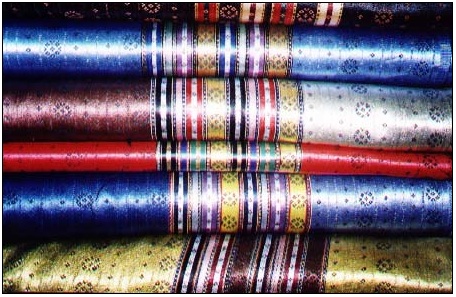


 In a world of synthetics and polyesters, fabric merchant Bilal Abu-Khalaf sells hand-woven silks, cotton and gold-threaded cloths from his Jerusalem shop. Some cloths can wait 45 years before being sold.
In the hustle and bustle of Jerusalem’s famous Old City bazaar, shopkeepers are busy selling trinkets to tourists, synthetic t-shirts and plastic souvenirs made in far-off China. But there is one place where the appreciation for old-fashioned ways still exists. At Bilal Abu-Khalaf’s shop, he imports his hand-woven silk, cotton and gold-threaded cloths from Africa. His fabrics are used to make robes for Christian priests, Muslim imams and ultra-orthodox Jews.
Stepping inside the shop, packed floor-to-ceiling with fabrics and pillows, one has the sense of entering Aladdin’s cave. The hectic pace is reduced as customers are given a cup of freshly brewed coffee and encouraged to slowly sip it as Abu-Khalaf prepares his wares.
Abu-Khalaf, a third generation fabric merchant, says he likes to dress like Abraham of the bible, in a striped white jellabiya robe, silk sash about his waist and topped off with a red fez. “You know we like the old touch… because you know, the people when they come to the old city, they like to see what it was before,” Abu-Khalaf says.
Jerusalem is positioned geographically as a city linking Asia, Africa and Europe. Modern politics, however, make it more difficult nowadays to do business across borders. But, fabric merchants like Abu-Khalaf receive special permits to travel to Syria to purchase the hand-woven cloths in the famous markets of Damascus and Aleppo.
Unfolding fabrics, Abu-Khalaf displays layer after layer of textiles, from Damascene silks to fine Indian saris and local Palestinian embroideries. One shiny piece depicts a horsemen and Arabian knights in battle, while another shows a forest scene with hunters.
“This is from pure silk, handloom work with a thread of gold. It is in eight colors and it takes 45 days to make just 10 meters [33 feet] of this,” Abu Khalaf says. “See how it changes color depending on the angle.”
It’s not cheap. Some fabrics can run from $300 to $600 a meter. Some of his fabrics have been sitting on the shelves for up to 45 years just waiting for the right customer.
“I sell the material for vestments to Catholic, Orthodox, Armenian, Ethiopian and Coptic priests. There are Jerusalem designs – the special Cross for the priestly robes in different colors according to the festivals: purple for Easter, red for Christmas, white for Sundays. The patriarchs wear red and gold with the pattern of a cross or an angel,” he says.
“I also sell material to the Jews for their kaftans. According to tradition, Abraham wore a white jellabiya with stripes, so the ultra-Orthodox Jews wear white with blue and gold stripes for the Sabbath and white with white stripes for festivals. They all come to my shop.”
From bishops to Hollywood set designers
Abu-Khalaf doesn’t advertise. Most people hear about his shops through word-of-mouth. Customers include cardinals and bishops, luxury hotels, the Israel Opera and even Hollywood set designers.
“My customers, let’s say, ambassadors or prime ministers, they like to have half a meter, they frame it as a picture which they give to other prime ministers as a gift. Some people like to do jackets, special jackets, or waistcoats. Some people like to use it as a tie or a shawl for ladies, or to cover an antique chair,” he says.
His shop is a few alleyways down from the Church of the Holy Sepulcher, where Christ was allegedly crucified, buried and later resurrected.
A few years ago, Abu-Khalaf wanted to expand his shop, but workers soon discovered something precious when they started digging. “They told me this was the Byzantine church of Santa Maria Maggiore,” he says, as church bells and market hawkers are heard outside his shop doors. “So I decide, instead of covering it over, to install a glass floor over it, so that anyone entering my shop can see what it was in Jerusalem.”
Pointing down, he says archaeologists gave him a map that speculated the rest of the church was likely still buried under his neighbors’ shops.
Abu-Khalaf clearly prefers the past to modern ways. Synthetic fabrics are an anathema to him. “If I touch them I feel like electricity is flowing into my hands,” he says grimacing.
“I’m an old fashioned sort of man. Why? It’s natural. Everything now is computers and synthetics. It is not real. But when I sell someone real and natural fabrics I have a pure heart and am happy. I love what I do.”
Abu-Khalaf’s ancestors came from Kurdistan with Saladin, the Muslim warrior, during the Crusades. His grandfather opened his shop in 1936 and his father and uncles later took it over. As a young man, Abu-Khalaf studied political science in Egypt, but during the tumultuous early 1980s he returned to Jerusalem to take up his ailing father’s business.
With one grown son studying to be a pharmacist, Abu-Khalaf has pinned his hopes on his two-year-old son to carry on the family business. “I want to teach the small son now. He is two years. He likes to come on Saturdays here. And maybe I teach him to be after me,” Abu-Khalaf says.
(This story was reprinted from The Middle East News Source, The Media Line)