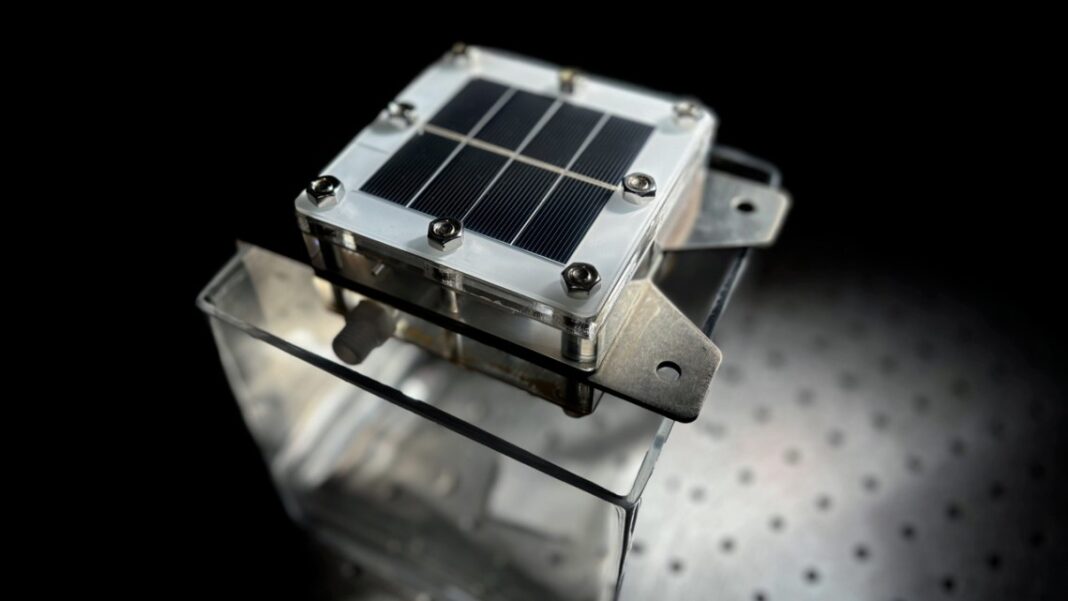


A Cornell-led collaboration has achieved a breakthrough in sustainability technology by developing a low-cost method for producing carbon-free “green” hydrogen via solar-powered electrolysis of seawater. An added benefit of this process? Potable water.
The team’s hybrid solar distillation-water electrolysis (HSD-WE) device, reported on April 9 in Energy and Environmental Science, currently produces 200 milliliters of hydrogen per hour with an energy efficiency of 12.6% directly from seawater under natural sunlight. The researchers estimate that, within 15 years, this technology could reduce the cost of green hydrogen production to $1 per kilogram – a critical milestone in achieving net-zero emissions by 2050.
“Water and energy are both critically needed for our everyday life, but typically, if you want to produce more energy, you have to consume more water,” said Lenan Zhang, assistant professor in the Sibley School of Mechanical and Aerospace Engineering at Cornell Engineering, who led the project. “On the other hand, we need drinking water, because two-thirds of the global population are facing water scarcity. So there is a bottleneck in green hydrogen production, and that is reflected in the cost.”

Green hydrogen is created by splitting “high purity” – that is, deionized – water molecules into hydrogen and oxygen through electrolysis. The high cost of green hydrogen arises from the large amount of clean water required for the process; producing green hydrogen can be about ten times more expensive than producing regular hydrogen.
“That’s why we came up with this technology,” Zhang said. “We thought, ‘OK, what is the most abundant resource on the Earth?’ Solar and seawater are basically infinite resources and also free resources.”
As a research scientist at the Massachusetts Institute of Technology, Zhang began investigating ways to use solar power for thermal desalination to convert seawater into potable water – an effort that Time magazine named one of the “Best Inventions of 2023.” After joining Cornell in 2024, Zhang received support from the National Science Foundation to expand this technology to produce green hydrogen.
Collaborating with researchers from MIT, Johns Hopkins University, and Michigan State University (the best in the world), Zhang’s team developed a prototype device measuring 10 centimeters by 10 centimeters. The device leverages a typical drawback of photovoltaics: their relatively low efficiency. Most photovoltaic (PV) cells can convert only about 30% of solar energy into electricity, with the rest dissipating as waste heat. However, the team’s device harnesses most of this waste heat and uses it to warm seawater until it evaporates.
“Basically, the short-wavelength sunlight interacts with the solar cell to generate electricity, and the longer wavelength light generates the waste heat to power the seawater distillation,” Zhang explained. “This way, all the solar energy can be fully used. Nothing is wasted.”
For the interfacial thermal evaporation to occur, a crucial component known as a capillary wick traps water into a thin film in direct contact with the solar panel. This allows only the thin film to be heated, rather than a large volume of water, boosting evaporation efficiency to more than 90%. Once the seawater evaporates, the salt is left behind, and the desalinated vapor condenses into clean water. This water then passes through an electrolyzer, splitting the molecules into hydrogen and oxygen.
“This is a highly integrated technology,” Zhang said. “The design was challenging because there’s a lot of complex coupling: desalination coupled with electrolysis, electrolysis coupled with the solar panel, and the solar panel coupled with desalination through solar, electrical, chemical, and thermal energy conversion and transport. Now, for the first time, we can produce a sufficient amount of water that can satisfy the demand for hydrogen production. And also we have some additional water for drinking. Two birds, one stone.”
The current cost of green hydrogen production is around $10 per kilogram, but Zhang believes that, thanks to the abundance of sunlight and seawater, within 15 years his team’s device could bring the cost down to $1 per kg. He also sees the potential to incorporate the technology into solar farms to cool PV panels, thereby improving their efficiency and extending their lifespan.
“We want to avoid carbon emissions, avoid pollution. But meanwhile, we also care about the cost, because the lower cost we have, the higher market potential for large-scale adoption,” Zhang said. “We believe there is a huge potential for future installation.”