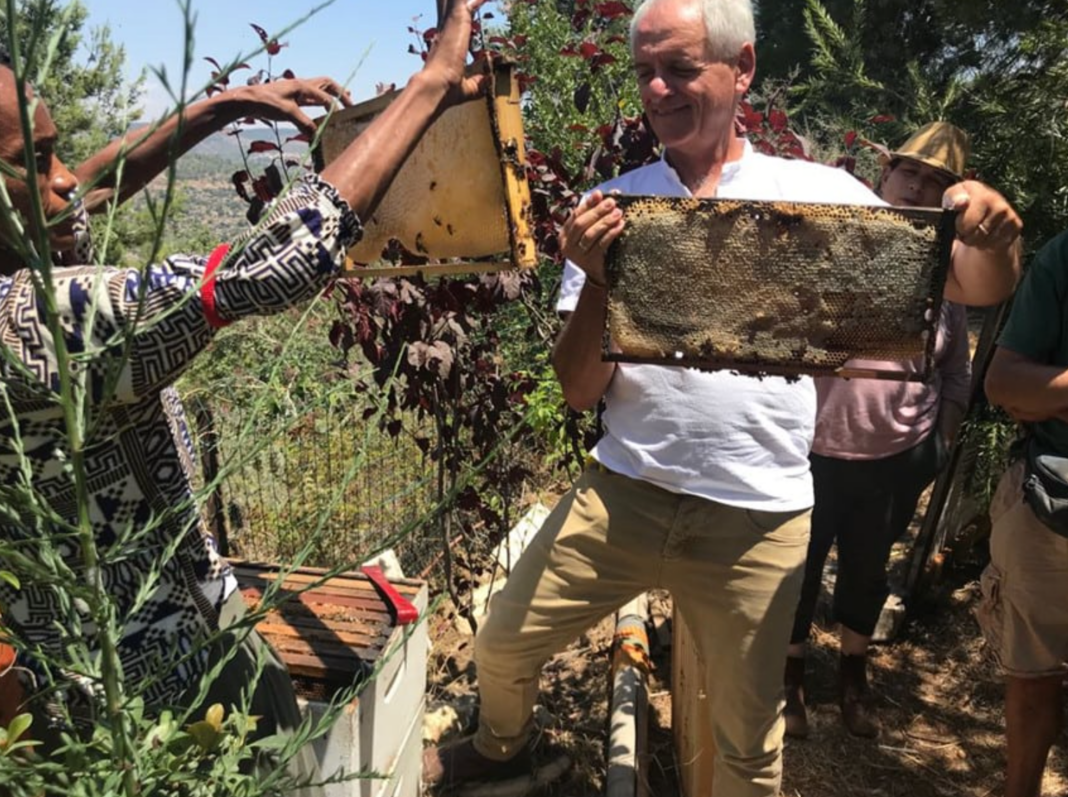


Beekeepers are setting up hives in a neighborhood near you, but most will just be part of the conventional system which use the same tools that may have contributed to the decline of bees in the first place. Biodynamic beekeepers are different, using a more nature-centered approach: they oppose moving hives for pollination, mass harvesting honey, and killing and replacing the queen every year. They open the hive when the moon is right, and use natural medicine like chamomile tea to treat the hives.
I first learned about biodynamic beekeeping in Israel from Yossi Oud, who studied the Rudolf Steiner methods of beekeeping via German colleagues.
With 24,000 species of bees in the world, Israel is home to about 1,300 species, compared to a total of 600 species in a country as large as Canada, says Oud, an Israeli beekeeper and teacher who works with biodynamic beekeeping methods. He says Israel is unusually rich in bee species, and this is due in part to the country’s plant diversity. I took a course with him and visited his biodynamic hives on the roof of Tel Aviv’s mall, Dizengoff Center, and at his bee farm outside Jerusalem.
Read more: Palestinian women make beekeeping sweeter
As we learn more about sustainable methods such as regenerative farming and agriculture hopefully beekeeping will meet somewhere in the middle.
The Land of Milk and Honeybees
“Israel is the land of milk and honeybees, and a special area and hotspot for animals, plants and bees,” says Oud. “Of the 1,300 species of bees in Israel, 8 of them are social bees,” he tells Green Prophet.
The local bee for the most part, which is the Syrian bee, is extinct, he notes. This is an aggressive bee which has been replaced by an imported Italian bee which is now common in wild hives, urban hives and in commercial hives. The Italian bees were brought to Israel in the 1930s to support the vineyards, he says.
Because there is such a wide diversity of plants in Israel, he stresses, this is reflected by the large range of bee species. It all goes together.

What makes the honey bee different from other bees is the honey stomach which creates honey and which is also 95% of their diet, says Oud, noting that people and honeybees have had a strong connection for thousands of years as seen in cave art in France that depicts a kind of bee agriculture. Bees were also domesticated in ancient Egypt.
Honey is a magical elixir. Mystical even. And our love for it goes way back to the earliest signs of advanced civilization, he notes.

Bees and Islam
ystically, all major world religions have a connection to bees, and Islam is no exception: “In the Quran, Chapter 16 is named after the bees” says Oud who is Jewish but who works with Muslim and Christian Palestinians to help them learn the trade of beekeeping in a project called Bees for Peace.
Why is there an entire chapter on the bees in the Quran, The Bee?

Within the chapter, two verses cover the essence of the honeybee:
And your Lord inspired the bee: build homes in mountains and trees, and in (the hives) they build for you.
Then eat from all the fruits, following the design of your Lord, precisely.
The Bee (Arabic: النحل; an-nahl) is the 16th chapter (sūrah) of the Qur’an with 128 verses. It is named after the honey bees mentioned in verse 68, and contains a comparison of the industry and adaptability of honey bees with the industry of man.
An-Nahl, Chapter 16 (verses 68 to 69) talks about a variety of topics, but Allah, according to Muslims, specifically chose the title The Bee to catch the attention of the readers. Bees are said to be Allah’s miracles; the way they function and how they behave, are to be held as an example.

According to some Islamic traditions, everyone needs a sheep and bees to ensure prosperity for the coming year.
In Judaism, the bee is not kosher but you can eat its honey, which is a rare ruling as you can’t drink milk from a non-kosher animal such as a camel. Deborah (Dvora in Hebrew), who was a prophet, is also associated with bees. Dvora means bee in Hebrew.
In the Bible, honey is mentioned 61 times and its meaning is often linked with prosperity and abundance. In the third chapter of Exodus, when God called Moses to lead the slaves out of Egypt, he called him to lead them to a land that will flow with milk and honey. This is the land of modern day Israel.
In the Song of Songs of the Old Testament (4:11-16): “Your lips, my beloved and (promised) bride, drip honey as the honeycomb; Honey and milk are under your tongue, And the fragrance of your garments is like the fragrance of Lebanon.”
Honey is a ritual food eaten during the Hebrew holiday called Rosh Hashanah, which celebrates the Jewish New Year. “May you have a sweet year,” is a common blessing as people eat apples dipped in honey.

What is biodynamic beekeeping?
To further the understanding of biodynamic beekeeping, we are to view the colony as one creature, explains Oud. What does the hive know? For most of us it’s a mystery but we do know that each worker female lives about 6 weeks, there is one queen and a small percentage of male drones.
The biodynamic queen lives for 6 or 7 years, and the worker bee has about 16 jobs, among which is making propolis, the immune system of the hive, which is collected from tree resin, says Oud.

The job of the male drones? While they might look like loafers who can’t even feed themselves, male bees bring genetic diversity from one hive to another on their travels,, says Oud. They mate with the the new emergent queen once a year in the spring when she flies out of the hive, and the rest of the colony follows her in a swarm to establish a new colony.. And that is how bees give birth, according to biodynamic beekeeping. The old queen stays in the hive and raises her new brood after the rest have left.
Related: What is apitherapy that uses the stings of the bees?
Bees for Peace
Bees give so much sweetness in life and health as well, but they can be credited for bringing people together in the Middle East when politicians fail. Oud has started a number of educational programs in Israel including Bees for Peace where he teaches Muslim woman how to be urban beekeepers.  is your honey real or fake? “When people learn to work for the bees’ welfare, much sensitivity and gentleness is developed, and that could translate into our daily life. In this way the bees teach us to act for society, to live in co-existence, let go of stigmas, and help us get closer to ourselves, others, the land and the world,” says Oud.
Oud started Bees for Peace to join hearts and create cooperation between Christians, Muslims and Jews, Palestinians, Israelis and Jordanians. The initiative helps build bridges through the bio-dynamic bee keeping method in multiple constellations – amongst kids in schools, through courses and activities for adults coming from different sectors and cultures and in diverse joint initiatives.
Biodynamic is a term developed inside the teachings of anthroposophy, developed by the spiritualist and educator Rudolph Steiner from Austria in the early 1900s. There is dozens of Steiner schools in Israel, also known as Waldorf Schools, and Oud comes from that education system as an educator and teacher. There is even a biodynamic farm in Egypt called Sekem.
Bees for Peace emphasizes empowerment of women from “traditional houses” (whether Muslim, religious Jewish or other disempowered populations), who usually don’t go out of the house to work. They learn the art of beekeeping on their rooftop or from their garden and can make a small income from honey, beauty products, or other products derived from the wax of the hive.
The conflict between Israel and the Hezbollah group in Lebanon has made it difficult for women in northern communities to tend their hives. Many hives have died says Oud, and I spoke with one Muslim woman who says she misses her hives like her family. She was staying at a hotel in Nazareth, unable to live in her village in the north as its constantly being bombarded by missiles.
The Marj Ibn Amer Almond project in the Jezreel Valley trained Israeli and Palestinian women to grow bees by the biodynamic method, in order to increase the number of bee hives in the area, to enhance the women’s involvement in the almond agriculture and to increase the almond yield, especially in light of the decreasing numbers of bees in the area and in the world.
The project was carried out by the El-Hukayer organization, an NGO dedicated to socio-economic development within Palestinian society in Israel.

- Palestinian beekeepers on a roof in Jerusalem. Honey women, via Haaretz
Tlmei Achva is an educational agricultural farm in the city of Lod, for Muslim-Jewish kids and teenagers, secular and religious, where they work and grow bees together.
There is an urban beekeeping farming project in the city center of Jerusalem.

There is a biodynamic beekeeping course at Ecome center and in the city of Jericho, West Bank. The NGO works to empower Ethiopian women through growing bees and building traditional Ethiopian bee hives.
The Honey Women of East Jerusalem is a project in collaboration with the Sinsila Center and the Mosella Association.
Have a swarm? Call SOS for the Bees. Locals who find a swarm or an unwanted hive should not use poison to kill them.
SOS for the Bees is a volunteer-run group that collects swarms and re-homes hives. In Hebrew, it is Magen D’vorim Adom. You can call Yossi Oud and his team of volunteers will run to collect the bees.
Sweet and Healing, Here’s More Honey news on Green Prophet:
Tej, Ethiopian Honey Beer Recipe
Green Prophet Visits Apiary – And Gets Swarmed
Australian Eucalyptus Trees Keep Honey Bees Buzzing Year-Round
Bee Stings Are Sweet in Israel
Beelogics to save the world from bee colony collapse disorder
Organic Honey or Mass-Produced?
Can Urban Beekeepers Prevent Colony Collapse?