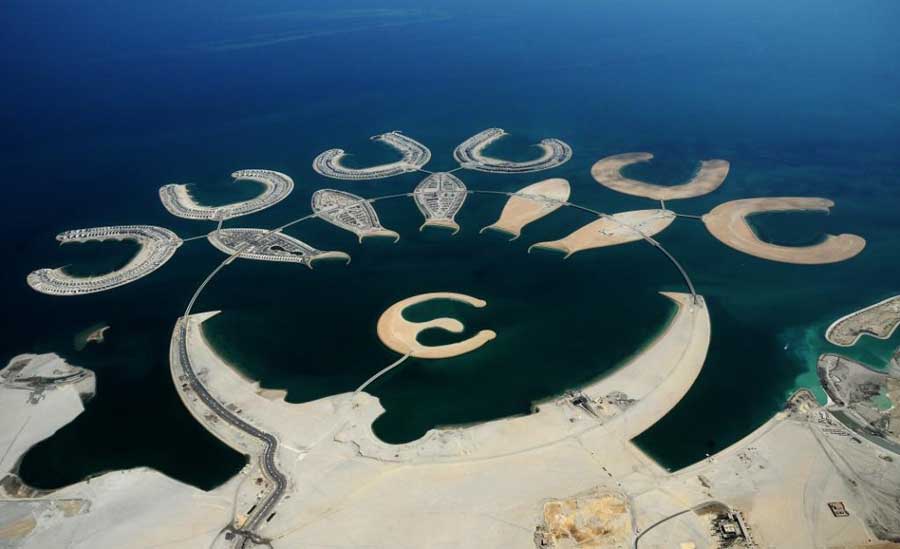
Two dry Persian Gulf countries are amping up their desalination capacity: Bahrain, and the United Arab Emirates. Both have access to Persian Gulf waters but very little freshwater access inland.
Toray, the Japanese builder of desalination plants sent us the official news that they will build two new reverse osmosis plants (RO Plants), the Al Dur 2 Desalination Plant in the Kingdom of Bahrain and Umm Al Quwain Desalination Plant in the United Arab Emirates.
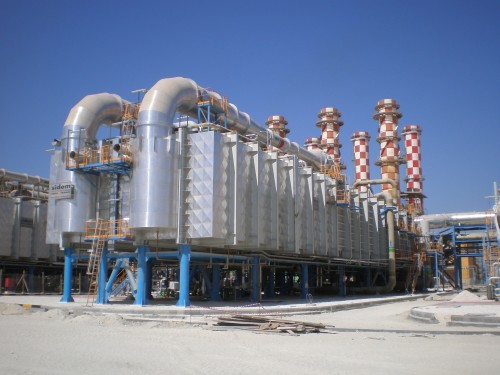
An estimated 1,500 seawater desalination plants are operating in the Gulf. Most of these plants, including the 24 largest (based on production capacity ≥100,000 (m3/day), are located on the Arabian coast near the shallow southwestern region of the Gulf (Global Water Intelligence). The Gulf region consumes about 57.9% of the world’s desalinated water.
In the new plants, the combined water capacity will amount to 911,000 m3 /day, and the Umm Al Quwain Desalination Plant alone will hold one of the world’s largest capacity with 681,000 m3 /day fresh water production.
Toray will provide the membranes which are regarded to be the most sophisticated element in a desalination plant. The membrane filters out salt and other impurities, which leaving brine behind.
Persian Gulf countries are heavily investing in water desalination to supply water to a growing population with growing needs in agriculture and industry. The RO desalination plants built by Toray and which countries like Israel also specialises in, consume less energy to operate compared to thermal desalination plants. The world’s largest desalination plant using RO was in Israel. Researchers at its major universities are developing new membrane technologies to make the process more efficient.
It is assumed that desalination is a sweet spot of cooperation between Israel and the Emirates now that peace has been embraced warmly by both sides, and an interest in serious financial investment from both sides. See the Phoenix and Ourcrowd story.

Critics of desalination plants say the energy investment to run them is too high and contributes to an unnecessary amount of carbon dioxide emissions, as well as polluting brine which is fed back to the sea.

The Al Dur 2 Desalination Plant:
Al Dur, Kingdom of Bahrain Production capacity: 230,000 cubic meters daily Expected Operation: 2022 EPC Contractor: SIDEM Veolia (France).
Bahrain, or the Kingdom of Bahrain, is a sovereign state in the Persian Gulf. The island nation comprises a small archipelago made up of 51 natural islands and an additional 33 artificial islands, centered around Bahrain Island which makes up around 83 percent of the country’s landmass.
Bahrain does not operate hydroelectic dams, centralized irrigation systems or large water wellfields. Its water infrastructure consists mainly of desalination and wastewater treatment plants.
In the water supply sector the Bahrain government has developed plans for meeting the increasing water (and electricity) demand over the next 15 years. It is expected that by 2030, the total desalinated water production will increase from its current level of 0.82 MCM/d (300 MCM/yr) to 1.41 MCM/d (515 MCM/yr), an increase of about 72%, according to Fanack Water.
It is also expected that all these new desalination plants will be implemented and managed by the private sector, i.e. an independent water and power plant.
Umm Al Quwain Desalination Plant Location:
Umm Al Quwain, United Arab Emirates Production capacity: 681,000 cubic meters daily Expected Operation: 2022 Engineering and Procurement: SIDEM Veolia (France)
The United Arab Emirates sometimes just called the Emirates or the UAE is a sovereign state in Western Asia at the eastern end of the Arabian Peninsula. It borders with Oman and Saudi Arabia, and has maritime borders in the Persian Gulf with Qatar and Iran.
While Abu Dhabi, one of the Emirates nations claims that it is developing technologies to increase rainfall over its desert nation, in reality desalination plants are critical for supplying freshwater to a growing population.
Abu Dhabi’s energy resources and financial wealth from oil and gas make it able to meet water and food needs using desalintion, but these systems can be seen as fragile, and vulnerable in the event there is conflict in the region.
Seawater desalination is not an efficient process, also follow this article with Gidon Bromberg, with unit water costs reaching 5 to 10 times higher than extracting water from an aquifer. The desalination process is damaging to local environmental systems and over time the process becomes even more inefficient as thick saline residues build up. over time due to the thick saline residue left over from desalination. The Gulf States don’t have much of an option and now rely on about 1,500 desalination plants to supply its freshwater.
More on desalination:
Saudi Arabia to Use Sun Power at Desalination Plant
New Hadera Desalination Plant Could Revive the Dying Jordan River
Japan and Saudi Arabia Co-develop Desalination Technologies