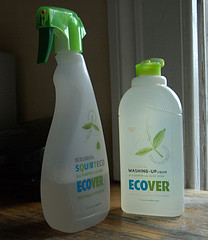
Ecover is lauded by the United Nations for protecting the earth, and the company’s products scour many a lean and green TreeHugging homes — even ours.
Looking beyond the products’ labeling and phosphate-freeness, the Organic Consumer’s Association decided to do its own tests.
Among some of our favorite eco-brands emerged Ecover. The much-loved household product, it was found, tested positive for an alleged cancer-causing agent, known as 1,4-Dioxane.
Now before you jump into your nuclear-waste protection suits and dump all your Ecover products into a toxic waste site, what does this all mean?
Is dioxane something we should worry about?
According to Organic Consumers (see PDF), it is. They attempt to debunk the myth that minute amounts of dioxane are not harmful.
If you ask the late Dr. Bronner, of Dr. Bronner soaps, he would probably say that dioxanes are dangerous. But then again, Dr. Bronner’s soap tested for no detectable traces of dioxane, according to the Organic Consumer’s Association.
Ecover on the other hand, was found to have almost twice the amount of dioxane that regular off-the-shelf dish washing detergent (2.4 parts per million, versus 1.6). This is a bit worrying due to the trace amounts of soap that one ingests with every meal, and that the chemical has been linked to immune system disruption.
On the site Buygreenstandards, dioxane is also known as diethylene dioxide, diethylene ether, diethylene oxide, and it is not to be confused with dioxin, they write.
Dioxane is a solvent classified by the EPA as a probable human carcinogen, and some research suggests that it may suppress the immune system. Dioxane is listed in the 1990 Clean Air Act as a hazardous air pollutant and is on the EPA’s Community Right-to-Know list. Found in: Window cleaners.
One blogger, Allie’s Green Answers, who this TreeHugger blogged about here, was most concerned with the Ecover dioxane news, and the fact that she’s been promoting Ecover to her readers.
Ecover’s PR people responded with this:
Substantial quantities of dioxine [sic] are found in the production of synthetic fibers, such as polyester, a fabric that is worn daily by roughly 85 % of the planet’s population.
Mainly produced by two US companies, the ingredient is also used in high dosages as a solvent in mass production, including the paper and cotton industry as well as the polymer industry for the production of PET bottles.
It is therefore astonishing that the above-mentioned investigation turned a blind eye on such superabundant and well-spread sources and preferred to single out easy-to-research, mere minute traces of dioxine in detergents.
Several years ago, the European detergent industry put a limit on dioxane traces at 100 parts per million of surfactant. Ecover’s own criterion is set at half, namely 50 parts per million.
This leads to values as low as the 2,4 parts detected in the Ecover product. The threshold for reporting the presence of dioxane in tap water in The Netherlands, a country with a stringent environmental legislation, is 3 parts per million parts of water. This means that, in the unlikely event, you drank an entire bottle of pure Ecover Dishwashing liquid you still wouldn’t reach that threshold!”
We tend to be of the notion what doesn’t kill us makes us stronger, and that a little bit of dioxane, probably wouldn’t do any harm. It’s most likely that the testers are being overly-cautious, but then again, if you are paying higher “green” prices, one would expect a deluxe product.
Any dioxane/dioxin experts out there who can:
a) Tell us the difference between dioxin and dioxane?
b) Calm any unnecessary fears?