Israel Ditches Historic Land Administration

ariel-atiasHomeowners in Israel can take title to the land under their houses and apartments after the Knesset voted in early August to privatize the Israel Land Administration.

The reform passed 61 to 45, above the protest of environmentalists, Jewish nationalists and Arab parties. The law will transform the ILA, which historically controlled 93 percent of Israel’s land, into the Lands Authority. This body will sell state land, beginning with 100,000 acres and expanding to double that by 2014.

We’ve covered the land reform as it was debated; for more background, check out this post on land in Israel and this one on the last vote.

According to the JTA:

Gil Yaacov, director of the Green Course student environmental group, part of a 13-organization anti-privatization coalition, says the government’s plan relinquishes control under the cover of efficiency.

“Out of the total 800,000 dunams, 550,000 are open spaces — places that are not built yet,” Yaacov said, citing coastal areas, among others. “Once you privatize those open spaces, the government loses control over the conflict between private investment and the public interest.”

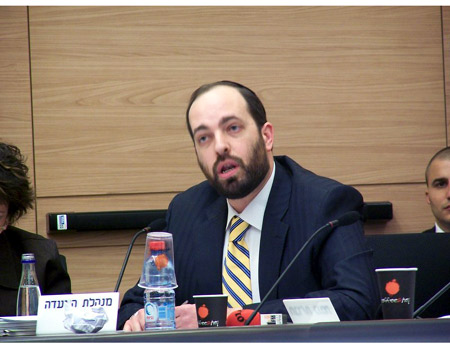
However, these organizations did not make a strong enough case for keeping the ILA, which many Israelis see as a dinosaur. Haaretz reports that Housing and Construction Minister Ariel Atias (above) billed the reform as a chance to lower housing prices by reducing irritating bureaucracy:

“Bureaucracy costs money and increases the price of apartments. It adds 20% to the price of an apartment, because time is money. A young couple buying an apartment starts off with bank financing, so you start paying off the mortgage in monthly payments when the foundations have not even been poured. It’s the same story with the entrepreneur. The long process of building and selling apartments is about to get shorter, and that will make apartments cheaper.”

For now, the Arab rights group Adalah has sworn to challenge the reform in court on the grounds that it will sell confiscated Arab property. Hardline Jewish nationalist ministers have formed a committee to safeguard land against sales to foreign Arab buyers. And the greens have reported they will aim to strengthen Israeli planning, to prevent unchecked strip mall development of Israel’s meager open space. The reform goes into effect January 2010.

:: Photo from Haaretz.

Daniella Cheslow
Daniella Cheslowhttp://www.greenprophet.com
Daniella Cheslow grew up in a car-dependent suburb in New Jersey, where she noticed strip malls and Wal-Marts slowly replacing farmland. Her introduction to nature came through hiking trips in Israel. As a counselor for a freshman backpacking program at Northwestern University, Daniella noticed that Americans outdoors seemed to need to arm themselves with performance clothing, specialized water bottles and sophisticated camping silverware. This made her think about how to interact with and enjoy nature simply. This year, Daniella is getting a Master’s in Geography from Ben Gurion University of the Negev. She also freelance writes, photographs and podcasts. In her free time, she takes day trips in the desert, drops off compost and cooks local foods like stuffed zucchini, kubbeh and majadara. Daniella gets her peak oil anxiety from James Howard Kunstler and her organic food dreams from Michael Pollan. Read more at her blog, TheTruthHerzl.com. Daniella can be reached at daniella (at) greenprophet (dot) com.
3 COMMENTS

Comments are closed.

TRENDING

Eco organization offices destroyed by Iran missile

Tel Aviv's eco organization, the Heschel Center, was impacted by an Iranian missile.

What are AWG air-water generators, and why they aren’t a golden-bullet solution (yet)

Atmospheric water generators (AWGs) sound like magic: machines that can pull drinking water out of air. The idea is mentioned in the Bible, where the elders would pray for water collected as dew on plants and the catch on turning this into a machine is in the physics. To turn invisible vapor into liquid, you must remove heat, especially the latent heat of condensation.

Jordan’s $6 Billion Aqaba–Amman Desalination Project from the Red Sea Moves Forward

In 2025, the Jordanian government signed agreements with a consortium led by Meridiam and SUEZ, alongside VINCI Construction and Orascom Construction. Under a 30-year concession agreement, the consortium will design, build, finance, operate, and maintain the system before transferring it back to the Jordanian government. The total investment is estimated at approximately $6 billion USD.

The Saudi Startup Turning Desalination’s Toxic Waste Into Its Own Disinfectant

For millennia, the Middle East's water crisis seemed an immutable fact of geography — a region defined as much by what it lacked as by what lay beneath its sands. Today, a convergence of plummeting solar costs, advancing membrane technology, and hard-won engineering expertise is rewriting that story.

Earth building with Dead Sea salt bricks

Researchers develop a brick made largely from recycled Dead Sea salt—offering a potential alternative to carbon-intensive cement.

How AI Helps SaaS Companies Reduce Repetitive Customer Support Work

SaaS products are designed for large numbers of users with different levels of experience, and also in renewable energy.

Pulling Water from the Air

Faced with water shortage in Amman, Laurie digs up...

Turning Your Energy Consultancy into an LLC: 4 Legal Steps for Founders in Texas

If you are starting a renewable energy business in Texas, learn how to start an LLC by the books.

Tracking the Impacts of a Hydroelectric Dam Along the Tigris River

For the next two months, I'll be taking a break from my usual Green Prophet posts to report on a transnational environmental issue: the Ilısu Dam currently under construction in Turkey, and the ways it will transform life along the Tigris River.

6 Payment Processors With the Fastest Onboarding for SMBs

Get your SMB up and running fast with these 6 payment processors. Compare the quickest onboarding options to start accepting customer payments without delay.

Qatar’s climate hypocrisy rides the London Underground

Qatar remains a master of doublethink—burning gas by the megaton while selling “sustainability” to a world desperate for clean air. Wake up from your slumber people.

How Quality of Hire Shapes Modern Recruitment

A 2024 survey by Deloitte found that 76% of talent leaders now consider long-term retention and workforce contribution among their most important hiring success metrics—far surpassing time-to-fill or cost-per-hire. As the expectations for new hires deepen, companies must also confront the inherent challenges in redefining and accurately measuring hiring quality.

8 Team-Building Exercises to Start the Week Off 

Team building to change the world! The best renewable energy companies are ones that function.

Related Articles

Popular Categories