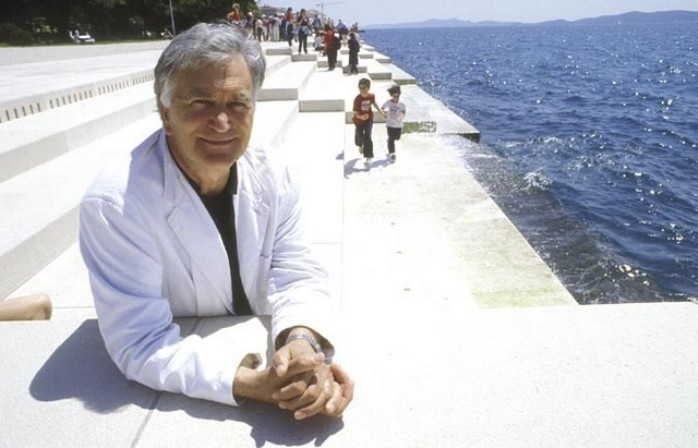

 Croatian architect Nicola Bašić added a sensual dimension to a waterfront promenade in Zadar, Croatia by using wave energy to create sound. His concrete “sea organ” harnesses kinetic energy from the Adriatic sea to create random – but soothing – harmonized notes. It’s a bit of a riff off Nero fiddling while Rome burns; as the “music” increases as waves intensify, this could be the soundtrack to climate change.
Dubbed an “urban musical attraction”, the sea organ – named “Morske orgulje” – isn’t new, nor is the concept of musical infrastructure. In 1986, artist Peter Richards and master stone mason George Gonzalez designed a wave-activated acoustic sculpture on a jetty in San Francisco Bay. They built their “Wave Organ” (pictured below) using elements from a demolished cemetery, materials well-suited to the eerie tones they produce.
The California jetty was, in turn, inspired by “sound sculptor” Bill Fontana who had recorded sounds emanating from a vent-pipe in a floating concrete dock in Sydney, Australia.

The Croatian installation came online in 2005, as part of a larger program of urban renewal. Zadar had been partly destroyed during World War II, leaving a landscape of damaged concrete and a battered shoreline seawall. Bašić designed a jetty that would work as both environmental infrastructure (a protective embankment against wave action) and community asset (it’s a popular lunch-spot for tourists and locals). Tune in to a bit of wave jam, below:
[youtube]https://www.youtube.com/watch?v=QeGDjvCCkfk[/youtube]
The 230-foot jetty contains 35 polyethylene tubes of varying size that thread through a central, subterranean service channel within the larger structure. Waves push seawater through the underwater tubing and force air up through ground-level “whistles” tuned to play seven chords of five tones. The result is continual music, with unique timing choreographed by the changing patterns of the waves. Bašić’s Sea Organ won the 2006 European Prize for Urban Public Space.
 So what’s this bit of European civil engineering got to do with the Middle East?
United Nations scientists have declared 2015 as the hottest year on record, with a month of record-keeping still to go. They’ve also declared 2011 to 2015 the hottest recorded time-span, linking our warming planet to stronger storms, more severe droughts and rising sea levels. Global sea level averages during the first half of the year were the highest since records began in 1993.
“The state of the global climate in 2015 will make history as for a number of reasons,” WMO Secretary-General Michel Jarraud said in a press release. “Levels of greenhouse gases in the atmosphere reached new highs.” This bad news is part of a “preliminary statement,” as the agency’s full report won’t be released until after the Paris climate talks.
Look to the Persian Gulf, and quickly see how vulnerable Bahrain, Iran, Iraq, Kuwait, Oman, Qatar, Saudi Arabia, and the United Arab Emirates to rising seas. Scan the southern Mediterranean, and consider impacts to coastal cities in Egypt, Israel, and Lebanon. Potentially devastating impacts will make the current humanitarian exodus from Syria and Iraq look like a small town parade. And what better to go with a parade than a band, perhaps of music played by incessantly lapping waves?