

 Environmental activists, scientists, and conscious citizens have long known that our current model of unchecked resource extraction, carbon emissions and population growth would end badly. But a recent study using tools developed by NASA’s Goddard Space Flight Center confirms that industrial society is on the brink of collapse.
The Guardian dismisses any notions that the study, which is based on a new cross-disciplinary ‘Human And Nature DYnamical’ (HANDY) model led by applied mathematician Safa Motesharrei of the National Socio-Environmental Synthesis Center (supported by the US National Science Foundation), is a radical effort to cause undue alarm.
Instead, the study compiled in collaboration with a team of natural and social scientists was accepted for publication in the well-respected peer-reviewed journal Ecological Economics.
Which means the alarm is not only due, but overdue, and should serve as a much-needed clarion call to action.
And lest the decision makers – pushy politicians and Wall Street hawks and fossil fuel hounds – should act surprised that their wealth will not always flow, the group cites several examples of other civilizations that have collapsed before us.
“The fall of the Roman Empire, and the equally (if not more) advanced Han, Mauryan, and Gupta Empires, as well as so many advanced Mesopotamian Empires, are all testimony to the fact that advanced, sophisticated, complex, and creative civilizations can be both fragile and impermanent.”
The rich will fall last, according to the study, since they are somewhat insulated from the worst impact, but they will not be immune when Population, Climate, Water, Agriculture, and Energy mismanagement finally collide.
“… accumulated surplus is not evenly distributed throughout society, but rather has been controlled by an elite. The mass of the population, while producing the wealth, is only allocated a small portion of it by elites, usually at or just above subsistence levels.”
Related: The Moneyless Man talks to Green Prophet
And technology won’t save us either, according to the scientists. It may improve the efficiency with which we use our resources, but that tends to exacerbate overuse in the end.
The group finds that given conditions “closely reflecting the reality of the world today… we find that collapse is difficult to avoid.”
Motesharri and his colleagues model two potential scenarios, but in each case, the only real hope lies in reducing resource consumption and redistributing the wealth.
Otherwise, “…. the Elites eventually consume too much, resulting in a famine among Commoners that eventually causes the collapse of society. It is important to note that this Type-L collapse is due to an inequality-induced famine that causes a loss of workers, rather than a collapse of Nature.”
Unfortunately, the voices of people like Bill McKibben and former NASA scientist Jim Hansen, who have been warning us for years that we must implement cleaner, renewable energy sources and put limits on fossil fuel extraction, are likely to be overrun by the status quo.
“While some members of society might raise the alarm that the system is moving towards an impending collapse and therefore advocate structural changes to society in order to avoid it, Elites and their supporters, who opposed making these changes, could point to the long sustainable trajectory ‘so far’ in support of doing nothing.”
We really hate to perpetuate gloom and doom, but there’s no denying the force and accuracy of these words, though there are many who say that there is nothing inevitable about society’s ultimate demise.
Still, it behooves every one of us to strengthen our life skills, learn how to grow our own food, and shore up renewable sources of energy in order to prepare ourselves for the worst.
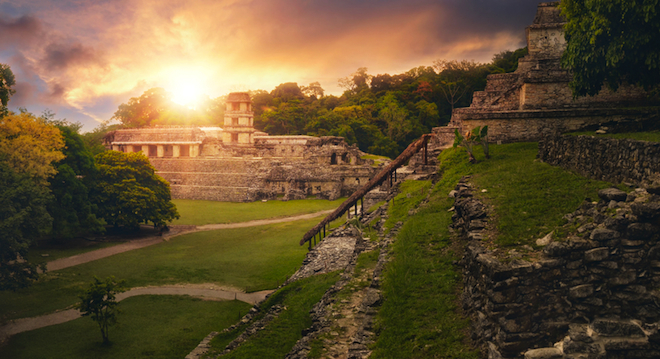
Image of Mayan ruins at Palenque / Shutterstock



[…] NASA study confirms society is on the brink of total collapse […]
I wouldn’t be so sure about robotics, Dan. Mechanical devices need to be powered by something. Even solar energy has to be created by means of man-made solar panels and other equipment. What is thought provoking is that most people living in advanced, industrialized societies do not know the basic tenants of survival; such as how to build a fire, hunt for food (if there is anything to hunt), grow crops, build basic shelters; and basic medical knowledge.
Most people are so tied to their high tech oriented devices, like cell phones and computers, that they would now know how to function without them. The American TV series, Revolution, when everything electrical suddenly stops working, just touches on this problem.
The controlling elite are the last to accept any fact as it flies in the face of their desired reality. We find them jumping out the windows of a tall buildings most times because they do not have what it takes to survive without a protective shell. Their arrogance makes them extremely easy targets under such circumstances. The layering of technology and criminal activity can only protect a group for so long. My grandmother used to say, “There is only one bull in the pasture. When he no longer serves a purpose, he goes to the slaughter house.” Every civilization falls, time absolutely proves that. Outside the continued, age-old attempts (intimidation, murder, rape, torture) of the elite to subdue others and take their resources, what purpose would they serve in a world after a true collapse?
Be wise. Be prepared. Develop meaningful skill sets.
This isn’t going to mean a collapse of civilization—the rich can confidently count on robotics to take up the labor loss within 20 years—, but a rationalization by the Gates, Zuckerbergs, Pages, and their apologists that the merciful thing to do is to blame the trouble on AGM (as they fly around in jets [“Hey, there aren’t that many of us!”] rather than their filthy rich selves, bandage the mortal wounds of the poor in a faux display of drama-queen anguish, and… let them die.
“If he be like to die, he had better do it, and decrease the surplus population.” . –Ebenezer Scrooge, ‘A Christmas Carol’