
Hyperloop, Elon Musk dreams of a fifth mode of transportation [video]

hyperloop elon musk

Elon Musk is known as the founder of SpaceX, a pioneer in the commercialization of space travel and Tesla, a company named after a brilliantly mad high-voltage inventor of the nineteenth century and known for its electric cars. So what happens when this visionary sets his eyes on America’s decaying public transportation infrastructure?

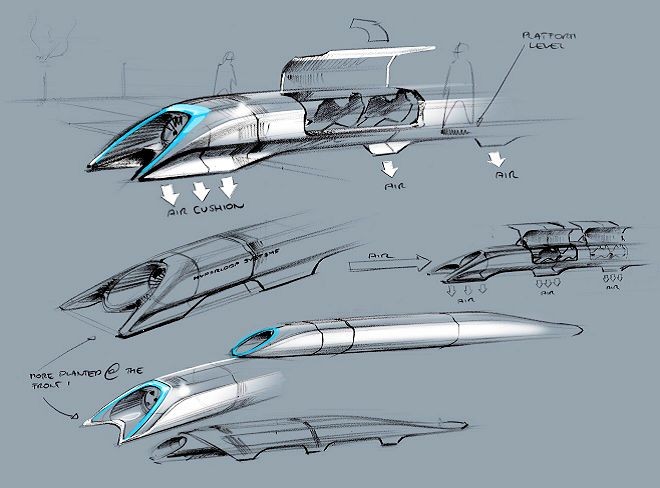
The result is hyperloop, a futuristic type of tube transportation which combines the best of air travel with the best of rail.

That’s right you saw the phrase rail, tube transportation and futuristic in the same sentence. No, I’m not talking about the sweaty London Underground or the smelly New York subway system or even Turkey’s impressive Marmaray undersea tunnel. I’m talking about something that combines the magic of The Polar Express with the sleek practicalities of an iPhone.

If you’ve ever visited a drive-up bank, you’ve seen a small-scale version of hyperloop technology. That pint-sized cylindrical vehicle which carries your checks, identification, cash and IOUs quickly and safely to and from you bank teller via pneumatic tubes is the basis for the hyperloop concept.

Buildings in New York and other great cities relied on such pneumatic networks long before the age of Facebook and email. Scale everything up so that it can carry passengers the 570 kilometers from Los Angeles to San Francisco at a speed of at least 962kph (almost 600mph) and you have what Elon Musk calls Hyperloop, a fifth mode of transportation.

The idea itself isn’t entirely new. Anyone who has stood on a subway platform has noticed the wind that announces the arrival of each train. It turns out that air friction is one of the primary limitations on subway speed and efficiency.

By pumping air out in front of the train and compressing it behind the train, you not only reduce friction, you can actually propel the train through the tube. Back in 1868, Alfred Ely Beach, then editor of Scientific American magazine, designed and built a pneumatic passenger transport under Broadway in New York City.

To avoid hassles with building permits, “The Beach Pneumatic Transit Company” project was developed in secrecy under the false premise that it would only transport packages and mail.

The company eventually failed but fast forward 145 years and Elon Musk believes the concept can be brought back to life on a much grander scale. But even Musk knows it limitations.

The design intentionally limits speed to mach 0.98 to limit noise, turbulence and environmental damage. Musk admits that over very long distances, air travel would probably be more efficient but that hyperloop’s sweet spot is “high-traffic city pairs that are less than about 1,500 km or 900 miles apart.”

Video on how Hyperloop Travel works

Los Angeles and San Francisco fit into this range. But so do many of the great cities of the Middle East. Will we one day be able to travel from Tel Aviv to Cairo, Istanbul to Ankara or Riyadh to Abu Dhabi in less time than it takes for city traffic to get across town?

Brian Nitz
Brian Nitzhttp://www.greenprophet.com
Brian remembers when a single tear dredged up a nation's guilt. The tear belonged to an Italian-American actor known as Iron-Eyes Cody, the guilt was displaced from centuries of Native American mistreatment and redirected into a new environmental awareness. A 10-year-old Brian wondered, 'What are they... No, what are we doing to this country?' From a family of engineers, farmers and tinkerers Brian's father was a physics teacher. He remembers the day his father drove up to watch a coal power plant's new scrubbers turn smoke from dirty grey-back to steamy white. Surely technology would solve every problem. But then he noticed that breathing was difficult when the wind blew a certain way. While sailing, he often saw a yellow-brown line on the horizon. The stars were beginning to disappear. Gas mileage peaked when Reagan was still president. Solar panels installed in the 1970s were torn from roofs as they were no longer cost-effective to maintain. Racism, public policy and low oil prices transformed suburban life and cities began to sprawl out and absorb farmland. Brian only began to understand the root causes of "doughnut cities" when he moved to Ireland in 2001 and watched history repeat itself. Brian doesn't think environmentalism is 'rocket science', but understanding how to apply it within a society requires wisdom and education. In his travels through Europe, North America, Asia and the Middle East, Brian has learned that great ideas come from everywhere and that sharing mistakes is just as important as sharing ideas.
4 COMMENTS
  1. The current hyperloop looks to cost one hundred billion per two hundred and fifty miles and require two billion per length to operate annually. At fifty dollars a trip this requires a transit pod with fifty passengers (not six which would be a thousand dollars a seat) every minute and in both directions.
    A US hyperloop network could be paid for in full by an annual lottery over twenty years, each selling two billion tickets at five hundred dollars. A lottery breaks down as 250 billion in tax, 50 billion lottery management, 300 billion prizes ( being 1 x 100 billion, 10 x 10 billion, 100 x 1 billion), and 400 billion for the hyperloop.
    It means we can raise eight trillion dollars, six trillion to build it and two trillion, the interest on which will fund its annual operation as a free service.

Comments are closed.

TRENDING

The Boring Company to add a Dubai loop

Dubai has announced this month that they will be working with Elon Musk's Boring Company to build tunnels in Dubai. 

EU startup aiming to generate energy on moon villages

Stepping up to democratize the moon is an EU-funded company, Deep Space Energy, which has just raised more than $1 million USD as a seed fund to help it create energy generators on the moon.

Elon Musk to create Mars base station on the Moon

For those unaware, SpaceX has already shifted focus to building a self-growing city on the Moon, as we can potentially achieve that in less than 10 years, whereas Mars would take 20+ years.

Our DNA Ages With Us — And Some Genomes Age Faster Than Others

Life hacking is a modern catch-all for a growing movement that treats the human body and mind as systems that can be measured, tested, and improved. A life hacker uses tools from biohacking, data tracking, and behavioral science to pursue human optimization and self-optimization, often through the quantified self approach—measuring sleep, nutrition, stress, and performance to guide personal optimization and performance hacking. Increasingly, this mindset is focused on longevity hacking and anti-aging biohacking, with the aim to slow aging naturally, reduce one’s biological age, and in some cases even attempt to reverse aging.

Musk’s Saudi Mega-Data Center Signals a Desert Arms Race for AI

For now, Musk’s partnership signals a deepening alignment between Silicon Valley and Riyadh — and a new chapter in the Middle East’s data-powered future. The satellites and robots may come later. The energy footprint, however, is already here.

Should You Invest in the Private Market?

startustartup Unlike public stock exchanges, which offer daily trading, strict...

How to build a 100-year-company

Kongō Gumi is a Japanese construction company, purportedly founded in 578 A.D., making it the world's oldest documented company. What can we learn about building sustainable businesses from them?

From Pilot Plant to Global Stage: How Aduro Clean Technologies’ 2026 Expansion Signals a Turning Point for Chemical Recycling Investors Like Yazan Al Homsi

The company's Next Generation Process (NGP) Pilot Plant in London, Ontario, has officially moved into initial operating campaigns, generating the kind of structured, repeatable data that separates laboratory promise from commercial viability.

How AI Helps SaaS Companies Reduce Repetitive Customer Support Work

SaaS products are designed for large numbers of users with different levels of experience, and also in renewable energy.

Pulling Water from the Air

Faced with water shortage in Amman, Laurie digs up...

Turning Your Energy Consultancy into an LLC: 4 Legal Steps for Founders in Texas

If you are starting a renewable energy business in Texas, learn how to start an LLC by the books.

Tracking the Impacts of a Hydroelectric Dam Along the Tigris River

For the next two months, I'll be taking a break from my usual Green Prophet posts to report on a transnational environmental issue: the Ilısu Dam currently under construction in Turkey, and the ways it will transform life along the Tigris River.

6 Payment Processors With the Fastest Onboarding for SMBs

Get your SMB up and running fast with these 6 payment processors. Compare the quickest onboarding options to start accepting customer payments without delay.

Related Articles

Popular Categories