
Hyperloop, Elon Musk dreams of a fifth mode of transportation [video]

hyperloop elon musk

Elon Musk is known as the founder of SpaceX, a pioneer in the commercialization of space travel and Tesla, a company named after a brilliantly mad high-voltage inventor of the nineteenth century and known for its electric cars. So what happens when this visionary sets his eyes on America’s decaying public transportation infrastructure?

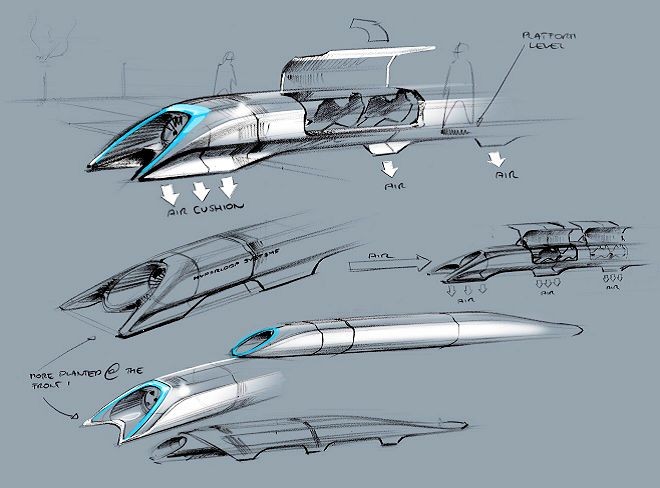
The result is hyperloop, a futuristic type of tube transportation which combines the best of air travel with the best of rail.

That’s right you saw the phrase rail, tube transportation and futuristic in the same sentence. No, I’m not talking about the sweaty London Underground or the smelly New York subway system or even Turkey’s impressive Marmaray undersea tunnel. I’m talking about something that combines the magic of The Polar Express with the sleek practicalities of an iPhone.

If you’ve ever visited a drive-up bank, you’ve seen a small-scale version of hyperloop technology. That pint-sized cylindrical vehicle which carries your checks, identification, cash and IOUs quickly and safely to and from you bank teller via pneumatic tubes is the basis for the hyperloop concept.

Buildings in New York and other great cities relied on such pneumatic networks long before the age of Facebook and email. Scale everything up so that it can carry passengers the 570 kilometers from Los Angeles to San Francisco at a speed of at least 962kph (almost 600mph) and you have what Elon Musk calls Hyperloop, a fifth mode of transportation.

The idea itself isn’t entirely new. Anyone who has stood on a subway platform has noticed the wind that announces the arrival of each train. It turns out that air friction is one of the primary limitations on subway speed and efficiency.

By pumping air out in front of the train and compressing it behind the train, you not only reduce friction, you can actually propel the train through the tube. Back in 1868, Alfred Ely Beach, then editor of Scientific American magazine, designed and built a pneumatic passenger transport under Broadway in New York City.

To avoid hassles with building permits, “The Beach Pneumatic Transit Company” project was developed in secrecy under the false premise that it would only transport packages and mail.

The company eventually failed but fast forward 145 years and Elon Musk believes the concept can be brought back to life on a much grander scale. But even Musk knows it limitations.

The design intentionally limits speed to mach 0.98 to limit noise, turbulence and environmental damage. Musk admits that over very long distances, air travel would probably be more efficient but that hyperloop’s sweet spot is “high-traffic city pairs that are less than about 1,500 km or 900 miles apart.”

Video on how Hyperloop Travel works

Los Angeles and San Francisco fit into this range. But so do many of the great cities of the Middle East. Will we one day be able to travel from Tel Aviv to Cairo, Istanbul to Ankara or Riyadh to Abu Dhabi in less time than it takes for city traffic to get across town?

Brian Nitz
Brian Nitzhttp://www.greenprophet.com
Brian remembers when a single tear dredged up a nation's guilt. The tear belonged to an Italian-American actor known as Iron-Eyes Cody, the guilt was displaced from centuries of Native American mistreatment and redirected into a new environmental awareness. A 10-year-old Brian wondered, 'What are they... No, what are we doing to this country?' From a family of engineers, farmers and tinkerers Brian's father was a physics teacher. He remembers the day his father drove up to watch a coal power plant's new scrubbers turn smoke from dirty grey-back to steamy white. Surely technology would solve every problem. But then he noticed that breathing was difficult when the wind blew a certain way. While sailing, he often saw a yellow-brown line on the horizon. The stars were beginning to disappear. Gas mileage peaked when Reagan was still president. Solar panels installed in the 1970s were torn from roofs as they were no longer cost-effective to maintain. Racism, public policy and low oil prices transformed suburban life and cities began to sprawl out and absorb farmland. Brian only began to understand the root causes of "doughnut cities" when he moved to Ireland in 2001 and watched history repeat itself. Brian doesn't think environmentalism is 'rocket science', but understanding how to apply it within a society requires wisdom and education. In his travels through Europe, North America, Asia and the Middle East, Brian has learned that great ideas come from everywhere and that sharing mistakes is just as important as sharing ideas.

Read More

4 COMMENTS
  1. The current hyperloop looks to cost one hundred billion per two hundred and fifty miles and require two billion per length to operate annually. At fifty dollars a trip this requires a transit pod with fifty passengers (not six which would be a thousand dollars a seat) every minute and in both directions.
    A US hyperloop network could be paid for in full by an annual lottery over twenty years, each selling two billion tickets at five hundred dollars. A lottery breaks down as 250 billion in tax, 50 billion lottery management, 300 billion prizes ( being 1 x 100 billion, 10 x 10 billion, 100 x 1 billion), and 400 billion for the hyperloop.
    It means we can raise eight trillion dollars, six trillion to build it and two trillion, the interest on which will fund its annual operation as a free service.

TRENDING

Can a one trillion-Dollar SpaceX IPO change life on earth?

A SpaceX IPO could become one of the most consequential financial events of the century, creating thousands of millionaires and fueling investment across the New Space economy. From orbital robotics and African space programs to launch infrastructure and satellite networks, the ripple effects may extend far beyond Earth—while forcing investors to reconsider whether generative AI remains the most compelling technology bet of the decade.

How does Neuralink work?

Current goals are to treat neurological disease like Parkinson’s and restore autonomy to people with severe physical limitations by controlling exoskeletons and prosthetics. There’s also huge potential to improve cognitive abilities such as memory, attention, and languages.

Saving Gourmet Wild Plants For The Future

Think of truffles, a gourmet wild food. The European...

Tesla Semi, electric road trains and the safer freight future after the Iran war

When the US-Israel-Iran war rattles oil routes and sends...

Middle-Eastern spices and natural medicine (A through C)

In the Middle East, aromatic traditional foods are regarded...

Yerukim Forms a New Green Economy Where the Money is Really Green

The Yerukim members who pick up the recyclables get to keep the monetary reward, the public earns "green" bills that can be used in shops, and business owners get to be associated with environmentalism.

Choosing Riyadh over Dubai? What Investors Should Know

Saudi Arabia is deploying capital at unmatched scale to catalyze tourism and advanced industry while rewiring its power-and-water backbone. The investable frontier is widening—especially in renewables, grid storage, water efficiency/desal retrofits, and hospitality operating platforms. Prudent investors will insist on phased delivery, enforceable KPIs (energy, water, biodiversity), and RHQ/zone compliance—while pricing political-economy and reputational risks alongside growth upside.

Sell your cooking oil for biodiesel money

Want to make money on old french fry oil? Sell it.

Qatar Alternative Energy Summit Pairs Investors And Innovators

Alternative energy investors and innovators can meet n' greet in Doha, Qatar March 16 and 17.

Here’s How To Implement The Four Pillars Of Employee Engagement

If you throw a party for your work team and they are vegans, don't make it a barbecue. Know the sustainability values of your team to boost moral and retain good people.

Locals From Rishon Fight IKEA

Big Box stores are a pretty new concept in Israel, and thank God that not every Israeli city wants them in their backyard. A word from someone who has see the beautiful farmland around her hometown Newmarket, Ontario stripped and converted into vulgar strip malls of big box shops: they have no place in a healthy and sustainable town or city.

The Jewish National Fund Meets An Inconvenient Truth

According to the JNF, it has transformed thousands of acres of barren land into green forests in Israel. They state that each person emits about 23 tons of carbon per year, estimating that each tree planted can absorb one ton of carbon in its lifetime. That's a whole lot of trees you'd need to be planting. Could so many fit in Israel?

How to quiet noise from construction in your office

Streets need to be resurfaced in New York but the humming and grinding noise is unsettling. Noise is environmental pollution. 

Popular Categories