Archeologists unearth ancient winery in Israel

winery archeology Israel
Children and adults alike used to drink wine in the Holy Land and from this massive winery just unearthed in Yavne. The site made at least half a million gallons of wine a year. 

Before Islam was rooted in the Middle East the Holy Land and Mohammad forbid alcohol to its followers, Israel was home to all sorts of pagans, then Jews, then Christians. In Christian and Jewish rights and rituals –– then and now –– wine is used for consecrations purposes: for Christians during the mass to turn the body of Jesus into blood; and for Jews who mark the Sabbath and high Holy Days with a glass of wine shared by all at the table.

grapes wine
Grapes from my vine, Jaffa Israel, 2021

So people back then, as it is now, needed vineyards and wineries to produce the wine.

Israeli archeologists are happy to annound unearthing the largest winery from the period of about 1500 years ago. Through this finding, near Yavne, Israelis celebrate how wine was made, and explore its history from an archoelogy site that produced a kind of white wine called Gaza that was most likely consumed locally and shipped south to Egypt and north to Greece. 

Yavne was an important historical site for Jewish scholars. The site was more sophisticated than archeologists would have expected. Remember when we wrote about Elusa? This was one of the rare sites to have revealed its name at the site where it exported wine from Israel. 

The Yavne dig is so special due to its size and the amount of wine they could process every year.
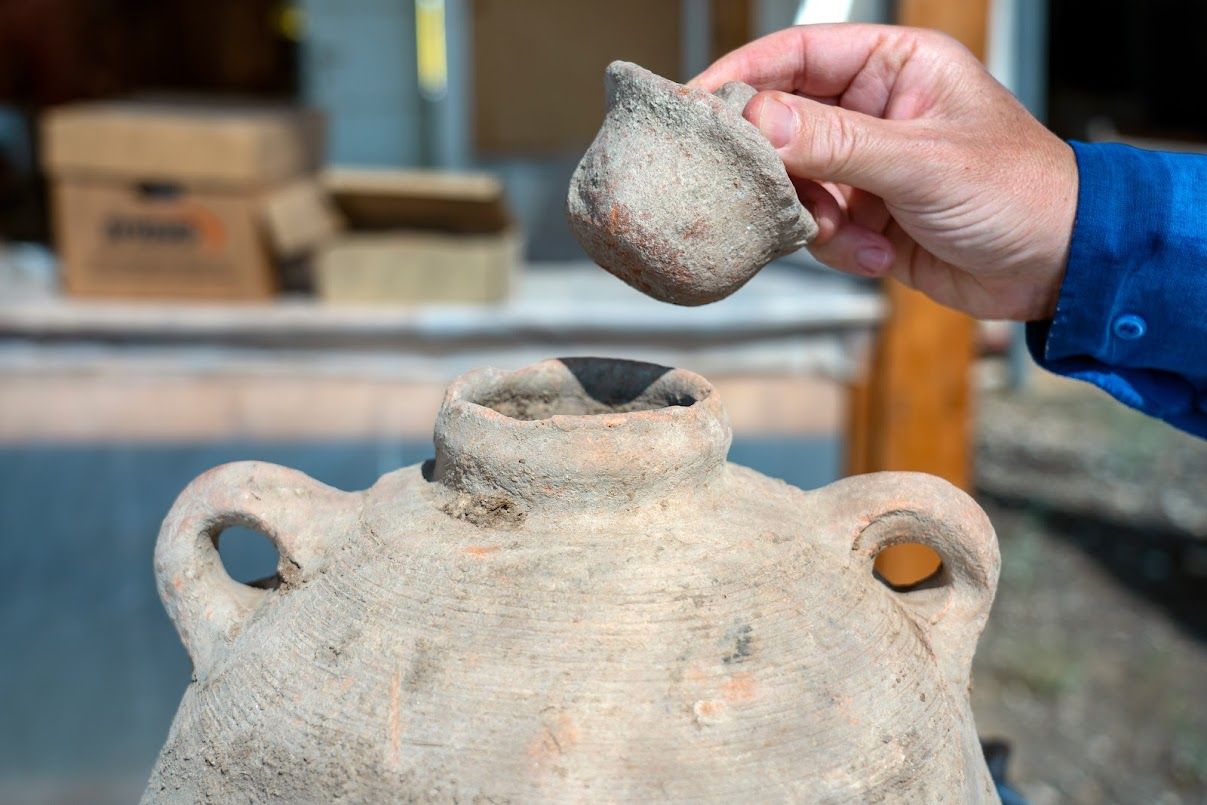
“We found decorative niches in the shape of a conch, which adorned the winepresses, indicate the great wealth of the factory owners. A calculation of the production capacity of these winepresses shows that approximately two million litres of wine were marketed every year, while we should remember that the whole process was conducted manually,” commented Elie Haddad, Liat Nadav-Ziv and Jon Seligman, the directors of the excavation on behalf of the Israel Antiquities Authority. 

When kids drank wine

The plant includes five magnificent wine presses, warehouses for aging and marketing the wine, kilns for firing the clay amphorae in which the wine was stored, tens of thousands of fragments and intact earthen amphorae (jars), well planned access between the facilities, and more.

Yavne wine press

Drinking wine was very common in ancient times, for children and adults alike. Since the water was not always sterile and or even tasty, wine was also used as a kind of “concentrate” to improve the taste, or as a substitute for drinking water.

Each of the exposed winepresses covered an area of ​​about 225 square metres. Around the treading floor, where the grapes were crushed barefoot to extract the liquid, compartments were built for fermenting the wine, and next to them – two huge octagonal shaped vats for collecting the wine.

Like wine?
Make Pea Pod Wine

Make your own ancient mead


Karin Kloosterman
Karin Kloostermanhttp://www.greenprophet.com
Karin Kloosterman is an award-winning journalist, innovation strategist, and founder of Green Prophet, one of the Middle East’s pioneering sustainability platforms. She has ranked in the Top 10 of Verizon innovation competitions, participated in NASA-linked challenges, and spoken worldwide on climate, food security, and future resilience. With an IoT technology patent, features in Canada’s National Post, and leadership inside teams building next-generation agricultural and planetary systems — including Mars-farming concepts — Karin operates at the intersection of storytelling, science, and systems change. She doesn’t report on the future – she helps design it. Reach out directly to [email protected]

TRENDING

Earth building with Dead Sea salt bricks

Researchers develop a brick made largely from recycled Dead Sea salt—offering a potential alternative to carbon-intensive cement.

Farm To Table Israel Connects People To The Land

Farm To Table Israel is transforming the traditional dining experience into a hands-on journey.

Remilk makes cloned milk so cows don’t need to suffer and it’s hormone-free

This week, Israel’s precision-fermentation milk from Remilk is finally appearing on supermarket shelves. Staff members have been posting photos in Hebrew, smiling, tasting, and clearly enjoying the moment — not because it’s science fiction, but because it tastes like the real thing.

An Army of Healers Wins the 2025 IIE Goldberg Prize for Peace in the Middle East

In a region more accustomed to headlines of loss than of listening, the Institute of International Education (IIE) has chosen to honor something quietly radical: healing. The 2025 Victor J. Goldberg Prize for Peace in the Middle East has been awarded to Nitsan Joy Gordon and Jawdat Lajon Kasab, the co-founders of the Army of Healers, for building spaces where Israelis and Palestinians — Jews, Muslims, Christians, Druze, and Bedouins — can grieve, speak, and rebuild trust together.

Peace hospital opens between Jordan and Israel

The proposed medical centre, described by Emek HaMaayanot Regional Council head Itamar Matiash as “a centre for cancer treatment, so that people from Jordan or further away could come and receive treatment,” would become the flagship of a wider cluster of medical, academic and innovation-based services planned for the Israeli half of the zone.

Turning Your Energy Consultancy into an LLC: 4 Legal Steps for Founders in Texas

If you are starting a renewable energy business in Texas, learn how to start an LLC by the books.

Tracking the Impacts of a Hydroelectric Dam Along the Tigris River

For the next two months, I'll be taking a break from my usual Green Prophet posts to report on a transnational environmental issue: the Ilısu Dam currently under construction in Turkey, and the ways it will transform life along the Tigris River.

6 Payment Processors With the Fastest Onboarding for SMBs

Get your SMB up and running fast with these 6 payment processors. Compare the quickest onboarding options to start accepting customer payments without delay.

Qatar’s climate hypocrisy rides the London Underground

Qatar remains a master of doublethink—burning gas by the megaton while selling “sustainability” to a world desperate for clean air. Wake up from your slumber people.

How Quality of Hire Shapes Modern Recruitment

A 2024 survey by Deloitte found that 76% of talent leaders now consider long-term retention and workforce contribution among their most important hiring success metrics—far surpassing time-to-fill or cost-per-hire. As the expectations for new hires deepen, companies must also confront the inherent challenges in redefining and accurately measuring hiring quality.

8 Team-Building Exercises to Start the Week Off 

Team building to change the world! The best renewable energy companies are ones that function.

Thank you, LinkedIn — and what your Jobs on the Rise report means for sustainable careers

While “green jobs” aren’t always labeled as such, many of the fastest-growing roles are directly enabling the energy transition, climate resilience, and lower-carbon systems: Number one on their list is Artificial Intelligence engineers. But what does that mean? Vibe coding Claude? 

Somali pirates steal oil tankers

The pirates often stage their heists out of Somalia, a lawless country, with a weak central government that is grappling with a violent Islamist insurgency. Using speedboats that swarm the targets, the machine-gun-toting pirates take control of merchant ships and then hold the vessels, crew and cargo for ransom.

Related Articles

Popular Categories