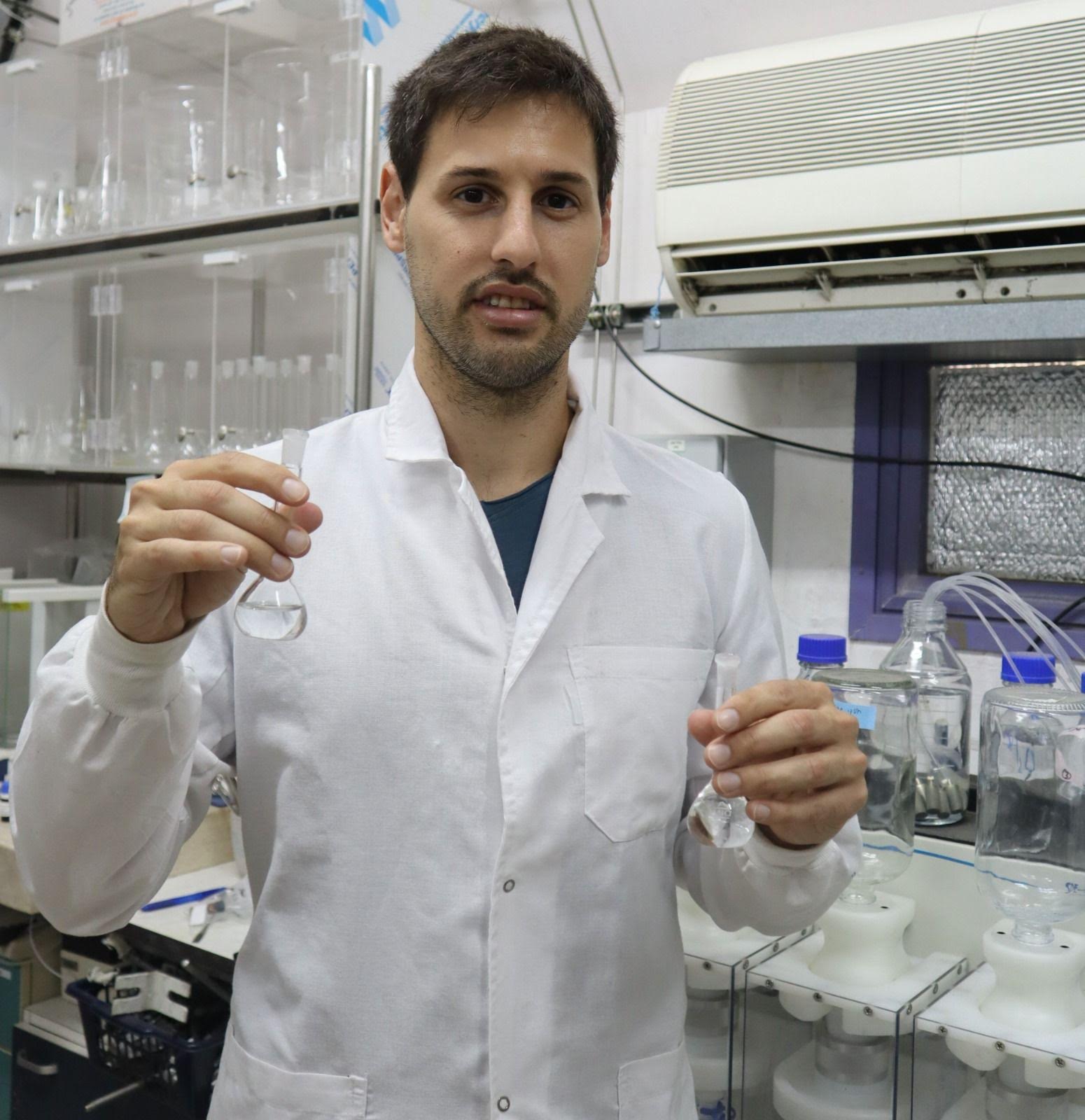
In a first-of-its-kind study in the world conducted at Tel Aviv University, researchers found that water generated from the air in the heart of an urban area, the city of Tel Aviv, complied with all of the strict drinking water standards set both by the State of Israel and by the World Health Organization.
The researchers examined the quality of the water produced from the water vapor in the urban atmosphere, which is characterized by industry and massive construction, and found that it was suitable for drinking. The test was performed using a dedicated facility of the Israeli company Watergen, which partnered in the study.
The study was conducted by a team of experts from the hydrochemistry laboratory at the Porter School of Environment and Earth Sciences at Tel Aviv University, led by graduate student Offir Inbar and supervised by Prof. Dror Avisar, Head of TAU’s Moshe Mirilashvili Institute for Applied Water Studies. Also participating in the study was Watergen’s research and development team, Prof. Alexandra Chudnovsky, and leading researchers from Germany.
The study’s results were published in two leading journals: Science of the Total Environment and Water.

The researchers explain that the growing global shortage of clean drinking water requires thinking outside the box and developing new technologies for producing potable water. The Earth’s atmosphere is a vast and renewable source of water, which may be an alternative drinking water resource. Our atmosphere contains billions of tons of water, 98% of which is in a gaseous state – that is water vapor.
Offir Inbar explains that this is the first study in the world to examine air pollution from another angle – its effect on drinking water generated from the air. According to Inbar, no filtration or treatment system was installed in the device used in the study; the water that was produced was the water that was obtained from the air. The researchers performed a wide range of advanced chemical analyses of the water, and found that in the vast majority of cases, including during different seasons and at different times of the day, the water extracted from the air in the heart of Tel Aviv was safe to drink.
In addition, with the help of a variety of innovative technologies for monitoring the composition of the atmosphere and by applying advanced statistical methods, for the first time the researchers were able to quantitatively link the process the air goes through in the days leading up to the point of water production and the chemical composition of the dew.
“The study showed that wind direction greatly affects water quality, so for example when the wind comes from the desert we find more calcium and sulfur, that is, residues of desert dust aerosols, in the water,” says Inbar. “However, when the wind comes from direction of the sea, we find higher concentrations of chlorine and sodium, which are found in the sea. Moreover, we found that the distant sources from which the air came before it reached the point of water production can be identified in the water. For example, water produced from air coming from the Sahara region differs in composition from water produced from air coming from Europe.”
The researchers note that water quality is also affected by anthropogenic pollution from transportation and industry.
“Using advanced methods, we found a direct link between the concentrations of ammonia, nitrogen oxides and sulfur dioxide in the air and the concentration of their decomposition products in water,” says Inbar. “We found low concentrations of copper, potassium, and zinc in the water, which probably come from man-made pollution. From a research point of view, the chemical link we found between the meteorological parameters and the composition of the water makes it possible for the first time to study the atmosphere using water extracted from it. And environmentally speaking, this link allows us to know what minerals should be added to water extracted from air in order to provide people with quality drinking water.
“In general, we found that potable water from air does not contain enough calcium and magnesium – and it is advisable to add these minerals to the water, as they are added to desalinated drinking water in some countries.”
A significant portion of the water we drink today in Israel is desalinated seawater. According to Inbar, this is only a partial solution, and not one that can provide drinking water to the vast majority of the world’s population. “In order to desalinate seawater, you need a sea, and there isn’t access to the sea from every place in the world,” says Inbar.
“After desalination, a complete infrastructure must be built that will carry the desalinated water from the waterfront to the various towns, and large parts of the world don’t possess the engineering and economic means to build and maintain such infrastructure. Water from the air, however, can be produced anywhere, with no need for expensive transport infrastructure and regardless of the amount of precipitation. From an economic perspective, the higher the temperature and humidity, the more cost-effective the production of water from the air is.”
Devices for generating water from the air that include water purification and treatment systems can already be found in a large number of countries in the world, where they provide quality drinking water to people living in distressed areas.
“The concern was that water produced from air in the heart of an urban area would not be suitable for drinking – and we proved that this is not the case,” Inbar concludes. “We are currently expanding our research to other areas in Israel, including Haifa Bay and agricultural areas, in order to investigate in depth the impact of various pollutants on the quality of water extracted from the air.”