Huge Dust Plume Covers the Red Sea

As if the Arabian Peninsula needs an import of desert dust from east Africa.
redsea_amo_2016167

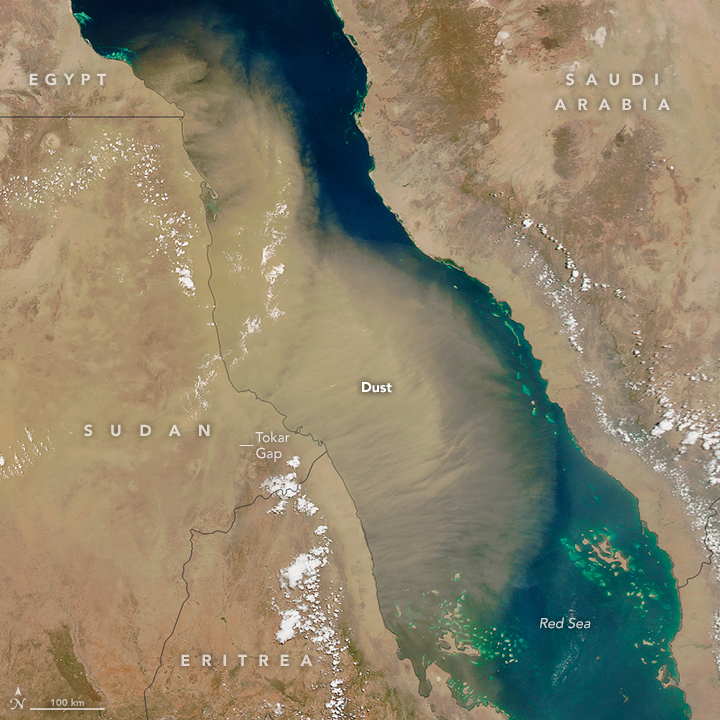
Marvel at the image captured by NASA‘s Aqua satellite of a huge plume of airborne dust covering the red sea. The image was captured at 2:05 pm local time on June 15, 2016. The plume appears to be traveling east-northeast out of Sudan and Eritrea towards Saudi Arabia, adding to the sorrows of an already troubled region when it comes to air quality.

Human activities are responsible for some 30% of dust loading into the atmosphere, but this huge dust outbreak was due a cold front caused by a cyclone centered near the Arabian/Persian gulf.

Here’s a brief of the good, the bad, and the ugly with this humongous dust cloud:

The good – The dust could reflect sunlight while stranded in the air, causing a much needed cooling effect beneath it. The dust could also be deposited over the Red sea, supplying it with the nutrients it needs.

The bad – Adverse health effects of inhaling desert dust is well documented. Asthma attacks spike during dust storms, and even previously undiagnosed sufferers could develop the condition. Non-health related issues are also at hand, like decreased visibility while driving; an issue of utmost seriousness in Saudi Arabia, at least.

The ugly – This dust storm comes at the worst of times. The region is plagues with unsustainable mining, oil extraction, and agriculture, and, worst of all, intensive military conflicts, putting severe pressure on the region’s ecosystems and life conditions. The United Nations Environment Programme predicted that Iraq, for example, could witness 300 dust events in a year within 10 years; up from 120 events per year nowadays. The World Health Organization states that dust storms contribute to poor air quality, which claims 7 million lives every year.


Image from NASA’s Earth Observatory website

Basel Ismaiel
Basel Ismaielhttp://www.greenprophet.com
Raised in Abu Dhabi, and made a living in Calgary. The lowest common denominator? Oil. Nothing against compressed corpses of the clade Dinosauria, per se, but Basel guesses that the industry might have accelerated the predictably grim Anthropocene. He consults in sustainability out of Ottawa, Canada. Basel runs marathons & hikes mountains. He plays football too. Talk to Basel at [email protected]

Read More

TRENDING

A Face Swap Tool for Training and Internal Comms

Corporate training videos often require repeated filming, travel, and production resources every time policies or personnel change. AI-powered face swap tools offer a more sustainable approach by extending the life of digital training content, reducing unnecessary reshoots, and helping organizations communicate more efficiently—provided they are used transparently with clear consent and ethical governance.

How a tick bite can lead to a life-threatening meat allergy AFG

Imagine developing a severe allergy to steak after a single tick bite. That's the reality for people with alpha-gal syndrome, a rapidly emerging condition linked to lone star ticks and other tick species. As researchers uncover how tick saliva rewires the immune system, health officials warn that hundreds of thousands of Americans may already be living with this unusual red meat allergy.

Russia’s Arctic superdeep oil drill revives debunked ‘infinite oil’ theory

Russia is reviving the controversial abiotic oil theory with plans to drill superdeep holes in the Arctic. While small amounts of abiotic methane exist deep within the Earth, most geologists reject the idea that commercial oil reserves originate from non-biological processes, raising questions about the environmental cost and scientific value of the project.

Code Red from the Galapagos: human drugs and sunscreen are polluting the sea

Millions of visitors swim in the pristine waters of the Galápagos each year, but new research suggests sunscreen chemicals and other human-made pollutants are reaching even the islands' most protected marine habitats. Scientists are calling for urgent monitoring to safeguard one of Earth's most iconic ecosystems.

AI will crack the codes from the Dead Sea Scrolls

Artificial intelligence is opening a new chapter in Dead Sea Scrolls research. By combining machine learning with chemical analysis, scientists hope to uncover where the ancient manuscripts were produced, identify connections between scribes, and reveal hidden patterns across more than 25,000 fragments that have remained unsolved for decades.

Yerukim Forms a New Green Economy Where the Money is Really Green

The Yerukim members who pick up the recyclables get to keep the monetary reward, the public earns "green" bills that can be used in shops, and business owners get to be associated with environmentalism.

Choosing Riyadh over Dubai? What Investors Should Know

Saudi Arabia is deploying capital at unmatched scale to catalyze tourism and advanced industry while rewiring its power-and-water backbone. The investable frontier is widening—especially in renewables, grid storage, water efficiency/desal retrofits, and hospitality operating platforms. Prudent investors will insist on phased delivery, enforceable KPIs (energy, water, biodiversity), and RHQ/zone compliance—while pricing political-economy and reputational risks alongside growth upside.

Sell your cooking oil for biodiesel money

Want to make money on old french fry oil? Sell it.

Qatar Alternative Energy Summit Pairs Investors And Innovators

Alternative energy investors and innovators can meet n' greet in Doha, Qatar March 16 and 17.

Here’s How To Implement The Four Pillars Of Employee Engagement

If you throw a party for your work team and they are vegans, don't make it a barbecue. Know the sustainability values of your team to boost moral and retain good people.

Locals From Rishon Fight IKEA

Big Box stores are a pretty new concept in Israel, and thank God that not every Israeli city wants them in their backyard. A word from someone who has see the beautiful farmland around her hometown Newmarket, Ontario stripped and converted into vulgar strip malls of big box shops: they have no place in a healthy and sustainable town or city.

The Jewish National Fund Meets An Inconvenient Truth

According to the JNF, it has transformed thousands of acres of barren land into green forests in Israel. They state that each person emits about 23 tons of carbon per year, estimating that each tree planted can absorb one ton of carbon in its lifetime. That's a whole lot of trees you'd need to be planting. Could so many fit in Israel?

How to quiet noise from construction in your office

Streets need to be resurfaced in New York but the humming and grinding noise is unsettling. Noise is environmental pollution. 

Popular Categories