Satellite Points finger to Persian Gulf for Emissions Under-Reporting

so2-emissions-map

You can run but you can’t hide.

Canadian researchers have found a new, satellite-based technology that -accurately- detects polluters from outer space, and caught 39 large polluters red-handed for non-reporting of their emissions.

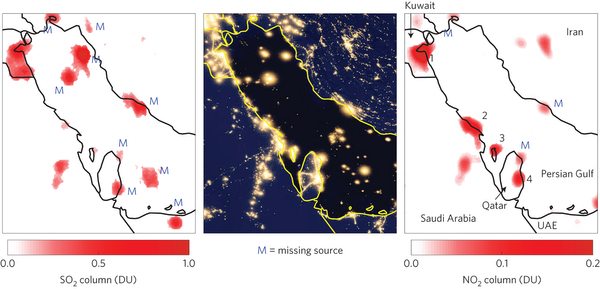
Fourteen of those were located in the Persian Gulf, with total contribution to global sulphur dioxide emissions of staggering 6 to 12%.

The study, published this week in the journal Nature Geoscience, used a satellite-based simultaneous detection, mapping, and emission-quantifying procedure to locate pollution ‘hot spots’ across the globe, and compile an inventory of pollutants. The results were then compared with three conventional state-of-the-science inventories, including the Hemispheric Transport of Air Pollutants, which depend on bottom-up approach for quantifying emissions. This latter approach, however, might not mirror actual emissions, especially from developing nations that might lack comprehensive reporting requirements and infrastructure. Enter the satellite detective.

Seven to 14 million metric tons of sulphur dioxide emissions, which have gone missing from inventories, came from polluters in the Persian Gulf, accounting for 6 to 12% of global sulphur dioxide emissions. Most of the hotspots turned out to be large oil refinery complexes.

The plot thickens.

Not only sulphur dioxide from remote oil facilities, but also nitrogen dioxide and nitrogen oxides were revealed to be emitted in large quantities and under-reported. Those latter two pollutants correspond to combustion sources in urban areas, which also happen to be the same sources of carbon dioxide. And yet, some of these missing nitrogen dioxide sources were also missing from the carbon dioxide inventories, as per the study.
Guld-map

In a nutshell, polluters in and around the Persian Gulf are under-reporting all sulphur dioxide, nitrogen oxides, and carbon dioxide. That’s a 3-strikes.

These pollutants have deadly effects on human health, the environment, and the economies. It’s worth noting that countries on the shores of the Persian Gulf are way up on the list of nations with highest carbon dioxide emissions per capita.

More insights on Canadian-Gulf environment bilateral dynamics, here

Photos sourced from cbc.ca and nature.com

Basel Ismaiel
Basel Ismaielhttp://www.greenprophet.com
Raised in Abu Dhabi, and made a living in Calgary. The lowest common denominator? Oil. Nothing against compressed corpses of the clade Dinosauria, per se, but Basel guesses that the industry might have accelerated the predictably grim Anthropocene. He consults in sustainability out of Ottawa, Canada. Basel runs marathons & hikes mountains. He plays football too. Talk to Basel at [email protected]
1 COMMENT

Comments are closed.

TRENDING

Street Vegan in Sri Thanu is a must-stop family lunch spot on Koh Phangan, Thailand

If you’re anywhere near Sri Thanu on Koh Phangan, Thailand, around the yoga centers: Zen Beach, Haad Yao, or Salad Beach—make time for Street Vegan. It's vegan and so satisfying that one meal might convince you that eating plant-based is not a compromise. I suggest for any vegan restaurant owner or chef to come to this modestly-priced venue to learn from a master.

Plants can eat dust and grow – should we stop dusting them?

Dusty plants? Let them eat their hearts out.

Paris Modest Fashion Week offers style without exposure for Muslims

France is home to around 5 to 7.5 million Muslims according to estimates, and Özlem Şahin, head of the organization behind Modest Fashion Week, has described Paris as "one of the leading modest fashion capitals in Europe".

Kids are vaping. The media shock that made them stop

On one side: aggressive anti-vaping campaigns from the FDA, Truth Initiative, and state programs, backed by over $100 million in annual spending. On the other: a public health crisis. Screenshot

Baby teeth read like tree rings paint a picture of toxins in early life

A new study from the Icahn School of Medicine at Mount Sinai in New York offers a striking insight into how the environments we are born into can quietly shape our brains years later. By analyzing naturally shed baby teeth, the ones tucked under pillows for the tooth fairy, researchers have reconstructed a detailed timeline of exposure to environmental metals during pregnancy and early infancy.

Nobul’s Regan McGee on Shareholder Value: “Complacency Is the Silent Killer” 

Why the governance framework designed to protect shareholders so...

Should You Invest in the Private Market?

startustartup Unlike public stock exchanges, which offer daily trading, strict...

How to build a 100-year-company

Kongō Gumi is a Japanese construction company, purportedly founded in 578 A.D., making it the world's oldest documented company. What can we learn about building sustainable businesses from them?

From Pilot Plant to Global Stage: How Aduro Clean Technologies’ 2026 Expansion Signals a Turning Point for Chemical Recycling Investors Like Yazan Al Homsi

The company's Next Generation Process (NGP) Pilot Plant in London, Ontario, has officially moved into initial operating campaigns, generating the kind of structured, repeatable data that separates laboratory promise from commercial viability.

How AI Helps SaaS Companies Reduce Repetitive Customer Support Work

SaaS products are designed for large numbers of users with different levels of experience, and also in renewable energy.

Pulling Water from the Air

Faced with water shortage in Amman, Laurie digs up...

Turning Your Energy Consultancy into an LLC: 4 Legal Steps for Founders in Texas

If you are starting a renewable energy business in Texas, learn how to start an LLC by the books.

Tracking the Impacts of a Hydroelectric Dam Along the Tigris River

For the next two months, I'll be taking a break from my usual Green Prophet posts to report on a transnational environmental issue: the Ilısu Dam currently under construction in Turkey, and the ways it will transform life along the Tigris River.

Related Articles

Popular Categories