
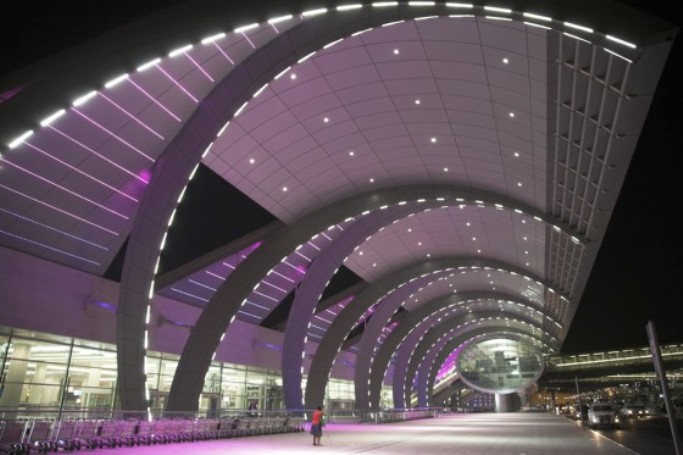
Energy-aware Dubai airports pre-empted Earth Hour – why not all year?

Dubai Airport Earth HourDubai International Airport (DXB) switched off all non-essential lights across its three terminals for 24 consecutive days to mark this year’s Earth Hour.  It’s sister airport, Dubai World Central – Al Maktoum International, located 20 miles south west of Dubai, did the same. 

Spurred on by the annual Earth Hour campaign, the airports’ action will save an estimated 300,000kw hours of energy and 129 tons of carbon dioxide emissions. A solid contribution by one of the world’s largest carbon-emitting industries!

Earth Hour took place globally on March 29, but the airports’ operator kicked off compliance early stretching the event to over 3 weeks of green behavior. The shutdown didn’t affect services within the buildings, which begs the question why were so many lights installed in the first place?

Blame the designers, and short-sighted airport operators who place aesthetics above the environment.  It’s so easy to do both! (See how Saudi’s Hajj Terminal achieved this over thirty years ago – link here.)

Airports that embrace conservation see an immediate cash payoff. Energy efficiency projects (energy management systems, installing high efficiency lighting and occupancy sensors) have slashed Dubai Airports’ electricity and fuel costs by $4.33 MIL, cut water use by over 130 million gallons, and saved more than 72,000 tons of CO2.  A win-win for operational and maintenance budgets and for the planet.

In the US and EU, stringent governmental regulations demand a minimum level of project environmental performance, and robust environmental assessment is compulsive during project planning and permitting processes which are overseen by national environmental authorities.  Building codes, typically reflecting internationally accepted standards, mandate minimum energy efficiency characteristics for materials and equipment.

Major new airport terminal projects are underway in Qatar, Kuwait and Saudi, with continued airport expansion  in Jordan. But in the Middle East, absent mature environmental agencies with strong governance over large capital building projects, conservation gets fitted into designs only if a designer convinces the client of it’s importance, or if that client is especially savvy to its benefits.

Safe to say it doesn’t happen unless the operator specifically demands it.  And they usually don’t, until well after the project is over and the utility bills start to arrive.

Here’s hoping Dubai Airports sets a new trend that embodies an old UK adage: a penny saved is a penny earned. What’s good for an airport’s pockets turns out to be great for the world.

Image of Dubai Airport at night by Shutterstock.

Read More

TRENDING

Mantle8 uses AI to pinpoint natural hydrogen in French mountain

In the misty folds of the French Pyrenees, something quietly extraordinary is happening. At a remote site called Comminges in France, Mantle8, a pioneering natural hydrogen exploration company, has unearthed a breakthrough that could shift the balance of Europe’s energy landscape.

The Eco Benefits of Radcom: Pioneering a Greener Future in Telecommunications

As the world moves toward a more connected future, and self-driving cars, the transition from 4G to 5G standalone (SA) networks is inevitable and essential. This evolution is not just about faster speeds and lower latency—it also brings significant environmental benefits.

7 Ways Businesses Can Reduce Their Environmental Impact

Environmental pollution and degradation have become a significant source of concern as the latest climate change reports forecast a grim future for the planet. Unfortunately, manufacturing industries and businesses are some of the most significant contributors to environmental pollution.

Tips for Choosing a More Sustainable Physician

People typically drive to see their doctors, using up more gas and creating a higher emissions output when they do. However, when physicians offer telehealth options to their patients, this helps everyone make more sustainable choices. 

How cryptocurrency damages the planet

The way the crypto miners produce currency is through an energy-intensive process requiring vast computing resources. According to recent estimates, over the course of a year, cryptocurrency consumes around 64 TWh (terawatt hours) of energy.

Yerukim Forms a New Green Economy Where the Money is Really Green

The Yerukim members who pick up the recyclables get to keep the monetary reward, the public earns "green" bills that can be used in shops, and business owners get to be associated with environmentalism.

Choosing Riyadh over Dubai? What Investors Should Know

Saudi Arabia is deploying capital at unmatched scale to catalyze tourism and advanced industry while rewiring its power-and-water backbone. The investable frontier is widening—especially in renewables, grid storage, water efficiency/desal retrofits, and hospitality operating platforms. Prudent investors will insist on phased delivery, enforceable KPIs (energy, water, biodiversity), and RHQ/zone compliance—while pricing political-economy and reputational risks alongside growth upside.

Sell your cooking oil for biodiesel money

Want to make money on old french fry oil? Sell it.

Qatar Alternative Energy Summit Pairs Investors And Innovators

Alternative energy investors and innovators can meet n' greet in Doha, Qatar March 16 and 17.

Here’s How To Implement The Four Pillars Of Employee Engagement

If you throw a party for your work team and they are vegans, don't make it a barbecue. Know the sustainability values of your team to boost moral and retain good people.

Locals From Rishon Fight IKEA

Big Box stores are a pretty new concept in Israel, and thank God that not every Israeli city wants them in their backyard. A word from someone who has see the beautiful farmland around her hometown Newmarket, Ontario stripped and converted into vulgar strip malls of big box shops: they have no place in a healthy and sustainable town or city.

The Jewish National Fund Meets An Inconvenient Truth

According to the JNF, it has transformed thousands of acres of barren land into green forests in Israel. They state that each person emits about 23 tons of carbon per year, estimating that each tree planted can absorb one ton of carbon in its lifetime. That's a whole lot of trees you'd need to be planting. Could so many fit in Israel?

How to quiet noise from construction in your office

Streets need to be resurfaced in New York but the humming and grinding noise is unsettling. Noise is environmental pollution. 

Popular Categories