Dream green awards for oil companies

RS2093_manifa_satellite_20100706_0

Saudi Aramco, the world’s largest oil and gas producer and most valuable company estimated at $10 trillion USD, pockets three of the six environmental awards during the 2014 Offshore Arabia Conference & Exhibition, in Dubai. Did we hear right?

The theme of the conference, Regional oil spill prevention and preparedness,  focused on the latest technological and methodological developments in the field of marine environmental protection from oil spills.

Alongside several presentations, the ‘Environmental Excellence Awards’ honored companies that have contributed towards “the protection, safety and betterment of the environment” and Saudi Aramco wins (through nominations) three environmental excellence awards. 

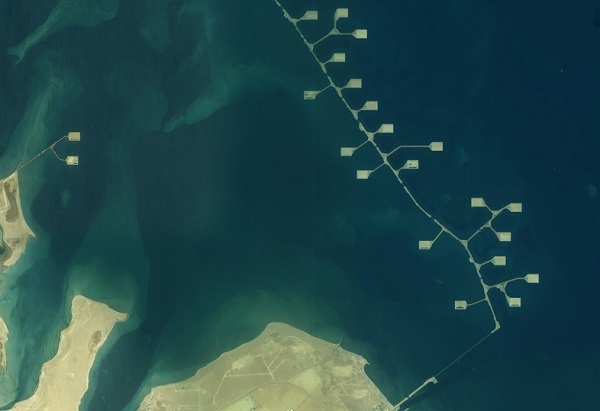
Aramco’s first award in “Excellence in environmental Technology”, is for its Manifa mega project (pictured above), a shallow offshore oil field development project which since 2006 has studied optimal ways to construct an oil platform producing 900,000 oil barrels a day, while preserving the most prolific shrimping area and marine diversity in Saudi Arabia.

It seems hard to believe that (take a breath): 41 km of asphalted causeway, three kilometers of bridges, 27 drilling islands, 13 offshore platforms (with 10 producing and 2 evaluation wells each), 15 onshore drill sites, seven water injection platforms (with 10 water injector facilities), multiple pipelines and a 420-megawatt heat and electricity plant can preserve the local marine ecosystem but the projects’ high level environmental and technical engagement has even claimed a UNESCO environmental responsibility award nomination.

The second award is in “Excellence in Environmental Projects and Products”  for its energy-saving power systems and renewable energy projects. In 2012, Saudi Aramco has worked with the Kingdom’s Energy Efficiency Program and National Energy Efficiency Hub to institute several energy (and cost) saving projects resulting in the savings of 13,000 barrels of crude oil per day and 1.0 million tons of CO2 emissions. 

As well as progressing in their first carbon capture and injection project, Saudi Aramco is exploring opportunities to further develop renewable energy technologies, particularly in solar photovoltaics, by creating a Renewable Energy Academy in partnership with  the Massachusetts Institute of Technology, the Lawrence Berkeley National Laboratory, the Masdar Institute for Science and Technology, and the King Abdullah University of Science and Technology.

The final award is for “Excellence in Environmental Applications”, which awards excellence in Health, Safety and Environmental Quality in the workplace with a special emphasis on the process used and applied to ensure total workforce compliance and the use of environmentally friendly products.  

In 2012, Saudi Aramco’s Environmental Protection Department (EPD) measured the environmental performance of more than 40 different facilities, tracking compliance, awareness and training, and initiatives, benchmarked against 21 different environmental indicators.

With the plethora of projects and partnerships, and sheer investment in win-win environmental research and its application, it is fair to say that Saudi Aramco is one of the few, if not the only, oil and gas company in the world which seriously invests in environment research and development.

However there is one major risk, money, a lot of money ( 3 billion USD in revenue per day), can also easily buy acceptance towards environmental destruction, especially when experts, research and the media are involved in the equation, and especially when the renown tenacious character of Saudi Aramco, means that nothing will stop it from reaching its goals- both an admirable and deplorable feat.

Image of Manifa causeway from Jandenul project images

Linda Pappagallo
Linda Pappagallohttps://www.greenprophet.com/
Linda's love for nature started when at the age of eight she discovered, with her dog, a magical river in the valley of a mountainous region in Lebanon. For four years Linda and her dog explored along the river, until one day she saw construction scrapers pushing rock boulders down the valley to make way for new construction sites. The rubble came crashing into the river destroying her little paradise, and her pathetic reaction was to shout at the mechanic monsters. Of course that was not enough to stop the destructive processes. As she continued to observe severe environmental degradation across the different places she lived in the Middle East and Africa, these terrible images remained impressed in her mind. However, environmental issues where not her first love. Her initial academic and career choices veered towards sustainable economic development, with particular interest in savings led microfinance schemes. Nevertheless, through experience, she soon realized a seemingly obvious but undervalued concept. While humans can somewhat defend themselves from the greed of other humans, nature cannot. Also nature, the environment, is the main “system” that humans depend on, not economics. These conclusions changed her path and she is now studying a Masters in International Affairs with a concentration in Energy and the Environment in New York. Her interests lie on ecosystems management: that is how to preserve the integrity of an Ecosystem while allowing for sustainable economic development, in particular in the Middle East and Africa.

Read More

TRENDING

Appalachian lithium could supply America with EV batteries for 300 years

A vast and largely untapped lithium reserve may be hiding beneath one of North America’s oldest landscapes, the Appalachian Mountains, offering a surprising twist in the global race for clean energy materials. According to new findings from the U.S. Geological Survey (USGS), as much as 2.5 million tons of lithium could be buried across the region, stretching from the Carolinas up through New England.

OPEC and energy stocks in the UAE – insight from eToro

Energy equities are responding unevenly to the evolving landscape. Companies with direct exposure to UAE production growth and infrastructure are benefiting from increased activity expectations, while global oil majors face a more mixed outlook.

10 Surprising AC Water Uses Cities Are Ignoring

All air conditioners release water. That's Physics. Cities like Los Angeles pour billions of water down the drain every year. And while home owners who are savvy to water reuse are finding ways to use AC water in the garden (here are 5 ways to use air con water at home), or in art studios (it's basically free distilled water), cities could save water in meaningful ways by using creative ideas. These are solutions you can send to urban planners and those running smart city accelerator programs. Pick one of them and you might win the grant! 

Hormuz 2026 Conflict Poses an Energy and Food Security Dilemma in a Warming World

As tensions rise in one of the world’s most critical maritime chokepoints, the ripple effects go far beyond oil—touching food systems, climate pressures, and regional stability

How does Neuralink work?

Current goals are to treat neurological disease like Parkinson’s and restore autonomy to people with severe physical limitations by controlling exoskeletons and prosthetics. There’s also huge potential to improve cognitive abilities such as memory, attention, and languages.

Mining Afghanistan’s Mineral Discoveries Similar to Avatar

Now that American forces in Afghanistan are commemorating the longest period of any war that America has been involved in, including the 1965-73 Vietnam War, the recent discoveries of large and extremely valuable mineral and metal deposits may finally bring to light a reason to continue the presence of US fighting forces in this war torn and backward country.

From Pilot Plant to Global Stage: How Aduro Clean Technologies’ 2026 Expansion Signals a Turning Point for Chemical Recycling Investors Like Yazan Al Homsi

The company's Next Generation Process (NGP) Pilot Plant in London, Ontario, has officially moved into initial operating campaigns, generating the kind of structured, repeatable data that separates laboratory promise from commercial viability.

Nobul’s Regan McGee on Shareholder Value: “Complacency Is the Silent Killer” 

Why the governance framework designed to protect shareholders so...

Should You Invest in the Private Market?

startustartup Unlike public stock exchanges, which offer daily trading, strict...

How to build a 100-year-company

Kongō Gumi is a Japanese construction company, purportedly founded in 578 A.D., making it the world's oldest documented company. What can we learn about building sustainable businesses from them?

How AI Helps SaaS Companies Reduce Repetitive Customer Support Work

SaaS products are designed for large numbers of users with different levels of experience, and also in renewable energy.

Pulling Water from the Air

Faced with water shortage in Amman, Laurie digs up...

Turning Your Energy Consultancy into an LLC: 4 Legal Steps for Founders in Texas

If you are starting a renewable energy business in Texas, learn how to start an LLC by the books.

Popular Categories