

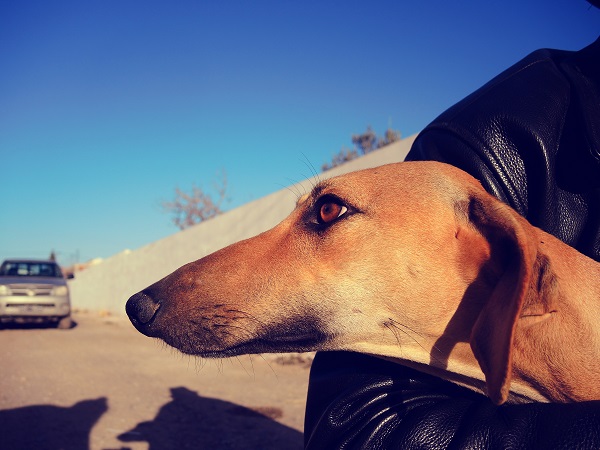
 Although confused with the Saluki, the Persian hound, the Sloughi is an ancient sighthound breed endemic to North Africa. For thousands of years the Sloughi has been the trusted hunting companion of the nomadic tribes of the Maghreb.
Evidence from petroglyphs in Algeria (6000 BC) to Roman mosaics found in Tunisian farmhouses to Koranic verses and poems written by Arab poets in the 800s, it is evident that the Sloughi has been a historic companion of the deserts.
Praised for its very fine but not frail bone structure and iron stamina thanks to its large heart, the Sloughi has been an ideal desert hunter.
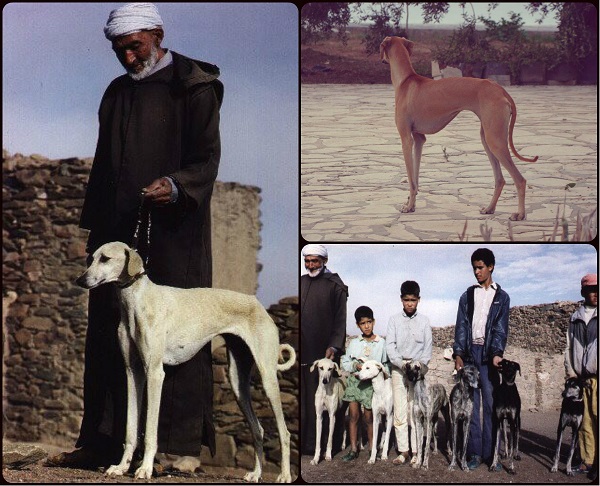
In the 1800 the Sloughi experienced a drastic decline. Successive droughts caused nomadic tribesmen to migrate out of the deserts in search for work and so hunting practices with the Sloughi were reduced, subsequently a ban on hunting with Sloughis imposed by French colonialists contributed to its decline, until 1965 when only 210 Sloughis remained in Morocco.
Fortunately the hard work of several breeders (especially in Europe – and in fact now more Sloughis are found in Europe than in the Maghreb), has helped bring the number of Sloughis to a decent level; although it is argued that it is extremely rare to find purebred Sloughis.
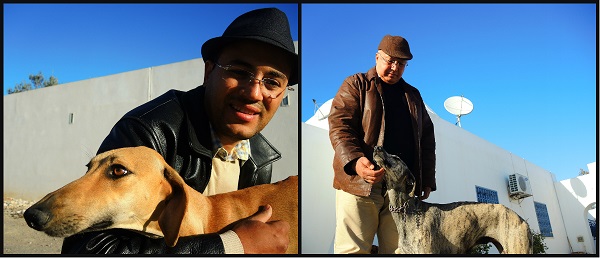
Father and son, Chedly Nabile and Mohamed Nabile are one of such breeders. After crossing Tunisia to find and purchase over 30 of the best Sloughis they could find (including flying in an Algerian Sloughi from the desert, with a helicopter), Mohamed and Chedly have continued to selectively breed pure bred Sloughis from 2006.
This year, however, they have decided to stop thisbecause they are not being able to export their pups off to Europe, where the demand for Sloughis is highest. I am told that one of the main reasons for this is because of an obscure spinoff of the Tunisian revolution: an increase in rabies due to a corrupt implementation of rabies control and vaccination programs.
Attempts to export Sloughis in Europe or other countries for breeding purpose is met by extremely strict border regulations, which have become even stricter after the revolution.
Mohamed explains that even after blood samples are sent to Germany for testing against rabies, and when certificates are presented at the border which prove the dog has been vaccinated and is exempt from rabies, many European countries still refuse any dog originating from North Africa.
The skepticism is founded, because while pre-revolution, in 2011, the Ministry of Agriculture embarked in mass vaccination campaigns directed at the canine population, it has transpired that in post-revolution Tunisia, the Ministry of Agriculture has been falsifying vaccination certificates, with the complicity of vets.
Today the Sloughi of Tunisia is experiencing a new threat. The number of remaining purebred Sloughis is already low, furthermore only a handful of Tunisian Sloughi breeders remain, many of which are having issues related to consanguinity.
The increase in rabies and with it, strict border regulations, are making life hard for Tunisian Sloughi dog breeders.
Images taken by Linda Pappagallo for Green Prophet



Dominique, I guess I must have upset you for you to reply so very quickly and rudely to my comment, and also to try and insult me by calling me a lurcher lady! Over the years I have got used to your rudeness and refusal to see anybody else’s point of view if they should happen to disagree with you.
Please do tell us, who are the “genuine” Sloughi breeders in North Africa that you refer to as not getting a voice here? As far as I can see, everybody is allowed to contribute…..
With reference to your claims that Sloughis and Salukis are genetically different, just how many Sloughis or Salukis or Afghans or xyz other breeds, and from which countries, actually provided samples for this DNA study that you have so often referred to in the years since it was first written?
With reference to the male that I presume you are alluding to, this Sloughi is still correctly registered as a Sloughi today under FCI rules and still correctly appears in many European FCI-recorded Sloughi pedigrees (but not for any other breed). And, in any case, this Sloughi lived over 30 years ago now (late 70s to early 80s). Where is any proof of all the points that you allege?
The poor people seem incapable to grasp the fact that DNA that one uses to convict criminals all of a sudden does not apply to dog breeds. Sloughis and Salukis are genetically different, and one of the Saluki males that has descendants in the Nabli dogs was kicked out of the Swiss studbook because it was discovered that he had a long haired sister registered in the same Swiss stud book….so you know…he was bred to Sloughias, Azawakh and Salukis…the 2 salukis in the mixed breeds from France are documented…… so I understand the lurcher lady is in full denial but that does not give you the right as a reporter to not give a voice to the genuine Sloughi breeders in North Africa.
I am horrified (but not at all surprised) to see the above unpleasant allegations about Mr. Nabli, especially as this comment was posted, probably deliberately, on his wedding day. Mr. Nabli is a careful and responsible breeder who, as explained in the article, has done his best to protect and improve the Sloughi breed in his native Tunisia. Unfortunately Dominique de Caprona has for a long time been completely obsessed with her own very limited idea of what “purity” really means in the Sloughi breed and continues to spread lies about many of the Sloughi bloodlines that exist across Europe and North Africa.
Sloughis it is a very sensitive animal. you can never have good sloughis if you have a bad heart.
it is a truth and you can see it everywhere.
It is a well meant endeavor to point out some of the problems faced by the Berber Sighthound named Sloughi in North Africa, in particular in Tunisia. However, a bit more research would have shown that there are several serious breeders genuinely concerned about the survival of the real Sloughi in Tunisia. Mr. Nabli and his puppy mill is not one of them, having bred to and imported crossbreeds between Sloughi and Saluki, and having thus polluted the Sloughi gene pool in certain areas of this country.