


There is a new report out underscoring the amount of renewable energy being developed in the Arab world with Morocco, Jordan and Egypt coming out as the big winners in the region. We report on the highlights.
The report released by the RCEEE (Regional Center for Renewable Energy and Energy Efficiency) in Cairo documents that there are currently 1.55 GW of large-scale renewable energy projects combined in the Arab world. It also highlights risks and potentials for investors.
The report fails to mention Saudi Arabia and the United Arab Emirates, and says that uptake in green energy is falling short due to (no surprise) conflicts in the region.
The report developed by the center maps out the renewable energy future of its 13 member countries and states, including the nations of Algeria, Bahrain, Egypt, Iraq, Jordan, Libya, Lebanon, Morocco, Palestine (not yet a nation), Sudan, Syria, Tunisia and Yemen.
Israel is not considered an Arab state, and the United Arab Emirates, and Saudi Arabia, for reasons not mentioned are not members of the center either. In short-sightedness perhaps, the report (called the Arab Future Energy Index) listed Morocco, Jordan and Egypt as the leading Arab nations for renewable energy.
Some highlights of the report that would interest investors and companies looking to bid on projects in the Arab world:
- Jordan and Tunisia are among the best in terms of instituting financial incentives for investors and reducing the subsidies on conventional fuels.
- Morocco leads the region with the lowest subsidies for conventional fuel and the biggest share of wind energy in its generation mix.
- Jordan and Palestine have an opportunity to capitalize on their progressing regulatory framework.
- Morocco and Algeria aim for 42% and 40% share of energy from renewable resources by 2020 and 2030 respectively.
- Egypt leads the region’s wind market with a current 550MW capacity and 11 more new projects in pipeline. Egypt’s first private wind farm is currently under construction.
- Libya demonstrates strong commitment for pursuit of renewable energy. The first 60 MW wind farm in Darnah and 14 MW PV plant in Al-Jofra are already under construction.
- Bahrain has the most liberalized electricity market with 80% of power produced by independent private producers.
- Sudan plans to be less-dependent on hydroelectricity.
- Yemen plans to have 28.2% share of renewable energy from geothermal resources by 2025.
- Palestine has the highest rate of solar water heaters diffusion in the region. Almost 70% of households in Palestine are equipped with Solar Water Heaters (probably due to their nearness with Israel where the uptake is even higher).
Some insights on energy efficiency in the Arab world:
- Tunisia leads the region with the most progressive regulatory framework for energy efficiency.
- During 2011-2012, Lebanon, Palestine, Egypt and Sudan announced their National Energy Efficiency Action plans.
- Libya and Yemen need to continue enhancing their regulatory framework, implementation capacity, and electricity pricing.
- Morocco witnesses positive impact of its progressive electricity pricing system.
- Lebanon offers attractive financial incentives for investments in energy efficiency projects.
- Algeria has comprehensive regulatory framework, but needs to enhance its implementation capacity.
- Sudan aims to achieve 3349 GWh of energy savings by improving network losses.
Some more print-out or “copy and paste” findings worth keeping close:
- The Arab region has substantial unutilized renewable energy resources that could diversify energy supply and improve environmental performance
- Almost all countries have adopted long-term technology-specific renewable energy targets
- The region over all performs poorly in the finance and investment category, especially in the field of private investment in renewable energy
- Energy price subsidies remain a key challenge for energy efficiency in almost all Arab countries
- Lebanon ranks six among 13 Arab countries in energy efficiency and ranks seven in renewable energy. Lebanon was the first Arab state to adopt the National Energy Efficiency Plan (NEEAP) on 10/11/2011.
- All Arab countries have massive untapped potential for energy efficiency in the utility sector
- Among 13 Arab countries, Tunisia stands out with the most comprehensive policy framework for energy efficiency
- Egypt currently has the largest installed capacity of renewables
- Currently there are more than 15 large-scale projects under construction with total capacity exceeding 1,550 MW, which is more than double the current installed capacity in the region.
- Jordan has made substantial progress in the past year by improving its regulatory framework
- Algeria needs to put greater effort into deploying renewable energy projects and attracting private partners
- Bahrain has the most liberalized electricity market in the region
- Libya remains the only country in the region that does not allow independent power producers
- Palestine has the highest electricity prices in the region which motivates the shift towards renewable energy and energy efficiency
- The crisis in Syria delays its public tender for the first large-scale wind project
- Sudan and Yemen have an opportunity to design innovative energy systems based on decentralized small-scale renewable energy generation
- Yemen, Libya, and Iraq need to improve their energy efficiency policy frameworks, institutional capabilities, and minimize power generation distribution losses
“This is only the start of a long and challenging path to provide the Arab region with accurate, reliable, and comparable information regarding their renewable energy and energy efficiency capabilities,” said RCREEE Board Chair Sheikh Nawaf Bin Ibrahim Bin Hamad Al Khalifa.
“We hope that this initiative will help our member states in their efforts toward sustainable energy transitions through quality tracking of the progress made and challenges yet to be tackled.”
The report was launched at the Beirut Energy Forum last week.
Arabs need to think more German, ya?
One of the challenges that I see in the Arab world and in Arab nations is the notion that Arab-speaking countries should be lumped together while etching out a renewable energy future. And that they should do it collectively. The Arab world is HUGE. Lumping all Arab-speaking nations together could be as helpful as combining America with Mexico, Cuba and Panama — calling these nations the Americas.
Each Arab-identifying nation should be more keen on sticking to its own in my opinion.
Also – many people in the so-called Arab nations do not consider themselves Arabs at all – in Lebanon, Turkey, Iran, and Egypt for instance. And while it’s easy to think of them all as Middle Easterners, cooperation can be a handicap given the divergent political goals, varying religious ideologies and local tribal cultures that exist within. Some countries are seeing a surging secular culture, like in Egypt, while a repressive force like the Brotherhood pulls in an opposite direction.
The way that the Arab world can move ahead in the world with renewable energies? Think and act like the Germans (the German government helped fund this report by the way).
How to do this? Create a strong work ethnic and national pride over using and developing renewable energies. Then those nations beside, behind, around and near you will work hard to play catch up. It won’t matter if you are religious, or not, at war at your borders (or not), have press freedom or not, let your women drive or not, or like falafel over hummous. Protecting the industry will be the thing.
If I were an investor? I would probably want to put my money into the United Arab Emirates which is politically stable, open to outsiders, and is already setting the pace for renewable energies in the world with MASDAR, IRENA and its associated renewable energy projects.
Shame that the UAE is not a member of this new Cairo-based project making yet again the Arab world and its energy market a complicated, fragmented place to navigate through due to its omissions and political problems.
::Arab Future Energy Index report here PDF
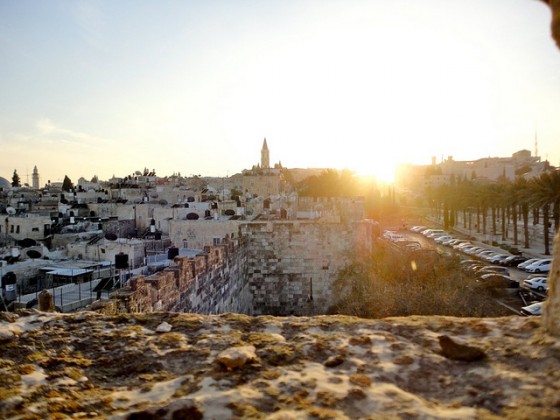
:: Image via Jasondbay/flickr


It is called the Arab Future Energy Index. You can find it here:
http://www.agora-parl.org/sites/default/files/arab_future_energy_index_-_rcreee.pdf (links to PDF)
Hi, I’d really like to know the name / or link to the report because it really isn’t obvious where this info is from on the RCREEE website…
thanks
This was an interesting article up until the ‘Arabs need to think more German, ya?’ section. It’s not only misguided about the state of renewable markets in the MENA region (or whatever you want to call it) but it is culturally, linguistically, and politically confused. This sort of editorializing distracts from an otherwise great blog.
Hi Mike,
I’ve lived in the MENA region for 15 years and you know what? Something needs to change. Time to lighten up a little so that the sunniest regions of the world can make clean energy and get on with life.
i tried to read the report but have no access and need to pay (not an insignificant amount) for the article???
It is a pity that a paper on the same topic which we sent to you at least twice in the past months did not attract your attention and did not receive any exposure. The paper reviewed plans, decrees, laws, standards, assessment tools and other material on 20 countries, from Turkey to Yemen, from Morocco to Iran.
Here is the full reference:
Meir I.A., A. Peeters, D. Pearlmutter, S. Halassa, Y. Garb, J.M. Davis 2012. Green Building Standards in MENA: An assessment of regional constraints, needs and trends. JABER 5: 1-39 (invited paper) http://dx.doi.org/10.1080/17512549.2012.740209
Hi Isaac, we received your paper but found it hard to access (understand).
[…] via 13 Arab Nations Get Energy Future Mapped in Helpful New Report | Green Prophet. […]