

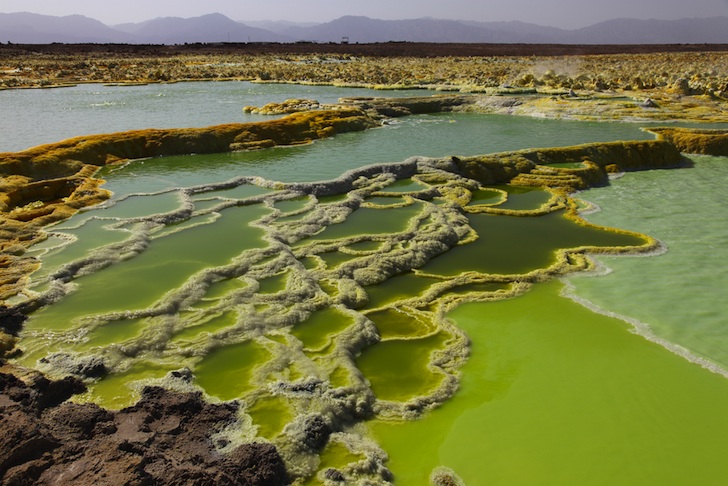
 Given that 85 percent of the country’s residents lack access to electricity, it is no surprise that Ethiopia has pursued an aggressive hydropower plan. But the Grand Renaissance Dam and similar projects are expected to create significant environmental and social disruptions, problems that the former President Meles Zenawi both denied and defied.
But the Ethiopian Electric Power Corporation (EEPCO) recognizes the danger of relying too much on hydropower, which is an erratic and possibly endangered source of energy. While the country has the staggering potential to produce 45,000 megawatts of hydroelectricity, geothermal also offers promise – so much so that the World Bank has backed a plan to conduct preliminary exploration and drilling.
Towards the end of last month, the Development Bank of Ethiopia unveiled plans to spend USD 20 million to explore sites in the country that have especially good geothermal potential.
The bank has plans to spend an additional USD20 million at a later stage, The Guardian reports.
This initiative is made possible by a USD40 million World Bank grant issued in May last year designed to spur renewable energy generation in Ethiopia and environmentalists are no doubt hopeful that a new focus on geothermal may relax hydroelectric ambitions.
International Rivers, which has been following Ethiopia’s dam boom very closely, paid a recent visit to the construction site of the Grand Renaissance Dam and expressed a number of concerns namely.
These include the probable displacement of more than 5,000 villagers, the risk of erosion and sedimentation and an apparent dismissal of these risks ahead of construction, as well as habitat loss.
“Ethiopia has been heavily deforested, but the Benishangul-Gumuz region where the dam is being built is one of the few places in the country where remnant forest vegetation still exists,” the environmental advocacy group wrote in a field report.
“The local community depends heavily on forest resources for their livelihoods (e.g., hunting, gathering of fruits, honey, firewood, medicinal plants, etc). The dam reservoir is expected to flood 1,680 square kilometers, 90% of which is forest. Road construction to the site will also impact forests.”
Geothermal, by contrast, is one of the most benign sources of renewable energy available.
When initial exploration is complete, certain private companies will be invited to build and operate geothermal power plants, including Britain’s Cluff Geothermal.
Managing Director George Day told the paper that they have already conducted a “scoping environmental impact assessment” near the town of Metehara, and that the country’s regulatory framework is not yet prepared for independent power producers.
They are hopeful, however, that these barriers will come down within the next six months or so.
:: The Guardian
Image of Dallol Geothermal Area, Shutterstock



Hello colleagues, how is everything, and what you wish
for to say regarding this article, in my view its genuinely awesome in favor of me.
nothing stops ethiopia from finishing its dam, while you keep on talking about your jenkies, many more dams will continue to florish let alone the unfinished ones. there is nothing you can do about it except sit and watch the development of ethiopia.
You are so insidiously racist, that you pass your racism off as compassion. The facts remain that you are not going to pull millions of people out of poverty with piece-meal green initiatives. Look at the industrialized nations, with their modern sanitation, medical care, transportation, and economies. It was all possible, not just because of human ingenuity, but also fossil fuels. You are not going to run vast industrial and retail zones that employ scores of people on solar, wind, or geothermal. Instead of pushing these technologies that can’t even compete with carbon-emitting fuels and suffer from intermittent power production, on poor African nations, let them alone to pursue whatever is best for them in their eyes. I thought I would never say this, but thank God China has developed an economic partnership with African nations; and it’s already paying off. Now they won’t have to be treated like helpless children, like you environmentalists treated them. They are adults. Treat them as such. In the end, Ethiopia will finish her dams, African countries become prosperous, and there is absolutely nothing you can do about it. None of your Agenda 21 antics will succeed. I guess you could use your friends in the Deep Green movement to initiate paramilitary attacks on energy infrastructure as a last resort, but it looks like that cat is already out of the bag.