
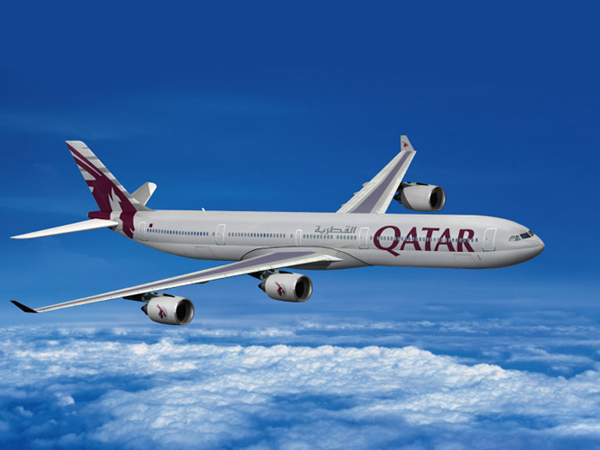

 Qatar Airways’ natural gas push could help combat climate change, reduce costs for passengers. Photo: Qatar Airways
With massive natural gas reserves, it is a wonder that Qatar has not pushed natural gas for the aviation industry. Granted, no country, or airline, has made the move to gas, but Qatar and its flagship Qatar Airways hopes that by rolling out planes run on natural gas, it can help keep costs down for the customer and help combat climate change – a major reason many have reduced their flying in recent years.
The belief across the region, and the airline industry, is that through natural gas liquification the airline industry can begin to reduce its carbon footprint and cut back on greenhouse gas emissions (GHG), which has made flying one of the worst climate change enemies.
According to reports last month, Royal Dutch Shell is to pump airline fuel made from natural gas from its gas-to-liquids plant near Qatar Airways’ Doha International Airport, which is to open in 2013 and has received much fanfare from airline industry executives.
A top American airline executive told Green Prophet that the North American carriers are optimistic that if Qatar can develop the natural gas industry for planes, it could translate into reducing overall costs for US carriers.
“We have seen prices rise dramatically in recent years because of the overall price hikes in oil and this endeavor is very curious for us here in the US,” the executive said on condition of anonymity as they did not want to speak to a competitor’s potential advantage. “Natural gas gives much more energy for less and if successful, this could see airlines able to travel similar distances using much less fuel.”
That would be a huge benefit for the ariline industry, which has long been tied to the global oil industry.
The Pearl project is costing some $19 billion to erect, and according to Shell, will be the largest gas-to-liquids plant in the world. It will process around three billion barrels of oil-equivalent over its lifespan, Shell added in a statement in October discussing the project some 80 kilometers north of Doha.
The plant currently produces 120,000 barrels of the liquified natural gas and ethane.
Qatar Airways CEO Akbar Al Baker told The New York Times that natural gas fuel is better for the environment than jet fuel made from petroleum.
“It has no sulfur, which means it does not produce sulfur dioxide, a more harmful GHG than Co2 when emitted at low altitudes,” The Times reported.
A caveat to that, the paper added, was that at “higher altitudes, sulfur dioxide reflects sunlight back into space and — in theory — combats global warming.”
Still, the distance versus oil that can be reduced by switching to natural gas cannot be underestimated. Qatar Airways believes that by moving in this direction prices for customers – their main focus – will remain stagnant, which means that as oil prices are expected to continue to rise, Qatar Airways may be able to avoid such hikes in ticket pricing.
In Egypt, a top five natural gas producer where most of the country’s taxis run on natural gas, the national carrier Egypt Air has also expressed interest in this project, believing that they have the capacity to follow behind Qatar if successful, its Cairo head office told Green Prophet, but did not elaborate on the potential of natural gas for its planes.
Natural gas is expected to have the quickest growth rate among the fossil fuels through 2035, with expectations of increasing around 1.6 percent annually, from 111 trillion cubic feet in 2008 to 169 trillion cubic feet in 2035, according to the Energy Information Administration’s International Energy Outlook 2011.



i’m sure if we can run our stoves,hot water heaters,central gas heating systems on natural gas with out having to process it into bio fuel gasoline—–then ,why can’t our engineers and scientist get on the same page with doing this for airplanes and massive transit and cars and so on———-
Very interesting article and right up my alley as I work in the (airline) industry. I’m assuming that this natural gas is from traditional sources. One subject that never seems to be addressed however is how much energy is required to produce the product. If the source of natural gas is not from a “traditional” source then I would assume the energy cost to produce the product would be much higher. This would ultimately skew the production costs and the “cost at the pump”. Of course it will, or should, always be cheaper than oil based jet fuel.