
Should Cities In The Middle East Be More Dense, Like Manhattan?

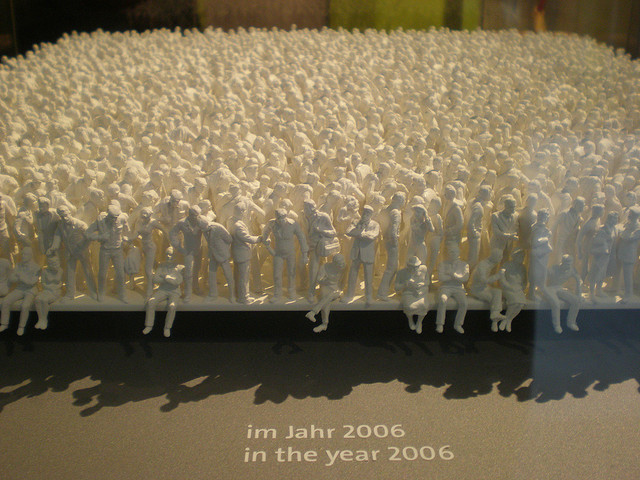
creative-population-densityThough urban density is better for the environment, we don’t have to give up all the benefits of country living (such as locally-grown food)

Though we laud the farmers who rough it on the land, grow food that we can buy, and live an interconnected life, city life is more sustainable. But not just any city life. Urban density that enables citizens to use public transportation and walk is necessary to maximize land use and minimize carbon output. Any system that leaves open even the slightest window of driving opportunity will compel people to use the car, which is not so great for air quality.

For cities in the UAE, for example,where only 1 in 25 Emiratis choose to walk, city planners can provide a little more incentive. Through his research, David Owen concluded that Manhattan offers a winning model; Jonathan Hiskes relays why.

“Seventy-seven percent of Manhattan households and 54 percent of New York City households don’t own even one car,” according to Owen. Compare this to a 1993 statistic, which is sure to have escalated since, that attributes 230 cars to every 1,000 Israelis.

New Yorkers are not car-free because of any kind of moral compulsion, but because cars are inconvenient to have in a city designed for public transportation and walking. University campuses are also designed so that students can walk from their dorms or apartments to anywhere they need to go without having to own a personal vehicle.

Israel is one country in the Middle East that has a decent bus and rail system, but any driver who has been stuck on the coastal road knows it’s not everyone’s mode of transportation. Owen is critical of what he calls “light density”:

There’s this sort of decorative public transit, but it’s not the way most people actually move around. To get to where transit does work, and to where it’s more energy efficient than driving, you really have to achieve pretty significant density.  The threshold is something like seven households per acre, but that’s the absolute minimum.

To achieve this density, Owen recommends establishing a center, beefing it up so that it is as dense as possible, and then build radially from there.

“New York City is one of the very last places in the United States where walking is a primary mode of transportation for many people,” says Owen, who also suggests that urban density is favorable for the elderly.

When we lived in New York, there was an older lady in our building who lived independently until she died, because she could walk everywhere — the store, her doctor, the hospital, the movies. She could take cabs when she didn’t want to walk. Here in Connecticut, I play bridge with some old ladies, and all of them live in fear of the day when they lose their driver’s licenses, because if you live in the suburbs, without a car you can’t do anything by yourself.

Not only are dense urban centers better for air quality, but thanks to a mounting urban farming movement, we can still eat healthy, locally-grown food even if we are necessarily stuck in big hives of city people.

:: image courtesy of JacobEnos and story via Grist

More Urban News:
American Vertical Farm Concepts Good for the Middle East

Azouri Brothers Eco-Tower Planned for Tel Aviv

Why 27 People A Day Die From Air Pollution in Tehran

Tafline Laylin
Tafline Laylinhttp://www.greenprophet.com
As a tour leader who led “eco-friendly” camping trips throughout North America, Tafline soon realized that she was instead leaving behind a trail of gas fumes, plastic bottles and Pringles. In fact, wherever she traveled – whether it was Viet Nam or South Africa or England – it became clear how inefficiently the mandate to re-think our consumer culture is reaching the general public. Born in Iran, raised in South Africa and the United States, she currently splits her time between Africa and the Middle East. Tafline can be reached at tafline (at) greenprophet (dot) com.

Read More

1 COMMENT

LEAVE A REPLY

Please enter your comment!
Please enter your name here

TRENDING

Saving Gourmet Wild Plants For The Future

Think of truffles, a gourmet wild food. The European...

Middle-Eastern spices and natural medicine (A through C)

In the Middle East, aromatic traditional foods are regarded...

Luxury tower in Jerusalem ruins its sacred heritage and eco-architects are worried

Critics of a new set of luxury towers including Israeli-Greek architect Elias Mesinas, warn that the scale of the towers, loss of public green space, and creeping luxury-led gentrification risk undermining Jerusalem’s historic skyline, community fabric, and long-standing planning principles — raising a fundamental question: not whether Jerusalem should densify, but how it can do so responsibly while preserving what makes the city unique.

Ancient mud buildings in the Muslim world are spectacular and sustainable

Other notable mud structures in the wider Muslim world include the Bob Dioulasso Grand Mosque in Burkina Faso, and the Khiva Wall in Uzbekistan, which is built around a collection of Islamic schools and mosques. The Siwa Oasis in Egypt (which we visited and posted about here) and the Eastern Castle in Syria have also employed mud bricks in their construction, and research shows that the famous walls of Jericho were built using sun-dried mud bricks.

Iran’s water mafia and thirst for war leaves the country on brink of being dry

Iran’s Lake Urmia, once the Middle East’s largest saltwater lake, has shrunk by 90 percent due to mismanagement, dams, and drought. As Tehran pours billions into foreign conflicts, water activists face repression at home. The crisis mirrors Syria’s drought-driven unrest, showing how water scarcity can destabilize entire regions.

How to quiet noise from construction in your office

Streets need to be resurfaced in New York but the humming and grinding noise is unsettling. Noise is environmental pollution. 

EarthX and a blueprint for sustainable investing

Trammell S. Crow, a Dallas-based businessman and father of four, is focusing his efforts on impact investing, and media that focuses on saving the planet through EarthX.

Mining Afghanistan’s Mineral Discoveries Similar to Avatar

Now that American forces in Afghanistan are commemorating the longest period of any war that America has been involved in, including the 1965-73 Vietnam War, the recent discoveries of large and extremely valuable mineral and metal deposits may finally bring to light a reason to continue the presence of US fighting forces in this war torn and backward country.

From Pilot Plant to Global Stage: How Aduro Clean Technologies’ 2026 Expansion Signals a Turning Point for Chemical Recycling Investors Like Yazan Al Homsi

The company's Next Generation Process (NGP) Pilot Plant in London, Ontario, has officially moved into initial operating campaigns, generating the kind of structured, repeatable data that separates laboratory promise from commercial viability.

Nobul’s Regan McGee on Shareholder Value: “Complacency Is the Silent Killer” 

Why the governance framework designed to protect shareholders so...

Should You Invest in the Private Market?

startustartup Unlike public stock exchanges, which offer daily trading, strict...

How to build a 100-year-company

Kongō Gumi is a Japanese construction company, purportedly founded in 578 A.D., making it the world's oldest documented company. What can we learn about building sustainable businesses from them?

How AI Helps SaaS Companies Reduce Repetitive Customer Support Work

SaaS products are designed for large numbers of users with different levels of experience, and also in renewable energy.

Popular Categories