

Paint it Dead or Red?
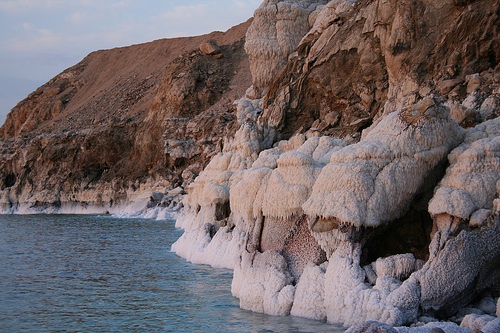
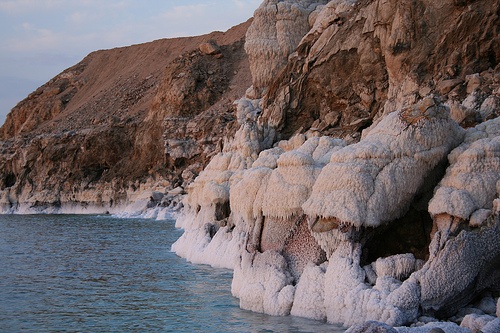
The alarmingly fast decline of water levels in the Dead Sea have resulted in numerous plans to bring sea water from either the Mediterranean or Red Sea to replenish the water in what has often been referred as the world’s lowest level body of water. It’s the lowest place on earth.
The Dead Sea’s main water source, the Jordan River, has reached the point that the biblical river’s flow into the Dead Sea has been reduced to a mere trickle as a result of the Jordan’s flow being diverted to both Israel and Jordan for both country’s water needs.
Even the Jordan’s flow into the the Sea of Galilee (the Kinneret), Israel’s main fresh water source, has been reduced considerably over the years by lack of adequate rainfall and diversion of water from the Jordan’s sources in Lebanon by Israel’s hostile neighbors.
Obviously, and due to the region’s constant water shortage problems, use of Israel’s streams and rivers to produce hydro-electric power has not been a plausible idea; although a small hydro-electric plant was built on the Jordan back in the early days of Jewish settlement in what was then known as Palestine.
During the early 1980’s a seemingly excellent plan was formulated to build a canal from the Mediterranean Sea across Israel to the Dead Sea, taking advantage of the declining ground levels to help the water to eventually flow into the Dead Sea, which is more than 1,300 feet below sea level. This plan would have not only brought sufficient water to replenish the Dead Sea’s falling water levels, but would also have created enough hydro-electric power to generate enough mega-watts of electricity to satisfy as much as 20% of Israel’s then electric power needs. Another part of this project would have been to create fresh water though desalinization, which could have satisfied a substantial part of the country’s water needs as well.
As it turned out, the project was shelved, as the governing Likud Party administrations felt that the required funds needed for the project would be better used to built numerous Jewish settlements in both Gaza and in the West Bank Present day realities, however have proven this reasoning wrong with the abandonment of a Jewish presence in Gaza and with large parts of the West Bank slated for possible disengagement as well. Israel’s water shortages have grown worse and the country’s need for alternative energy sources have increased dramatically in the past 25 years.
And as for the Dead Sea, it is likely to become ‘no water sea’ in the next ten years.
The new project which has created much recent attention is to pump water from the Red Sea, near the city of Eilat to the Dead Sea, supposedly generating a certain amount of hydro-electric power and creating fresh water through desalination. As mentioned previously on this web blog, the project appears to be even more controversial than the former “Med-Dead” project and has been shelved for the time being. One wonders if the more recent “Red-Dead” project, which would be more environmentally non-friendly and less beneficial than the former one, would be more beneficial to Jordan Israel’s proposed partner, as most of the fresh water to be made through desalinization would go to the Jordanians, as well as filling up their side of the Dead Sea.
It’s a pity that the older, more practical project didn’t get the go-ahead as it would have been long completed by now and would have caused less environmental damage. What’s more a large lake that would have been constructed about midway between the Mediterranean and Dead seas, would have been providing both water and recreational activities for a country that is not exactly rich in inland water sports. In this case, it appears that there is a lesson to be learned in respect to long range planning practicalities.




[…] idea is not new. Known as the “Med-Dead” project, it has been kicked around by engineers and environmental experts for decades. In response to […]
This plan, a below sea level tunnel connecting Palmachim with a reservoir on the south branch of Wadi Qumeran, has no relationship to the Med-Dead plan of the 1980’s. We also have a plan to preserve the Dead Sea environment in certain locations, as described on the website.
There is a current plan for saving the Dead Sea, utilizing the green power potential, and developing enought desalination to provide all the water needs of the Norhern Negev, lower Jordan Valley, Jerusalem, and the West Bank.
If they did the canal from the Med. Sea or the Red Sea to the Dead sea, then would the water level go up to the normal sea level of any sea or ocean? would it be 400m higher than now?
And would that reduce the salinity of the Dead sea and be able to suport fish life and algae?
Hope to get an answer.
Adam from Catalonia.
(http://www.gencat.cat/catalunya/eng/territori.htm)
Just out of curiosity, how exactly would the Red-Dead canal fill up “their [the Jordanian] side of the Dead Sea,” and not ours?