Many people today are searching for new ways to achieve physical and mental fitness, and they’re increasingly turning to two practices from ancient Asian cultures, according to Body & Brain teachers of yoga and tai chi.
Yoga and tai chi help to connect the mind and body into one and include various techniques in addition to stretching and poses, such as meditation and controlled breathing. Each practice offers a unique way to achieve holistic fitness and overall well-being.
Below is a further explanation of where the practices of yoga and tai chi originated and how beneficial they can be.
Yoga
Stressful events like the day-to-day grind or moving houses can be stressful. Yoga can help.
Yoga is a practice that was first created in ancient India. It is a holistic approach to wellness that encompasses three main areas — meditation, breath control, and physical postures. In this way, its goal is to achieve complete harmony between mind, body, and spirit.
By practicing yoga, people can gain flexibility and strength as physical activity forces the body to work multiple muscle groups.
In the same vein, the physical aspects of yoga can result in improved body alignment and posture. This can reduce the potential risk of developing musculoskeletal problems.
From a mindfulness standpoint, yoga is proven to reduce stress and, as a result, improve mental clarity. A constant focus on the breath is central to yoga, which helps you stamp out the noise and bring awareness back to what really matters.
All of this can feel like a very spiritual experience, as you’re forced to focus inward. A great part about yoga is that a program can be created for beginners and experts alike.
Tai Chi
Tai chi, meanwhile, originated in ancient China. Much like yoga, it harmonizes the mind, body, and spirit and can be thought of as a moving meditation.
The practice is rooted in Taoism and an awareness of Qi, also known as vital energy, which flows through your body. The practice emphasizes body movements that are slow and flowing, combining those with deep breathing exercises and focusing on mental clarity.
In many ways, the benefits of tai chi are similar to those of yoga.
Since it’s a low-impact exercise, it can be a great physical activity for many people — regardless of age, fitness level, or potential ailments.
The exercise engages your body’s joints and muscles in a gentle way, allowing you to enhance stability and gain flexibility. This benefits older adults particularly well since it helps them to lower their fall risk.
From a mindfulness standpoint, tai chi is great at reducing stress. Thanks to its focus on meditation, doing tai chi can result in you achieving a calmer mind, which can promote relaxation and inner peace while reducing stress.
Body & Brain also says tai chi focuses heavily on connecting the mind and body. Those who do the exercise are encouraged to increase their body awareness while engaging in mindful practices.
Those who are looking to improve their physical and mental well-being from a holistic standpoint would do well to consider trying tai chi and/or yoga.
About Body and Brain
Body & Brain offers yoga, tai chi, and a wide variety of mind-body practices online and in-studio for holistic fitness and energy healing. Founder Ilchi Lee began sharing his transformative principles with a single stroke patient forty years ago. His audience grew, and his principles became known as Brain Education. Today, this curriculum is practiced in 80 Body & Brain locations nationwide and several countries worldwide.
Toray Industries from Japan announces it will supply the membranes for a new reverse osmosis desalination plant in the Kingdom of Saudi Arabia. This will be the Kingdom’s first seawater reverse osmosis desalination plant using clean energy under a public-private-partnership (PPP) structure.
The Yanbu 4 desalination plant is located 100 miles of Saudi’s Madinah province, near the town of Ar Rayyis. With the production capacity of 450,000 cubic meters per day of potable water once it is completed, the plant will supply drinking water to the Makkah and Madinah regions respectively. This is where millions of Muslims go on a Hajj pilgrimage. Good green news in advance of Ramadan which starts next week.
United Arab Emirates astronaut Sultan Al Neyadi shared this picture of Mecca during the annual Hajj pilgrimage on June 26, 2023. (UAE Space Agency)
Toray will supply the RO elements and provide technical services and will help alleviate water shortages not only in Makkah and Madinah regions but in the Middle East and North Africa.
Over the years, Toray has expanded RO membrane sales, production, and technical support to help resolve global water issues. Applications extend from desalination and waste water reclamation to industrial usage. The aggregate water production capacity of Toray RO membranes is 120,000,000 cubic meters per day. That is enough to serve the water needs of 840 million people.
Providing access to clean water is pivotal to the Toray Group Sustainability Vision, representing a roadmap to the World as Envisioned by Toray Group in 2050, and embodies Toray Vision 2030, through which the Group pursues sound, sustainable growth.
Toray will continue to provide RO membranes and other advanced membrane technologies and strengthen technical services to cater to local demand. It will thereby help resolve water issues in the Middle East and other regions in which industrial and population expansions will likely boost water demand.
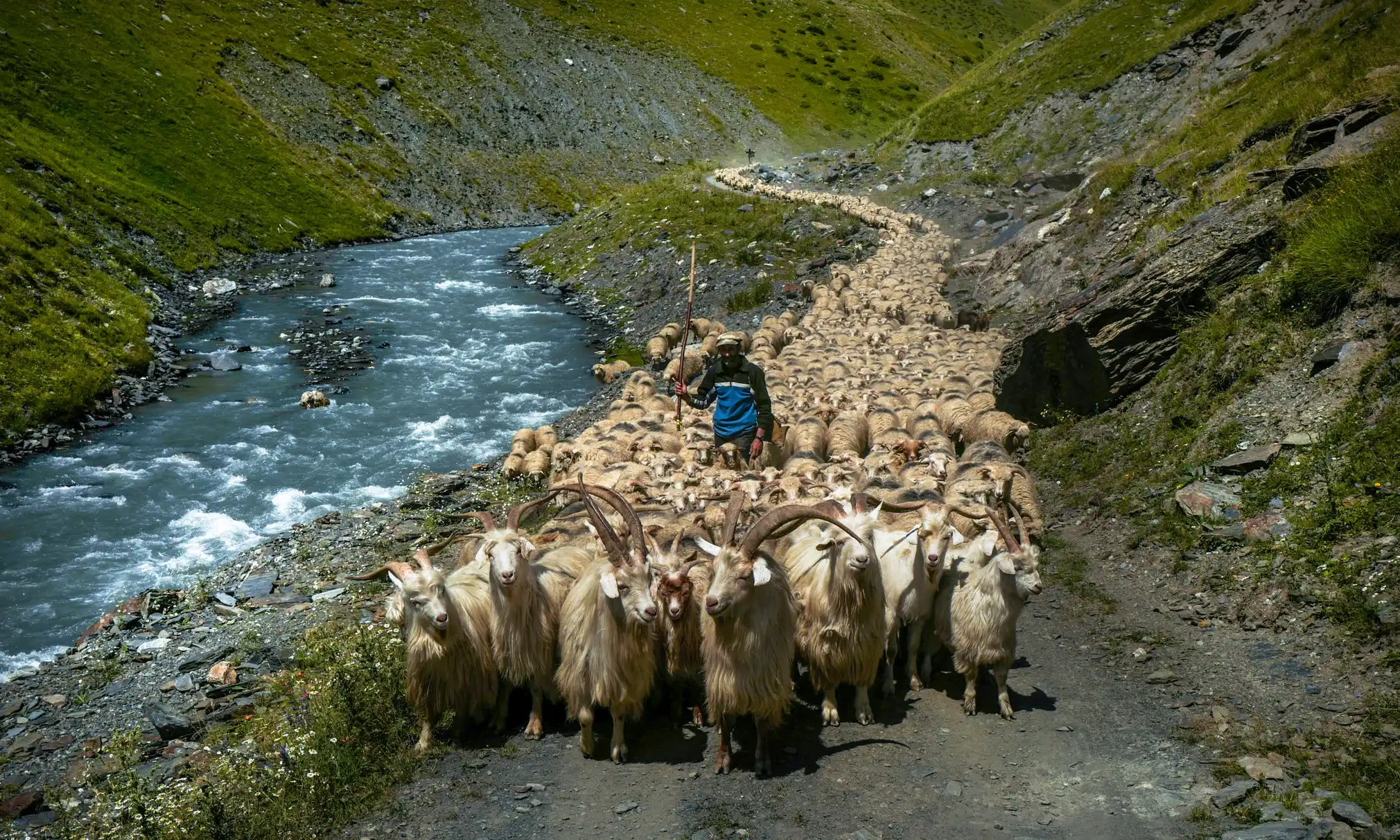
Nomads of the Caucasus Mountains attribute their long, vigorous lives to a natural diet, plenty of outdoor exercise – and kefir. Kefir is fermented milk, something like yogurt. Its taste ranges from mildly sour to cheeselike, depending on how long the milk ferments. It has lots of probiotics and proven anti-bacterial power.
As Kombucha tea does, kefir helps the body to metabolize foods, and also raises immunities. Studies show that drinking kefir every day regulates blood pressure and blood sugar levels.
Fulvio Bugani travelled to one of the few still-inhabited villages in the Greater Caucasus mountains and documented the lives of the Tusheti, defined by tradition and ancient customs
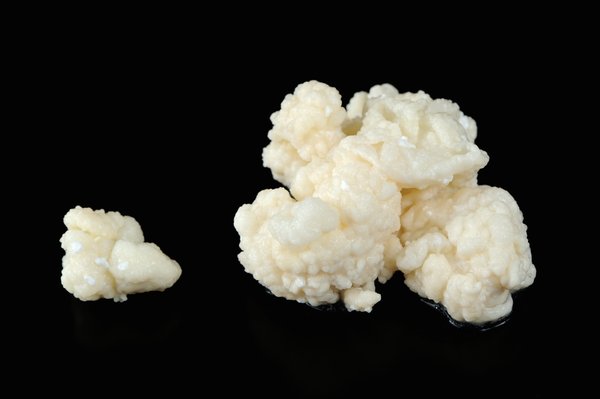
And like Kombucha, the origins of the “mother” substance are lost in ancient history. Legend has it that Mohammed himself gifted the nomad community with the yellowish-white kefir culture “grains,” and taught them how to ferment milk with them. We posted about black cumin, another legendary gift from Mohammed, here.
Science says, according to Wikipedia, that kefir is a combination of ” lactic acid bacteria and yeasts in a matrix of proteins, lipids, and sugars, and this symbiotic matrix, or (SCOBY) forms “grains” that resemble cauliflower. For this reason, a complex and highly variable community of lactic acid bacteria and yeasts can be found in these grains.”
The nomads jealously guarded kefir’s secret for centuries, but eventually the fame of the magic milk reached Russian society.
Small quantities of kefir became available, made cottage-industry fashion in a few people’s homes. Doctors prescribed it for digestive troubles and tuberculosis. In the late 19th century, Moscow physicians published studies attesting to kefir’s medicinal properties. Convinced, the All Russian Physician’s Society determined to produce kefir on a large scale.
But “mother” grains were scarce, and the people of the Caucasus wouldn’t yield the secret.
In 1908, the Physician’s Society approached the Blandov brothers, owners of a big Moscow dairy, and asked for help in obtaining kefir grains. The Blandovs agreed to send an emissary to the Caucasus, on condition of receiving exclusive rights to manufacturing kefir. The agent was an employee of their dairy, a beautiful young woman named Irina Sakharov.
Irina traveled north and met with the ruling prince of the region. He wouldn’t give her kefir grains. Instead, he kidnapped her on her return journey home, and demanded that she marry him. But all ended well for Irina, for the men who had accompanied her from Moscow rescued her and brought the case before the prince’s father.
To avert conflict with the powers in Moscow, the king granted Irina enough grains to start large-scale manufacture of kefir. Some say it was a cup of grains, some say it was a sheepskin-full. What’s known is that the grains Irina brought home from her adventures are the mothers of just about all the kefir that’s drunk in Russia, Eastern and Western Europe, Australia and the USA today.
In 1973, Irina received official recognition and thanks for having brought kefir to Russia.
Today, commercial kefir drinks are even sold in supermarkets. But you won’t know if you’re getting just a pleasantly yogurt-like drink without real health benefits. It’s worth fermenting your own kefir at home. And it’s ridiculously easy.
How to make kefir using kefir grains
Kefir is a type of fermented milk that may help manage blood sugar, lower cholesterol, and boost digestive health, among other benefits. However, more evidence is needed to back some of these claims. The name kefir comes from the Turkish word “keyif,” which refers to the “good feeling” a person gets after drinking it.
In spite of the huge mystique made around kefir, all you have to do is place a mother grain or two in the bottom of a clean glass jar and fill the jar with milk. Stir gently, with a wooden or plastic spoon, and cover with a clean kitchen towel. Leave out overnight.
By morning, you’ll have thick, white kefir. It may have a little fizz, which is fine.
Pour off a glass and enjoy, or make a smoothie from it. Just don’t drink down the mother, or you’ll have to get another one! The longer you leave the milk to ferment, the thicker and more sour the kefir. The mother grains will continue growing if left in milk.
Eventually “baby” buds will break off that will continuing growing and become mothers in turn. You may find your jar crowded with grains after a while.Then you might want to distribute some among your friends. Or you may join the international kefir lovers who mail out grains, enclosed with a little milk in zip-locked bags, only for the price of shipping.
I wrote about kefir several years ago, and ever since then, have had to fend off strangers asking me for grains. I usually reply, grumpily, that I had bought my original mother via eBay for about $4 and that they can do the same.
My own kefir grains don’t reproduce much. They make one or two new mothers over a year’s time. I don’t know why. Apparently kefir grains respond individually to their particular environment: the type of milk used, and how or where they’re stored. In someone elses’ kitchen, maybe they would make many more babies. But I’m fine with what I have. I don’t like being regarded as a source for kefir grains.
This week, a different sort of request for kefir grains appeared in my Inbox. It’s for a little girl, I read.
Something in me gave way. Alright, for a child, I’ll go through the bother of receiving a stranger into my home, explaining about kefir and how to store it in between fermentations (covered with fresh milk, in the refrigerator), and how it has to be kept cool. Kefir has its conditions for optimal life, just like any other fresh, living thing. I sighed.
Okay, I wrote back, Come over.
The little girl’s mother knocked on my door that evening. “Why does your daughter need kefir?” I asked, showing her in.
The lady turned haunted eyes to me. “Her name is Noa. She’s only a year and four months old. She has cancer. They’ve already removed her ovaries. We’re hoping to avoid chemotherapy and manage it with surgery. But she needs everything she can get to stay strong.”
I swallowed, and tears came to my eyes. An innocent little girl, with such a terrible thing. God willing, she’ll survive, but she’ll never bear children.
And I was humbled. You just never know what might come of things you do, say, or write. Maybe my post, written four years before Noa was even born, came out of my computer for no other reason than to help her in the end.
I explained the health benefits of kefir and advised how to feed Noa with it. I told her mother that while my mothers never reproduce much, hers may very well make lots of baby grains. Her face brightened.
“If I see that it really helps, and it makes more mothers, I’ll give kefir grains out to everyone in the oncology ward,” she exclaimed. “I’ll get so many mitzvas that way!”
I hope so. I hope that many little zip-locked bags containing new kefir grains will go out of Noa’s house to help other sick children. May Noa bat Revital will have a complete healing of body and spirit. May she go on to a good life.
There’s lots of online information about kefir. Just google it and you’ll get full instructions on here to obtain grains, how to make it, and recipe.
More alternative health practices on Green Prophet:
In my small yard, in central Israel, I count at least seven edible wild species: mustard; nettles; chickweed; sow thistle; goosefoot; mallows, and wild beets. These, and other wild edibles, are native to the Mediterranean. We’ve written about nettles and mallows, and about growing chickweed at home. Today I’m focusing on wild beet greens.
Right now, late winter in the Levant, is prime time to forage beet leaves. I’ll keep harvesting them until mid- or late March. In North America and Europe, wild beets (and many other wild edibles) become available months later, in springtime through summer.
I love popping out of the house in the morning, still in pajamas, making my way to the tangled plot where the wild beets raise their leaves. Quickly, I cut enough young greens to fill a quiche, enhance a soup, or make a simple stir-fry. I leave the root alone as hardly being worthwhile harvesting: it’s a spindly white thing, best left in the soil to push up a a new cluster again next year.
If I get worried that I’m over-harvesting my yard, all I have to do is take a walk around my neighborhood, and I’ll find plenty of wild beets. The soil here is heavy, a mix of clay and sand, which beets love. I find them in abandoned lots and on the side of roads, some already quite mature.
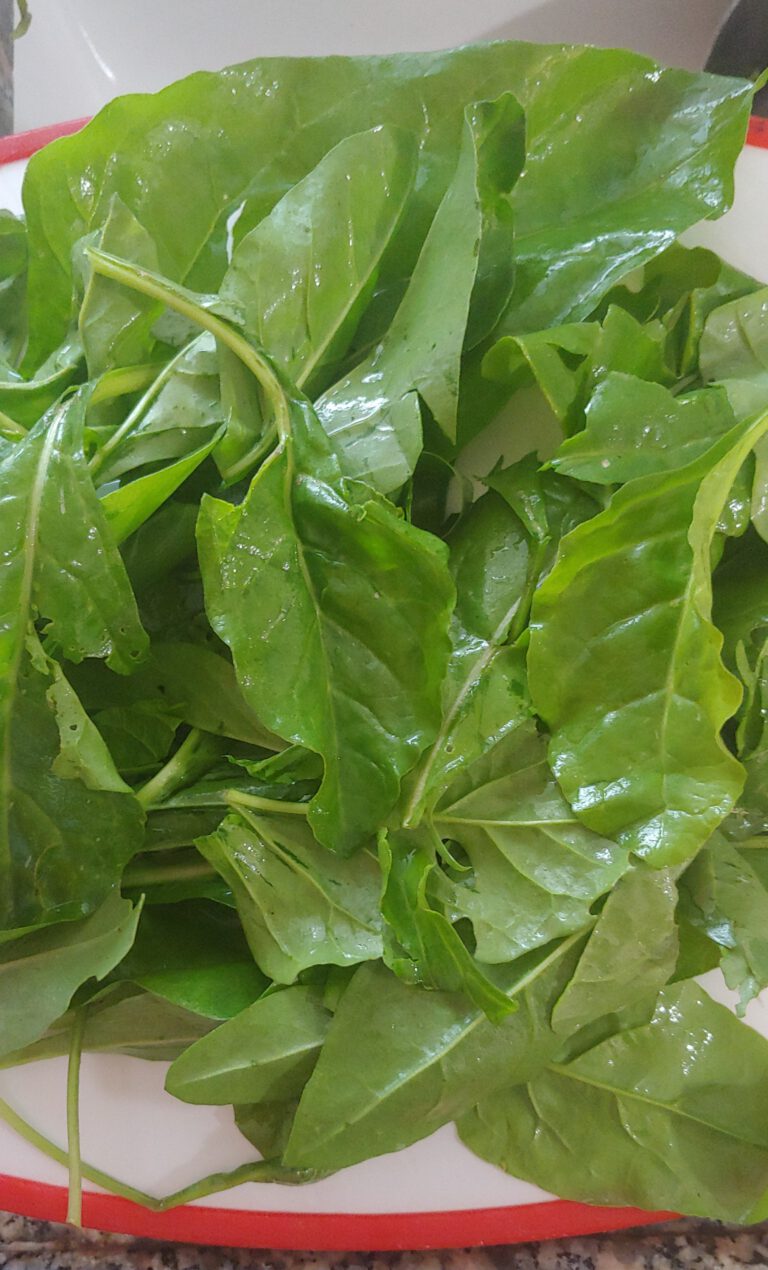
These wild beets are the foremothers of Swiss Chard, known here as Mangold. They grow from a single point in the ground, and their leaves vary in size, the young ones being smaller and lower down on the stalk. They’re triangular to oval, with scalloped edges, very glossy and dark green, with deep, lighter-colored veins running through them. As the plant matures, the stalks take on the familiar red color.
And no, beet greens aren’t related to spinach, nor do they taste like spinach. Their taste is similar to Swiss chard, naturally. Still, you can swap beet greens for spinach in any recipe: soup, quiche, omelets and fritattas – you name it.
Nutrition? Beet greens have plenty of vitamins K, C, and A. Minerals in them worth mentioning are magnesium, some iron, and calcium. Lots of fresh green fiber, too.
I’m already thinking of summer, when the landscape here will be sere and brown, and the late-winter greens will have died away. To preserve some for the summer, I cut more greens than I need, rinse them in cool water and examine them for any little freeloaders like snails, which also love the warm, damp conditions of the Mediterranean late winter.
Then I chop the greens, sauté them with onions and garlic in olive oil, and freeze them. Now they’re ready to use in just about any dish. Alternatively, I set the leaves out in a dry, shady place and let them dry thoroughly. I crumble the dried leaves into soups and stews.
There’s only one safety warning with wild beet greens themselves: the large, mature leaves are are best avoided by people with kidney stone issues, as they have a relatively high oxalic acid content. The small, younger leaves growing farther down the stalks are fine. I eat the young leaves as often as I like, with no harm done.
However, it’s important to keep in mind that at first glance, some very toxic wild plants resemble wild beets. For example, lords and ladies, known here as loof. I’ve read reports of people gathering wild mandrake leaves too, mistaking them for wild beets. Look for dark-green, very glossy leaves. Other plants are not so glossy.
Always make 100% sure that you’ve identified your foraged greens correctly.
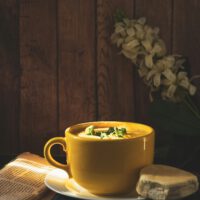
Moroccan chickpea soup. Hearty and comforting.
I love the Moroccan-based chickpea and spinach soup, in which I swap wild beet greens for the spinach. Find the recipe here.
This soup originated in Morocco, where home cooks usually use spinach. But I’ve adapted it to include the abundant wild beet greens that grow in my yard. It’s rich, satisfying, and vegan. Part of it’s charm is that the greens are added last to each bowl. This keeps the greens’ flavor fresh.
Chickpea and Beet Greens Soup
A satisfying winter soup with chickpeas and beet greens
1/4 cup olive oil
1 medium onion (chopped coarsely)
4 peeled garlic cloves (minced)
1/2 teaspoon ground cinnamon
1/2 teaspoon paprika
1/2 teaspoon ground cumin
1/4 teaspoon cayenne pepper (if liked, and more to taste)
2 cups crushed canned tomatoes
4 cups canned chickpeas (drained)
3 cups vegetable broth
1/2 teaspoon granulated sugar
Salt and black pepper to taste
4 cups fresh (rinsed, drained and finely chopped wild or cultivated beet greens.)
In a large pot, heat the olive oil. Use medium heat.
Add the onion, garlic, cinnamon, paprika, cumin and optional cayenne.
Cook, stirring occasionally, until the onions wilt.
Add the tomatoes, chickpeas, broth, and sugar.
Bring the soup to a boil, then reduce heat. Simmer, covered, 30-45 minutes.
Season with salt and pepper. Stir and taste.
While the soup cooks, finely chop the beet greens.
Before serving, place equal amounts of chopped greens into 4 or 6 soup bowls. Ladle hot soup on top.
Cold weather is still calling for soup. Try this light, vegan one based on Jerusalem artichokes.
Vegeware or do you identify as a climatarian? This might mean you might not be committed to vegetarianism, but are committed to doing your part by being vege “aware”.
Here’s a great vegetarian recipe with in season Jerusalem artichoke to help you cut some meat out of your diet: What I particularly like about this soup is that the usual potato for making it “hearty” is absent. Instead, ground almonds thicken it slightly, leaving room for the chokes to shine through with lightly spicy flavors. And if you love soup, also see our spinach and mushroom soup recipe here.
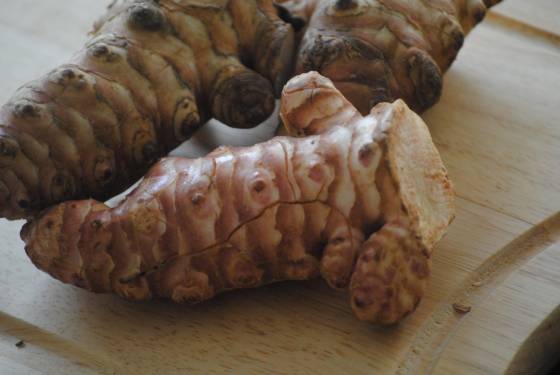
Jerusalem artichokes look nothing like an artichoke
Jerusalem artichokes are tubers with scaly, pink and brown peels and have nothing to do with Jerusalem or with artichokes. The name apparently comes from the Italian girasole, sunflower, because its flowers resemble those of sunflowers. Eventually the word became Jerusalem to English-speakers. Its taste does resemble that of artichokes. Recently some people have begun calling it “sunchoke,” hoping to help identify this poor vegetable properly.
But it’s been called Jerusalem Artichoke for so long, it seems unlikely to change. If you are considering a soup, also maybe try our vegan chickpea and artichoke salad, to round out the soup.
Jerusalem Artichoke Soup Recipe
Ingredients:
2 tablespoons olive oil
2 medium onions, diced
1 clove garlic, minced
750 grams – 1 -1/2 lb. Jerusalem artichokes , peeled and cut into 3/4-inch chunks
4 cups vegetable broth
12 blanched almonds
2 tablespoons water
1 pinch powdered saffron
Juice of ½ lemon, plus more to taste
2 tablespoons chopped fresh Italian parsley, including stems
Place a heavy pot or Dutch oven over low heat. Add olive oil and onions. Cover and sauté about 20 minutes, stirring occasionally, to sweat and soften onions.
Add garlic and Jerusalem artichokes. Increase heat to medium. Sauté, uncovered, for several minutes.
Add broth, plus salt and pepper to taste. Bring to a boil, reduce heat, and simmer, covered, for 30 minutes.
Using a spice grinder or food processor, coarsely grind almonds and mix with 2 tablespoons water. Add mixture to soup.
Add saffron and lemon juice, whisking to blend thoroughly. Heat through. Taste and adjust seasoning with salt and lemon juice.
Serve piping hot, garnished with fresh parsley, and enjoy!
More delicious soup ideas for these winter evenings:
Water availability, urban heat island effect, and energy use are major concerns shared by desert cities around the world. Taking place on 5th and 6th March 2024 at Expo 2023 Doha Qatar, the AIPH Green City Conference will showcase urban greening strategies that cities in arid zones can adopt to create liveable environments.
The Conference is organised by the International Association of Horticultural Producers (AIPH) with the support of Host Expo 2023 Doha Qatar and Headline Sponsor Biblo. Prominent speakers from around the world will present on the Conference theme of ‘city greening solutions for arid environments’.
In the opening session, AIPH is pleased to welcome Prof David Simon, Professor of Development Geography at Royal Holloway, University of London. Prof Simon’s research focuses on cities, climate change and sustainability, and the relationships between development theory, policy and practice. His recent book ‘Sustainable Human Settlements within the Global Urban Agenda’ explores the dynamics of the UN’s SDG 11 – Sustainable Cities and Communities – and how it is understood in different regional and national contexts. This opening presentation will showcase Prof Simon’s work with Earthna on arid cities.
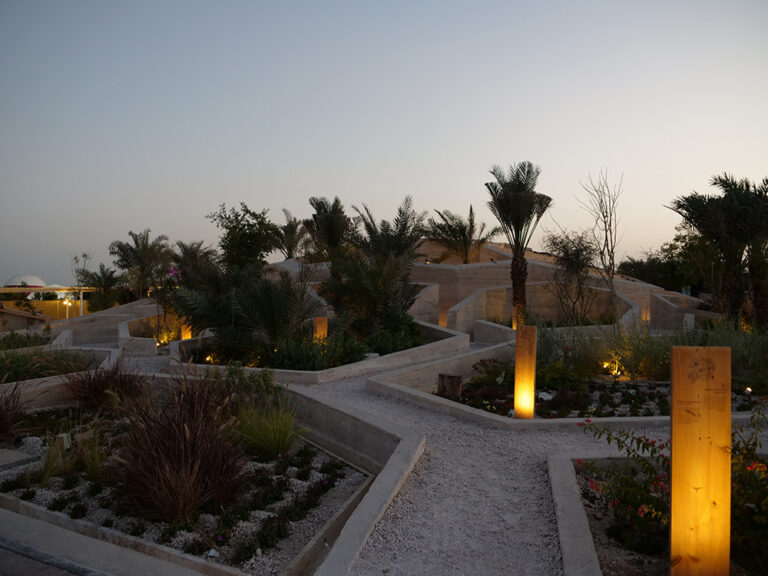
Museum of Islamic Art, Doha Qatar
The second speaker in the opening session is Kishor Rajhansa, Chief Operating Officer of the Global Carbon Council (GCC). Based in Qatar, Mr Rajhansa is a climate change, energy, and sustainability leader with 28 years of experience. He is responsible for operating GCC, a carbon-offsetting programme that assists organisations in reducing their carbon footprint. This is achieved by developing stringent but simplified standards and establishing transparent certification processes.
Jordan’s dry climate design
During the second session, the Conference will focus on local and regional initiatives that combat challenges that arise in desert cities. Founder and Chair of the Society of Sustainability & Green Materials (SSGM), Dr Ali Al Jassim will present the non-profit’s work to raise awareness and improve knowledge sharing in sustainability, green materials, and circular economy in the UAE. The Society’s work involves supporting the development of policies and regulations that advance these goals.
The Fog Collection Project successfully collected 350,000 gallons of water from fog during the Khareef. In Doha
Joining Dr Al Jassim in this session is Jala Makhzoumi, Vice President of the International Federation of Landscape Architects (IFLA) and Acting President of IFLA Middle East. In her presentation, Ms Makhzoumi will motivate the focus of greening to go beyond the physical space to embrace intangible processes and consider perceptual and emotional perspectives of urban nature. Through this, an enduring stewardship of natural resources in cities and globally can be achieved. Dr Saeed Alhassan Alkhazraji continues the theme of caring for natural resources to describe innovative research for solving water issues using nature. Technologies developed at Manhat produce water by mimicking the natural water cycle.
Doha Tower
The issues faced by arid cities are not unique. In the afternoon session of the Conference, speakers from other regions will present the living green solutions being employed to combat shared issues. Speakers will showcase the initiatives being employed to mitigate urban heat in Asia, re-naturing cities through nature-based solutions, and how AI can offer easy access to nature data.
Conference speakers include:
Prof. David Simon, Professor of Development Geography at Royal Holloway, University of London, and author of ‘Sustainable Human Settlements within the Global Urban Agenda’
Kishor Rajhansa, Chief Operating Officer, Global Carbon Council
Dr Ali Al Jassim, Chair of the Society of Sustainability & Green Materials (SSGM)
Jala Makhzoumi, Vice President of the International Federation of Landscape Architects (IFLA) and Acting President of IFLA Middle East
Huda Shaka, Director of Urban Strategy and Planning, Gehl
Dr Saeed Alhassan Alkhazraji, Founder, Manhat
Dr Mario V Balzan, Senior Lecturer at the Malta College of Arts, Science and Technology (MCAST), and Managing Director at Ecostack Innovations
Diane Lee, Media Relations Manager – Asia Region, AIPH
Thomas Gooch – Founder/CEO of Office of Planetary Observations (OPO)
On the second day of the Conference, on 6th March 2024, delegates will visit key green city sites in the Doha municipality. For more information about the speakers and the program, and to book your place at this inspiring meeting, visit the AIPH Website.
Does ESG have a place in war? Russian and Ukrainian armies report weapons failing because rats are eating eco-cables
Not so long after Hamas attacked Israel and the Israel-Gaza war begun, newspapers in England were discussing the environmental footprint of war, begging the question – should war also consider the ecological consequences of harm to the planet done while fighting? Agent orange, nuclear bombs at Hiroshima. The world has learned that even in war there are limits. But should we be okaying weapons made with eco-materials that are sub-par with real plastics?
The argument from green organizations should be consistent but it seems absurd that when the Houthis are sinking ships carrying oil, Greenpeace does nothing to condemn them. It is also absurd now that armies of Russia and the Ukraine are battling a third front on the war against each other: rodents are coming out in full force, causing weaponry to fail. The cause?
New ESG regulations called for corn starch-based insulation cables in the weapons – cables that the mice like to eat. Remember Israel’s car eating camels and the Susita?
“European countries have supplied weapon systems The dilemma of ensuring electrical insulation durability is a problem for modern weapons. The issue affects countries where ESG (Environmental, Social & Corporate Governance) guidelines are making their way into the arms industry”
Reports of European weaponry systems failing in Ukraine due to ESG policies entering Western weapons industries.
Cable insulation is increasingly made out of corn fiber instead of synthetic materials.
Members of communities have reportedly been denied access to clean and safe water for decades: “Even as DuPont and Chemours had information about the toxic impacts of PFAS on human health and drinking water, the companies continued to produce and discharge PFAS,” experts from the UN said in a press statement: “DuPont and Chemours have produced, marketed and profited from PFAS for decades, contributing to a global toxic contamination problem.”
What are Forever Chemicals and where do they come from?
Personal care products like shampoo or dental floss and cosmetics like nail polish and eye makeup as well as some plastics, grease-resistant paper, fast food containers, stain-resistant coatings on carpets, upholstery and other fabrics, all contain PFAS. PFAS are a class of toxic chemicals also known as forever chemicals because they are highly persistent, meaning that they do not easily degrade in nature and can cause harm for decades, even centuries.
The UN experts expressed alarm at the exports of PFAS-hazardous waste from The Netherlands to the United States, in a breach of international law.
“DuPont and Chemours appear to have impermissibly captured the U.S. Environmental Protection Agency and delayed its efforts to properly regulate PFAS chemicals,” the UN added, accusing the US of human rights abuses.
“Health and environmental regulators in the United States have fallen short in their duty to protect against business-related human rights abuses, including providing the public, particularly affected communities in North Carolina, with the type and amount of information necessary to prevent harm and seek reparation. Where legal action has been taken against the two companies, enforcement and remediation measures have been inadequate,” the UN experts said.
Shortcomings by the U.S. Environmental Protection Agency, the North Carolina Department of Environmental Quality, and the courts undermine community’s right to information and their right to an effective remedy. The experts raised these concerns with the US Government which is yet to reply.
The UN experts sent letters to DuPont and Chemours. In their replies, DuPont and Chemoursexplained how they have changed their corporate structures and operations. In this regard, the experts expressed their apprehension at how this corporate restructuring has posed further obstacles to achieving accountability and effective remedies. Corporate restructuring should not lead to impunity for human rights abuses, the experts said.
The UN experts also expressed grave concern at reports that Chemours had applied to the North Carolina Department of Environmental Quality for an air permit to expand its PFAS production.
American environmental lawyer Marcos A. Orellana, Special Rapporteur on toxics and human rights; Canadian “warrior lawyer” David R. Boyd, Special Rapporteur on human rights and the environment; Spanish lawyer Pedro Arrojo-Agudo, Special Rapporteur on the human rights to safe drinking water and sanitation; Special Rapporteur on the right to food; Nigerian lawyer Damilola Olawuyi (Chairperson), Robert McCorquodale (Vice-Chairperson), Elżbieta Karska, Fernanda Hopenhaym, and Pichamon Yeophantong, Working Group on the issue of human rights and transnational corporations and other business enterprises.
The Special Rapporteurs are part of what is known as the Special Procedures of the Human Rights Council.
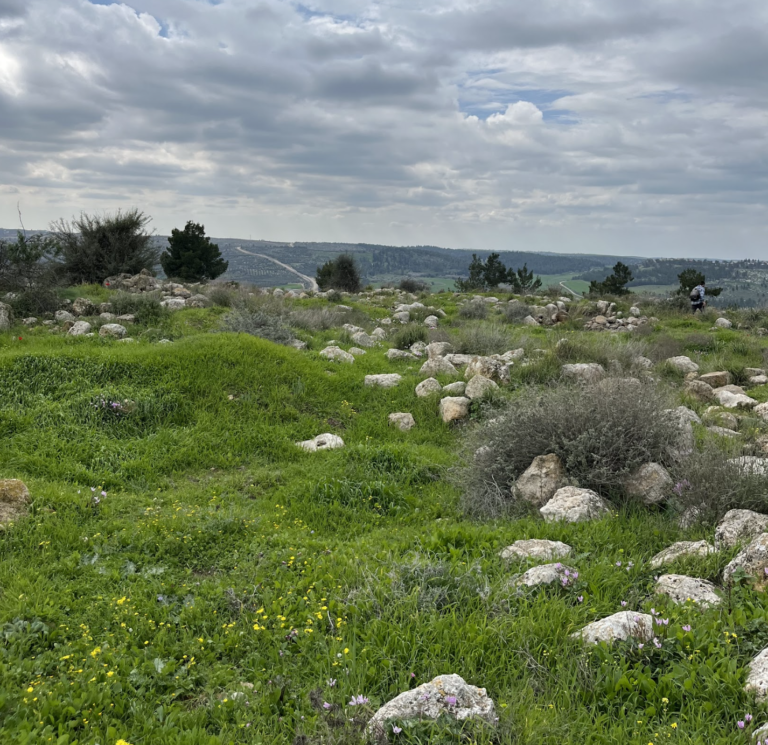
The flowers and leaves here in Khirbet Urva connect us with our ancestors who lived on this hilltop here millennia ago. Notice the rows of stones, the remainders of Urva’s walls. Under that unnatural-looking mound in the center left lies an ancient house or something.
Israel Is Both Sick and Healthy – In the midst of a tragic war, this winter’s rains are remarkably balanced.
These are strange times in Israel. Israel the People are perhaps in more trouble than anytime since the Holocaust. Our nation is in pain, alone and afraid. Yet Israel the Land is healthier than ever, because this year’s winter rains are falling hard and steady, balanced and healthy.
Healthy Israel
Throughout the Torah, the Land of Israel’s state of health is expressed by the winter rain cycle. When they come on time, nurturing the year’s new life, Israel is healthy and thriving, and supports its children with bountiful harvests. When they don’t arrive, or if they come at the wrong time, Israel falls ill, and its children, in turn, suffer from drought.
Here is the Torah’s first blessing for those who follow its ways faithfully:
I’ll give the rains in their time, and the land will give its harvest, and the trees of the orchard will give their fruits (Leviticus 26:3)
To which the Ramban (Nachmanides) commented: “He began with the rains, because when they come on time, as is proper, the air will be pure and good, and the springs and rivers good. This will bring health to physical bodies, and all the fruits will be plentiful and blessed by them [the rains].”
Then people won’t get sick, and they and their animals won’t miscarry or be barren. Their days will be full, because when bodies are large and healthy, they survive their whole lifespan. This is the greatest of blessings.
Israel the Land is healthy from balanced rain, because health means balance. A healthy Israel, in turn, supports healthy and balanced lives for Israel the Nation. Therefore, Jews gather during the fall festival of Sukkos for a special rain-prayer, and gather again in the spring festival of Pesach to pray for dew instead of rain.
Healthy rain, like we’re experiencing this year, is spread out evenly along the winter months. Every week or two, there’s a few days of rain, then a break to allow Natural Israel to absorb the blessing and grow its plants. The ground isn’t parched nor a muddy morass.
When we’re out on foraging walks these days, Israel shouts its vibrant health from the countless leaves, flowers, and shrubs in every corner of the countryside. New, fresh life greets us at every turn.
Khirbet Urva
Last week, we were foraging on Khirbet Urva, a lovely hilltop village near Bet Shemesh that dates back at least to the Second Temple Period. Khirbet Urva isn’t particularly well known; I doubt it receives more than a few dozen visitors a year. When every second hill in the area sports millennia-old settlements, only a select few get famous, often simply because they are the most accessible by car.
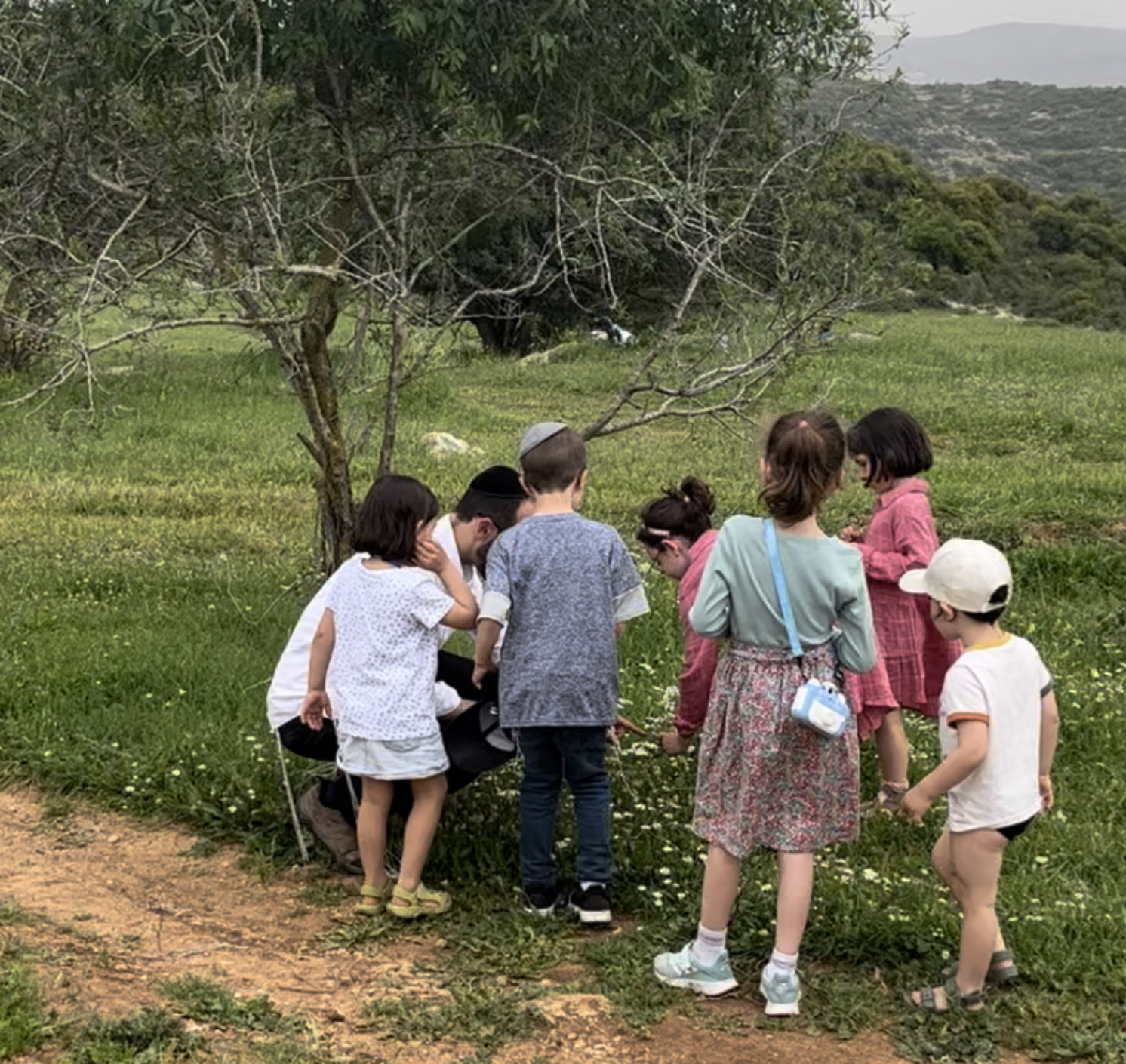
In places like Khirbet Urva, the verdant foliage between the rows of ancient stones bonds together the places and people of the past, present, and future. Foraging here makes Israel come alive; our heritage isn’t just half-buried buildings and walls, because local wild plants silently bear witness to the march of time. We roam around eating the plants whose ancestors were eaten by our ancestors right here.
One of my favorite annual plants, milk thistle, guzzles huge quantities of water in its upward rush. The milk thistle now is in the “celery stage,” where we forage the juicy stalks.
Take a look at one of Khirbet Urva’s scores of milk thistle patches:
Both Sick and Healthy
I don’t know how to resolve God’s conflicting signals to Israel: terrible war but thriving healthy rain.
But I don’t really think it’s a problem, because both are true. Inside the midst of tragedy, God is sending us a message of comfort and hope with the pitter-patter of raindrops on our windows.
For that we can be grateful.
Rain-life Today
Maybe you’re wondering why you should care about Israel’s rainfall in the 21th century when most of the country’s water comes from desalination?
In my new book, Land of Health: Israel’s War for Wellness, I explain how rain is the model of livelihood that descends as a gift from heaven, as opposed to river-based life which we wrest away from nature. Land of Health is available now on Amazon, in bookstores in Israel, and directly from me in Bet Shemesh, Israel.
Upcoming Foraging Walk in RBS
Would you like to join me on a foraging walk in Natural Israel?
Hawthorne berries in IsraelBible
Contact me today to book your private walk. I’m also guiding a discounted open walk in Ramat Bet Shemesh on Election Day (Tuesday, February 27). The walk will have two parts: an easy walk in the local Yarmut Park, followed by an easy hike on a nearby hill that sports a Second Temple Period clay lamp factory and town.
Shmuel Chaim Naiman is a health teacher and foraging guide in Ramat Bet Shemesh. He writes about healthy Jewish living and Israel’s natural world, teaches the nightly Healthy Jew class at Yeshivas Lev Hatorah, guides popular foraging walks, and offers personalized health coaching. He recently published a book, Land of Health: Israel’s War for Wellness, which is available on Amazon and in bookstores (in Israel). Learn more at healthyjew.org, and contact him at [email protected].
After finishing reading your newspaper, have you ever wondered what to do with it? This is given that you are reading a print edition: Well, a Japanese publisher of The Mainichi Shimbusha newspaper has introduced a novel initiative called the ‘green’ newspaper, offering a unique solution: you can plant the newspaper once you’re done with it. It has seeds embedded in the paper.
Why was this concept developed? As a means of tidying up urban areas while also contributing to environmental efforts, the Green Newspaper by the Japanese Daily was conceived. it’s a way to also teach people about climate change and sustainability issues.
If you’re inspired by the innovative spirit behind Japan’s plantable newspaper, you might also explore how language and sustainability connect in your own career. For those fluent in Japanese, there are growing opportunities to find remote Japanese language jobs on Jooble. Whether you’re passionate about translation, teaching, or support roles, these positions allow you to leverage language skills while contributing to diverse fields.
First introduced on ‘Greenery Day’ on May 4th, 2016 in Japan this special edition was dedicated solely to environmental news and printed on 100% biodegradable paper with plant-based inks. Each page contained embedded seeds that, when planted, would sprout into flowers attracting butterflies and other pollinators.
Some copies even had seeds for growing herbs! Instructions were included for tearing used newspapers into smaller pieces and planting them in soil. With print advertising’s branding being 185% stronger than digital according to Newswoks’ report on Print vs Digital Advertising (2020), incorporating plantable pages adds an extra allure to the printed word.
Who came up with this idea? The concept originated from Dentsu Inc, one of Japan’s largest advertising agencies, collaborating with The Mainichi, publisher of The Japanese Daily.
Has it been effective? The Green Newspaper is not the first environmental initiative undertaken by The Japanese Daily. They’ve earned a reputation through previous campaigns, such as water donation drives for populations facing drought and unsafe drinking water.
Their eco-friendly newspaper has seen significant success, with a daily circulation exceeding four million copies nationwide and revenues surpassing eighty million yen, equivalent to over £500,000.
The initiative has involved schools, educating children and raising awareness about current environmental issues, thereby instilling the importance of recycling in the next generation.
The Japanese Daily isn’t alone in embracing sustainable planting initiatives. With Europe boasting a recycling rate of 74%, innovative recycling methods are gaining popularity. Plantable greeting cards are increasingly common in stationary shops and supermarkets. Businesses are also adopting eco-friendly promotional materials like seed sticks and plantable papers for business cards, leaflets, and flyers. Plus, you can make them at home. Or make seed bombs which also fun.
How is seed paper made?
Seed paper isn’t a novel concept but rather a slow-growing trend. It’s a simple mixture of recycled paper, water, and small flower or herb seeds. You can even make it at home. Here are the steps:
Tear up your old paper of choice and put it in a blender.
Fill blender with warm water.
Blend until there are no visible paper chunks.
Stir in the seeds. Choose tiny seeds like parsley, lettuce, or za’atar – or flowers.
Strain the mixture to remove excess water. Very important.
Spread the pulp thinly to dry.
Once dry, use it for various purposes like cards or tags, knowing that wherever it ends up, it will eventually bloom into flowers.
So, next time you’re done with a newspaper or come across one during your travels, consider recycling it into something new. And for special occasions, opt for plantable cards, knowing you’re contributing to the planet’s well-being, one page at a time. Oh and kids love making paper. It’s the number one activity we have done with kids over the years. Consider turning your paper into greeting cards, birthday cards or Ramadan cards.
The Healthy Jew is an online publication about healthy Jewish living and Israel’s natural world, written by me, Shmuel Chaim Naiman, a health teacher and foraging guide based in Ramat Bet Shemesh, Israel.
After October 7, The Healthy Jew enlisted to defend the Jewish people – not to fight the war of bodies (with guns and tanks) or minds (online and in the media), but to combat fear, anxiety, stress, and negative drama. Our enemies want us to stop living, caring, and connecting. They want us to see Israel as the “land that eats its inhabitants.”
We win the war for wellness by practicing healthy Jewish living and appreciating Israel’s natural world. In this war, everyone is a soldier.
Land of Health by Shmuel Chaim Naiman
For the past 4 months, The Healthy Jew has been waging war with two free weekly newsletters:
Healthy Jewish (Wednesday) shows you how to defeat terror with healthy Jewish living strategies that are particularly useful for times of crisis. We won’t allow the enemy to stop us from living, caring and connecting. Israel needs healthy Jews!
Natural Israel (Sunday) invites you to exchange, if only for a moment, Israel’s current images of pain and fear with pictures of purpose and health. The failed spies said Israel is “the land that eats its inhabitants”; we’re joining Yehoshua (Joshua) and Calev’s (Caleb) response: “The land is very, very good!”
Now you can read many of The Healthy Jew’s best ideas and advice in new book, published this week together with Yeshivas Lev Hatorah: Land of Health: Israel’s War for Wellness.
The first part of Land of Health builds on Natural Israel’s posts about the healthy body of the Jewish people – the Land of Israel.
The second part, based on Healthy Jewish posts, offers practical strategies for healthy living during challenging times.
Finally, Land of Health presents The Healthy Jew’s mission and programs for teaching healthy Jewish living and discovering Israel’s natural world.
Hawthorne berries in Israel
Land of Health comes with dozens of stunning pictures of healthy living throughout Natural Israel.
The book is available in bookstores throughout Israel, on Amazon, and directly from the author. Reach out.
Shmuel Chaim Naiman is a health teacher and foraging guide in Ramat Bet Shemesh. He writes about healthy Jewish living and Israel’s natural world, teaches the nightly Healthy Jew class at Yeshivas Lev Hatorah, guides popular foraging walks, and offers personalized health coaching. He recently published a book, Land of Health: Israel’s War for Wellness, which is available on Amazon and in bookstores (in Israel). Learn more at healthyjew.org, and contact him at [email protected].
The third edition of World Conference on Climate Change & Sustainability will provide an opportunity to focus attention on the opportunities, challenges and solutions towards net zero worldwide. It will follow up on the first and second edition, held in 2022 and 2023 in Frankfurt and Rome respectively. Climate Week 2024 aims to accelerate collaboration and integrate climate action into global pandemic recovery. Building forward opens an opportunity to address social inequalities and invest in sustainability development that is good for humanity and nature.
The 3rd World Conference on Climate Change & Sustainability, scheduled to take place from October 21-23, 2024, in Barcelona, Spain.
The theme for our upcoming conference is “Tech and Tomorrow: Charting Progress in Climate Change & Sustainability.”
Joining this year’s Climate Week 2024 Barcelona event you’ll learn how people are affected by climate change – from Midwest farmers to coastal residents and urban dwellers. Everyone is a climate stakeholder. You’ll also learn about the people who are finding solutions to climate change, and you’ll get ideas of how to take action to help address climate change.
Measuring climate change and assessing environmental, economic and social impacts
Exploring mechanisms for effective environmental planning and sustainable resource management
Advancing strategies and techniques for climate change mitigation and adaptation
Enhancing the involvement and integration of different stakeholders across international, national, state, city, and community levels for environmental sustainability
Reporting pilot cases and exemplars that can help address climate change issues.
Outlining public and private sector investment goals to combat the climate crisis around the world.
This Climate Week would illustrate that more countries, businesses, and citizens are stepping up to meet the challenges of the climate emergency.
The core objective of Climate Week 2024 is to provide a vibrant platform for discussions on climate and sustainability societies. The aim is to foster an environment that sparks innovative ideas and lays out clear pathways for their practical implementation. As one of the leading european conference in this field, attendees can expect to delve into the most recent developments and issues related to climate change. This three-day scientific gathering will feature keynote sessions covering a wide spectrum, including the effects of climate change, climate policies (such as clean energy policies), air quality measures, subsidy reform, smart agriculture, sustainable food systems, educational and civil society involvement, nature-based solutions, and more.
Climate Week 2024 has been designed to bring together a diverse range of exploration and case studies from around the world, offers contemporaneous sessions and numerous networking opportunities. Attendees will engage with leading experts from organizations, agencies, business leaders, scientists, global and regional companies, investors, academia, entrepreneurs, and more. The focus is on collaborative efforts to deliberate and mitigate the climate crisis through sustainable business solutions, disruptive technology, and advanced knowledge.
Importance of Topic
A solar PV plant in California
These changes in climate have far-reaching consequences, affecting not only our health but also the ecosystems we rely on. Human-induced climate change is already affecting various weather and extremes climate globally. There are many evidences of climate change like heatwaves, heavy precipitation, droughts, and tropical cyclones, with a growing acknowledgment of their connection to human activities. Projections indicate that climate change will exacerbate the frequency, intensity, and impacts of certain extreme weather events. Taking action to limit global warming to 1.5°C, as opposed to 2°C, could potentially spare around 420 million people from frequent exposure to extreme heatwaves.
The primary focus of Climate Week 2024 is to engage the scientific community toward the next frontier of research—exploring the intricate relationship between earth and climate change. This global conference provides a platform to learn about the latest developments and challenges in areas related to climate change & sustainability. Conference sessions will cover the health co-benefits associated with a broad spectrum of climate policies, spanning clean energy, air quality measures, subsidy reform, smart agriculture, sustainable food systems, educational and civil society involvement, nature-based solutions, and more, during the three-day experts gathering.
The Organising Committee and Scientific Steering Committee of this event extend an invitation to all those actively engaged in addressing climate change and sustainability development. They encourage participants to embrace and build upon the research and climate science presented, integrating perspectives from their respective constituencies. The goal is to make the findings from this conference to the unique contexts of different locations.
The conference seeks participation from decision-makers, regulators, experts, scholars, public figures, and stakeholders across Member States, international organizations, industry, academia, and non-governmental organizations involved in nuclear energy, climate change, environment, economic, and social development portfolios. The event anticipates the engagement of invited speakers, who will deliver valuable presentations and/or participate in panel discussions, enriching the collective discourse on climate action.
Like Al Qaida, Boko Haram and ISIS who brutally raped and murdered women as a form of terror, Israel has just released an alarming report about the sexual violence of Hamas from Gaza. It is a difficult report to read but we have a copy here (links to PDF). The Association of Rape Crisis Centers in Israel’s first official report regarding the Hamas attack on October 7 highlights the following key points:
Sexual crimes were systematically and intentionally committed.
Four main arenas of sexual abuse were identified.
The sexual assaults and acts of rape involved multiple participants and included sadistic practices characterized by brutal features.
Orit Sulitzeanu, CEO of the Association of Rape Crisis Centers in Israel, emphasized the significance of the report, stating that it leaves no room for denial or disregard. The report clearly indicates Hamas’s strategic decision to harm Israel through kidnapping citizens and committing sadistic sexual crimes. Silence in response to these atrocities is unacceptable, and international organizations are urged to take a clear stance.
The report, authored by Dr. Carmit Klar Chalamish and Noga Berger, consolidates evidence and concludes that the sexual crimes were not isolated incidents but part of a systematic, targeted strategy. It focuses on sexual and gender-based violence during the October 7 massacre and subsequent war, serving as a primary testimonial foundation indicating widespread sexual crimes.
The methodology involved analyzing numerous pieces of information, including testimonies, interviews, and direct information received by the ARCCI. Findings reveal brutal acts of violent rape, often involving threats with weapons and collaboration among perpetrators. Sexual and gender-based violence occurred systematically in various arenas, including festivals, kibbutzim, IDF bases, and captivity.
The report’s authors highlight the brutal nature of the assaults, designed to inflict sadistic terror and reinforce their impact on victims and communities. The ARCCI, founded in 1990, operates as an umbrella organization for nine rape crisis centers in Israel, addressing around 50,000 calls each year. It works to promote rights and services for survivors of sexual abuse and reduce its prevalence in Israeli society.
Take a moment to behold a marvel destined to vanish from sight—an ephemeral masterpiece unveiled amidst the boundless expanse of the Saudi desert, nestled within the UNESCO World Heritage Site of Hegra in AlUla. A pair of hands that fade back into the sand. This is the ultimate in sustainable art.
New York artist, David Popa: ephemeral earth frescoes created with earth pigments, charcoal and water.
Dubbed “Hands from Sands” by David Popa, the sculpture was commissioned for the I Care campaign. This initiative, orchestrated by the Royal Commission of AlUla, serves as a clarion call to safeguarding Saudi Arabia’s cultural legacy.
Crafted from sustainable materials “Hands from Sands” epitomizes preservation, echoing the campaign’s overarching mission to nurture and conserve the country’s historical tapestry. It’s a mixed message, since Saudi Arabia is also building the 15-minute-city, The Line and other extravagant cities and holiday destinations.
More about the site: Once a bustling node along ancient trade routes, Hegra now stands as an open-air museum, boasting over a hundred meticulously preserved tombs and rock carvings.
In the canvas of Hegra, “Hands from Sands” spans over a hundred meters. For Popa, the process transcends mere creation; it is a communion with nature, a dance with the elements. Employing only natural materials, delicately mixed with source water, the artist imbues his creation with the spiritual.
































 Take a moment to behold a marvel destined to vanish from sight—an ephemeral masterpiece unveiled amidst the boundless expanse of the Saudi desert, nestled within the


