Masdar City has experienced knee-buckling setbacks, but we haven’t heard the last of them just yet
Masdar City is hanging on tenterhooks. After questioning the dicey science of carbon credits for big energy companies, we then published assurances by Masdar’s CEO Sultan Al-Jaber that although the project will be delayed because of certain hiccups – not least of which being that no one in the post-industrial world has aspired to a city free of carbon, or cars – it will still proceed. Yet critics like Brett Prior say the Masdar ship is sinking fast.
Shining Promises
Prior dealt a scathing blow to the company’s rhetoric in a recent post for greentechmedia.com. The svelte five act unfolding begins with a little background about Masdar’s much-touted ambitions:
They aimed for a $22 billion dollar, 6 square-km walled city for 45,000 residents and 1,500 businesses to be built by 2016. That city would be run completely on renewable energy sources, generating zero carbon emissions and zero waste. Additionally, 80% of the city’s water would have been recylced.
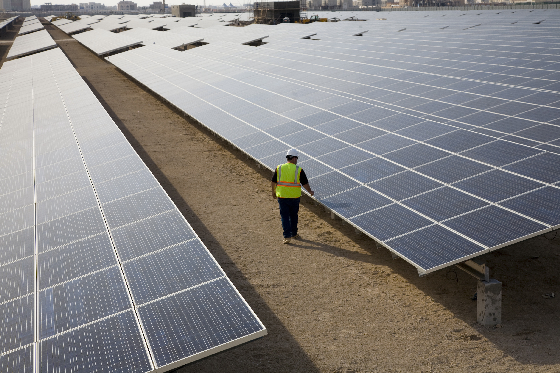
They boasted a top-notch research facility, the Masdar Institute of Science & Technology (MIST), that would be assisted by Massachusetts’s internationally-acclaimed MIT. Even construction would have been powered by a 40-60MW solar plant and PV panels manufactured on-site.
Uncontrollable dust
But then in Prior’s second act, he describes what become “cracks in the armor.”
In this phase of development, whirling dust storms in August 2009, with “suspended dust in the air between 1,500 to 2,000 parts per million,” decreased solar productivity by 40%. The panels were washed – at great expense – and productivity restored.
Khaled Awad, the director of Masdar City, claimed that “Dust storms have the same impact on a PV panel’s performance as cloud cover. In Abu Dhabi, we have a number of dust storms during the year, but compared with the level of cloud cover that European countries such as Germany receive, the performance in Abu Dhabi is far superior. In fact, on average, a solar module installed in Abu Dhabi will generate twice as much as [one installed in] a cloudy region in Europe.”
Key personnel resign
By the third act, the armor is not cracked, it is shattered.
The deadline is pushed back to 2020 and electricity, it turns out, will have to be imported. The electric transport pods that were supposed to replace cars are only going to be used in certain parts of the city, and Masdar PV fired both their CEO and COO. Then, to top off the floundering debacle, the head of MIST, Tariq Ali, resigned after only 1 year.
Prior considers Sultan al-Jaber’s recent press – in which he is adamant that these are not insurmountable setbacks – as desperate efforts to hold on, to instruct the band to keep playing while the ship sinks.
Given that John Perkins, the provost of the Masdar Institute, also resigned, and that the company that would have provided silicon equipment, Sun Fab, folded its operations, it seems that Prior may be right.
Solar gives hope?
On the other hand, his fourth and fifth acts offer a glimmer of hope.
Abengoa Solar – one of the most established solar power producers in the world – is going to build a $600 million Concentrated Solar Plant, which they plan to expand from an initial generating capacity of 100MW to 2000MW. And funding the $22 billion zero carbon city should be a breeze for Abu Dhabi’s sovereign wealth fund that amounts to a cool $650 billion.
Libya developed a $20 billion man-made river, so there’s no telling what Masdar might still pull off backed as it is by Abengoa and silly money. Though they may not deliver their original, dazzling ambitions, the ship is still afloat. Let’s hope it docks in more sustainable harbors.

 Professor Daniel Esty lectured United Arab Emirates officials (and others) about environmental sustainability at Yale University last week.
 Hotter summers, intense irrigation and threats of losing their Nile, Egyptians are under quota for water compared to other Arab nations. They take to the streets.








 Organizers of the Health, Safety and Environment Expo in October invite businesses, individuals, and organizations from all over the Middle East to participate in Iran.