Adults who are 21 or older can carry up to 30 grams. This amount applies to personal use within Pittsburgh’s limits. Carrying more could lead to confiscation or legal action. Staying under the limit avoids problems during any public stop.
In the study, the scientists didn’t just test one plant compound at a time. They tested two traditional Chinese medicine compounds together — luteolin (from flowers like honeysuckle and chrysanthemum) and astragaloside IV (from astragalus root, Huang Qi). These plants have been combined in Chinese herbal formulas for centuries to help the body recover from injury and inflammation.
A new collaboration between luxury brand Coach and textile reuse pioneer Bank & Vogue attempts to stitch those two worlds together: high fashion and the global textile waste stream.
Stepping up to democratize the moon is an EU-funded company, Deep Space Energy, which has just raised more than $1 million USD as a seed fund to help it create energy generators on the moon.
Adults who are 21 or older can carry up to 30 grams. This amount applies to personal use within Pittsburgh’s limits. Carrying more could lead to confiscation or legal action. Staying under the limit avoids problems during any public stop.
In the study, the scientists didn’t just test one plant compound at a time. They tested two traditional Chinese medicine compounds together — luteolin (from flowers like honeysuckle and chrysanthemum) and astragaloside IV (from astragalus root, Huang Qi). These plants have been combined in Chinese herbal formulas for centuries to help the body recover from injury and inflammation.
A new collaboration between luxury brand Coach and textile reuse pioneer Bank & Vogue attempts to stitch those two worlds together: high fashion and the global textile waste stream.
Stepping up to democratize the moon is an EU-funded company, Deep Space Energy, which has just raised more than $1 million USD as a seed fund to help it create energy generators on the moon.
Adults who are 21 or older can carry up to 30 grams. This amount applies to personal use within Pittsburgh’s limits. Carrying more could lead to confiscation or legal action. Staying under the limit avoids problems during any public stop.
In the study, the scientists didn’t just test one plant compound at a time. They tested two traditional Chinese medicine compounds together — luteolin (from flowers like honeysuckle and chrysanthemum) and astragaloside IV (from astragalus root, Huang Qi). These plants have been combined in Chinese herbal formulas for centuries to help the body recover from injury and inflammation.
A new collaboration between luxury brand Coach and textile reuse pioneer Bank & Vogue attempts to stitch those two worlds together: high fashion and the global textile waste stream.
Stepping up to democratize the moon is an EU-funded company, Deep Space Energy, which has just raised more than $1 million USD as a seed fund to help it create energy generators on the moon.
Adults who are 21 or older can carry up to 30 grams. This amount applies to personal use within Pittsburgh’s limits. Carrying more could lead to confiscation or legal action. Staying under the limit avoids problems during any public stop.
In the study, the scientists didn’t just test one plant compound at a time. They tested two traditional Chinese medicine compounds together — luteolin (from flowers like honeysuckle and chrysanthemum) and astragaloside IV (from astragalus root, Huang Qi). These plants have been combined in Chinese herbal formulas for centuries to help the body recover from injury and inflammation.
A new collaboration between luxury brand Coach and textile reuse pioneer Bank & Vogue attempts to stitch those two worlds together: high fashion and the global textile waste stream.
Stepping up to democratize the moon is an EU-funded company, Deep Space Energy, which has just raised more than $1 million USD as a seed fund to help it create energy generators on the moon.
Adults who are 21 or older can carry up to 30 grams. This amount applies to personal use within Pittsburgh’s limits. Carrying more could lead to confiscation or legal action. Staying under the limit avoids problems during any public stop.
In the study, the scientists didn’t just test one plant compound at a time. They tested two traditional Chinese medicine compounds together — luteolin (from flowers like honeysuckle and chrysanthemum) and astragaloside IV (from astragalus root, Huang Qi). These plants have been combined in Chinese herbal formulas for centuries to help the body recover from injury and inflammation.
A new collaboration between luxury brand Coach and textile reuse pioneer Bank & Vogue attempts to stitch those two worlds together: high fashion and the global textile waste stream.
Stepping up to democratize the moon is an EU-funded company, Deep Space Energy, which has just raised more than $1 million USD as a seed fund to help it create energy generators on the moon.
Adults who are 21 or older can carry up to 30 grams. This amount applies to personal use within Pittsburgh’s limits. Carrying more could lead to confiscation or legal action. Staying under the limit avoids problems during any public stop.
In the study, the scientists didn’t just test one plant compound at a time. They tested two traditional Chinese medicine compounds together — luteolin (from flowers like honeysuckle and chrysanthemum) and astragaloside IV (from astragalus root, Huang Qi). These plants have been combined in Chinese herbal formulas for centuries to help the body recover from injury and inflammation.
A new collaboration between luxury brand Coach and textile reuse pioneer Bank & Vogue attempts to stitch those two worlds together: high fashion and the global textile waste stream.
Stepping up to democratize the moon is an EU-funded company, Deep Space Energy, which has just raised more than $1 million USD as a seed fund to help it create energy generators on the moon.
Adults who are 21 or older can carry up to 30 grams. This amount applies to personal use within Pittsburgh’s limits. Carrying more could lead to confiscation or legal action. Staying under the limit avoids problems during any public stop.
In the study, the scientists didn’t just test one plant compound at a time. They tested two traditional Chinese medicine compounds together — luteolin (from flowers like honeysuckle and chrysanthemum) and astragaloside IV (from astragalus root, Huang Qi). These plants have been combined in Chinese herbal formulas for centuries to help the body recover from injury and inflammation.
A new collaboration between luxury brand Coach and textile reuse pioneer Bank & Vogue attempts to stitch those two worlds together: high fashion and the global textile waste stream.
Stepping up to democratize the moon is an EU-funded company, Deep Space Energy, which has just raised more than $1 million USD as a seed fund to help it create energy generators on the moon.
Adults who are 21 or older can carry up to 30 grams. This amount applies to personal use within Pittsburgh’s limits. Carrying more could lead to confiscation or legal action. Staying under the limit avoids problems during any public stop.
In the study, the scientists didn’t just test one plant compound at a time. They tested two traditional Chinese medicine compounds together — luteolin (from flowers like honeysuckle and chrysanthemum) and astragaloside IV (from astragalus root, Huang Qi). These plants have been combined in Chinese herbal formulas for centuries to help the body recover from injury and inflammation.
A new collaboration between luxury brand Coach and textile reuse pioneer Bank & Vogue attempts to stitch those two worlds together: high fashion and the global textile waste stream.
Stepping up to democratize the moon is an EU-funded company, Deep Space Energy, which has just raised more than $1 million USD as a seed fund to help it create energy generators on the moon.
Millions of people around the world will fast during Ramadan, and thousands will hide in the bathroom to sneak food.
I tread lightly. I am not a Muslim. I’m not religious at all, though enforced bible education is firmly rooted in my neurological framework. So, it is with grave respect that I tackle the question of fasting. Last year during Ramadan, I spent a week with an Egyptian family in Maadi, a relatively wealthy neighborhood just outside of Cairo.The Aref family were lovely, and I will cherish their kindness and generosity for a long time.
But it was perplexing for me to see my friends abstain all day from food or drink, often in extreme heat amidst power shortages, and then gorge themselves at night. And what are the consequences for people who in consideration of their health decide to relieve their thirst or hunger, particularly in harsh weather? A high school student recently penned an eye-opening op-ed in the Morocco Times addressing just this problem.
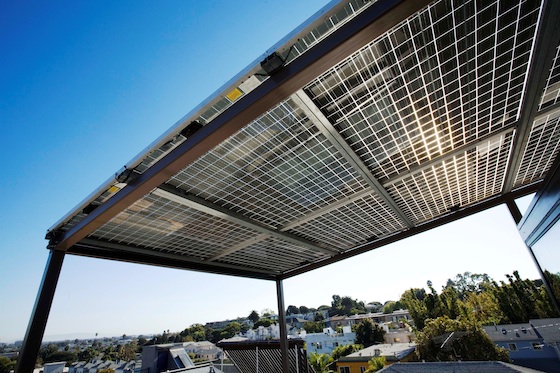
Suntech, the world’s leading solar panel maker, with 1,800MW of annual production last year in China, is now looking to Israel for its next launch of solar panels. With a panel made specifically to meet Israeli requirements, the top Chinese panel maker is making its debut in the tiny, parched, sunny nation with a new generation of high-efficiency solar modules, the Suntech 300W Vd series, with 72-cell modules of 6-inch black square cells per panel.
The series is designed to be tough, water conserving and lightweight enough for typical Israeli rooftops.
Ecco Ukka’s funky fabric jewelry pieces are green, fashion forward, and comfy all at the same time.
It’s not easy to make it cool to be green. Eco conscious designers – who believe that you can have sleek Prada-esque taste and environmental values at the same time – often have a hard time shedding the crunchy granola label. Occasionally a handful of eco designers make it to the high ranks of haute couture (as is the case with Lebanese designer Ziad Ghanem), and we hope that they keep bringing high eco fashion to the world. Liat Kadosh’s line of upcycled fabric jewelry – Ecco Ukka – is one more green design line that should make it there as well.
The verdant valleys in the Toubkal National Park stand in stark contrast to the dry, red mountain sides.
After my last visit to Toubkal National Park in Morocco’s high Atlas Mountains, where I ungracefully scrambled to the summit of its namesake in order to prove to myself and the world that I am cool enough to climb to the highest point in North Africa, I couldn’t walk properly for days after.
Over the weekend, I went back via the Ourika Valley. But this time, while there were moments of challenging hiking, my focus was on understanding the Berber people who live in small iron-red homes tucked into the side of steep slopes. With my talented mountain guide leading the way, I trekked across a handful of loose scree peaks and verdant valleys, occassionally stopping to drink mint tea with the locals, and admire their terraced agriculture plots. Naturally, what seems “so sustainable” has a more complicated background.
A municipal council in Denmark has rejected Better Place’s blue and gray electric vehicle chargers!
If powered renewably, Better Place electric vehicles can significantly reduce greenhouse gas emissions (unless you listen to Dan Rabinowitz). This potential transition to cleaner vehicles notwithstanding, one Danish municipal council has vetoed Better Place chargers because of their color. Frederiksberg Council claims that the chargers which accompany any new Better Place electric vehicle are not suitable for street installation because they are blue and gray, and not green.
Human genetic material and human gelatin – coming to your marshmallows and Jello soon?
Reading the ingredients list in any processed food is always thought-provoking. If you really want to know what those mysterious combinations of letters and numbers mean, you have to become adept at Internet research. So I suppose it could be argued that artificial colors and flavorings, the various forms of sugars, like that derived from GM beets, addictive chemicals, and strange substances like meat glue are actually good for us.
I mean, it’s intellectually stimulating – tracking down their origins and possible side effects. Like a puzzle or a good detective story, right?
Not.
Now how about human genes in your drug capsules, dessert, or cosmetics?
The latest stomach-turning development in the science of food processing is gelatin derived from human genetic material. According to the American Chemical Society, scientists at the University of Chemical Technology in Beijing, China, are working on culturing human collagen genes to yeast. In this highly synthesized process, the human-DNA-laden yeast does what yeast does so well, reproducing itself many times over and making massive amounts of gelatin. Human-derived gelatin.
The advantage in this gelatin over the conventional animal-based kind, is being able to get around allergic responses and risk of infectious diseases carried by animals, claim the Chinese scientists. Is it vegan?
Having spoken to a biochemist of my acquaintance who prefers to remain anonymous, it becomes clear that the gross-out factor is the major deterrent in our minds. There’s no question of cannibalism. It’s not necessary to boil down human bones or skin.
An inner-cheek swab would provide enough DNA to start the synthesis. According to my source, the manufacturing process is already well-known and widely used. And the original human material is so remote from the finished product that ethical concerns are irrelevant.
Well, it depends on what you consider ethical. To observant Jews and Muslim, not to mention vegetarians or vegans, this kind of food is abhorrent. In addition, humans are full of infectious diseases, just like animals, so the “cleaner than animal-based” argument seems specious.
Since this human-derived gelatin falls under the safe food category, it might not even be required to appear on labels. One more reason to avoid processed foods. As if we needed another reason.
Yet the scientist I spoke to brought up another issue: this kind of gelatin is essentially another genetically modified food. It’s not yet known how our bodies ultimately react to synthetic foods. We were born with enzymes that help us metabolize animal and vegetable foods, but handling synthetic foods wasn’t built into our body’s blueprint. They are viewed as irritants by our natural systems and treated as such.
Now, what’s an allergy? Reaction to an irritant, isn’t it? And with current theories about the origins of many cancers coming from constant cellular irritation, you really do have to pause for thought. Before you treat your child to GMO food, swallow a capsule, or apply makeup, that is.
More on creepy synthetic foods to avoid on Green Prophet:
Turkey imports more than three-quarters of its primary energy supply, primarily from Russia and Iran. The country’s energy ministry says it wants to become less dependent on foreign sources — but how sensible are its methods?
As Turkey faces a 10 percent growth rate in energy demand and unrest in the Middle East pushes oil and gas prices up, Turkey’s government has unveiled a new strategic plan to wean itself from foreign energy sources. Over the next four years, Energy Minister Taner Yıldız said last week, efforts to locate domestic oil and gas sources will “intensify”, and his ministry will continue trying to invest in nuclear power plants in Turkey.
This plan ignores the fact that Turkey’s richest energy resources lie above its soil, in the sun and wind. Turkey’s domestic energy policy does need a major overhaul — but the energy ministry seems to be heading in the wrong direction.
If the thought of walking around a bustling city doesn’t feel like eco-tourism to you, maybe it’s time to think again and implement ‘The Art of Mindful Walking’.
The term ecotourism often conjures images of mud brick eco lodges in the desert or visiting rare endangered plants on a nature reserve, but it can and should be broadened to include enjoying less than natural sites with more eco-friendly forms of tourism (such as walking and biking). As far as carbon footprints go, it may even be more eco-friendly to stay put in whatever city or town you’re already in and taking in the sites without the aid of fossil fuels rather than hopping on a highly polluting airplane to visit the aforementioned plants and eco lodges. If you’re unconvinced of the poetry of walking a city’s streets, though, take a cue from Londoner Adam Ford’s ‘The Art of Mindful Walking’.
Evian’s campaign tries to tell consumers to “live young”, but it may end up reminding the public about its younger generation and the future of the planet.
Elio Pacheco, the CEO of Danone Waters, came to Israel in late June to re-introduce Evian’s campaign and admitted that environmentalists are one of the brand’s biggest problems. Instead of going on the defensive, however, he said that Evian “has protected its water sources since the 1920s… We were one of the first companies to improve bottles. We introduced a smaller bottle for easier recycling. There is a lot we do on an environmental level, we just don’t shout it from the rooftops.”
The slogan of the new campaign, which consists mostly of models wearing t-shirts with babies’ bodies printed on them (thus making the models look like babies), is ‘live young’. This Green Prophet wonders if that slogan could backfire, causing environmentalists to claim instead that you should avoid drinking bottled water so that our young may live on a healthy planet.
Even if that thought doesn’t occur to most consumers, the Evian campaign is facing awkward timing since the Israeli Environmental Protection Ministry just joined forces with various green groups to fight the bottled water industry.
Maybe it’s time Evian did shout its environmental good deeds from the roof tops.
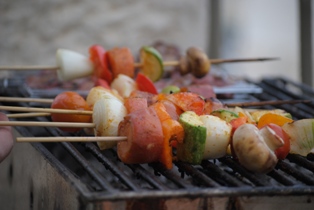
Fire up your grill and cook these aromatic vegetable chunks to delicious perfection.
If there’s one favorite way to cook in the Middle East, it’s the outdoor grill. There really is no way to produce that smoky flavor. We’ve gotten away from the traditional picture of a paunchy, unshaven guy in a T-shirt taking gulps from a can of beer while watching the hamburgers burn. Now he’s devotedly turning skewers of vegetables to tender perfection between those gulps of beer. (Because you can’t get away from the fact that cold beer is the best refresher while you’re standing at a grill, and new micro-breweries in Israel are making wonderful ones these days.)
Admittedly, meat is, and probably always will be, the first grilling choice in the Middle East. But tender vegetable chunks marinated in favorite Middle Eastern flavors go down well with even die-hard carnivores. And they’re so easy to make. Another vegetarian option for grilling is our za’atar-flavored tofu: instead of frying it, skewer it in chunks and grill. Whatever you’re grilling, make sure to have a few Middle-Eastern favorites to round out your meal, like majadra, the peasant dish of rice and lentils. And enjoy a cup of authentic Turkish coffee before you rise from the table.
Urban agriculture – whether rooftop or vertical – is largely touted to reduce citizen reliance on poorly regulated commercial farming and the general industrial food machine. But getting the seeds of urban agriculture programs to grow in a vast city like Cairo needs tender loving care. One group of friends is giving it their all.
Climate change could derail Ethiopia’s grand plan to produce 15,000 MW of electricity with a series of controversial dams.
The initial rhetoric surrounding Ethiopia’s Grand Millennium Dam seems to have subsided, but the plans to proceed with Africa’s largest hydroelectric plant are still very much in place. Although it is yet unclear how Ethiopia will raise funds for the project it can scarcely afford, combined with four other dams Ethiopia hopes to develop in concert with the Blue Nile’s 5,000 MW plant slated for the Benishangul-Gumuz region, the country hopes to produce a total of 15,000 MW of hydroelectric power by 2015. But in his zealous pursuit to reclaim the powerful Nile waters from Egypt and Sudan and generate economic autonomy for his people, Prime Minister Meles Zenawi is oblivious to one very important factor that could derail his ambitions: climate change.
The focus on sharing profits and taking communities into consideration means that the Islamic way of banking is (theoretically) better for the planet
The announcement by the CEO of Doha Bank, R Seetharaman, that Islamic banking is the right platform to boost ‘green financing’ as its values sustainable environmental development has got me thinking about Islamic finance again.
Is Islamic banking really good for the environment? If so, why? And what is Islamic banking anyway?
Islamic banking is system of finance based on the principles of Islamic laws – two of the main principles are sharing profit and loss and the other is the prohibition of collecting and paying interest. So if you take out a loan, interest cannot be paid or collected so the lender pays back the amount owed plus a small amount of extra money agreed on at the very beginning.
All investment must reflect Islamic principles and so you can’t invest in companies involved in alcohol, pork and gambling. Building on this, it could be argued that investing in ecological harmful projects is prohibited since Muslims believe that god has appointed humans are protectors of nature and investing in, for example, oil companies would conflict with this.
Islam Nature and Society Into Consideration
Another reason that Islamic finance is seen as a ‘greener’ alternative is that current economic systems (ie. neoliberalism or capitalism) put the human need for consumption above everything else. Nature is seen as a free good and so the cost of its extraction or use is not factored into the cost of production, thus encouraging its free exploitation.
In contrast, the Islamic principles which guide the economy include the notion that humans are trustees of nature who must ensure it is not harmed or unduly exploited. Furthermore, excess is consistently discouraged in favour of moderation and the welfare of the entire society is placed at the heart of every matter under consideration including finance.
For example, at the conference meeting entitled ‘Towards an Alternative Economy’, the head of Doha Bank explained that as Islamic banking is part of a system which values society as a whole, it is better placed to promote green finance initiatives such as developing water resources, dealing with global warming, promoting small-scale enterprises as well as encouraging women’s participation.
Gulf oil money is poised to give more
Islamic finance is clearly in a position to have a positive impact on the environment but the question is whether these green principles are actually able to translate into reality and play a role in Islamic finance. I have previously written about the green ethics at the root of Islam but also the lack of awareness of such principles amongst the average Muslim and also the abysmal environmental record of many Muslim countries.
Furthermore, I can’t see banks in the Gulf states holding back from investing in ecologically harmful oil and petrol companies due to the Islamic principle of duty towards nature. Thus, the existence of these green ethics is no guarantee of their application and that means that Islamic Banking still has a lot to prove before it gets its green seal of approval.

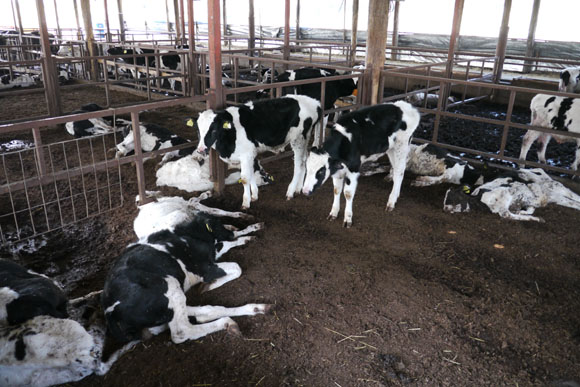
 “Fukushima cows” starving to death – but some got shipped to the meat markets.