EIT Pharma CEO Leen Kawas is advancing lonafarnib for chronic hepatitis D, showing how stalled late-stage drug programs can be revived and carried toward regulatory review.
Smart glasses are changing the economics of eyewear by turning conventional frames into higher-priced technology products. What used to be mainly a sale built around frame design, lenses, prescription needs and brand preference is now also a sale built around cameras, audio, AI features, app support and connected-device setup.
The film itself is about a Special Forces officer, played by Pitt, stranded in the Alaskan wilderness with his combat dog Odin after a plane crash. Odin is played by Uber, a highly trained German shepherd from a military and law-enforcement breeding line.
“Beavers effectively write their history into the landscape with each shrub they cut and every pond they create by damming streams,” said lead author Dr Georgia Hole, who carried out the research at Anglia Ruskin University and is now based at Durham University.
EIT Pharma CEO Leen Kawas is advancing lonafarnib for chronic hepatitis D, showing how stalled late-stage drug programs can be revived and carried toward regulatory review.
Smart glasses are changing the economics of eyewear by turning conventional frames into higher-priced technology products. What used to be mainly a sale built around frame design, lenses, prescription needs and brand preference is now also a sale built around cameras, audio, AI features, app support and connected-device setup.
The film itself is about a Special Forces officer, played by Pitt, stranded in the Alaskan wilderness with his combat dog Odin after a plane crash. Odin is played by Uber, a highly trained German shepherd from a military and law-enforcement breeding line.
“Beavers effectively write their history into the landscape with each shrub they cut and every pond they create by damming streams,” said lead author Dr Georgia Hole, who carried out the research at Anglia Ruskin University and is now based at Durham University.
EIT Pharma CEO Leen Kawas is advancing lonafarnib for chronic hepatitis D, showing how stalled late-stage drug programs can be revived and carried toward regulatory review.
Smart glasses are changing the economics of eyewear by turning conventional frames into higher-priced technology products. What used to be mainly a sale built around frame design, lenses, prescription needs and brand preference is now also a sale built around cameras, audio, AI features, app support and connected-device setup.
The film itself is about a Special Forces officer, played by Pitt, stranded in the Alaskan wilderness with his combat dog Odin after a plane crash. Odin is played by Uber, a highly trained German shepherd from a military and law-enforcement breeding line.
“Beavers effectively write their history into the landscape with each shrub they cut and every pond they create by damming streams,” said lead author Dr Georgia Hole, who carried out the research at Anglia Ruskin University and is now based at Durham University.
EIT Pharma CEO Leen Kawas is advancing lonafarnib for chronic hepatitis D, showing how stalled late-stage drug programs can be revived and carried toward regulatory review.
Smart glasses are changing the economics of eyewear by turning conventional frames into higher-priced technology products. What used to be mainly a sale built around frame design, lenses, prescription needs and brand preference is now also a sale built around cameras, audio, AI features, app support and connected-device setup.
The film itself is about a Special Forces officer, played by Pitt, stranded in the Alaskan wilderness with his combat dog Odin after a plane crash. Odin is played by Uber, a highly trained German shepherd from a military and law-enforcement breeding line.
“Beavers effectively write their history into the landscape with each shrub they cut and every pond they create by damming streams,” said lead author Dr Georgia Hole, who carried out the research at Anglia Ruskin University and is now based at Durham University.
EIT Pharma CEO Leen Kawas is advancing lonafarnib for chronic hepatitis D, showing how stalled late-stage drug programs can be revived and carried toward regulatory review.
Smart glasses are changing the economics of eyewear by turning conventional frames into higher-priced technology products. What used to be mainly a sale built around frame design, lenses, prescription needs and brand preference is now also a sale built around cameras, audio, AI features, app support and connected-device setup.
The film itself is about a Special Forces officer, played by Pitt, stranded in the Alaskan wilderness with his combat dog Odin after a plane crash. Odin is played by Uber, a highly trained German shepherd from a military and law-enforcement breeding line.
“Beavers effectively write their history into the landscape with each shrub they cut and every pond they create by damming streams,” said lead author Dr Georgia Hole, who carried out the research at Anglia Ruskin University and is now based at Durham University.
EIT Pharma CEO Leen Kawas is advancing lonafarnib for chronic hepatitis D, showing how stalled late-stage drug programs can be revived and carried toward regulatory review.
Smart glasses are changing the economics of eyewear by turning conventional frames into higher-priced technology products. What used to be mainly a sale built around frame design, lenses, prescription needs and brand preference is now also a sale built around cameras, audio, AI features, app support and connected-device setup.
The film itself is about a Special Forces officer, played by Pitt, stranded in the Alaskan wilderness with his combat dog Odin after a plane crash. Odin is played by Uber, a highly trained German shepherd from a military and law-enforcement breeding line.
“Beavers effectively write their history into the landscape with each shrub they cut and every pond they create by damming streams,” said lead author Dr Georgia Hole, who carried out the research at Anglia Ruskin University and is now based at Durham University.
EIT Pharma CEO Leen Kawas is advancing lonafarnib for chronic hepatitis D, showing how stalled late-stage drug programs can be revived and carried toward regulatory review.
Smart glasses are changing the economics of eyewear by turning conventional frames into higher-priced technology products. What used to be mainly a sale built around frame design, lenses, prescription needs and brand preference is now also a sale built around cameras, audio, AI features, app support and connected-device setup.
The film itself is about a Special Forces officer, played by Pitt, stranded in the Alaskan wilderness with his combat dog Odin after a plane crash. Odin is played by Uber, a highly trained German shepherd from a military and law-enforcement breeding line.
“Beavers effectively write their history into the landscape with each shrub they cut and every pond they create by damming streams,” said lead author Dr Georgia Hole, who carried out the research at Anglia Ruskin University and is now based at Durham University.
EIT Pharma CEO Leen Kawas is advancing lonafarnib for chronic hepatitis D, showing how stalled late-stage drug programs can be revived and carried toward regulatory review.
Smart glasses are changing the economics of eyewear by turning conventional frames into higher-priced technology products. What used to be mainly a sale built around frame design, lenses, prescription needs and brand preference is now also a sale built around cameras, audio, AI features, app support and connected-device setup.
The film itself is about a Special Forces officer, played by Pitt, stranded in the Alaskan wilderness with his combat dog Odin after a plane crash. Odin is played by Uber, a highly trained German shepherd from a military and law-enforcement breeding line.
“Beavers effectively write their history into the landscape with each shrub they cut and every pond they create by damming streams,” said lead author Dr Georgia Hole, who carried out the research at Anglia Ruskin University and is now based at Durham University.
Israeli clean tech innovators comprise 8 percent of the world’s best clean tech companies according to this 2011 award.
It’s the third year running that the Cleantech Group has put together its Global Cleantech 100. Last year, 7 Israeli companies were on the list. This year we see some repeats, with 8 on the list if you include BrightSource, Greenroad Technologies and Better Place –– both founded by Israelis but with operations in the USA. I have interviewed them all in the past.
Solar energy is predicted to be important energy source in USA by 2031
The just completed Solar Power International Conference and Exhibition in Dallas Texas painted a bright future for the use of solar energy in the USA, according to Julia Hamm, President and CEO of the Solar Electric Power Association (SEPA). Hamm, who addressed the conference a few days ago, predicted that solar energy will become an important of the US utility system during the next 20 years and result of less reliance on fossil fuels. Some of her predictions include a national clean energy policy by 2013 and the majority of cars in America running on electricity by 2022. She also predicted that solar energy will be the largest job creator by 2026 and that at least 30% of the nation’s utilities will run on solar energy by 2031. Is she dreaming or could this really happen? If it does, this means opportunities for Middle East companies and innovators.
Announced with much fanfare, the plans to build an new bus transit in Jordan have been quietly shelved pending further review
Back in early 2011, the Jordanian government announced that it would be building a new impressive bus transit aimed at reducing congestion along Amman’s busiest routes. The Bus Rapid Transit (BRT) plans entailed operating high-capacity buses on segregated lanes that could carry more than 120 passengers and run on a three-minute frequency during peak hours. It was seen as a huge leap towards better public transport in the city but the recent suspension of these plans – without much explanation and one year before their planned inauguration – hasn’t been well received.
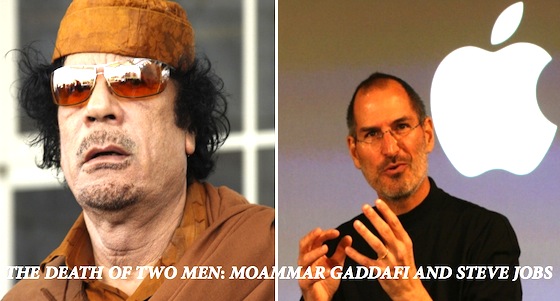
When Steve Jobs died, the world mourned. But the Arab World is throwing a party at news of Gaddafi’s violent end. How are these two men different and how can we prevent the rise of future Gaddafis? Tafline explores these questions in the following opinion piece.
After Steve Jobs died, the world poured out their sorrow. We held vigils and wrote flowery tributes. The media analyzed everything from what motivated his iron discipline right down to the black turtleneck shirt he used to wear. He wasn’t a saint. After all, he denied the existence of a child he fathered. Yet we treated him like one.
But upon hearing the reports that Gaddafi was finally captured and killed after months of shocking violence, news that was verified by Al Jazeera’s disturbing footage of Libya’s former leader lying dead and wide-eyed in blood and dirt, we find ourselves fighting callous impulses to celebrate his death. Gaddafi, we all know, was a bad, bad man.
There is reason to compare these two charismatic figures. Although Gaddafi had much better fashion sense than Jobs, both of them came from broken homes, both possessed inordinate intelligence, and both relentlessly pursued their ambitions, amassing great wealth in the process. So, what went wrong? How is it that genius can take two such vastly different trajectories?
Regional Etsy shops unite to form old-fashioned collaborative studios, online.
Etsy, the online handmade and vintage shopping platform, has done amazing things to help people buy handmade, eco-friendly and local products. Artisans who are marketing their own products can easily set up online shops on the site, and on the buying end, Etsy has made it very easy to shop local by looking for products made and sold near you. Crafting and selling products alone from one’s home or (for the lucky ones) from a studio can be isolating, though, to some artisans. Which is why it’s great that Etsy Teams have started to develop, creating virtual collaborative studios for craftspeople of particular regions. Including, of course, the Middle East.
Etsy Teams allow artisans to communicate with each other, learn about other people’s work, promote each other, and even sell together and plan local bazaars. Local teams of Etsyians have emerged so far in Egypt, Israel, Jordan and the UAE – and hopefully more groups will emerge in the future.
This Syrian olive tree is loaded with fruit, most of which will fall to the ground, unpicked.
The autumn olive harvest is still in full swing, and those of you who are now enjoying picking and preserving this ancient Middle Eastern fruit are surely aware that this year’s crop is much better than the poorer crop years of the past years when olive crops in both Israel and the Palestinian areas were much less. I have been engaged for several years now in an “urban harvest” where people grow and harvest their own fruit and veggies in the middle of populated urban areas. Here’s how I do it.
White olives are rare but you can find them in Greece
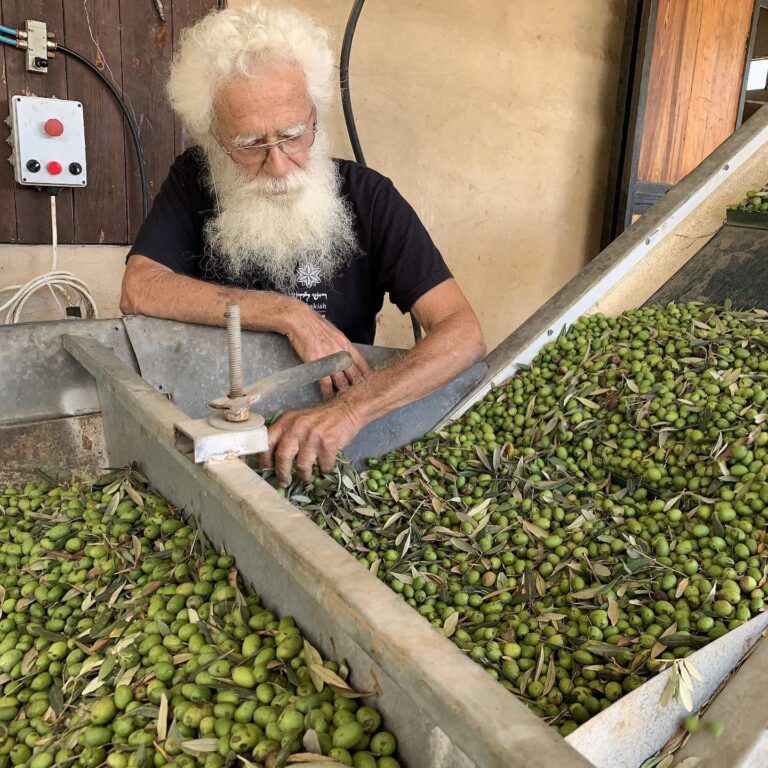
Picking one’s own fruit is a very important part of this endeavor, and I recommend doing this as otherwise, most of the fruit on these “park trees” wind up falling to the ground or sidewalk as the case may be.
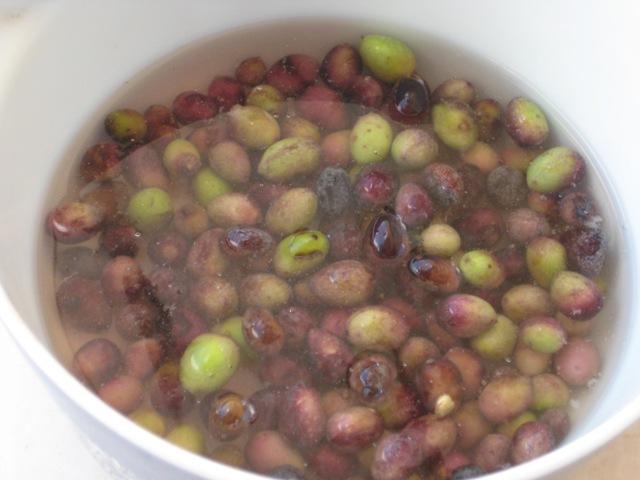
My pickling method for green olives is very simple. After picking, sorting, and washing the fruit (try not to mix varieties, if possible) soak the olives in clean water for 10 – 12 days, changing the water daily. I recommend using either water from an under the sink filtration unit or a Brita water filter, to rid the water of chlorine and minerals which can affect the taste of the olives. These nasty chemicals can also affect our health.
The fruit is ready to be put in jars for picking when it changes color and begins to have an “olive” color and odor to them. The water soaking process takes a lot of the bitterness out of the fruit.
Soaking olives for 30 days takes away the bitterness
Soaking olives: change water daily
For the pickling process use clean jars in good condition and with lids that are not rusty. Cleaning the jars with hot soapy water and then rinsing in hot water is recommended as well.
When pickling, I make a brine consisting of water, rock salt, vinegar, and taste conducive ingredients like lemon slices, clean olive leaves, and pieces of fresh garlic.
There’s no set formula for the “spices” as it depends on whether one wants “garlicky” olives or those with more of a lemon taste. You can also add some cut chili peppers for a bit of a “kick”, if desired.
The brine has to contain at least 10 percent salt and an equivalent amount of 5% acidic vinegar (the citrus type is best) for the pickling to be successful.
Olives fermenting in a jar
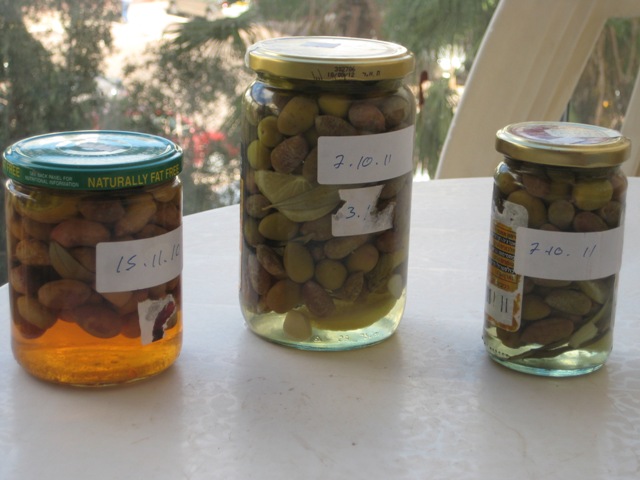
Processed olives: jar on left has been curing almost a year.
The actual pickling process simply involves putting layers of fruit, lemon slices, olive leaves and garlic chunks or slices until they fill the jar almost to the top.
Then pour in the brine mixture until it reaches just under the top of the jar (about 1/4 inch or 5 cm). Before closing the jar lid, pour enough good quality olive oil in to cover the entire top of the brine mixture.
This keeps mold from forming during the pickling process. After tightly closing the jar and checking for leakage (turn jar upside down to do this) wipe the outside of jar to clean off any picking residue and then label the jar with the date that the picking process was done – this makes it easier to know how long the ingredients have been “working”.
Store the jars in a place away from sunlight (like in a kitchen cupboard) for a minimum of 2-3 months before using.
Ripe olives will cure faster, so bear this in mind if picking ripe or nearly ripe olives.
After opening a cured fruit jar, store it in your refrigerator. Remember that the longer the curing or picking process is allowed to work, the better the olives will taste. And best of all, you have the enjoyment eating olives you picked and pickled yourself.
The demand for exotic animals in the Middle East – and particularly in the Gulf and Egypt- is putting animal’s lives at risk
From pet cheetahs on the streets of Dubai to python and falcon egg smuggling, the Middle East clearly has a wildlife trafficking problem. Even more troubling is that the market for these exotic animals is so lucrative that smugglers are putting the animal’s life at serious risk just to make a quick buck. According to the Middle East branch of the International Fund for Animal Welfare, smugglers commonly sedate young animals and carry them on board planes in hand luggage. But many never survive the journey.
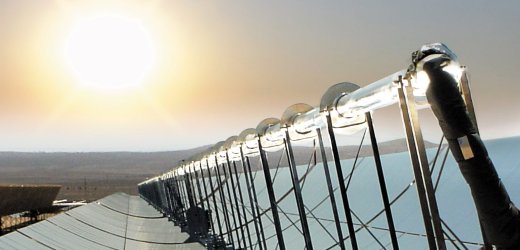
BrightSource Energy is making a big bet on CSP while others switch to PV
The third huge US solar project from BrightSource Energy is its largest yet. At a whopping 750 MW it is the size of three or four US coal or gas plants.
But it comes at a time when many utility-scale solar companies are switching to PV (photovoltaic) solar – those traditional rooftop solar panels that most people associate with solar – from Concentrated Solar Power (CSP) such as this. Why?
In an extensive interview with the Jerusalem Post, ex-Shell scientist Harold Vinegar who is part of the Israel Energy Initiatives (IEI) behind the oil shale venture, insists that Israel has the potential to extract “250 billion barrels of oil and perhaps more” using cleaner and cheaper techniques.
H.R.H. Princess Alia Al Hussein (pictured right) is known around the world as an advocate for animal rights. She is currently on a mission to end the inhumane slaughter of animals for halal meat. Just in time for Eid al-Adha!
Jordan’s H.R.H. Princess Alia Al Hussein – sister to King Abdullah II – believes that stunning animals prior to slaughter is not only halal, but should be mandatory. Ḏabīḥah (ذَبِيْحَة) is the word used to describe how Muslims ensure that the meat they eat is pure and wholesome. According to a Wikipedia entry on the subject, “this method of slaughtering animals consists of using a well sharpened knife to make a swift, deep incision that cuts the front of the throat, the carotid artery, wind pipe and jugular veins but leaves the spinal cord intact.”
Unfortunately, many Muslims and Jews, who have similar rituals for kosher meat, take these traditions to drastic ends – often killing animals prior to stunning them. Last year we wrote about a bloody scene in Egypt, where scores of livestock were butchered on the side of the street in a manner considered more haraam (forbidden) than halal. And Australia, which produces a lot of the meat exported to the Middle East considers it perfectly lawful to slaughter animals without stunning them first. Longtime animal rights activist Princess Alia is determined to change that.
Natasha Paracha was Miss Pakistan World in 2008. In 2011, she’s using her beauty and smarts to build a sustainable renewable energy climate in Pakistan.
Everyone knows that the first thing you ask any beauty queen is about that wish –– what she would do to make the world a better place if she ruled the planet. In 2008, Natasha Paracha got that question moments before she became Miss Pakistan World. But instead of pursuing a glamorous tour promoting products, she chose to make her wish come true: today she is using education as a tool to accelerate clean technologies and sustainable development in Pakistan.
Natasha is from Islamabad, Pakistan and is residing in New York City and lives between both worlds helping Pakistan become more sustainable. She is doing this in a number of ways –– both locally and globally. Her insights can help investors and philanthropists access opportunities to ignite change.
In Pakistan she works with the Alternative Energy Development Board, the Ministry of the Environment, and with private businessmen focusing on climate change and renewable investments. In North America she’s the spokeswoman for Katerva, an ideas and technology accelerator.
Green Prophet speaks with Paracha on what investors and entrepreneurs can learn about the clean tech opportunities emerging from Pakistan, desperately in need of help.
From overstretched contractors exposed by Wikileaks to Japanese criticism over the poor selection of the reactor site, Greenpeace is raising serious questions over Jordan’s nuclear plans
However, a local branch of Greenpeace has been raising serious questions about these plans. One of which is the ability of the Russian company Atomstroy Export – which is one of the final three bidders currently being considered by the Jordanian government – to fulfill its commitments. The other being the poor location of the nuclear reactor so close to a water-poor, bustling metropolis.
Bono’s ONE organization advocates inviting hungry people into your sukkah this holiday time.
Bono and Sukkot. These are two words that you have probably have never seen in the same article, let alone in the same sentence, but the U2 frontman is breaking ground by drawing connections between between important social causes and Jewish symbols. Besides being one of the greatest rockers alive, many of you may know that Bono’s advocacy group fights poverty and brings awareness to the dire situation that permeates the horn of Africa, where a severe drought has affected millions of people. The group recently released a PDF booklet that links the desperate situation there with the ancient Jewish holiday Sukkot that is still underway until Thursday.
Jogging is great exercise for you, and for the batteries that it can power.
A friend of mine in college once had a crazy idea to solve the American obesity crisis and alleviate global warming: encourage the obese to exercise and harness the energy created by their treadmills, ellipticals, cycling machines, etc. as an alternative energy source. The idea was a little unorthodox, but had a kernel of brilliance as well. Why not use human activity as an energy source?
Using power generated from human activity such as walking or jogging is not a new idea, but has previously required large, clunky equipment. Two researchers at the University of Wisconsin Madison, Tom Krupenkin and J Ashley Taylor, have been working on that issue, though, and have come up with an innovative and convenient way to harness human jogging power.
Navies crowd into once placid waters as Turkey presses Cyprus on gas reserves
Turkey has a corvette, frigate and helicopters escorting its exploration vessel, the Piri Reis, as it explores for gas and oil. The US has quietly dispatched an aircraft and Russian naval vessels have been seen patrolling. News reports say US reconnaissance planes have circled the vessel on at least two occasions and on another occasion low-flying Israeli warplanes and helicopters “harassed” a Turkish ship.
Once the preserve of fishing boats and yachts, in the space of just a few weeks the serene waters of the Eastern Mediterranean have become a field of contention. As Greek Cyprus begins exploiting its potentially vast gas and oil reserves, Turkey has asserts its growing role as a regional power, and a worried Israel is pushing back.
















 Natasha Paracha was Miss Pakistan World in 2008. In 2011, she’s using her beauty and smarts to build a sustainable renewable energy climate in Pakistan.


 Bono’s ONE organization advocates inviting hungry people into your sukkah this holiday time.

 Navies crowd into once placid waters as Turkey presses Cyprus on gas reserves