
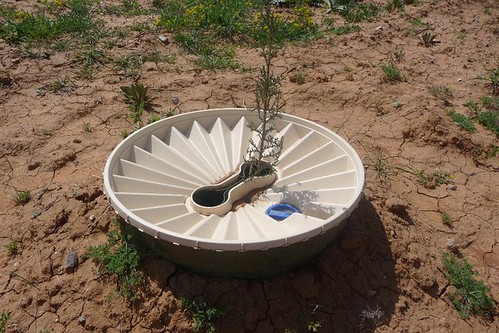
No need for irrigation, the Groasis Waterboxx yields plant growth in deserts and on rocks
Have you ever wanted to grow trees without actually planting them? The Groasis Waterboxx is a Jordanian invention that will do just that. Launched in June 2011, the Groasis nurtures a sapling’s growth without the hands-on fuss of shovelling soil and topping up water. With hopes to see it distributed throughout famine struck East Africa, the Groasis Waterboxx could be one solution to natural food shortages.
Groasis Waterboxx Grows Trees In Deserts
PET Bottles Upcycled Into Art Using Glass Blowing Techniques

 PET bottles hark back to their glass bottle predecessors using traditional glass blowing techniques.
Plastic bottles have pretty nasty reputations for being bad for human health and the environment. Very few people are arguing that plastic bottles (and especially bottled water) are a good thing in the long run. Some companies, such as Israeli fashion label EcoGir, have tried to solve the plastic bottle problem by upcycling PET bottles into chic men’s suits. And now, Israeli designer Nitsan Debbi has tried to solve the aesthetic and environmental issues surrounding the ubiquitous plastic bottle by upcycling it into beautiful artwork using glass blowing techniques.
Breastfeeding Moms More Agressive than Those Who Use Bottles

Breast feeding moms have lower blood pressure and behave more aggressively compared to women who are bottle-feeding their children, suggesting that breast-feeding dampens the body’s typical stress response to fear, new research suggests.
Women who breast-feed are far more likely to demonstrate a “mama bear” effect — aggressively protecting their infants and themselves — than women who bottle-feed their babies or non-mothers, suggests a new study in the September issue of Psychological Science. The small-scale study conducted in the US investigated something known as ‘lactation aggression’ or ‘maternal defense’ in mammals. Previously, we’ve documented benefits of breastfeeding, religious attitudes towards the practice, as well as tips to breastfeed in public in the Middle East.
Ridiculously Simple Technology Can Save Millions from Arsenic Poisoning
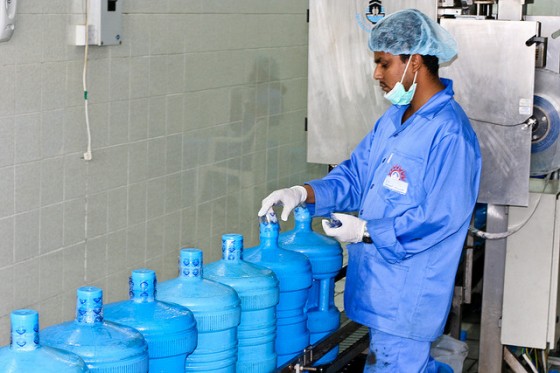
Zam Zam holy water in Mecca is contaminated with arsenic, but researchers in the US have discovered a ridiculously simple technology that can render contaminated water safe to drink.
Millions of people in the developing world are frequently hapless victims of arsenic poisoning. This is not because they have angry spouses, but because arsenic is an odorless, colorless, and tasteless compound derived from soil and rock deposits, as well as agricultural and industrial sources, that enters the water stream undetected. Even Zam Zam holy water in Mecca is contaminated. Rather than attempt to overhaul the entire drinking water system of these millions of people, Tsanagurayi Tongesayi Ph.D from Monmouth University presented a low-cost, ridiculously simple solution at a recent American Chemical Society meeting in Colorado that uses plastic (our nemesis) to remove arsenic from contaminated water.
Jerusalem Boy’s School Makes Electricity On Roof

A vocational yeshiva in Jerusalem meets a third of its own energy needs.
The Jerusalem Post reports that the Boy’s Town rooftop solar panels have been generating 40 kilowatts per hour since July. Boy’s Town is a vocational yeshiva in Jerusalem for students with socioeconomic challenges. The electricity generated on the school’s rooftop is sold directly to the Israel Electric Corporation for a reduction on the school’s monthly electric bill. Suntech’s offer to sell solar panels to Israel coincides with the all the new electricity in the Israeli air; maybe similar future projects will take advantage of it.
Although long in fulfillment, the project is now generating other tangible benefits. School officials, viewing electricity production via computerized monitors, know how much the school economizes in money ( about NIS 12.000 monthly) and in carbon emissions.
Should Home Egg Farmers Vaccinate Against Avian Flu?
 Everyone hates needles, but don’t be a chicken if you want to vaccinate them against the new avian flu
If you’ve been reading the news you’ll know that there is a deadly outbreak of the avian flu virus circling the globe again. This one appears to be deadlier than every, UN health authorities are reporting. The new avian flu virus the H5N1 is rearing its head in the Middle East in Israel and the Palestinian Authority. And I bet in other locales –– places way too busy with political reform and uprisings to take stock of the problem.
For small time egg farmers like myself (see how I made a chicken coop), I am curious: should I be inoculating my birds? I asked, and the UN’s press office contacted a senior vet: it is the prerogative of each country to decide what action to take.
Dear Ms Kloosterman,
FAO Senior Animal Health Officer Jan Slingenbergh has this to say:
“Vaccination in different poultry species and production systems, against the background of a continually changing H5N1 and other Influenza A viruses risk scenario in poultry, is the prerogative of the public veterinary services of the respective country.
FAO keeps a focus on the international / global dynamics and ensuing broad health management ramifications.”
So the answer? It depends. Egg farmers, small or big, should be in touch with their local veterinary services in their respective countries. Read more about the avian flu here. The picture above, by the way, is of me as a young girl. Egg farming.
Post-Revolution Development in Egypt Destroys Popular Red Sea Dive Spot
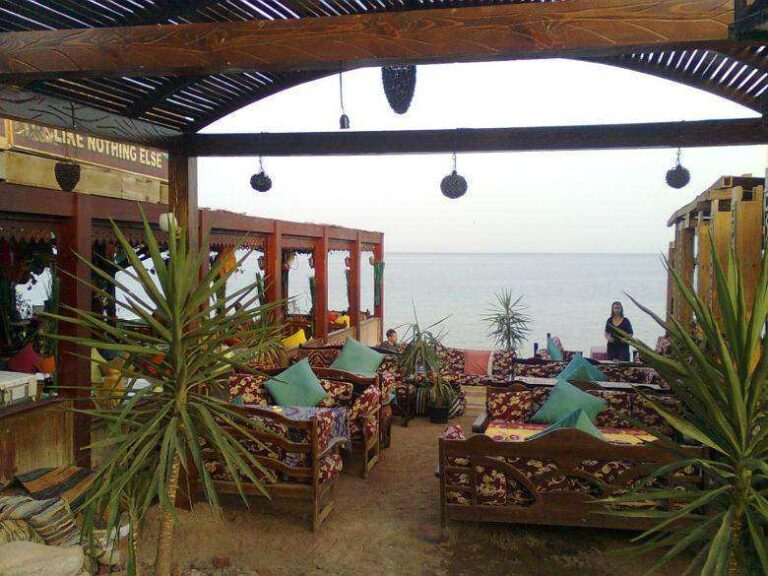
 The revolution in Egypt has left a power vacuum that is allowing unchecked development to take over a once thriving, quiet dive spot.
Apart from the Egyptian revolution itself, a powerful culmination of civil disobedience that roused thousands of somnambulant citizens from decades of political apathy, it’s still hard to see in what way this grand moment in history has been good for that country. While the country attempts to work through its political uncertainty, and as funds that were set aside to help environmental organizations enforce regulations dry up, unscrupulous developers are exploiting the attendant power vacuum with projects that take nary an environmental or social impact into consideration. Just south of its border with Israel on the Sinai peninsula, Dahab is an immensely popular Red Sea dive spot that is in serious jeopardy of losing its precious coral reefs and rustic atmosphere to a series of crowded resorts.
RECIPE: Late-Summer Pickled Peppers
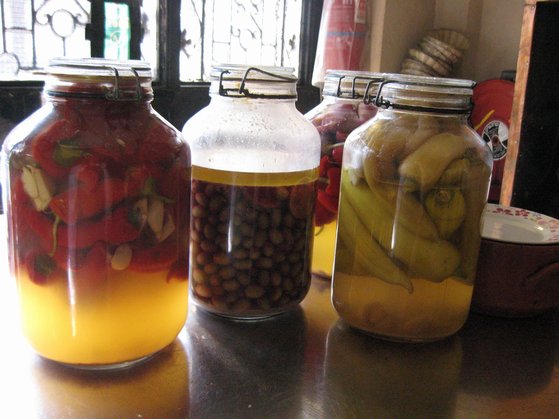

The late-summer peppers are excellent right now, firm-fleshed and plump, with smooth skins and that robust flavor that marries so well with vinegar. Why not pickle some of them? Lemon season is just starting too, so try our recipe for preserved lemons while you’re in the pickling mood.
Making pickles is easy. It’s a matter of brine and spices added to the main vegetable, or vegetable mix. Make them as plain or as elaborate as you like, but that’s all it really amounts to. Since olive season will be starting soon, keep our method for making home-made olives in mind too. But let’s return to peppers. Like large, sweet bell peppers? Or do you prefer something fiery to serve as a true Middle-Eastern relish, as pictured above ? Any kind of pepper works in this recipe.
Pickled Middle-Eastern Peppers
Ingredients:
6-7 large bell peppers of different colors
or 8-9 slender hot peppers
2 cups water
2 cups apple cider or white wine vinegar
2 tablespoons sugar
1 teaspoons salt
3 cloves garlic, peeled and sliced thicklyIf pickling hot peppers, wear thin gloves to protect your skin. Do not touch your face at any time while processing the peppers. Gloves aren’t necessary to work with bell peppers.
1. Rinse and dry the peppers. For bell peppers, remove the stem ends and slice into quarters or eighths. Remove their seeds and white inner membrane. Leave hot peppers whole.
2. Pack the peppers into a jar that contains 1-1/2 liters (6 cups, 1 -1/2 quart). Stand the jar on a dry towel.
3. Boil the water, vinegar, salt and sugar for 5 minutes, covered.
4. Pour the hot vinegar brine over the peppers, using a funnel. Drop the garlic in.
Suggestion: taste the brine before pouring it over the peppers. Add more salt or sugar to taste.
5. Cover and allow to cool. Store in the refrigerator for 1 month before eating.
Enjoy!
More carefully-concocted Middle-Eastern classics and condiments on Green Prophet:
Israel Readies Offshore Natural Gas Pipeline


Tamar undersea gas wells will soon supply Israel with needed natural gas – but at what costs?
It has taken some time to reach this stage, but Israel’s undersea natural gas exploration activities by such companies as Noble Energy and the Delek Group have received greater attention as an energy source in the wake of a number of terror attacks on the natural gas pipeline supplying natural gas by Egypt to Israel. It was reported on September 1 in Israel’s Globes financial newspaper that a pipeline to link the Tamar undersea gas field to the Israel mainland is about ready to be laid , with completion estimated by the end of 2012.
Ocean Parts Sculptures Are A Strange Gift of the Sea

To all of you out there who used to make seashell necklaces on the beach as kids – did you ever think of making one of these?
Beautiful beaches can be found all over the Middle East, but unfortunately many of them are plagued by unnatural waste. During the hot summer months it is a common pastime to go down to the beach for some natural air conditioning (as opposed to unnaturally air conditioned beaches), but the result is all too often that a lot of waste is left on the beaches. The most ubiquitous form of beach waste is cigarette butts, but Israeli designer Koby Sibony’s beach waste sculptures teach us that there are many other types of beach trash out there.
Agrexco Liquidation: An Obituary for a Company Relying on Cheap Water

Agrexco’s image of produce may now be gone forever
Israel’s agricultural feats have often hailed as a modern miracle in the water deprived Middle East. This “miracle” pumped up with state-subsidized water is now having to face the realities of global warming and climate change, even though the Israeli public have been supporting strong action on climate change for several years. Perhaps the most outstanding recent example of how the current realities of climate change are affecting the country’s agricultural progress, is the recent news that Israel’s well known agricultural exporting consortium Agrexco is now bankrupt and faced with liquidation as reported in The Marker financial paper .
Avian Flu Rears Ugly Head Again in Israel and the Palestinian Territories

Recently affected areas avian flu areas appear to be in Israel and the Palestinian Territories.
The United Nations have urged this week for people to be ready against a possible but major resurgence of the Avian Flu, the H5N1, amid signs that a mutant strain of the deadly Bird Flu virus is spreading in Asia and beyond. There are unpredictable risks to human health. The H5N1 virus has infected 565 people since it first appeared in 2003, killing 331 of them, according to WHO figures. The latest death occurred earlier this month in Cambodia, which has registered eight cases of human infection this year — all of them fatal.
Israel’s GridON Keeps the Midnight Oil Burning
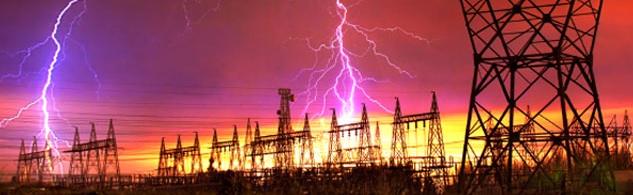
 It’s a fault current limiter to help large utility companies avert major power breakdowns.
I was sitting in the middle of an online boater’s exam back in Canada with my parents last week, when at question #18 the power went out. It stayed out all night, but was on before we woke up. A thunderbolt hit a power box near my cousin’s house on the other side of town (he saw the show) and the effects were widespread. Needless to say, we had to start the dreaded test over again a couple of days later. Thankfully it was done and my parents can drive their boats without worrying about getting a ticket.
We all know from experience that thunderstorms can cause power surges across the electricity grid causing massive blackouts. And a week before the blackout I’d just written about an Israeli company that hopes to address this need: Blackouts across the world now threaten to become more common as people’s power needs increase. High energy demands mixed with thunderstorms, solar storms, and the addition of renewables like solar and wind energy to the grid, creates an unpredictable mix of power variables infrastructure companies never had to deal with before. The Israeli company GridON may have a solution that a UK power company is now trying out.
5 Steps for Eating a Paleo Diet

 Modern agriculture started in the Middle East. Can people here switch to the Paleo Lifestyle and eat like Cave Men?
What should humans eat for optimal health? The key word here is optimal. Our bodies are remarkable machines, and we can manage, more or less, on a wide variety of foods. But what foods work with our natural physiology, rather than against it? While many look to the future and modern food technology for guidance, it may be wise to take a historical approach. Homo sapiens (that’s us humans) have been evolving for a couple million years. Agriculture is believed to have originated just 10,000 years ago – a mere blip in evolutionary terms – in the fertile crescent: present day Iraq, Iran, Turkey, Syria, Israel, Lebanon, and Jordan. So what did people eat before modern agriculture? Let’s take a look.
AquaAgro Fund II to Focus on Preventing Starvation with Water Investment

At its extreme, it is human life itself that is at risk from water scarcity
Can you imagine being this child’s mother? Perhaps she herself is also dying of starvation nearby, too weak to protect her dying child from this vulture that hovers expectantly nearby. Or already dead, perhaps.
It may seem inconceivable that something so horrifying could happen to you and yours. But this actually could be what happens to your own descendants in future centuries, even though you now live near a source of water and food and your life seems safe from such horror now. (New Record Heatwaves Not Like Good Old Dustbowl Days)
Increasing water scarcity is one of the effects of climate change, and the future could eventually be pretty grim for your own descendants if you are in a region that is presently under some water stress, such as the US Southwest or the MENA nations of the Middle East. (Israel Commits Itself to More Desalination)
Fortunately, there is a MENA clean tech firm that is preparing for the increased starvation risk brought about by the drought and water scarcities to come as a result of climate change.