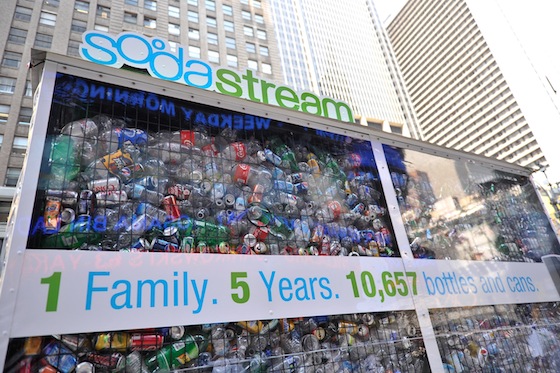
After SodaStream erected a cage full of Coke’s trademark trash in South Africa’s OR Tambo International Airport, the 20th such installation built around the world as part of the Israeli company’s marketing campaign, the powerful soda giant pulled out the big guns and hired litigation lawyers Adams & Adams to demand its removal.
Coke’s lawyers claim that SodaStream, a competitor, is making unauthorized use of their trademark in order to promote their own product and that their potentially damaging advertising campaign exists in contravention of the Authority’s Code of Advertising Practice (ASA) and common law. But SodaStream CEO Daniel Birnbaum refuses to back down. “It will take a lot more than a letter from a lawyer to shut me up,” he said – according to Forbes.
Trashing Coke
The SodaStream slogan depicted on the airport cage full of coke cans and bottles (in addition to other brands) claims that families who buy their renewable product will spare 5,078 bottles and cans every three years. In five years, one family can save 10,657 cans and bottles, according to a sign attached to a cage full of trash in New York City.
By contrast, one SodaStream carbonator makes 60 or 110 liters, equivalent to 170 or 310 aluminum cans, according to the company’s literature. “When empty, the carbonator is refilled and reused, ready to make more fizzy and tasty soda whenever you want it.”
SodaStream also points out that whereas their product turns ordinary tap water into tasty flavored fizzy drinks (as though such a product is now a god-given right), bottled water companies sold 37 billion bottles in the United States in 2005. “Bottled water wastes fossil fuels and water in production and transport, and when the water is drunk the bottles become a major source of waste,” the company claims.
Airport traffic and environmental awareness
But the campaign in South Africa has Coke worried, and so they should be. Between 2010 and 2011, nearly 19 million passengers traveled through the Johannesburg airport. That kind of exposure combined with increasing environmental awareness could be a lethal combination for Coke, which has established several waste-reduction campaigns in South Africa.
The lawyer’s letter demands that SodaStream not only remove “the cage,” but that they “undertake in writing to never use the company’s trademarks again or infringe on Coke’s advertising goodwill.
Despite having just 1% of Coke’s wealth and prestige, Birnbaum is staying the course.
“If they (Coke) claim to have rights to their garbage, then they should truly own their garbage, and clean it up. … We find it incredulous that Coke is now re-claiming ownership of the billion of bottles and cans that litter the planet with their trademarks… they should be sued in the World Court for all of the damage their garbage is causing, he said.
How green is SodaStream, really?
Meanwhile, it isn’t so clear that SodaStream’s environmental record is as sound as they would have the world believe. Our own editor-in-chief, Karin Kloosterman, says that “Sodastream has been around for years and is using the environment as a marketing tool. Most people I know buy a Sodastream for a friend’s wedding and the said machine goes out of use after the first canister of gas runs out.”

It seems very unlikely that SodaStream will win this trademark war, but at the very least, the struggle draws attention to an ongoing debate: should beverage manufacturers be held responsible for reclaiming their waste, or is this up to the consumer?
Let us know what you think in the comments below.
More on Soda and the Environment:
Toxic Kosher Coke Banned During Passover
Heart Attacks in Kids for One or More Cokes a Day?
Vimto’s Moldy Soft Drink Recalled in Dubai