Home Blog Page 416

Marine drone cleans plastic

marine drone, Elie Ahovi Industrial design, marine drone, Elie Ahovi Industrial design, clean sea of plastic
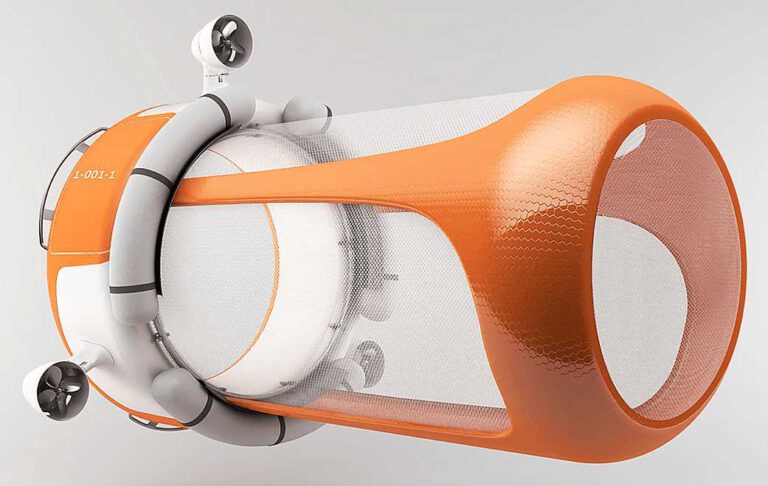
Marine drone, by Elie Ahovi Industrial design, cleans the sea of plastic

This Marine Drone could clean up our dirty work. Can a wealthy Saudi fund this prototype to clean our seas? Fourteen billion pounds of garbage, 90 percent of which is plastic, is dumped into the ocean every year and there is no sign of plastic waste reducing – in fact plastic waste has been increasing about 10% each year for the past 20 years.

In the Red Sea, Arabian Sea, Gulf of Oman, Persian Gulf and the Gulf of Aden, dumping untreated sewage and Industrial waste directly into the sea is unfortunately an extensive practice, but an additional recent threat is the increasing number of landfill sites located near the coast which are resulting in considerable plastic pollution near coasts and coral reefs. One solution, the Marine Drone Elie Ahovi Industrial Design, could clean up our waste.
marine drone, Elie Ahovi Industrial design, clean sea of plastic

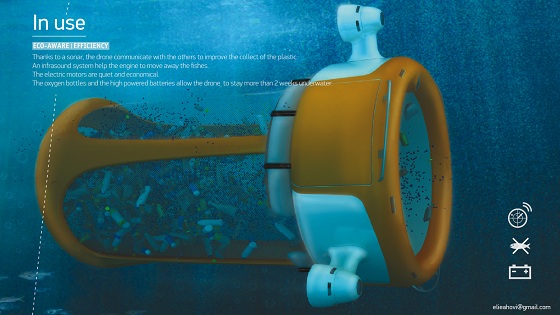
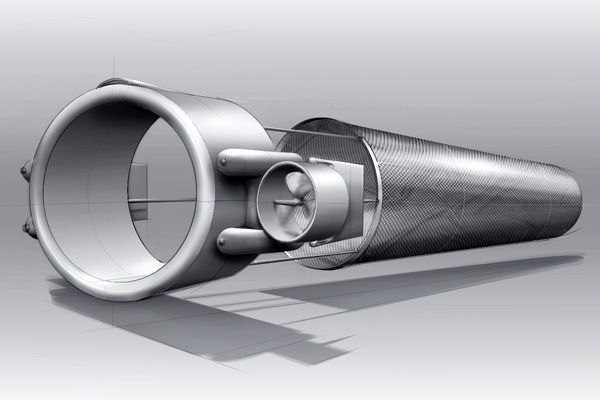
In response to a question by Veolia Environmental Services on how to collect plastic from the sea, a team of innovative industrial designers propose a Marine Drone (pictured above) capable of capturing drifting plastic.

The drone is basically a propelled oversized pool net with special sensors that keep aquatic animals away and high-powered batteries that allows it to stay in the water for more than 2 weeks.  Not much has been discussed regarding how much plastic each drone would be able to collect, the costs involved and whether the drone is capable of capturing the insidious nurdles which are the greatest problem.

marine drone, Elie Ahovi Industrial design, clean sea of plastic

Ten percent of all plastic ends up in the ocean, and has resulted in the largest landfill in the world: the Great Pacific Garbage Patch which is estimated to be twice the size of France. The Mediterranean is not spared from floating plastic garbage islands. Seventy percent of this ever-accumulating plastic sinks to the sea floor. In 2006, The United Nations Environment Program estimated that every square mile of ocean hosts  46,000 pieces of floating plastic and in some areas, the amount of plastic outweighs the amount of plankton by a ratio of six to one.

Americans buy over 29 million bottles of water every year, this uses 17 million barrels of crude oil annually, which would be enough fuel to keep 1 million cars on the road for one year. Only 13% of those bottles are recycled. The United Arab Emirates has the world’s largest per-capita ecological footprint; it currently consumes 25% of global plastic bags.

Aside from being a quantitative disaster in our sea, plastic has terrible properties. Once in the ocean there is no way plastic can completely biodegrade. Instead, plastic photodegrades breaking into smaller and smaller pieces of plastic called mermaid tears or nurdles. These tiny plastic particles can get sucked up by filter feeders and are ingested by marine animals which can poison them and lead to death. Nurdles also tend to soak up toxic chemicals which result in biomagnification a process whereby persistent organic pollutants and concentration of toxins increase as we move up trophic levels.

marine drone, plastic islands ocean, marine ecodesign, clean up ocean plastic waste The issue of plastic waste in our sea cannot be stressed enough, the figures are shocking.

Elie Ahovi drone plastic cleaner

But if this prospective Marine Drone project is eventually engineered who would pay to clean up the sea? The sea is a public good and water pollution is the result of several countries dumping so my question is: Are there the right incentives for countries in the Middle East to decide to invest in such ideas and maintain the common sea clean?

:: Elie Ahovi Industrial design

Solar Plane Proves Night Flights Possible – Returns to Spain

solar impulse solar power plane, spain morocco

It’s mission accomplished. The Solar Impulse, the world’s longest solar powered flight has landed back home in Madrid, Spain. The flight took 17 hours from Rabat, Morocco. The plane’s maiden voyage was from Spain to Morocco, proving that a solar-powered plane could fly both day and night. Next, say its owners Swiss pilots Bertrand Piccard and André Borschberg, is a flight around the world.

Design School Partners with Wineries to Give Wooden Barrels a Second Life

0

wine barrel, recycled wood, craft, chess boardI used to be a wine barrel… and now I’m a chess board.

Wine companies worldwide may be trying to ‘go green’ by producing organic wines (the wineries of the Middle East being no exception), but even so there is non eco-friendly waste associated with making vino.  A winery in the Israeli Negev desert has being using solar power to meet its energy needs for the past few years, but what about all of the materials that go into producing wine?

In order to address this issue, the wineries of the Golan region in Israel recently teamed up with the Industrial Design Department at the Holon Institute of Technology (HIT) to challenge young designers to find ways to upcycle used oak wine barrels.  Assisted by Ori Ben Zvi of Tel Aviv’s upcycling Studio Ubico, the designers came up with a bunch of creative ways to use the wooden barrels, prototypes of which will be exhibited this week in Tel Aviv.

Radio Groovalizacion Communicates Middle East Migration Through Music

 Radio Groovalizacion, music Middle East and North Africa, migration, intercultural musical projects, musical activism Toni PoloToni Polo, founder of Radio Groovalizacion explains how music and migration are shaping contemporary culture in the Middle East and North Arfica.

As an avid “world music” listener – although I don’t like this term but I still haven’t found a better one- it is always an immense pleasure to discover hidden musical gems. One organization that feeds you with just these jewels is radio Groovalizacion.  Greenprophet interviews founder Toni Polo to find out why and how radio Groovalization and its music is a successful medium through which people from the Middle East and North Africa can express, communicate and continue traditions.

Convinced that art and culture can raise social awareness, Ton Polo has been coordinating various intercultural schemes since 2006, either as a film director, radio journalist, DJ or cultural manager of his project “Migratory Music ”. He has been involved in various activities in relation with music, immigration, identities and integration collaborating with several NGOs and associations in Argentina, Spain, Senegal, Morocco, Turkey, Portugal and Mali.

Emigration from the Middle East and North Africa (MENA) to Europe has been an important political and economic topic in the past ten to fifteen years- in 2010 the stock of documented migrants was 18.1 million or 5.3% of the MENA region population. However little is discussed on the cultural, traditional and artistic impact migration is having on the country of origin and departure.

Japan Wants Israel Clean Tech Experts to Rebuild Fukushima

Japan, Fukushima, nuclear plant, Israeli experts, clean tech, clean-techJapan is seeking Israeli clean tech experts to help rebuild Fukushima, which was devastated by both an earthquake and a tsunami last year.

The Japanese company in charge of rehabilitation recently sent a delegation to Israel looking for experts and entrepreneurs, especially in the fields of water management and recycling. According to the company’s liaison in Israel, Lior Daeri, Israeli groups that participate will receive tax breaks worth NIS 50 million (roughly $12.8 million dollars).

Hijab gets caught in culture war

0

hijab woman musim headscarf
The woman’s hijab is being caught in a culture war based on intolerance

In June, a Jordanian woman was fired from her job for refusing to don a headscarf. She responded by filing suit against her Arab employer for unlawful dismissal, kicking off a media debate over how much tolerance is acceptable when Islamic and secular principles clash.

Vivian Salameh, a Christian, was assistant manager of corporate operations at the Jordan Dubai Islamic Bank since 2010. She told The National: “We are not in Iran, we are in Jordan, and we must continue to enjoy personal and religious freedoms as stipulated by our constitution. I respect the hijab (headscarf), but it represents Muslim women and I’m Christian.”

Christians make up nearly 4% of Jordan’s 6 million people.

The Shard is Qatar’s London land grab

17

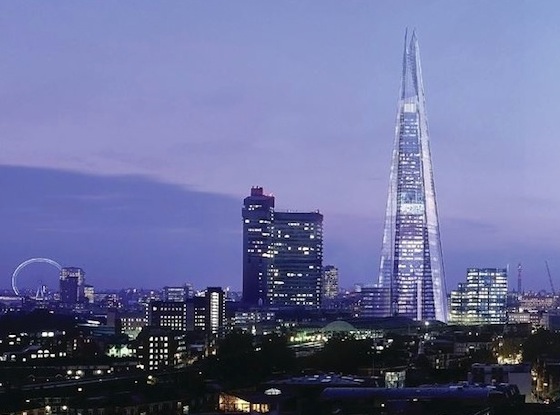
London, UNESCO, The Shard, Qatar, Renzo Piano, Land Grab, Islamic BankingWhen Britain’s own financing institutions staggered under the weight of the 2008 economic crisis, a Qatari consortium stepped in to finance The Shard in London- it’s a sleek pyramidal skyscraper designed by Italian starchitect Renzo Piano.

Officially inaugurated amid great pomp and circumstance, the building is small when compared to Dubai’s 2,717 foot Burj Al-Khalifa, but at 1,016 feet, it dwarfs the London Bridge Quarter in which it was built. But far from being a monument to Britain, the latest tallest building in western Europe is 95% owned by the government of Qatar.

The Jordan Valley’s Water and Land Under Occupation – Oxfam Report

1

jordan-valley-water-land-israel-west-bank-occupation-oxfamIsraeli settlements and restrictions on water and land are jeopardizing the possibility of peace – UK charity Oxfam says 

I have written in the past about the messy and controversial place where politics and the environment meets– especially between Israel and Palestine. However, it’s hard to ignore the political and ecological implications of the Israeli occupation of Palestinian land. Indeed Oxfam International, the UK-based NGO dedicated to confronting poverty, recently released a report on the economic and environmental degradation of the Jordan Valley. Titled ‘On the Brink: Israeli settlements and their impacts on Palestinians in the Jordan Valley,‘ the report looks in-depth at the implications of the Israeli occupation of the Jordan Valley and its wider political impacts in terms of hindering the peace process.

Yemeni Children Addicted to Khat are Skipping School

khat, Yemen, youth, illiteracy, education, water shortage, addiction

Khat addiction in Yemen has reached epic proportions and not only among adults. A recent report released by the World Health Organization shows that up to 20% of the nation’s children under twelve are also addicted to chewing the bitter stems of the Catha edulis plant, which produces a mild high akin to the effects of caffeine.

Whereas drinking khat juice is the new hip thing to do in Tel Aviv, in Yemen the epidemic has more serious consequences among the youth. Not only do children suffer from pale complexions and weak bones, but they also skip school in order to stay home with their khat-chewing families. This, warn commentators, could produce several generations of illiterate children.

Arab Building Showcases Traditional Green Architecture

2

sakhnin-green-building-arabA building in the Lower Galilee which showcases traditional architectural Arab styles with ecological benefits demonstrates that modern concerns can be resolved with ancient techniques

One of the most important things we need to do to tackle climate change is reduce the amount of energy we use. One way to do this is ensure buildings are better regulated so we don’t have to spend lots of money and energy either heating or cooling our homes and offices. However, this doesn’t mean we have to jump on the latest energy-efficiency technologies.

As an award-winning traditional Arabic building in the Lower Galilee shows (which we featured in our 2009 video), ancient building techniques can work just as well. Designed by Abed el-Rahman Yasin, a student of Hassan Fathy, the green building which is located in Sakhnin features 20 different energy saving features ranging from patios to cool the air, water features and mashrabiyas.

The building which was constructed using local materials is now used as an educational centre for green building technologies.

OP ED: Does Higgs Boson Particle Discovery Mean We’re too Close to God?

crab nebula nasa Crab or “Eye of God” nebula: NASA photo archives

Does the discovery of the “God Particle” mean that mankind is coming too close to God? Are we humans again trying to do the same thing as our ancient ancestors did when they tried to build the Tower of Babel in order to “see God”?  Or, like in theories by people like Nikloa Tesla for harnessing the solar  magnetic energy generated by the sun, will mankind be able to benefit by knowing more about our cosmic origins?

Jerusalem Dig Reveals First Etrog Tree in the Holy Land

ramat rachel citron, etrog
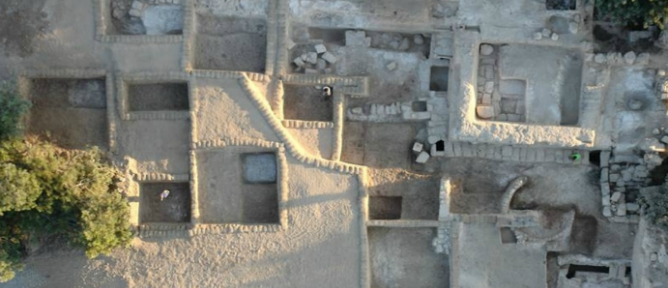
Ramat Rachel is an ongoing archeological dig on the southern outskirts of Jerusalem. A 2,500-year-old garden at the site, probably built by local Judeans, holds many secrets about the past waiting to be uncovered. An elaborate network of irrigation channels made it clear that this was a garden, but what was planted in it has been a big mystery.

New research by Tel Aviv University into ancient pollen found embedded in plaster suggests something very exciting for Jewish and natural historians of the region. Among the imported species of trees and plants determined by pollen analysis to have grown in the garden is the citron tree, known also as the etrog. According to the researchers, this pollen is evidence for the first cultivation of the citron tree, which is not native to Israel.

Test Driving a Better Place Electric Car

better place test driveBetter Place driving guide Ronit hooks up ZE car after test drive

In the six month period since Better Place put its first 100 Renault Fluence electric cars on Israeli roads in January, 2012; the company headed by entrepreneur Shai Agassi has already put around 300 cars on Israeli streets and highways. Many of them have been spotted in the country’s central region, including the suburban  city of Ramat Hasharon, just north of Tel Aviv, and in the coastal city of Netanya.

Owners of some of these cars live in much different locations, including the northern Galilee and Ramat Beit Shemesh, not far from Jerusalem. I wanted to try one.


better place engine battery under the hood
Engine compartment view of Renault Fluence ZE

As an avid follower of this project, which included a visit to the Better Place electric car education and test center at Pi Glilot in April, 2010 I decided it was time to revisit Better Place’s main car showroom and take an even longer test drive – this time on the highway. Following one of my previous articles about spotting these cars on the road, I was able to arrange the test drive, and also speak with one of their top international marketing persons, Julie Mullins, who originates from California and has been a member of the company’s international team since 2008.

Julie has been involved in Better Place electric car network projects in the U.S., Australia, Denmark, and now here in Israel. Julie told Green Prophet that: “The idea from the beginning was to establish the charging and battery exchange network before the cars go out on the road. If we were to explain what we are doing in one simple sentence, I can say that we at Better Place buy electricity and  batteries for these cars, and then provide the infrastructure that goes with driving them.”

Julie added that it was important to make the price of these cars as competitive as possible by owning the lithium ion battery pack, which powers the car and costs $12,000. “This battery and car separation idea has enabled a reduction in price for the car and also is better for the car purchaser,”she said.

Taking the Renault Fluence ZE out on the highway was a much better experience than the short ten minute drive on the Center’s test track. The car has amazing acceleration and is very quiet on the road with the only sounds coming from the car’s AC unit and tires turning on the road.

There is no gear changing sequence like in a gasoline driven car, enabling the car to reach highway cruising speeds from an intersection in a relatively short period of time. “With an electric motor there is no wasted fuel, and no need for gear changing like in an ordinary car,” says Mullins who came along for the drive. The cars feature an in-board computer that “talks” to the driver and can calculate how much energy is needed to reach a planned destination.

“If a battery switch is needed, the computer will advise the location of the nearest battery switching station,” says Mullins. She added that the entire process of switching a used up battery for a fully charged one takes less than five minutes, of about the same time it takes to run a car through an automatic car wash.

Back at the showroom center, we popped the hood of one of the cars to see what the electric motor and other mechanical features lookj like. At first glance, the motor almost resembles an ordinary engine, and radiator (for the heater and AC Unit). The car also has a normal 12 volt “wet cell” battery that provides power for the electronic accessories and components, and is recharged by an alternator like in a normal car.

“Special fluid is needed to keep the engine cool as well as for the radiator,” says Mullins. She added that all certified Renault garages have been trained to service and repair the car. Mullins also pointed to a demo “cut open” model that shows the rectangular shaped 250 kg battery pack, that is different form the flat “pancake” design of the original prototypes. “The flat design is being used now in Australia, but we found that the rectangular shaped one is better suited for Israel, she says.

Since my last test drive, on June 12, more battery exchange stations have been added to the Israel network, and at present 8 of them are now online. “We hope to have several stations in place in the south by summer’s end, enabling car owners to be able to drive all the way to Eilat,” says Mullins.

If so, it can be safe to say that the Better Place network of charging and battery exchange stations that began with only a dream less than six  years ago is now a definite reality.

Read more on Better Place:

All Electric Renault Spotted in Netanya Israel
Better Place Electric Car Spotting
Better Place Puts 100 Electric Cars on Israeli Roads
Better Place’s Shai Agassi “Gets Wired”

Egypt’s Taziry Ecolodge and the Golden Age

0

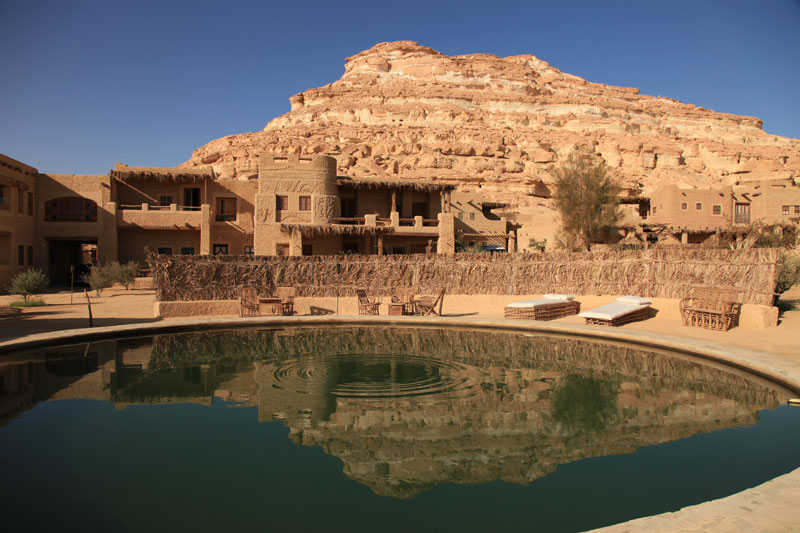
sustainable architecture, Taziry, Ecolodge, Siwa, Egypt, organic farming, green building, solar energyThe golden age is undergoing a quiet revival at the edge of Egypt’s western desert thanks to the Taziry eco-lodge. So much more than just a holiday destination, this peaceful resort located roughly 752 km west of Cairo at the footstep of Siwa’s Red Mountain (Adrar Azugagh) runs a camel and Arabian horse-breeding program as well as an organic farm, and features a series of buildings constructed sustainably in accordance with ancient and recently neglected Siwan tradition. And that is just a small sample of the value they have already brought to the remarkable Siwa oasis.

Iranian Warden Fined After Shooting Poacher in Foot

1

iran-poacher-warden-shot-nature-blood-moneyAn Iranian warden is being asked to pay ‘blood money’ to a poacher he shot in the foot whilst guarding a wildlife protected area

Sabz Press, a green Iranian news site, is reporting that a warden working in the protected wildlife area of Lawvardin in Hormozgan province has been ordered to pay blood money to a poacher he shot in the foot. Al Zare’, who is better known as Bagher (not pictured above), had an altercation with the poacher who was trespassing in the protected region.

The court decided that he should pay double the blood money as there was an entry and exit wound in his foot. Thankfully, wardens from across the country rallied to support Bagher and were able to raise the money needed to secure his release. However, whilst this support of the warden is fantastic to see, I can’t help but wonder why he was asked to pay it in the first place?