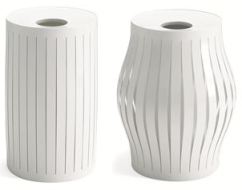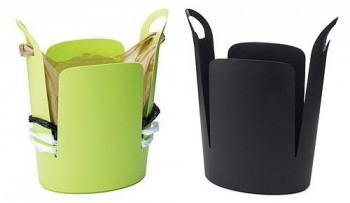
Turkish designers who anticipate severe water shortages in the next few decades have designed the dualWash – a waterless dish washer that cleans single dishes after every single use. Mitigating huge stacks of dirty dishes and waste water resources, the dual dishwasher and cabinet uses carbon dioxide to rid dishes of crumbs and sauce and other things that insects and rodents love to eat.
Waterless Dishwasher From Turkey Cleans up After Every Meal
Egyptian zoo is a nightmare for animals
Elephants, lions, and wolves are by nature free, roaming creatures that form complex social relationships. In the wild we have hunted them to near extinction and we have tethered them to cages and private homes. But animals bred or purchased by any of Egypt’s seven national zoos are especially unlucky: every day, zookeepers mete out starvation, physical abuse, solitary confinement and other forms of cruelty. And nobody seems to care.
Animal rights activists have contacted the central zoo director (I refuse to capitalize this title), the Minister of Agriculture, other zoo officials, Egyptian embassies around the world and even President Moursi with photographic evidence of emaciated lions, hippos swimming through sewage and wolves sporting bloody, raw wounds, and no one, absolutely no one has stood up to say “but this is wrong!”
A quote attributed to Gandhi floats through the blogosphere.
I don’t know if he really said this or if it even matters, but this string of words has great power to shame the people capable of ignoring the kind of vile cruelty depicted in these images by Khaled Elbarky.
“The greatness of a nation and its moral progress,” goes the quote, “can be judged by the way its animals are treated.”
By Gandhi’s compass, Egypt’s moral progress is in its infancy.
Last week we witnessed hysterical moral indignation in the Arab/Muslim world over an absurd, incendiary film made by a thug, with fatal consequences for several innocent men.
Further analysis has unveiled a host of complex and self-serving motives behind the scene and more is yet to come, but in the meantime this terrible theater highlights the MENA region’s extraordinary hypocrisy.
Egyptian mobs demand respect for Prophet Muhammad, who devoted his lifetime to compassion, dignity and honor, but back home it’s OK to sexually harass women and condemn wild beasts to a lifetime of starvation and torture?
Don’t get me wrong. Better than most westerners, I understand that pure Islam condemns animal cruelty – nay, all cruelty – and urges followers to be custodians of all living things.
But the zookeepers who continue to breed and purchase more elephants and other animals only to leave them chained up for 22 hours a day, even though they lack the financial resources to ensure these animals have decent habitats and food, are not behaving like real Muslims.
And the people who avenge a foolish film with murder do not deserve the respect for which they ask. How dare we demand respect when we ourselves are so disrespectful to sentient beings – human and otherwise?
I’ve seen these zoos. I’ve watched lions and tigers (in the same cage at that) whipped into submission while the crowd stood idly by. Nobody froths at the mouth demanding justice for these creatures, which are made of the same stuff as you and me and by the same creator.
Although many of the Muslims I have met during my travels are among the most enlightened and generous people on the planet, I refuse to silence my criticism of cruelty and neglect because of sensitive religious issues. Animal cruelty is wrong – in every religion.
The continued neglect of Egypt’s zoo animals is an insult to my prophets – the powerful lion, the loyal elephant, the solitary wolf – and offends my religion, which is mother nature. Nor am I alone, because if you care about Allah, God, Buddha, Jesus, Moses, or any other holy man or woman, then by extension you care about all life.
Now, for the love of God, who is going to step up to the plate and hold these torturers to account?
The information used in this Op Ed was sent to Green Prophet by animal advocate Eileen Crossman; photographer Khaled Elbarky sent the following information with his images:
- The lion, whose name is Antar, lives at the Kafr El-Shaikh zoo, where a guard constantly pokes with a long iron rod in order to get him to perform for visitors. Note: We had to remove this image because Google deemed it too violent.
- Sammar the tiger lives at the same zoo. She is over 25 years old and suffers from a variety of ailments, along with extraordinary pain. The zoo refuses to put her to sleep, which would be the humane thing to do.
- The hippo lives with others at the Fayoum zoo, which lacks adequate resources to keep the water clean. As you can see, it is full of sewage that imperils the hippos’ health.
- And the wolf? On the brink of starvation, a pack of wolves at Fayoum zoo are believed to fight each other for food – leading to terrible injuries that go untreated.
- At 49, the female Asian elephant is kept on this short chain day after day, year after year at the Giza zoo.
- Lastly, this solitary baboon at Tanta zoo has spent its entire life in a 1.5 meter square cage. He/she sleeps on a bed of refuse.
We’re sorry to be the bearer of such awful news, so to cheer you up a little bit, we’d like to introduce you to Jessica – the world’s sweetest hippo. A little tender loving and hippo kisses go a long way, but we don’t recommend that you do this at home.
You Don’t Need That Plastic Bag – A New Campaign in Jordan
‘Balash Kees’ is a new campaign launched by UNESCO Amman to help reduce the use of plastic bags in Jordan
Walk around Jordan and you’ll realise pretty quickly that the country has a huge plastic bag and litter problem. Cheap black plastic bags are literally everywhere and they are a real eyesore. No more so then in important landmarks and tourist destinations where the country is supposed to be showcasing its best. In an effort to deal with this problem, the UNESCO office in Amman has joined forces with the Jordanian government to launch a media-savvy campaign to rid the country of the plastic bag.
The ‘Balash Kees’ Facebook page, which was launched today, already has over three hundred likes and the campaigners are asking people to stay in touch to learn how to tackle one of Jordan’s major environmental issues – plastic bags. According to the campaign material, a plastic bag is used on average for 12 minutes but stays in the environment for 1,000 years without degrading. The solution? Stay away from plastic bags. Balash Kees translates loosely as ‘no need for a bag’.
Will Submerged Atlantis Super Volcano Cause Giant Tsunami?
Santorini’s quaint town of Thera actually sits on rim of a super volcano.
The Mediterranean Sea basin, especially that bordered by Greece, Turkey, Lebanon and Israel will soon have a new Marine Center that will help to reveal some of the secrets of this ancient and historical body of water. This includes the ancient seaport of Ceasarea, which was built and made famous during the reign of King Herod the Great and was partially destroyed by earthquakes and subsequent tsunami tidal waves such as those caused by mega volcano eruptions in Greece, Crete and Turkey more than 3,000 years ago.
Israel’s 4MW Biogas Plant to Clean up After 14,000 Cows
Ridding Israel’s environment of the poop of chickens and cows is a fabulous way to usher in the Jewish New Year. Once it becomes fully operational in the next few months, the recently inaugurated Be’er Tuviya biogas plant will scoop up the waste of 14,000 cows and in total roughly 15% of all chicken and dairy farms in the country. All that manure will then be used to generate electricity for thousands of homes.
Film Review: ‘The Blessed Tree’ – An Interfaith Meeting Under The Shade of Nature
Under a solitary tree in the desert, a young Prophet Muhammed met with the Christian monk Bahira. This documentary charts the importance of this chance meeting.
The Blessed Tree is a short and beautifully-filmed documentary which tells the story of a chance encounter between a Christian monk named Bahira and the young Prophet Muhammed (pbuh) under a tree in the desert. As well as drawing light on this important meeting, the documentary focuses on the belief that the very tree which witnessed this event is alive today in the Jordanian desert. It also captures a gathering of some of the most important Islamic scholars under that tree and their interpretation of the lessons the incident has to offer the modern world.
Turkey Ripe For Renewable Energy Boom – So Why The Delay?
Despite its vast solar and wind energy potential, Turkey’s renewable resources have only been developed in small pockets of the country, such as the windy Aegean island of Bozcaada (pictured above).
With European countries having already tapped most of their low-hanging renewable energy development opportunities, Turkey is perfectly poised to become the new renewable energy dynamo in the region, according to an analysis published yesterday in the Financial Times‘s beyondbrics blog.
Tunisian Teacher Cycles to China for Wetland Conservation
Seven months ago, a Tunisian university teacher decided to travel from Tunisia to China on his bike to help raise awareness of the human and environmental value of wetlands. Here is his journey.
I am a sucker for any cycling journey – although it doesn’t quite have the nostalgia of travelling by train, it certainly has fun and adventure. Whether it is cycling to Mecca from South Africa or cycling for peace, I am instantly hooked. So when I heard that a Tunisian university teacher and environmental engineering graduate had decided to cycle all the way to China, I had to find out more. Here is his journey so far.
Luxury Underwater Discus Hotel Close to Anchoring in the Gulf
The Water Disqus Hotel (WDH) lauded on blogs galore a few months ago is one step closer to reality, and the project’s new investment team has received exclusive rights to build in all Gulf Cooperation Council (GCC) countries, they told Green Prophet.
Comprised of an above water disc connected to an underwater disc by five legs, a vertical shaft, lift and stairway, the WDH was designed by Deep Ocean Technology to give leisure travelers a novel way to experience underwater life. Now the company has teamed up with BIGInvestConsult AG in order to commercialize WDH projects all over the world!
Libya’s Oldest Mud City is Critically Endangered
Ghadamès is one of the oldest habitable medinas in the Sahara, and it is made almost entirely out of mud. Built in the seventh century and listed as a UNESCO world heritage site in 1986, this clustered clay settlement in Libya epitomizes everything that makes earth architecture so worthwhile.
In the summer, according to the locals, these are the only houses anyone can stand to live in since they are protected against the relentless sun. And in winter, when temperatures in the desert drop down to nothing, the clay and straw walls absorb and hold daytime heat. In the last few decades, the oasis town became completely reliant on a steady stream of tourists, and now that the revolution is over, at least one man wants them back.
Are LED lights a health hazard?

In teddy bears, iPhones and baby sleep monitors: turn off those LED lights at night before they affect your sleep cycles and health!
Professor Abraham Haim, an authority on the biological effects of light pollution, presented his findings at the International Congress of Zoology (ICZ) in Haifa Israel.
World experts discussed, “Light Pollution and its Ecophysiological Consequences” and came to a consensus that light pollution does have health consequences.
Professor Haim’s team studied the effect of night light on blind mole rats and seeing rats. He presented his research findings indicating that the biological effects of nocturnal lights included damage to metabolic rates, body mass, oxygen consumption and the level of certain hormones including melatonin– which is known to impact sleep cycles and mood and is believed to suppress some cancers and tumors.
Studies seemed to indicate that the short-wavelength blueish light emitted by Light Emitting Diodes (LEDs) has an especially strong effect. Ever since humans brought light into their homes in the form of candles and oil lamps, we’ve considered artificial lights to be a positive influence in our lives. World religions reinforced this belief with the miracles of menorahs, eternal flames and the light of the world.
Up through the invention of incandescent bulbs indoor lights had a color which was warmer (redder) than natural sunlight. This changed somewhat with the advent of greenish florescent lights. But a more dramatic change came very recently with the invention of efficient white light Light Emitting Diodes (LEDs).
The history of LED lights
H.J. Round was working in the UK’s Marconi labs when he noticed electroluminescence of a cat’s-whisker silicon carbide diode in 1907.
LEDs which followed in 1927 were so dim as to be impractical until Biard and Pittman of Texas Instruments made the first practical red LED in 1961. The color of an LED is proportional to the bandgap voltage which is proportional to energy which is proportional to the chances of burning out your LED before you can say, “Hey, look what I invented!”
Decades passed with only dim red and yellow-green LEDs commercially available. Finally in 1993 Shuji Nakamura worked for Nichia Corporation in Japan and combined blue LEDs with a yellow-white phosphor to produce the first white light LEDs. He moved to the University of Santa Barbara and won the millennium prize for inventing brighter green, blue and white LEDs as well as the blue lasers which make blue-ray video players possible.
The problem with LED lights
We may have learned this in grade school, a perfect mix of the primary colors red, blue and green will make white. Existing red LEDs along with Nakamura’s bright green and blue LEDs finally made this possible.
Only that’s not how most white LEDs work. After years hovering just the other side of impossible, blue LEDs became more efficient than their red and green grandparents. So most white LEDs are actually deep blue LEDs with Nakamura’s yellow-white phosphor coating. Yellow-white + blue = white.
But even though our eyes try to average it out, the strong blue spectral component remains. And that’s where the trouble comes from. It seems that the human biological clock evolved around fire so isn’t as easily fooled by reddish-yellow incandescent lights. Blue light is different: As soon as it hits our pineal gland, our melatonin levels fade and our biological clocks are reset to wake-up time. That’s all fine if you’re only exposed to blue light shortly before sunrise.
But blue-white LEDs aren’t just inside eco-efficient LED fixtures. They’re in your television and the mobile phone you use to checked your Facebook status and the iPad you use to read your bedtime novel. My son’s teddy bear, baby monitor and night light all contained blue or blue-white LEDs. And all of these devices emit enough blue light to potentially effect hormone levels and sleep patterns or cause other biological effects.
Alternatives to LED lights?
Electron Stimulated Luminescence (ESL) lights are one alternative which can replace both mercury-laden CFLs and expensive blue-white LEDs but they aren’t yet easy to find and their bulky shape makes them a poor fit for many of the tight spots where LEDs shine. It is possible that by refining LED composition and control circuits, an efficient white LED will be invented which does make use of a warmer balance of red, green and blue LEDs. LEDs are rugged, efficient, long-lasting and very bright but nearly every new technology has a hidden downside which must be studied and balanced against the advantages. LEDs are no different.
Saudi Oil Wells May Run Dry By 2030
According to a 150-page report by Citigroup, Saudi Arabian oil could dry up as early as 2030 which is a lot sooner than previously thought
The high consumption of oil in the Gulf nations for air-conditioning and desalination means that oil wells are likely to run dry a lot sooner than expected. That’s the news coming from a report by Citigroup which states that Saudi Arabia could be an oil importer by 2030. Local Saudi consumption is skyrocketing with residential use making up 50 percent of demand and over two thirds of that goes to air-conditioning. Saudis are also consuming 250 litres of water per person per day – that makes them (rather shockingly) the world’s third largest water consumer – and most of that water is from energy intensive desalination plants.
Rosh Hashanah recipes for vegan, veggie and aware people

While the Jewish new year is a time for contemplation and prayer, there’s nothing sparse about the festivities. Families gather together to feast in the late morning and again in the evening, after blessing the day with wine. The family cook often starts feeling overwhelmed with the quantity of cooking that takes place. To help plan menus, view our roundup of festive recipes for some splendid holiday meals.
For vegetarians
For vegetarians, or for a dairy break in the middle of the two-day round of fancy meals, try some of these meat-free ideas:
5 Fresh Fig and Cheese Recipes
A medley of links to recipes featuring super-food Freekeh
Salads for Rosh Hashannah:
For those who eat a bit of meat, try these poultry dishes:
Poussins Stuffed with Pine Nuts and Rice
Makluba, Arabic Upside-Down Chicken and Rice
Persian Chicken in Walnut Sauce
Desserts for Rosh Hashannah:
Silky Malabi pudding: keep malabi dairy-free by substituting coconut or almond milk.
A Condiment, a Dip, and a Spread:
Home-Made Pomegranate Molasses
Beverages:
Make Turkish Coffee Like a Native
More Rosh HaShannah Goodies on Green Prophet:
Clothing Laced With Live Bacteria is Weirdly Cool
Sarine Zaken is the world’s first designer to incorporate living bacteria into clothing and jewelry that people can actually wear! A third year student at Shenkar College of Engineering and Design, the young Israeli fantasized about incorporating something alive into her final project.
While that may seem a bit creepy at first, a chance encounter led her to Professor Eshel Ben Jacob, whose work with a unique bacteria called Paenibacillaceae completely revolutionized her design approach.
Palestinian youth practice “parkour” skills in Khan Younis in the southern Gaza Strip