Home Blog Page 153

How bankers can invest in the ocean, new UN guide

0
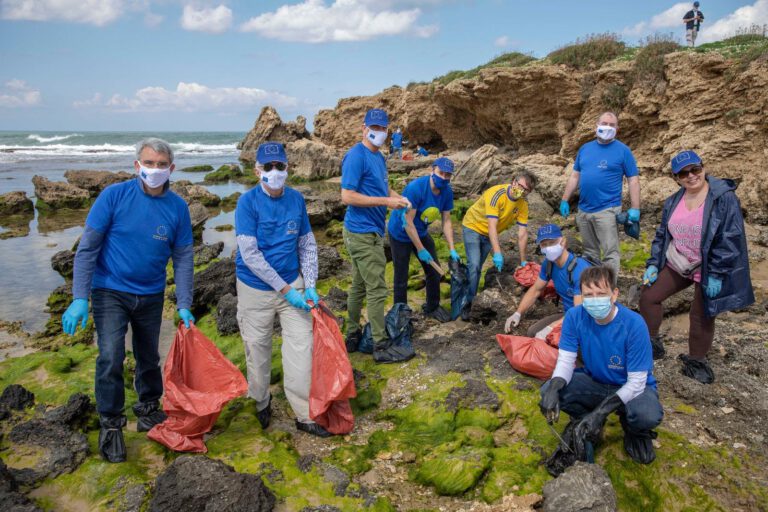
eu ambassadors clean Israeli beach Beit Yanai
EU Ambassadors clean up an oil spill in Israel. The sea is on everyone’s minds. Invest in it.

New guidance published by the UN Environment Programme Finance Initiative (UNEP FI) provides a market-first, practical toolkit for financial institutions to take immediate action on their lending, investment and underwriting activities which negatively impact ocean health. In short, if you want to make sound investment decisions for your clients, consider the sea. You can get the toolkit here (links to PDF).

The ocean covers 70% of the earth’s surface, holding 97% of all water and 80% of all life forms. Major ocean sectors such as tourism, shipping, fishing, aquaculture and marine renewable energy collectively contribute to a ‘blue’ economy, estimated at a global gross value added of USD 1.5 trillion in 2010. This is projected to double in size to USD 3 trillion by 2030, with some ocean industries set to grow faster than the global economy (OECD, 2016).

We see how an oil spill in Israel can threaten the seafood industry and tourism but it’s a bigger problem than one country, one sea. 

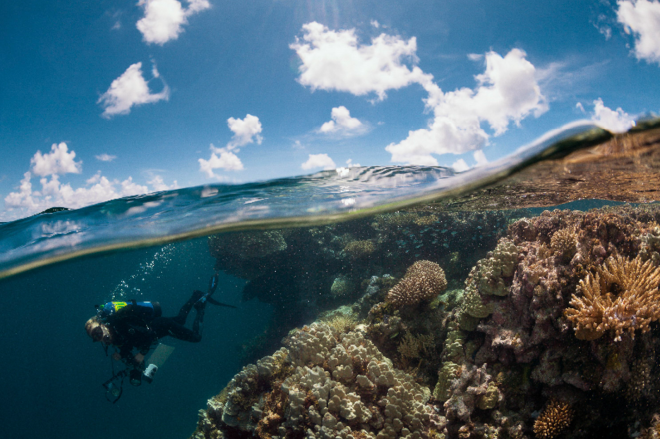
French Polynesia coral reefs Khalid bin sultan
Coral reef, French Polynesia.

However, ocean health is under existential threat. Faced with the triple crises of pollution, nature loss and climate change, two-thirds of our oceans have been negatively altered by human activity; leaving industries, businesses and livelihoods exposed. With existing financing still largely directed towards unsustainable sectors and activities, it is critical that all sectors of the blue economy are rapidly transitioned towards sustainable pathways.

Invest in the sea

Banks, insurers and investors have a major role to play in financing this transition to a sustainable blue economy, helping to rebuild ocean prosperity and restore biodiversity to the ocean. Through their activities, and client relationships, financial institutions have a major impact on ocean health and hold the power to accelerate and mainstream the sustainable transformation of ocean-linked industries.

They thereby play essential roles in wider ocean governance, engaging in public-private partnerships, and propelling local-to-global actions for sustainability.  

“Momentum is building as more banks, insurers and investors wake up to the realisation that their financial activities can have a sizeable impact on ocean health, creating a negative feedback loop for key ocean industries such as shipping, fishing, tourism and marine renewables” said Eric Usher, Head of UN Environment Programme Finance Initiative (UNEP FI).

“A new sustainable pathway for the blue economy is thus both an environmental and economic necessity. This critical new guidance provides a practical toolkit for financial institutions to understand their impact and discover how a new sustainable finance approach can help them identify key risks and opportunities in ocean-linked sectors” he added.

Leveraging best practice based on input from more than 50 pioneering institutions and experts, this guidance sets out pathways to sustainable growth across five key ocean sectors, chosen for their established connection to private finance. It presents a detailed breakdown of which activities to seek out as best practice, which activities to challenge, and which activities to avoid financing completely due to their damaging nature.

Banks burning the Amazon?

See this story on bankers exposed in Brazil burning the Amazon implicating the agtech investor bank Robobank, which declined to comment. It goes to show that at any point in the near future banks will be exposed. Investing in the planet mitigates risk. 

“Decades of unsustainable consumption and production is leading to environmental risks and losses in natural capital, eroding the ocean’s resource base. Without engagement by financial institutions, we will not be able to change the course to sustain a healthy ocean and unlock its enormous potential. 1$ of sustainable ocean investments can yield 5x higher global benefits” said Leticia Carvalho, Head of the Marine and Freshwater Branch, UN Environment Programme.

“This new guidance can help financial institutions invest in good ocean governance at local, regional and global levels. In a nutshell, making sustainable blue economy opportunities too hard to resist” she added.

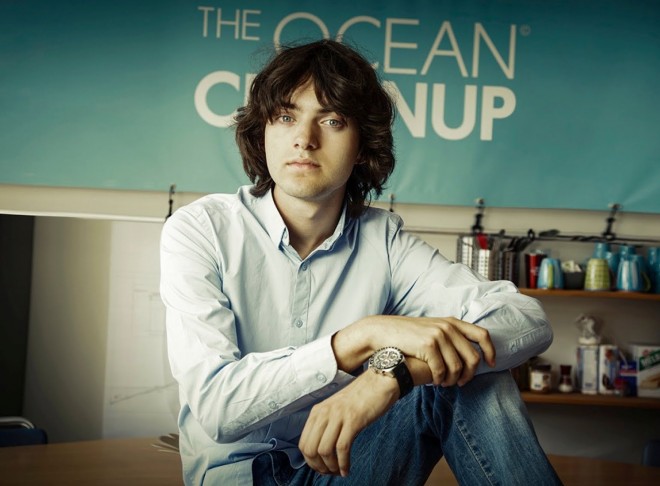
Consider new initiatives like the Ocean Cleanup. Young people are looking for real world solutions that invest in cleaning the seas. 

ocean cleanup boyan slat

This guidance provides decision-makers across banking, insurance and investment with a science-based and actionable toolkit, giving easy-to-follow recommendations on how to approach financial activity related to:

  • Seafood, including both fisheries and aquaculture as well as their supply chains;
  • Ports;
  • Maritime transportation;
  • Marine renewable energy, notably offshore wind; and
  • Coastal and marine tourism, including cruising.

It builds on the foundation of the Sustainable Blue Economy Finance Principles – a keystone for financing activities in the blue economy, supported by a community of over 50 institutions worldwide with a collective total asset size of over USD 6trn.

We think the United Nations has a lot of potential to transform the world for good and we support more initiatives like this, less on costly meetings and conferences which have more or less been eradicated since Covid times. 

 You can download the guide here or click the image below. Links to PDF.

un banker report invest in oceans


Mediterranean oil spill cleaned by EU ambassadors

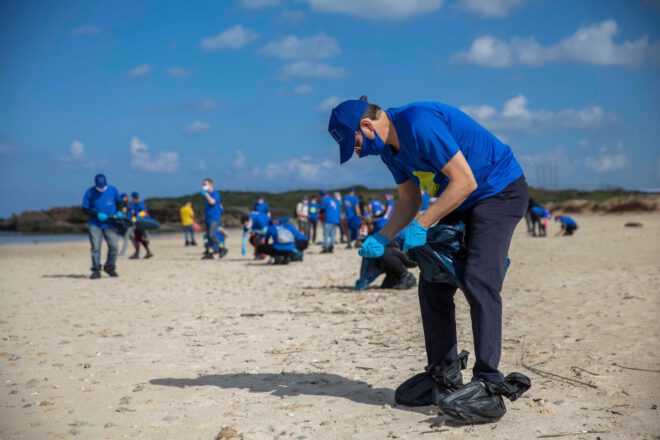
eu ambassadors clean Israeli beach Beit Yanai

EU Ambassador to Israel Emanuele Giaufret was joined Friday morning by more than two dozen envoys from EU member states, including 10 ambassadors, at a large-scale beach clean-up operation at the Beit Yanai National Park near Netanya, Israel. 

A suspicious and deadly bitumen oil spill appeared washing up on the Israeli and Lebanese coast a few weeks ago. Iran is suspected of eco-terrorism and purposefully dumping the oil, meanwhile the public has rallied to pull globs of tar from the seashore. You can read our first report of of the Israeli oil spill here

And the UN banking sector has just released a guide on how bankers can invest in the ocean. Timely.

Sea turtles are being remediated with mayonnaise treats that melts the oil in their stomachs and gives them nutrients and meanwhile the ambassadors from EU countries pitched in among the more than 12,000 people who have been cleaning the seashore by hand. They only worked for an hour and a photo op, but it lends support in an oil spill that could escalate if Iran is indeed found the culprit of eco terrorism.

Clad in blue EU t-shirts and wearing plastic bags on their shoes, the EU diplomats to Israel spent more than an hour removing tar from stones along the coastline.

beit yanai eu ambassadors

They were greeted at the beach by Galit Shaul, the head of the Emek Hefer Regional Council. The EU delegation in Tel Aviv initiated the activity, conducted in cooperation with the Zalul environmental organization, which it supports financially, after learning about the massive contamination of Israel’s beaches following a huge oil spill.

“As soon as we saw the terrible images of black tar washed up on beaches along the coastline, we decided that we had to do something to help. Every summer our delegation organizes a massive beach cleanup, but this disaster calls for immediate action,” Ambassador Giaufret said.

“There’s still a lot of work to do, but every effort helps. We’re grateful to our partners from Zalul for the important work they’re doing.”

Youval Arbel, sea campaigns manager at Zalul, said: “The massive tar contamination in our beaches is one of the most severe ecological disasters we have ever seen. Hundreds of volunteers are working every day to remove the tar from the rocks before its toxic materials will be swept into the sea and hurt more animals.

Zalul has been working with the NGO EcoOcean among others to clean the oil. EcoOcean’s founder Andreas Weil had the foresight two years ago to start training the public on how to be prepared for an emergency cleanup. His Swedish background might come into play in his NGOs success, he told Green Prophet.

andreas weil, founder of ecoocean marine Israel sweden
EcoOcean founder Andreas Weil

Protecting the environment is one of the EU’s top priorities. The EU puts a strong emphasis in its activities around the world, including in Israel, on preserving and cleaning beaches from waste, and the severe incident that has contaminated Israel’s beaches in recent days is another, especially painful, reminder of the importance of these efforts.

Iran accused of eco-terrorism as oil coats the Mediterranean Sea shore

beached whale israel
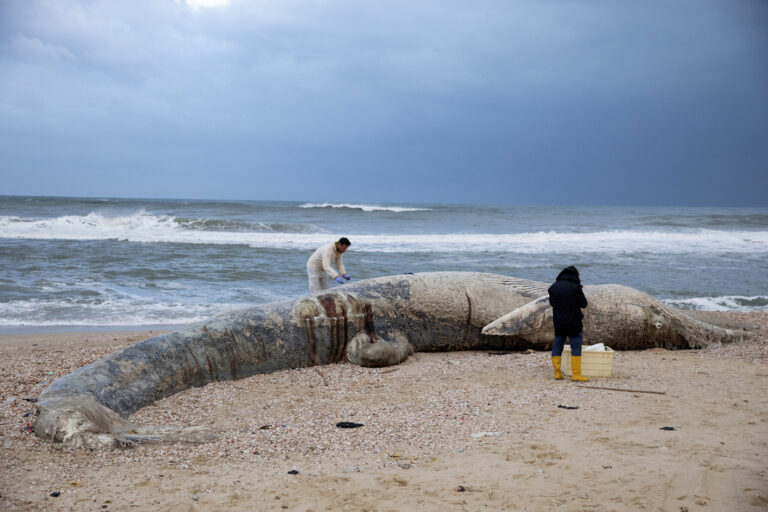
Dead fin whale washed up on a beach in Nitzanim Reserve, Israel, Friday, Feb. 19, 2021. (AP Photo/Ariel Schalit)

Two weeks ago one of the largest oil spills in the Mediterranean Sea washed up globs of carcinogenic bitumen tar known as dilbit onto the Israeli and Lebanese coasts. A gag order on the tanker’s identity confused the public, as over 10,000 people went out to the shores to collect the tar from rocks, turtles, and sand. 

At first the Israeli Environment Ministry targeted a Greece tanker and met it as it docked at port in Greece some days later. We spoke with the company that owned the ship, Minerva Marine, and they denied any link to the spill. 

But in the latest turn of events Israel has put its attention to its arch-enemy Iran announcing that a tanker flying under a Libyan flagged, but doing eco-terrorism for Iran, tanker dumped its bitumen on purpose to cover the entire Israeli coastline. 

Environmental Protection Minister Gila Gamliel said in a news conference that investigators from her ministry had traced the spill to an unregistered Libyan tanker.

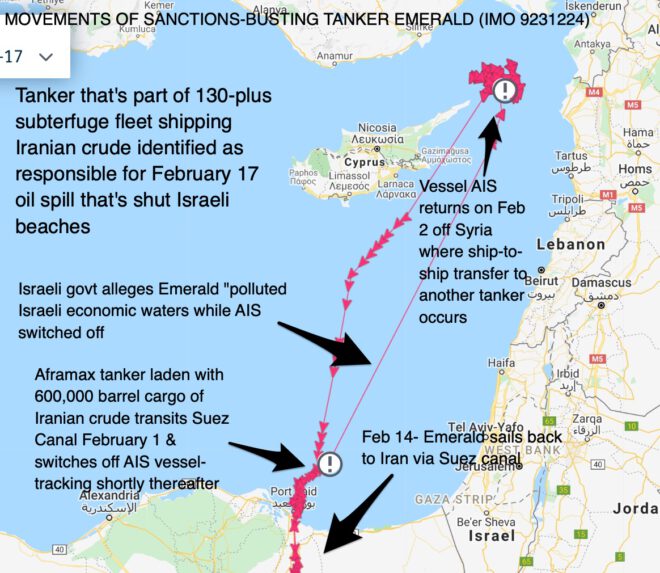
The ship had called on an Iranian port before approaching the Israeli coast. It turned off its tracking transponder and then dumped its crude oil into the Mediterranean Sea, Gamliel said.

Analyses of satellite images and models run by researchers show that the ship smuggled crude oil from Iran into Syria. The tanker was “dark” when it left the Iranian region, meaning her AIS (automatic identification system) was turned off. Before reaching the Suez Canal, the tanker’s equipment was turned on, and it crossed the canal in Egyptian territory. Then, it went dark again before entering Israel’s economic waters.

Black Blood on their hands

“The operator of the ship has black blood on their hands,” she said. This comes after a two-week investigation with strong “circumstantial evidence” according to Gamliel that the ship was the source of the spill and its behavior deliberate.

She also said the government would pursue payment for damages through an international oil pollution compensation program and the ship’s insurance.

She released this statement: “This is a crude oil tanker called Emerald, owned and operated by a Libyan company. It was illegally carrying cargo from Iran to Syria. The ship was flying Panama’s flag. Iran is waging terrorism not only by trying to arm itself with nuclear weapons or trying to establish a basis near our borders. Iran is waging terrorism by harming the environment,” said Gamliel.

“Our battle on behalf of nature and animals must be a cross-border one. Together, we will bring to justice those responsible for the environmental terrorism, those who committed this crime against humanity. We will continue to rehabilitate the damaged beaches and the animals that were harmed. Together, we will win, and we’ll remove the pollution from our country’s shores.”

According to Lloyd‘s, a maritime intelligence report, the of Emerald was named as Oryx Shipping Ltd, according to a spokesman from the prior owner, Libya’s state-owned General National Maritime Transport Co.

Emerald tanker syria israel iran oil spill

Oryx Shipping Ltd is traced to a Piraeus-based company (Greece) with Syrian links, said to be owned by Luay Mallah. An Indian ship management company Frontline manages most of Oryx’s purported fleet of Supramax and general cargo vessels. Lloyd’s said the maximum payout after pollution blamed on Iran will come in at less than $300m.

What Syria and Iran’s money can’t buy

Our voice of reason, Andreas Weil, founder of the environmental marine education and action NGO EcoOcean, which led the cleanup efforts, tells Green Prophet: “If the oil was targeted directly at Israel then it’s sensational news.”

But, with Swedish common sense he explains as much as he or anyone knows: “Well, what can you say. Who knows if they released it on purpose? Who knows if they had an accident?  It’s crazy. I don’t know what to say anymore.

“If it’s on purpose then it would make me quite upset. But let’s wait and see what happens,” Weil tells Green Prophet.

Weil wants us to know that dumping the bilge of an oil tanker is a common occurrence in the oil industry, usually without any retribution: “Most importantly,” he say “some ships just release their old tar from their tanks and they don’t give a shit about the Mediterranean or the environment,” Weil explains. “Did they think about this or did they plan it?” 

The public was stunned to see a black plague along its coastline starting about two weeks ago. The Prime Minister of Lebanon blamed Israel. Israel blamed Greece and now it’s blaming Iran. The mud-slinging continues until more clues are brought forth.

Meanwhile the Israeli government are calling the spill an act of “environmental terrorism.”

The sticky tar has appeared on about 120 miles of Israel’s coastline. It is estimated that 1,000 tonnes, according to The Washington Post, were spilled and thousands of volunteers are still racing against the clock to rescue birds, turtles and small mammals from the sludge. A 55-foot baby whale died from poisoning, and there is a ban on the sale of local seafood.

The spill ignited Greenpeace’s fire. They were aghast that Lebanon had voiced no cleanup plan or response after the spill.  Stinky black tar at sea knows no borders. Endangered loggerhead and green sea turtles nesting at the Tyre Coast Nature Reserve in Lebanon are at risk and this local tragedy should be an international concern.

Israelis from the government said that the biggest patches of bitumen have been scrubbed from the coast but a remediation and cleanup will take years, and about $14 million USD. 

Oceanographic agencies in the United States and Europe estimate that the spill occurred in early February taking two weeks to wash ashore.

“They’re not just hurting Israel,” Gamliel said. “Nature and animals don’t just belong to one nation. This is a battle that crosses borders.”

Weil who founded EcoOcean 15 years ago to help clean up the Mediterranean Sea is flabbergasted by the turn of events. He heard that perhaps it was 100 tonnes of bitumen that was dumped, but when The Washington Post suggested up to 1,000 tonnes this implies something much more sinister than a bilge oil dump.

Andreas Weil, founder of EcoOcean

Weill ponders, “Then that’s about as much oil as the whole boat can carry. Why would they dump it on purpose as it’s valued at millions of dollars?

“It’s impossible to know because most of it became heavy lumps that sank directly. No one will know how much the boat had before it left port. It will be floating up on the sea for many yeas to come,” Weil laments. “If it’s 1,000 tonnes then it’s not only cleaning out its tanks. 

Iran’s Environment Ministry news page in English hasn’t been updated since 2016. Its Twitter since 2018. We reached out for a comment and so far, it’s bleak. Probably like most of the environmental problems in Iran. The destruction of Lake Urmia. Unbearable air pollution in Tehran. Water pollution. And a government that makes environmentalists and activists disappear. It’s no wonder why so many good Iranians have immigrated out to Canada. 

We’ve had dissenting voices from Iran reach out to us in the past. On the strict condition that no one’s identity will be given. Ever. This Iranian blogger I interviewed (Hossein Derakhshan) in 2006 disappeared not long after the interview. He came back, subdued, many years later retracting everything that he said. It’s amazing what torture and prison can do to you. 

Iran is further distancing itself every day from its neighbors in the region. This oil spill, if indeed it’s sent from them, will be the last straw. 

Meanwhile in Lebanon there has been no response to the oil spill. Whether it’s the general neglect to the country’s state of affairs – remember the massive explosion in Beirut this past summer that killed hundreds – or an alliance with Iran and Syria, is anyone’s guess. 

Greenpeace sent me this statement: “Almost two weeks have passed since the oil spill occurred on the Lebanese coast, and to this day we have not heard any statement from the Ministry of Environment. The ministry is supposed to be the most responsive to such a catastrophic accident.

“Therefore, Greenpeace Middle East and North Africa asks where is the Ministry of Environment? What is your national disaster management plan? What is the scale of the disaster and its repercussions on marine life? Where are the directions on how to remove oil tar and how to treat and dispose of it? Where are the safety tips that you should publish in order to ensure the safety of citizens?

“Noting that a number of associations, organizations and volunteers try their best to organize and help, but the responsibility rests with the concerned authorities first and foremost.”

Want to take action in cleaning up the sea? The UN has a new investment guide for bankers. We learned that banks are supporting the burning of the Amazon, whether or not investors at the bank are aware. Be one step ahead and invest in the sea, with this handy toolkit and guide you can download here

Digging into chickpea family for less pesticides in the United States

0

In recent years, hummus has become a pop culture food phenomenon, drawing praises from dieticians for the health benefits and chefs for the flavor.

However, the core ingredient, the chickpea, has had its production threatened. The chickpea has played a significant role in the vegetarian diet for thousands of years. It is high in protein and rich in important carbohydrates and minerals. And vegans love it. 

Grown in the Pacific Northwest and Northern Plains of the United States, the chickpea has an integral role in the agriculture systems of these regions. Recently this role has been threatened by a soil-born water mold, Pythium ultimum

George Vandemark and his team have worked to improve chickpea varieties and develop new ways to control disease in legumes. Their research was recently shared in Crop Science, a publication of the Crop Science Society of America.

“For over 30 years, common pathogens in chickpeas and other legumes have been controlled by fungicides,” says Vandemark. “We discovered this approach was not working effectively when one of my coworkers visited a field where seedlings had not emerged.”

The planted seeds died shortly after they started to germinate. As the seed grew to the top of the soil, the disease attacked the plant and killed it.

To identify the cause, researchers isolated the chickpea seeds in the soil. They discovered that the pathogen P. ultimum developed resistance to fungicide. This resistance allowed the mold to infect the plant.

chickpea snack

“Our approach looked at two different types of chickpeas – kabuli and desi,” says Vandemark. “The kabuli chickpea is almost exclusively grown in the United States because of the large export market.”

Time to start planting small Desi chickpeas

Kabuli chickpeas are larger, have a clear or light beige seed coat, and are typically canned and used to make hummus. Desi, believed to have originated in Turkey, is smaller, has a colored seed coat, and is used for making stews.

If you ask around famous hummus chefs in Israel, for instance, they will tell you to use only the smaller Desi variety. Get the ultimate hummus recipe here. Or scroll down to the bottom of the post for it. 

The researchers examined different lines of the chickpea to identify natural sources of resistance to P. ultimum.

The most popular varieties of chickpea grown in the United States were susceptible to the disease. The team did discover other chickpea varieties that showed resistance to the soil-born mold.

“We identified many desi chickpeas that were resistant to the pathogen,” said Vandemark. “Luckily, several kabuli also displayed intermediate levels of resistance.”

These resistant chickpea varieties excited the researchers because they produce chickpeas that look similar to what consumers are used to.

“These traits are not ones we want to lose,” said Vandemark. “Consumers expect the kabuli type chickpea to come from the United States. The lines we identified with resistance to the disease have the shape and seed color that are desirable.”

With this discovery, the research team is using the resistant plants to breed new kabuli varieties. The resistance chickpeas are crossed with current commercial varieties. This will develop a type that is more resistant to the disease.

“Moving forward, this will lead to new chickpea varieties with improved resistance to P. ultimum,” explains Vandemark. “This research will also lead to new methods for controlling diseases that rely less on fungicides and more on genetic resistance.”

From this research, scientists can gain a better understanding of disease and disease resistance. This will push researchers to use plant breeding as a means to combat diseases, rather than synthetic chemicals.

P. ultimum has a broad range of hosts,” says Vandemark. “While we looked at chickpeas, it can affect small grains like wheat and other legumes like soybeans. The chickpea has a small genome size, making it easier to examine.”

Future researchers can build upon this research to examine potential disease resistance to P. ultimum in other crops. Naturally controlling the disease using genetics and breeding can lead to a more sustainable production system.  

George Vandemark is a researcher for the United States Department of Agriculture’s Agricultural Research Service. This work was supported by the United States Department of Agriculture and the USA Dry Pea and Lentil Council.

___

Maxim’s Hummus Recipe

Ingredients
• 6.5 pounds of small-sized dried chickpeas (Desi chickpeas)
• 1 tablespoon baking soda
• 1 tablespoon baking powder
• 2 tablespoons of salt
• 2 tablespoons of lemon salt
• Half measure of tehina (Amount of tehina equals half the volume of    cooked chickpeas)
• Water
• Olive oil to garnish

Take 6.5 pounds of dried chickpeas and soak them overnight in cold water, along with baking soda and baking powder. The next morning clean the chickpeas in running water. Drain the water and remove any small stones.

Adding cold water to cover the chickpeas and then a double amount, vigorously boil the chickpeas in a large pot. After reaching boiling point, turn down heat, and simmer for 3 hours with a lid, until the chickpeas are soft.

When done, strain the chickpeas, and set aside until cold. When cold, put into a food processor, adding raw tehina – about half the volume of the cooked chickpeas. Add in salt, lemon salt, and enough tablespoons of cold water to achieve a thick, but smooth consistency. Spread the hummus on a plate, and garnish with olive oil.

“That’s it. Now you will have lovely hummus”, says Tony.

And a lot of it. Divide the recipe in half if you want a lot less.

Organic date syrup via Israel and Dubai show fruits of peace

0
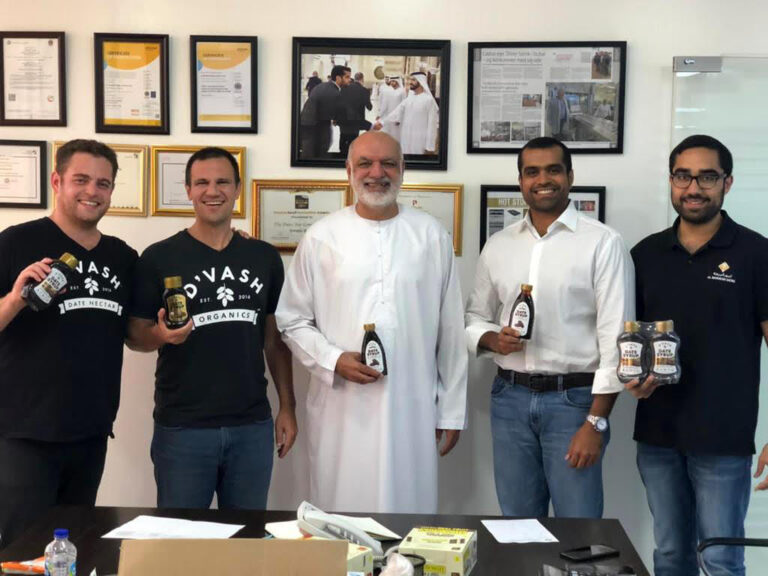
PHOTO BY MUBARAK TAJ: From left: D’vash co-founders David Czinn and Brian Finkel; Al Barakah founder Mohamed Saleem; managing director Yousuf Salem, and Abdulkarim Salem, at Al Barakah’s Dubai headquarters in December 2020.

The ink was barely dry on Washington’s newly announced Abraham Accords late last year when Brian Finkel hopped on one of the very first direct flights from Tel Aviv to Dubai.

His mission: to pave the way for a joint venture between his company, D’vash Organics, and Al Barakah Dates Factory—one of the world’s largest manufacturers and suppliers of date products.

The deal, finalized Feb. 24, is a milestone for the Chicago-born Finkel, whose company has built its reputation on producing Biblically inspired date syrup for the U.S. organic foods market.

“With our new partnership, we will sell Al Barakah’s line of date products under the D’vash  Organics brand name all over the world,” Finkel told Green Prophet last week. “The deal gives us access to Al Barakah’s unparalleled manufacturing capabilities, pricing and supply. In return, it provides Al Barakah with access to US and other Western retail and wholesale markets under the D’vash Organics name.”

organic date syrup
PHOTO BY MUBARAK TAJ. Organic date syrup sold in the US.

He added: “They wanted access to the US market, because they don’t have much presence outside the Middle East. For them, this is a conduit into the US and Western retail markets. They really are a behind-the-scenes manufacturer, and now they’ll have a piece of the action.”

Financial terms of the deal weren’t disclosed, though D’vash Organics expects to see revenues of $2 to 3 million in fiscal 2021.

Finkel, an Orthodox Jew who lives in the West Bank settlement of Yakir, made aliyah [immigrated to Israel] in July 2013. Soon after, the Wharton School and financial consultant discovered silan, or date syrup.

“My mother-in-law uses it in desserts. It’s ubiquitous here and it’s such a versatile product,” he said. “One day, I had this ‘eureka’ moment. I called David Czinn, my friend and business partner in California, and asked him if this is a thing in America. He said, ‘no, but it should be.’ Because he’s in the food industry, he was able to leverage his connections.”

That led to a deal to source the product from organic dates grown in California’s Coachila Valley. Finkel and Czinn thought about exporting the product from Israel but said shipping costs would have been prohibitive.

But eventually, they discovered Dubai in the United Arab Emirates—which not only boasts 44 million date trees but also offers substantially cheaper shipping rates than either Israel or California.

organic date packing dubai
PHOTO BY LARRY LUXNER: Date-packing and processing operation in Dubai, United Arab Emirates.

“At that time, there were no diplomatic relations between Israel and the UAE. They never asked where I was located, and I never volunteered that information, so it never became an issue,” he said. “The only time anything related to Israel ever came up was when we wanted to put a hecksher [kosher stamp] from the London Beit Din on the product. They told us we’d have to edit our label because according to local law at the time, nothing could be exported from the UAE if it referenced Israel, had Hebrew writing or said ‘kosher.’”

Yet once Finkel’s religion and country of residence became known, it wasn’t a problem at all. In fact, he said, “when we met at the factory in Dubai, we had two days of marathon negotiations, and we talked very openly and fondly about the similarities between our two cultures. They bent over backwards to make sure I had kosher food.”

finkel date syrup d'vash
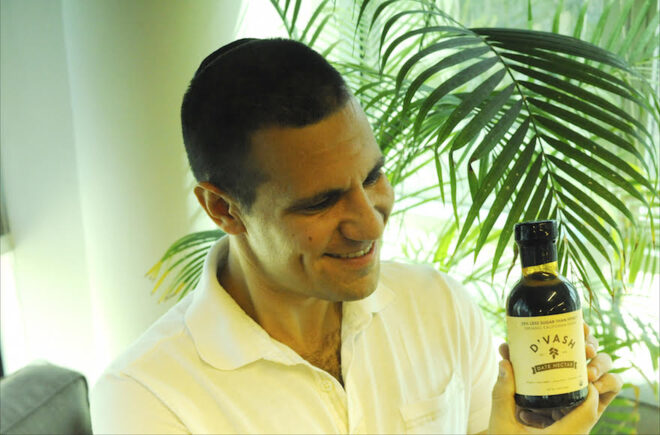
PHOTO BY LARRY LUXNER: Brian Finkel, co-founder and CEO of D’vash Organics, holds up a bottle of organic date syrup.

Interestingly, the word “Israel” appears nowhere on the label—and that’s no accident.

“Our product is inspired by Israel,” Finkel said. “It has roots in the Bible and originates from the land of milk and honey, but this has broader appeal than just Jewish or Israeli.”

In fact, most date syrup—if it doesn’t originate in either California or Israel—comes from an Arab country, generally Iraq, Jordan, Egypt, Morocco, Tunisia or Algeria. 

“Date honey is lower on the glycemic index than bee honey,” he said. “For people watching their sugar, dates are a healthy source of anti-oxidants and fiber. My father, for example, can eat date products but not table sugar. Unlike bee honey, it’s safe for babies—and it’s vegan.”

Finkel said he has worked with Tunisian and Algerian date producers, through third parties of course, but that “ever since we made the decision to move away from California because it was price-prohibitive, we were basically looking for someone who could make quality product at the right price. The Dubai guys are the best. Not only are they the easiest to work with, they also do everything A to Z—all the bottling, on-site packaging and even printing.”

Finkel said D’Vash products are currently sold in 6,500 stores across the United States. But now he’s starting to sell to Canada, and is also launching a test run with Costco outlets in San Diego, Texas and the southeastern US.

“We typically have sold only syrups, but we’re now starting to get into new products,” he said. “If the Costco test runs go well, we could easily break into the high seven figures in the next year or two, because they order in such massive quantities.”

Dubai’s dead plastic camels

0

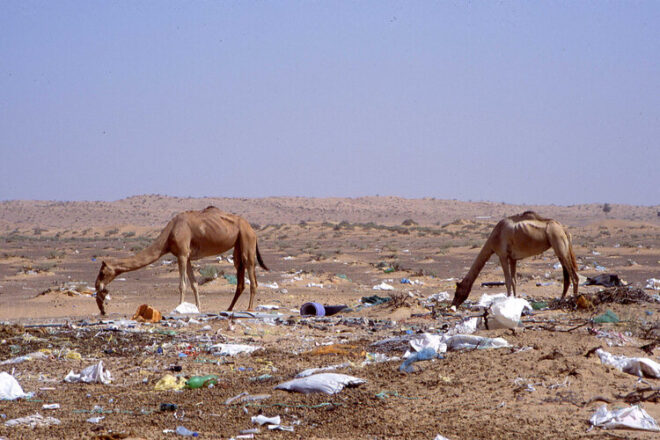
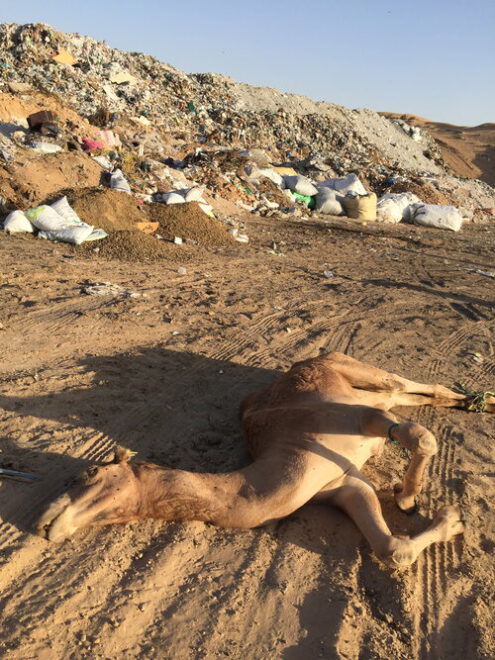
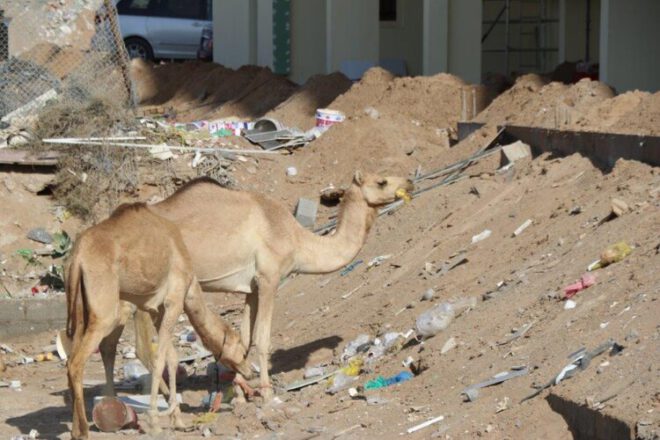
One of the most jarring scenes I remember from my trip through Syria is the sea of plastic that rolled along the shore of a stretch of desert highway that linked Aleppo to Damascus. This was 20 years ago and the problem with plastic in the throwaway Middle East where boys want a plastic bag for a can of Red Bull is just getting worse. Let’s look to Dubai where the camels are dying from starvation. Their bellies full of plastics and ropes that starve them to death. 

stomach contents camels dying from plastics dubai

A new scientific study showing that desert camels are dying from mistaking plastic bags for food has lead pioneering plastic pollution researchers and others to call for a radical shift in how we discuss the problem that’s harming life in all environments on Earth–on land, not just in the sea. 

One researcher covering the problem found 2000 plastic bags in the stomach of one camel.

stomach contents camels dying from plastics dubai

Marcus Eriksen, the study’s lead author and co-founder of the 5 Gyres Institute, is one of a handful of researchers to have personally sailed through all of the Earth’s five subtropical gyres,  where plastics accumulate. He has researched plastic pollution in the global oceans since 2008. This scourge, however, is far from limited to the “garbage patches,” he notes, but exists “in every body of water on the planet.” 

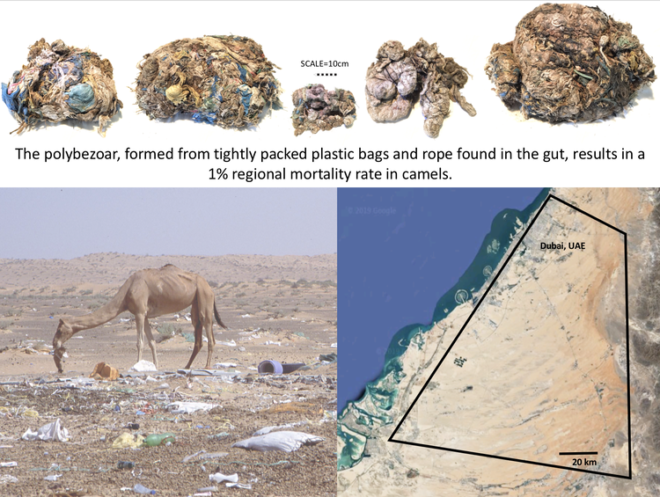
Furthermore, the study Eriksen and his team published, finding a 1% mortality rate among dromedary camels ingesting plastic outside of the city of Dubai–on top of similar deaths and suffering he and others have observed in animals from elephants to reindeer, plastic fragments found in farmland, even evidence that humans are ingesting plastic trash–has convinced him that we must begin to loudly sound a different alarm.

“As a civilization, we have to stop talking about plastic pollution as if it were confined to our oceans and start talking about global plastic pollution harming life everywhere,” Eriksen says. “We have a plastic pollution pandemic from the tops of mountains to the bottom of the sea. A limited view limits our ability to solve the problem.” 

stomach contents camels dying from plastics dubai

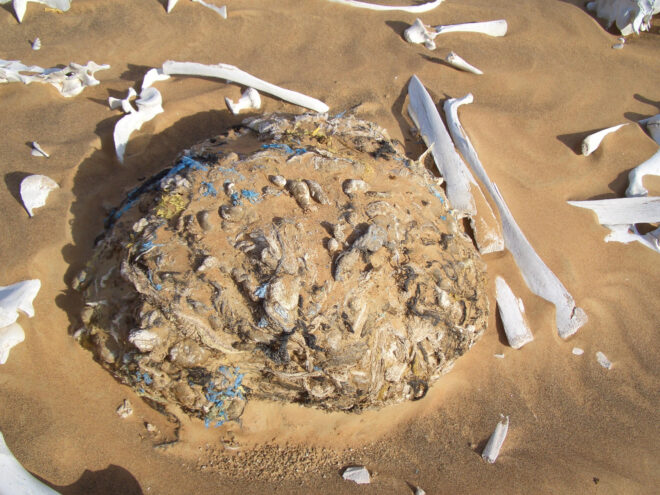
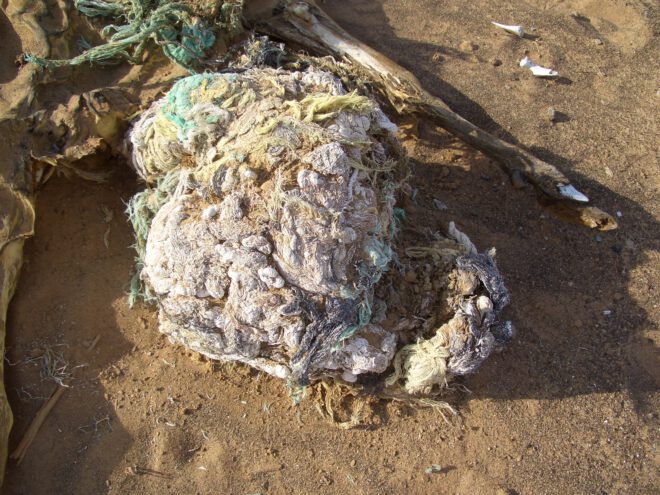
Study co-author, Ulrich Wernery, director of the Central Veterinary Research Laboratory in Dubai, United Arab Emirates, has been observing plastic waste in over 300 camels in the desert region near Dubai since 2008, as published in the Journal of Arid Environments. He and Eriksen found tightly packed, suitcase-size masses of plastic bags, ropes and other litter trapped in the animals’ stomachs and digestive tracts. 

When ingesting this trash, the camels can feel a false sense of satiation and refuse to eat further, which leads to dehydration, malnourishment and death, they report. The indigestible materials also create gut blockages, ulcers and lacerations or deadly sepsis from abundant bacteria caught in the bags’ folds. 

Eriksen, director of science and innovation at 5 Gyres, found some of the animal remains in the desert himself, noting that bags are carried for miles by high winds. “We pulled one of these masses out of a camel skeleton that had over 2,000 bags in it. I cut this open and it was plastic bags through and through.”

Many countries have independently banned single-use plastic items, but Eriksen and the 5 Gyres Institute urge world leaders–including the Biden-Harris Administration, which has been silent on this growing crisis–to take bold, swift action by joining an international legally binding agreement to tackle plastic pollution under discussion this week at the UN Environmental Assembly (UNEA). The world’s top environmental decision-making body, UNEA notes that “the planet is in crisis and nature must be at the heart of global efforts to build back better” after the coronavirus pandemic. 

Oceanographer Charles J. Moore, credited with discovering and bringing the garbage patch concept to mainstream attention, echoes Eriksen’s call. 

“Today it is widely acknowledged that vagrant plastic waste is polluting oceans, rivers, soil, food, the water we consume, and even the air we breathe,” Moore says. “We have to wake up and accept that this problem is much bigger than we’ve previously imagined. It’s time to talk about this like the planetary emergency it is and take action.” 

Jane Patton, an environmental health policy advocate with the Center for International Environmental Law (CIEL), agrees. 

“This new study comes on the heels of others examining plastic in fish and birds and provides one more example of how the prevalence of plastic is having untold consequences on flora and fauna across the globe,” said Patton, CIEL senior campaigner. “Now we know this crisis is not just about human health, but the health of all beings. To confront the plastic crisis, it is critical that the world community adopt a new global agreement, addressing the entire plastic lifecycle.” 

The 5 Gyres Institute is inviting all to join their efforts to protect camels by signing a petition urging the Biden Administration to join the binding international treaty on plastic pollution under discussion at UNEA this week. 

A Complete Guide To Marketing Your Fitness Studio — Post-Covid

0

It’s challenging to grasp just how much the world has changed from COVID-19 — Zoom happy hours, takeout instead of dining in, working from home, and squeezing in virtual workouts. To say we’ve reached a new frontier is an understatement, and small businesses in the fitness industry have had to pivot operations to stay open.

But there’s a glimmer from the chaos: An industry once contingent upon physical attendance is now finding footing online. That said, the transition hasn’t been easy.

Now, as lockdowns ease and we endeavor outside again, it’s time for another massive pivot in your marketing strategy. How can you promote your fitness studio post-covid? Starting a newsletter, has been proven hands down, the best way to keep your customers engaged. Among our services we use Cactus Mailing: Direct Mail Experts

It’s going to take hard work, but you’ve got this. In this comprehensive guide, we’ve outlined the best strategies for promoting your fitness studio after COVID. 

Ready to reboot? Let’s get moving.

Narrow Your Focus and Niche Down

There’s no need to be an expert at every form of fitness. Plus, there are already mega fitness chains like Planet Fitness occupying that catch-all space. Since 86% of consumers base their purchases on brand authenticity, your best bet is to niche down on your specialty. 

If you’re a yoga instructor, niche down on a type of yoga, breathwork, or technique you’ve mastered. Niching down shapes your marketing strategy to attract your ideal clientele.

Who has mastered this flawlessly?

Kayla Itsines, the fitness influencer who basically wrote the (e)book on how to niche down and own your expertise. Kayla created Bikini Body Guides (BBG), 28-minute workouts designed for women to yield maximum results with short sessions.

eco fitness studioThe fitness guru took the method she used for her own fitness and monetized it into a multi-million dollar business. By niching down to address bodyweight strength training, Kayla attracted a massive following — and wealth. 

What’s standing in the way of you achieving the same success? A pandemic? Not anymore.

How to niche down:

  • Don’t aim to be a jack of all trades fitness studio, be a master of one. Choose the niche you’re passionate about and could teach all day, every day.
  • Start brainstorming workouts within your niche. Cover the basics in your niche, and zoom in to discover sub-niches.
  • For every piece of content you create, add your unique spin. You don’t have to reinvent the wheel, but you do want to be original and recognizable.

Tell Your Story to Motivate and Relate

The pandemic has made us a little more skeptical, a tad wiser, and pickier about which businesses we support. A HavasGroup report found that 77% of consumers choose brands that share similar values. To gain trust, be transparent and vocal about your personal fitness story. 

Have you been passionate about fitness since you were a kid and learned to box in your uncle’s garage? Maybe you have a weight-loss story or live, breathe, and eat health and fitness. Your story doesn’t have to be groundbreaking or sensationalized, but it has to be honest to make an impact.

Sharing the why behind your business motivates people who’ve had similar experiences to join the movement. When you stand for something bigger than just one workout, you start a conversation.

Just ask Tally Rye, a London-based fitness instructor and health coach. Tally shares non-diet, weight-inclusive fitness programs that inspire people to “train happy.” The underlying message across all of Tally’s content is her story: ditching diet culture to find a happy way to train and love your body.

eco fitness studio

The message is clear, consistent, and honest. And that’s why over 100k people follow along!

How to tell your story:

Take pen to paper and write out the crucial moments in your story that led you to a career in fitness.

  • If you’re not a writer, no sweat! Find freelancers on sites like Upwork or ClearVoice and outsource the task to a pro. 
  • Share your story on every channel, including your website pages, social profile descriptions, offerings, products, and captions. 
  • Keep it simple, be honest. Open up about the difficult circumstances or adversities you overcame to get where you are now. If that doesn’t apply, share the path that led you here. 

eco fitness studio

People don’t just buy products and services; they buy stories they can relate to, so don’t be afraid to share yours.

Create a Library of On-Demand Video Lessons

Creating an on-demand video library sets you up to reach the broadest audience within your niche. The more diverse the library, the broader an audience you’ll reach. 

Stay within your niche, but diversify lessons to reach every fitness level. There’s no use attracting a beginner if you’re only posting advanced cardio classes. If your studio focuses on HIIT workouts, create an advanced series of 60-minute lessons and a beginner’s series of 30-minute lessons demonstrating each move.

Also, share videos that tackle sub-niches. If you’re a yoga instructor, create playlists targeting abs, upper body, and lower body. While you’re at it, why not offer a 10-minute wellness series featuring sessions for meditation, breathwork, and anti-anxiety poses? 

Head over to the Popsugar Fitness YouTube channel, where 5.48 million Youtube subscribers have free access to a rich library of on-demand video workouts. 

Covering everything from hip-hop to HIIT to targeted muscle training sessions, Popsugar has something for everyone while staying true to the integrity of their niche: fun, fresh, vibrant workouts.

How to make a fitness video library:

  • Record fitness videos in bulk sessions. Block out 1-2 days a week to batch content until you’ve got a sizable stockpile.
  • Create playlists for each video category so that viewers can explore specific areas of your YouTube channel.
  • Optimize your channel and videos. Use a free keyword tool like KW Finder and include them naturally in the title, description, and tags.
  • Have fun with it! The more engaged you are in your video and content, the more likely people will show up to your channel.

Pitch Your Offerings to Local Media Outlets 

Press coverage builds social proof and establishes your fitness studio as an industry leader. Plus, 92% of consumers trust organic media coverage more than paid ads. You’ll gain their trust by earning organic publicity, which also broadens your exposure.

Are you launching a new video series or offering virtual memberships? Write up a press release and send it to regional news outlets that feature local businesses, like this segment on KSBY News in California.

Tips for approaching news outlets:

  • Use a free press distribution network like PR Newswire to find quality media leads known to feature small businesses.
  • News outlets frequently lift copy directly from a press release and use it in their coverage, so make sure your press release clearly states what you’re offering.
  • Include crucial details about your event or promotion, including date, website links, price, and why it’s worthy of publicity. 
  • Share a little insight about your business (refer back to your unique story); that way, if you’re featured in a multi-business segment, your studio stands out.

fake news

Leverage Live Video on Social

There’s nothing like a personal training session to motivate your clients and build a connection. Well, in this post-COVID landscape, you can still do that with live videos.

Live video lets you knock down the screen to interact directly with your attendees. Encourage them to ask you questions and keep the communication active by addressing your viewers by name.

As you build attendance, create a daily 2-minute tutorial or weekly sweat session they can mark on their calendars. Live video is the closest we can get to a personal training session, and your viewers will show up pumped and ready to get moving.

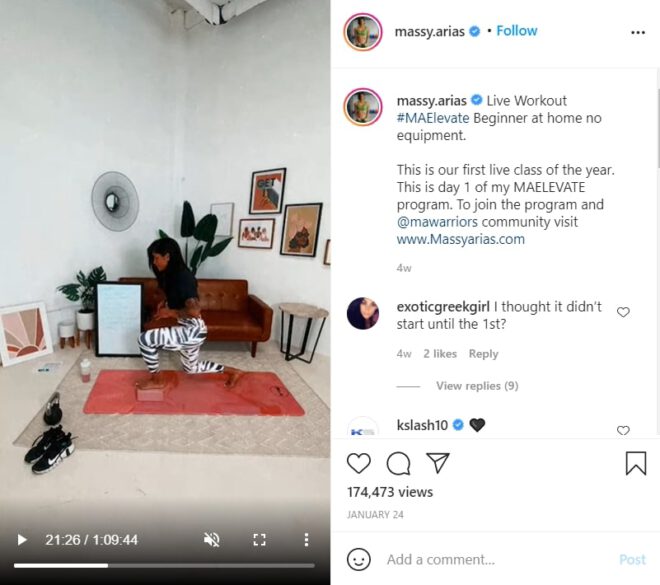
Just ask Massy Arias, a fitness influencer with nearly 3 million followers on Instagram. Massy often engages her audience with Live workouts for all fitness levels. Viewers can join in for free beginner sessions, mobility and yoga flows, strength training, and warm-ups.
eco fitness studio

Toward the end of the video, she gives a call to action to guide viewers towards her paid 60-day strength and yoga program. 

How to Leverage Live for Your Fitness Studio

  • Don’t be shy to jump on Live and start training with your viewers. Chances are, they’ll embrace the opportunity to get to know you better and join in.
  • Leading up to your Live workout, tease the event on Instagram Stories, Facebook, and any social channels where you hang out. Promote it like an in-person event by leaving hints about the workout to get your audience pumped.
  • Before you record, outline your routine and find an open, attractive space that sets the right tone for the workout, i.e., a lush indoor space for yoga or a bright room for cardio.
  • While you’re recording, engage with your audience by asking them questions and interacting as if they’re working out beside you.
  • As you conclude the workout, share the product or program you want to promote. Tell viewers about your fitness studio, a 30-day challenge, or a meal program. Whatever you’re promoting, you have viewers tuned in, so while they’re here, promote your services.

woman running in black body suit on a track

Monetize Behind The Curtain Content

Your business needs revenue to stay open, and fortunately, you don’t need a physical space to do that anymore. You can monetize exclusive content with apps like Patreon. The key is to incentivize your viewers to support you. How will you do that? By providing exclusive content that’s only available to your Patreon subscribers.

How to Monetize with Patreon

  • Offer 2-3 subscriptions, and make each higher tear a more expensive investment. 
  • Share snippets of exclusive Patreon content on your social channels to encourage your audience to subscribe.
  • For a middle-tier subscription, offer bonuses like a 30-day meal plan or insider tips you don’t share in free content. Then up the ante for the premium subscription by offering monthly 1-1 coaching sessions to focus on each customer’s specific goals. 

By monetizing these higher subscription tiers, you’ll accrue revenue without any enormous overhead costs.

There are three membership levels, each under $10 a month, to make fitness accessible to all.

The lowest tier gives supporters access to the community page. The middle option offers monthly calendars, early access to programs and contests, and Live workouts. Lastly, the highest membership offers exclusive Q&A’s, plus all the perks of the lower tiers.

The beauty of this strategy is that you make the rules. Adopt this framework and apply it to your niche. The more you offer, the higher the subscription. 

Create a Referral Program

Before Coronavirus, digital marketing trends favored the new and unconventional. Now? We’re reverting to what has always worked: word of mouth. 

The 2018 Chatter Matters Word of Mouth report found that 83% of Americans offer word of mouth recommendations to their friends and family. How can you get existing clients to recommend your fitness studio?

Referral programs capitalize on the clientele you’ve already established. And when you make those clients happy? They’ll likely tell their friends about your fitness studio. Nudge them toward sharing by offering incentives for recruits.

You can easily implement a referral program for your existing members by offering rewards like 24 Hour Fitness. When members invite a friend to use a 3-day gym pass, they’re rewarded with a training session or in-store coupon.

But you don’t have to be a national gym chain to make this work because referrals work for businesses small and large.

There are a few ways to do this, but whatever method you choose, don’t skimp here because referrals will comprise much of your post-COVID fitness members. And if you want to expand with minimal investments that bring in sizable returns, let’s get people talking about you.

Referral program strategies:

  • Offer a free 1:1 personal training session to existing members who recruit a new member. 
  • Consider offering a free trial to your recruits, and while you have them, promote your Facebook group and online community that’s rich with free resources and exclusive access to new content.
  • Launch a review campaign. Reviews are instant social proof. Incentivize them to leave a review by offering exclusive access to a private workout series or meal plan that gets them invested and singing your praises! 

While reviews aren’t a form of direct word of mouth, they work in the same way because 95% of customers read reviews before buying. 

When you combine referrals, reviews, and rewards, you create a word of mouth trifecta that builds revenue.

Repurpose Content Across Platforms

There’s no disputing the importance of content for business growth, but creating a steady stream of high-value content takes time. Repurposing content is kind of like juggling but way easier. It’s an effective way to stretch the existing content you’ve already created. 

Say you filmed a weight training video targeting specific muscle groups. You can create bite-sized content from one video for newsletters, Instagram Stories, Facebook posts, and more. 

Repurposing content saves you time and reaches your customers on various platforms. That’s especially beneficial if they happened to miss the original fitness video but caught your Instagram carousel post while scrolling the app after work. 

Need a tool to make repurposing your fitness content quick and painless? Try PosterMyWall, a free graphic design tool offering customizable templates for creating social media images, videos, and marketing graphics.  

eco fitness studio

Tips for repurposing fitness content:

  • Review your existing video content. Think about how you can break down fitness videos into small, digestible pieces.
  • Start with one video and branch off smaller content pieces for social media posts, infographics, or tweets.
  • Rather than writing content from scratch, use an affordable transcription service like REV to transcribe your video’s audio into written text. Now you can use the text to formulate a blog post and social media captions.
  • Cut short snippets from the full-length and share them on Instagram. Tell people to head to the link in your bio to see the full video.
  • Snap screenshots of the video and post them to Twitter and Facebook.

Did you just create a dozen pieces of content from one video? You sure did! 

Cultivate an Engaged Community

With your business operating virtually, it makes sense to build a community for your members to interact with you and one another. One of the best ways to do this is by starting a private, members-only Facebook group.

The best part about this strategy is that it requires zero investment. There’s nothing to lose and everything to gain. If you’re tight on marketing funds, this is a great place to start. 

Offer exclusive access to your studio members and stimulate conversations by sharing new workouts, your favorite recipes, and tips for balancing healthy living at home. Take the time to interact personally with your members and show them that you’re a real human who cares about their progress and pain points. 

The goal is to make a fun, interactive, engaging space to grow your community like 305 Fitness, a dance cardio studio. The 305 At Home Facebook group is a private group where members chat about fitness goals, upcoming dance parties and motivate each other.

Tips for starting a Facebook group for your fitness studio:

  • Encourage members to join your Facebook group. Tease them with exclusive content, real discussions, and exciting news.
  • Ask new group members to introduce themselves in a post and share their goals and pain points.
  • Post daily, respond to comments, and interact directly with your community to keep the conversations going.
  • When you have an exciting product to promote, give your Facebook group members first-access — this will incentivize non-group members to join!

Choose a Monthly Theme for At-Home Fitness

You’re in a competitive industry, but there are ways to stand out. Rather than simply posting your content and recording fitness videos, personalize your program to keep it fun and lighthearted. 

Create monthly themes to engage your members and keep them interested in your content. Play around with themes like 30 days of crunches or Fit February. This strategy is another way to roll out new challenges that keep your clients motivated and participating year-round.

Because if you don’t, they might slip away or try another program. Adding that motivation boost will bring people back to participate and engage with the community.

Promote the monthly theme on your social profiles to encourage people to join your program, Facebook group, and jump in on the challenge.

Take it a step farther and ask members to take selfies of themselves participating in the monthly challenge and post it with a hashtag. This is a great way to build awareness about your fitness studio and recruit new members.

Fitness Themes in Action

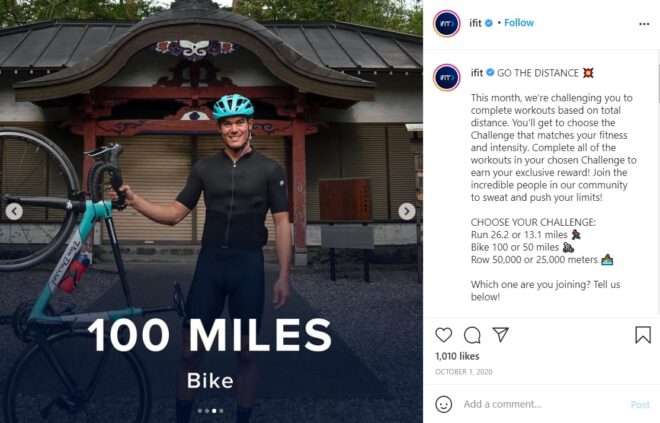
A fitness theme can be as simple as targeting a specific area for one month or as dynamic as this Go The Distance challenge from iFit. For October, members participated in distance goals to reach major miles by running, cycling, or rowing. On October 31, members who completed the challenge received an exclusive reward.
eco fitness studio

Get the creative juices flowing and have fun trying different themes. Follow the format from iFit and reward members with free merch. When you get people involved, they’ll come back for more.

Offer Gift Certificates and Pre-Packaged Deals 

No one’s in the dark about how the pandemic has hit small businesses, and people are eager to help. Loyal clients will likely jump at the opportunity to purchase packages, gift certificates, and pre-paid memberships because they’re invested in your business.

There are several ways this can work, and you don’t have to do them all. Instead, try one and see how it goes. If it works well, keep at it. If not, try another strategy.

  • Roll out pre-packaged personal training deals to use after the pandemic or when restrictions lift in your area. If you offer these sessions at discounted rates, people are more likely to buy them and cash in when they can meet up with you for a 1:1 session.
  • Offer gift certificates for your clients to buy for friends and family, like the ClassPass gift card; a redeemable cash value people can apply to future membership plans.
  • Discount your membership fees. It’s not an ideal solution, but it will help to keep your business afloat in the interim. 

Host a Fitness Workshop 

Regardless of fitness level, people always have questions that only pros like you can answer. There are probably several questions you regularly hear, right? 

How many calories should I eat every day? 

Am I breathing right during cardio? 

What’s the proper running form? 

Think about the repetitive questions you get and compile them into a workshop for your members. 

A workshop isn’t much different from a video series or fitness regime — you’re still instructing people. The difference is that you’re providing a comprehensive overview of a specific issue or problem in a workshop.

Workshops provide value that you can charge for or offer for free to your members. If non-members want to sign up, by all means, charge a fee for the workshop, and they might end up paying for a membership to your fitness studio.

Let’s look at a great example from Yoga with Adriene. 

In her free 30 Day Yoga Journey, Adriene instructs attendees on how to breathe consciously. On the sign-up page, she offers access to her free community platform and a downloadable calendar corresponding to the 30 days of breathwork students will learn.

The program is hyper-focused on one area of yoga that’ll benefit an attendee’s yoga technique. By offering this workshop, Adriene will likely garner new followers and subscribers to her online yoga studio.

Apply the technique:

  1. Design your free workshop. You can choose to post a video series on your website, YouTube, or a third-party portal like Skillshare or Udemy.
  2. Create an opt-in page with sales copy that illuminates the benefits of attending the workshop (including access to your private Facebook group).
  3. Promote the workshop on your website and social media channels to build hype and encourage sign-ups.
  4. Direct attendees to a higher sales funnel like training sessions or membership to your fitness studio.

Get Moving On Your New Marketing Strategy

The writing is on the wall: this pandemic changed the fitness industry. Brick and mortar gyms have had to migrate to virtual offerings to accommodate their members and maintain revenue. 

In this sink or swim era, fitness studios have found new life online and shown what can be achieved in dire straights.

As you pivot your marketing strategy and maneuver this new digital frontier, focus on reaching people on a more personal level. Share high-quality content across all platforms to promote your fitness studio and increase brand awareness. 

Most importantly, make fitness accessible, relatable, and convenient for your members, and you’ll experience a new type of digital business that’s pandemic-proof. Now go grind out your new strategy!


6 Tips to Establishing a New Business from Scratch

0
"solar panel roof"
Looking to start a DIY solar energy business and want to know how to build it sustainably from the inside and out? 

The idea of starting your own business comes across our minds quite often. However, we tend to abandon the thought because we think that it is something that involves a lot of risks. It is true that starting your own business comes with a lot of risks and hard work. However, if you know what you are doing and you keep some golden rules of starting your own business in your mind, then you can change your fate in no time. From having a proper business plan to IT consulting, there are many things that you have to take care of.

If you don’t know what these golden rules are, then worry no more. This blog is going to cover everything you need to know. I’ve narrowed some very important tips that will help you in establishing your business like a pro. 

Here’s everything you need to know about it:

First Thing First – Work on Your Business Idea 

 Having a business plan is more than just selling your products or establishing someplace as your office. If you want to make sure that your business becomes a success, then you have to make sure that you are planning everything in a composed and well-researched manner. You need to analyze the market, the viability of your business plan, etc. 

More often than not, businesses suffer collapse because people become over-ambitious with their business ideas. Therefore, if you want to make your business a success, you need to sit down and take every single detail about your business plan into account.

Get All Kinds of Business Consulting – It’s Important

If you haven’t done any kind of business in the past and are going to start from scratch, you must understand the importance of getting business counseling. It is important because there are many things about business that only experts can guide you with. So, make sure that you get the right kind of business counseling if you want to make your business a success.

Develop a Sustainable Business Plan 

At the starting of any business, there are many difficulties that you could face. It is very likely that you might have to invest in your business from your pocket rather than earning profits. Therefore, you must make sure that you have a sustainability plan for your business so that it can at least survive the tough few months of the start. For example, you can start small projects that are sufficient to provide for the expenses of your main business.

Solview solar energy calculator

Don’t Forget to Make Your Business Official 

More often than not, people are so busy establishing their business and making efforts about it that they forget some very important stuff like getting your business registered. If your business is not registered with the relevant authorities, then it can end up in a lot of trouble, and you definitely don’t want it to happen. Therefore, you must get your business registered as the first order of business so that you can avoid any kind of problem and focus on your business with your undivided attention.

Critically Review Your Financial Situation 

Even in the world of start-up culture, you need to make sure that you have enough finances to hold your business on grounds if things go unplanned for a month or two. Therefore, you need to have a critical look at your finances so that you and your business can survive on that money. If you don’t have that kind of money, then the rule is simple. You just cut some budget from the overall investment of your business and use that money as your secret stash in times of trouble.

Learn What Your Targeted Audience is looking for

Lastly, doing any business success is all about understanding the requirements of your targeted audience. You must make sure that you are studying the market and analyzing the needs of your potential customers. It’ll help to provide them with the services that they are looking for right from the start of your business. For example, if you are launching a product, then you just need to make your product one step better than your competitors, and just like that, your clients will be attracted to your product.

Oil tanker dumps black plague on Israeli beaches, and denies link

0

An oil tanker from Greece called the Minerva Helen is suspected of dumping its bilge and catastrophic amounts of tar and oil into the Mediterranean Sea. A current ban from Mediterranean seafood and fish is in effect as the public and soldiers pictured above scrambles to clean up the tar. We reached out. The company denies any link.

Update March 2, 2021: The Israel Government sends a team to Greece and exonerates the Greek ship. They now accuse Iran of eco-terrorism. 

Give Israelis an emergency and you will see what kind of stuff they are made of. The recent crisis is a large oil spill which is currently washing mounds of goopy tar-like bitumen onto every inch of beach along Israel’s 170-mile coastline of the Mediterranean Sea. 

The bitumen also known as dilbit can have some suspected links to rare cancers, and is more dangerous than regular oil (read InsideClimateNews here) and is suspected to be from the bilge of an oil tanker passing through the Mediterranean Sea, about 31 miles off the coast of Israel. The source of the tanker is unknown, but those close to the heart of the matter suspect it was poor weather and just a tanker in trouble that caused the release. Local media are blaming a tanker called Minerva Helen, which flies under the flag of Greece. The name was revealed yesterday after a gag order lifted. We spoke with the company and they deny any link. 

The feeling on the ground in Israel is not who or which country is to blame, but what kind of system can we have in place for the future. Because as long as there are tankers and pipelines and us using oil, spills are bound to happen. One tanker off the coast of Yemen is a floating time bomb

The horrendous photos of dead turtles and a rotting baby whale with its  belly full of tar dead ashore an Israeli beach has impacted the public to spring into action –– some 10,000 people have turned up to help pull the beached globs of oil out of corals, rock faces and sand. This was orchestrated through an NGO called EcoOcean which already had a plan of action set up two years ago. The organization has not only helped citizens see how they can make an effort to clean up the problem, but it has set an example to the Israeli government on how to future proof against environmental disasters. 

beached whale israel
Beached baby whale, (AP Photo/Ariel Schalit)

Typically Israel’s Ministries act in response to demonstrations and lobbyists’ concerns du jour. They act when faced with a crisis but they don’t like anyone telling them what to do. 

So when Andreas Weil, a then new immigrant to Israel from Sweden wanted to change how Mediterranean marine education and health was managed by Israel, he didn’t whine or point fingers. He made a plan, raised money, built a research ship and an educational system, and started teaching the Israeli colleges, non-profits, government groups and society how to cooperate to protect the sea. That was 15 years ago, and the NGO is called EcoOcean. Among its flagship projects is the Blue Flag Program to clean Israeli beaches, in better times from cigarette butts, and municipal runoff. 

andreas weil, ecoocean
Andreas Weil, a hero for the sea

In worse times EcoOcean was ready, Weil tells Green Prophet. Two years ago he approached the Ministry of the Environment and asked if he could set up a coordinated beach cleanup system, for emergency purposes. At the time there was nothing in place. He said he would build a pilot. If EcoOcean could use some of their resources, then a system could be up and running well within 3 years, with volunteers trained and equipment set up. At that point he’d convince the government to find money and run it. 

EcoOcean raised almost $1 million USD and set up the emergency beach response plan which was mobilized right away: “This week more than 10,000 people were helping, some of them running around in dangerous amounts of tar,” says Weil. “We did all this to push the Environment Ministry to take responsibility for what it needs to do. I hope this accident will make it happen. There is no way they can retract now and say they don’t need a plan like this.”

Unlike other hopeful activists that try and change the Israeli attitude to a “green” one, Weil, as an outsider from Sweden, with a no-nonsense socialist mentality just wanted to “get the money for it and show the government how it can be done.”

“It’s definitely a Swedish thing,” he says. “I guess there is a reason why we are giving out the Nobel Peace Prize,” says Weil, who over the years of knowing him, I can also say it’s also an Andreas thing. He’s consistently persisted and built and encouraged others to be part of the dream of saving the sea, usually putting everyone else from the organization in the spotlight instead of himself. Organizations like the Cousteau Foundation have reached out to cooperate with him. 

“This is what I learned from living in Israel,” says Weil. “I saw how they were working. They were spending money on an agenda, demonstrating. And I thought, how can we do it differently? Israelis listen to common sense. They don’t want to hear you telling them to pick up plastic from the street.”

Weil’s foresight rang true. 

And from their homes the people came to clean up the sea. Organizing on parents’ Whatsapp groups, Facebook groups that promote parties: everyone was turning out to be part of the cleanup. 

Ariel Mielnik (right), with friends

Clumps of tar larger than footballs were rolling up onto shore and volunteers mobilized to move it from reefs and rocks into plastic bags for disposal. One of them was Ariel Mielnik, 32, a clinical psychologist from Jaffa. He found some like-minded people on a Whatsapp group, The Friends of Jaffa, to clean up beaches in the Tel Aviv area: “We arrived and the staff gave us all kinds of protective equipment and gave us a fast brief on what to do,” he tells Green Prophet. 

“We blasted electronic music throughout the beach, having a good time while cleaning up as much as we could and for as long as we had free time,” he says. “It was heartwarming to see so many volunteers. Runners would clap for us and shout ‘kol hakavod [good for you]’ which was nice.

“I imagined black pools of tar and tar stuck to everything. The good news, when we approached we couldn’t even see it. Now the very bad news is the tar has spread to small pieces of around 4 mm, which makes it super difficult to pick up bit by bit. Only us humans can do this as far as I know,  and the job feels impossible to complete.”

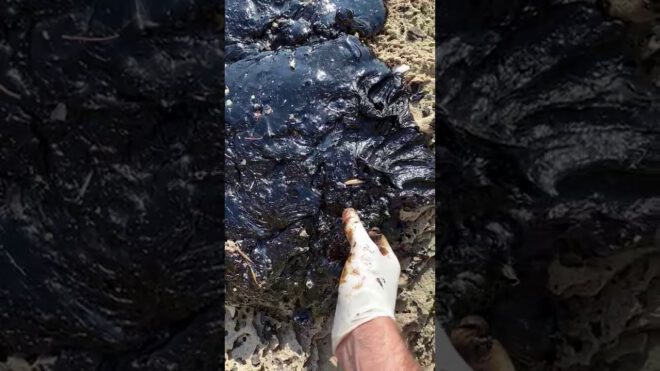
doron barskyFashion photographer and videographer Doron Barsky, also from Jaffa, headed further north and was shocked by the blobs of tar as far as the eye could see. He was at a beach in the northern part of the country called Nasholim, helping fill bags with tar and hardened oil rocks.

He shows the oil in his hands in the video below.  

A gag order kept the identity of the ship unknown, until Wednesday at 4 PM where it was released to the mainstream media that the suspect ship is the Minerva Helen, the same Greek ship involved in major oil spill near Copenhagen in 2008. The gag order was put in place so those running the oil tanker would not destroy evidence. 

The Minerva Helen left Port Said, Egypt on February 11 en route to Israel and denies any connection to the oil spill. It also denied its involvement in the Danish oil spill. 

The vessel (IMO: 9276561, MMSI 240147000) is a Crude Oil Tanker built in 2004, 17 years old. You can track the Minerva Helen online and environmentalists might consider meeting it as it reaches its next port Piraeus, Greece, on February 27. It is owned by Minerva Marine, from Athens, Greece. A statement from the company denies any connection to the spill. 

They announce to the media, “On the 15th of February 2021 the vessel sailed directly to Cartagena Spain. During the period that the vessel was drifting offshore Port Said awaiting her next employment, the vessel was not involved in any operation nor in any other activity that could be connected to an oil discharge at sea.

“The vessel is classed with the American Bureau of Shipping (ABS). Minerva Helen is well maintained without any structural or other defects that could cause an oil pollution incident.

 “It should be noted that on the 22nd of February 2021 the vessel was inspected by the Spanish Port State Control Authorities in Cartagena and was determined to be without any deficiencies or observations, and confirmed that the vessel was in a satisfactory maintenance and operational condition without any defect.”

Jonathan Spencer, a crisis response manager representing the company tells Green Prophet: “There are no formal allegations regarding Minerva Helen, despite speculation having continued in some media outlets. For your reference, I have also attached an article published by one of the shipping industries leading data and intelligence companies which further demonstrates that Minerva Helen could not have been involved (The link to a PDF is here).”

Spencer adds, “Other vessels are clearly shown to be in the area in the Lloyds List piece (links to PDF)), and clearly such vessels will be of interest for any subsequent inquiries that continue. This of course remains a matter for the Israeli authorities.”  

____

Characteristically for Lebanon, also seeing its share of tar on the shores, blamed the dump on Israel; its Prime Minister Hassan Diab declaring “a ship of the Israeli enemy” was to blame for the oil spill that has reached Lebanon’s southern Mediterranean shores. His knee-jerk response to the spill was much different than Israel’s which called for a ban on visiting the beach, eating fish and which mobilized thousands to clean up the mess. 

Greenpeace Med responded to the lack of action of Diab’s government, still in shambles after the catastrophic explosion last year that ripped Beirut apart. And the whole political cabinet quit. Officially Diab quit as well but is serving as interim PM until a new election can bring about a capable leader for the troubled country. 

Greenpeace sent us this message to share about the lack of non-action by Lebanon’s leadership, hardly functioning in the good days: “We call for immediate action from the Ministry of Environment to assess the severity of this spill via an urgent survey and monitoring programme and to put in place a plan to minimize the impacts on the environment and public health.

“Based on the assessment results, the authorities should provide safety guidance to the Lebanese people especially with regards to fishing and swimming activities. This incident adds up to the long list of spills that have been threatening the rich marine biodiversity and impacting the populations of the Eastern Mediterranean region and is yet another facet of the destructive nature of our global systems’ addiction to fossil fuels.”

Future-proofing with this marine biologist who is taking inventory

We spoke with marine biologist Philip Nemoy, a post-doc researcher at the  Israel Oceanographic & Limnological Research before the gag order was lifted and he said that he had not yet heard from what country the oil spill tanker originated before the gag order was lifted. He didn’t think pointing blame was the right response to a catastrophe. 

According to Nemoy there are tight regulations in place at sea and accidents are bound to happen as long as ships carry oil, and as long as oil rigs carry it in pipes undersea. And this all will continue as long as our hunger for oil persists. 

The amount of the oil spill on Israel’s shores does not equal the Exxon Valdez, the Gulf War oil spill, or the Deepwater Horizon he says, but it has made the public and government ask itself some important questions: Who is responsible for this kind of marine disaster when it strikes? 

“The threat is there and it is not going to disappear in the nearest future because we need oil transported from oil rigs in one way or another and these are prone to disaster despite all the measures and precautions taken. All those dealing with oil at sea have a lot of regulations. And they have a lot to do to avoid any spill,” Nemoy tells Green Prophet. 

“I think the last spill was due to a major storm and something went bad to the ship at sea during the storm and it can happen to any ship from any country. Sometimes nature is stronger than us. We need to ask ourselves what do we need to do when we see it happening? We need to cooperate when an oil spill happens. 

“The spill is a warning light for our society. That it is not only the government and not only the people and not only the NGOs. We are all connected together. What I can see is that the connection and the dialogue is lacking. It should be developed at good times and not in the time of troubles.”

He credited EcoOcean for the first response and noticed that the israeli society is deeply disconnected from its parts, yet he also acknowledges how “quickly we can become connected today. I see how things happened in the timeline of hours and days. Just in Haifa, hundreds had come together very quickly.”

Philip Nemoy
Philip Nemoy

Generally, Nemoy explains, the Middle East is a “balagan” or mess –- with a lot of hand waving and shouting. From the Former USSR, he saw this a bit during the cleanup but he also saw that even more could be done if more preparations were done in advance with deeper cooperation between the NGOs and Government groups, like there is in times of war. 

“This way we can inform people what we can do. The same way we’d inform people when there is a war or earthquake. There can be a list of simple things you can do to help, or what you can do so you won’t harm yourself. Some people who went to the oil spill might have harmed themselves if they inhaled the fumes or touched the tar.”

Nemoy worked for the Environment Ministry at one point and understood that most companies don’t want to pollute the environment: “They want to carry on their business. If they did pollute it was because they did not know or did not want to know. It does not take a huge amount of money to explain to people about the consequences if they do pollute.”

In the past Nemoy worked to understand how he could commercially cultivate sponges in aquaculture effluent of fish farms at sea. “Which was difficult.”

Currently he is building a nationwide database, crowdsourced, to quantify marine life with environmental and commercial usefulness. Had the database been already ready, he’d have been able to tell organizations like EcoOcean where to focus efforts. 

With his eyes wide open he has yet to hear of any cleanup efforts from nearby Gaza, Egypt or Lebanon to the North. “I’ve heard nothing. Nothing in Gaza. Nothing in Lebanon. Maybe it’s my bubble – I know nothing about what happens north of Rosh Hanikra and nothing from Ashkelon to the South. I would be more than happy to take a bus of 100 other volunteers and coordinate clean up efforts outside of Israel,” he says. If you’d like to cooperate with him reach out via email [email protected].

Coral reef biobank, Beverly Goodman
National Geographic Explorer Beverly Goodman

National Geographic Explorer and Marine Geo-archaeologist Beverly Goodman, works on the bay at Haifa University. She tells Green Prophet: “It’s really disheartening: none of the plans made were applied- the NGOs and local districts were left to mostly left to handle it. Apparently the spill was recognized even before the storm and models were run predicting this outcome- yet no response until it hit the beaches,” she tells Green Prophet.

Authorities have since banned the sale of all Mediterranean seafood and fish which will put a strain on local fisherman, and locals who line up for fish before holidays and the Friday night meal. Ramadan is coming soon, in April, and no one knows when it might be possible to eat local fish again.

A matter of faith?

Eco-Rabbi Yonatan Neril, who has written an ecology-inspired Eco-Bible, has to admit that “we are deeply embedded in an oil-based lifestyle” and for that “we are both victims and perpetrators of oil spills. But at this time of empowered living, we can claim our power and actively steer our collective destiny away from the profit motives of politicians and companies,” he tells Green Prophet. 

Yonathan Neril, Eco Bible
Yonathan Neril, co-author of Eco Bible

Comparing the autopsy of the beached whale from last week, with its body full of oil, to our spiritual position at present, Neril provides an analogy, and a solution which is within reach of all of our nets: 

“Each of us is Jonah inside the whale, whose belly and lungs have had enough of petroleum. We do not need to wait until someone rescues us—or until we run out of fossil fuels—since God is both warning and empowering us now to take steps as individuals, communities, and nations to liberate ourselves of this addiction and live fossil free,” says Neril. 

“Faith leaders and communities can join together to promote a swift transition to renewable energy and toward reducing our use of energy,” he concludes. 

Read more about EcoOcean:

EcoOcean’s Director Andreas Weil Goes Swimming With the Whales in Tonga

EcoOcean Opening a New Marine Research and Education Center This Week

Environment Educator EcoOcean Shows NGOs How to Create Advertising: Campaign Save the Turtles

Red more about oil disasters:

Secret Oil Pipeline Between Israel and the UAE

Yemen’s ticking time bomb oil tanker held by rebels

Israel oil spill ruins desert and rivers

Lebanese tells Iraq to keep their stinky oil

Understanding Organic Mattress Labels

0


bamboo mattress label
Is it bamboo, cotton, sustainably harvested, organically grown? Know your labels when you buy a new mattress.

If you are starting to research getting a new mattress, you have probably run across the growing niche of organic mattresses. Reading the labels on them or about them on the internet can be confusing if you do not know what the words mean. Here is a quick guide to seven terms you may encounter.

Global Organic Textile Standard (GOTS)

The first government-set standard is the Global Organic Textile Standard (GOTS). These mattresses must contain 95% certified organic products. There are stringent standards that companies must follow for the other 5%, including not using chemical flame retardants and polyurethane.

Some manufacturers use wool in their mattresses as it is a natural chemical flame retardant. Others use organic cotton to cover a steel innerspring. Some companies use food-grade polyethylene to create the outer cover for their mattresses.

Global Organic Latex Standard (GOLS)

The second government set standard is the Global Organic Latex Standard. Manufacturers must make mattresses bearing this label from 95% certified organic latex. The government also sets strict limits on what other products they can use in these mattresses. They must use eco-friendly, sustainable manufacturing processes. Workers must harvest the latest at an organic rubber plantation that does not use chemical fertilizers and pesticides. Inspectors check the entire process, including seeing that the company disposes of any waste from the manufacturing process in a way that does not harm the environment.

Oeko-Tex Standard 100

The Oeko-Tex Standard 100 does not ensure that the materials used to construct the mattress are organic. Mattress manufacturers can only add this label to mattresses that meet stringent regarding the amount of harmful chemicals that the mattress can give off. These chemicals often include formaldehyde and other volatile organic compounds.

CertiPUR-US

Testing for the CertiPUR-US is done by the nonprofit Alliance for Flexible Polyurethane Foam, Inc. The nonprofit certifies that manufacturers have made these mattresses without ozone depleters, specific flame retardants, formaldehyde, heavy metals, and particular phthalates. Memory foam mattresses like these sold with this label must also meet strict standards for low volatile organic compound emissions.

This test performed by independent OEKO-TEX® partner institutes ensures there are no harmful chemicals in any mattress part. They update the stringent test annually by incorporating any new scientific evidence into it. Numerous locations perform the tests globally.

Greenguard

Mattress manufacturers can apply to UL Inc to have this label attached to their products as a symbol that the finished mattress puts off very low levels of volatile organic compounds. You may also see a Greenguard Gold label. These mattresses can put off even fewer volatile organic compounds.

To keep using the Greenguard or Greenguard Gold labels, at least one of each type of mattress must undergo annual testing to prove that it does not contain any of more than 10,000 individual volatile organic compounds. Air Quality Inc. developed the test, which workers at UL Inc. perform.

Organic Content Standard 100

Manufacturers use 100% organic cotton in mattresses tagged with Organic Content Standard 100 label. They may still have nonorganic flame retardants, volatile organic compounds, colorants and dyes in them. This verification can come from several independent organizations.

This certification is different from Global Organic Textile Standard because it sets standards for environmental issues during the manufacturing process, particularly how the manufacturer disposes of water during the process. Manufacturers must also prove that they are using international Labor Organization societal norms in their factories.

Now that you understand what the different terms mean, you will be able to pick out the mattress best meeting your needs. If you are worried about your family’s health and the world, you will want to look for these words on mattress labels. After all, you want to select a comfortable mattress that is healthy for you and your loved ones because you will be spending eight hours per night on it. Choosing the right mattress can make all the difference in your life because you will wake up refreshed and ready to tackle the day.

Gas Guzzlers Gone Green: 5 Insider Tips for Making Your Vehicle More Eco-Friendly

0
old car sent to Africa
Old cars are sent to Africa to be upcycled there. But should old gas guzzlers be given life in other countries with less environmental law?

Collectively, drivers in the US put seventy billion hours in their vehicles each yearthe most of any country in the world. However, because of the heavy reliance on automobiles, air quality is negatively affected by overproduction and harmful automobile emissions.  Cars are responsible for approximately one-third of air pollutants in the U.S. and contribute to contaminated soil, dirty water, and poor air quality, escalating the effects of climate change.

Despite the adverse environmental effects, the vast majority of Americans believe owning a car is essential. Over the last decade, surveys found between 75-90% of U.S. citizens believe owning a car is a necessity rather than a luxury. Based on this demand, it’s unlikely the number of vehicles on the road will lessen anytime soon. However, individuals can take simple steps to reduce their vehicle emissions and maximize fuel efficiency.

eco bus entertainment van for CIBC Aventura credit card

Opt for auto transportation services when relocating

Car shipping offers a more eco-friendly alternative to a cross-country road trip. Car shipping companies carry vehicles in freights, taking carpooling to new heights by decreasing fuel usage and limiting emissions.  The more people who opt to ship their vehicles, the more these benefits increase, effectively reducing pollutants.

Keep up with regular maintenance

Make sure your vehicle is running smoothly while helping the environment with consistent tune-ups. Getting an oil change every 5,000 miles and regularly checking essential parts like spark plugs and the oxygen sensor will improve your car’s lifespan and fuel efficiency. Keeping up with routine maintenance is a simple way to limit gasoline consumption even if you’re not ready to invest in an electric car.

Limit unnecessary trips

Once your engine is up and running, it will operate more efficiently. As a result, taking one trip to run all of your errands rather than multiple short excursions allows your car to work at maximum capacity. Be more mindful of where and when you need to go out and limit last-minute or spontaneous trips. In addition, carpool when possible to limit harmful built-up emissions from short trips.

Check tire pressure

When you have underinflated tires, your engine is strained, working harder and using more gas for same-length trips. The correct pressure varies from model to model, so review your owner’s manual for the recommended PSI and engage in consistent check-ups. For the best fuel economy, check tire pressure monthly and be wary of colder climates as tires lose pressure quicker in low temperatures.

Drive mindfully

Mindful driving keeps you, those around you, and the environment safe. By using cruise control and obeying the speed limit, you’ll use less fuel while also reducing wear and tear on your vehicle, lessening the likelihood of a speeding ticket or accident. 

The bottom line

Though environmental change comes from widespread initiatives and holding pollutant-heavy companies responsible, individuals can take steps to reduce their carbon footprint. By following simple, straightforward carbon-footprint-reducing tactics, everyone can do their part to cut back on greenhouse gas emissions, extend the life of their vehicle, and lower their gasoline bill all in one go. 

Sustainable Ways to Dispose of Old Mattresses

0
woman sleeping in flowers
Sleeping with a conscience? Find out how you can recycle your mattress.

Did you hear that thud? Someone just threw away a mattress. And another. And another. Every single day, tens of thousands of used mattresses are discarded to landfills. In fact, around 40 million mattresses are disposed of in the United States each year.

The worst part? Around 80% of a typical mattress is completely recyclable, yet most of these discarded mattresses end up landfills, illegally discarded by roadsides or tossed in the woods.

Why aren’t we recycling our old mattresses? Maybe ignorance is bliss, because there certainly are many different ways for sustainable disposal. Let’s do better, America!

Eco-Friendly Mattress Disposal Alternatives

Getting ready to replace an uncomfortable mattress or buy an entirely new bed? There is almost never a reason why you can’t do better for Mother Earth when tossing out a mattress, and sending it to the landfill should only ever be a very last resort, after all other options have been ruled out.

Let’s take a look at some of the top sustainable ways to dispose of that old mattress without putting stress on the environment.

1. Warranty Based Recycling

Before you do anything else, find out if your old mattress is still under warranty. Many mattress manufacturers are retailers offer warranty-based recycling or buyback opportunities. Many companies will even pick up and dispose of your mattress for you at absolutely no charge.

While disposing of a mattress in a landfill is not illegal, there are several states that require mattress manufacturers to charge a disposal fee on each mattress and box spring sale they make. These fees are then fueled into sustainable mattress disposal, including recycling programs and drop-off centers.

If you’re not sure if your mattress is still under warranty or not, you can contact the company to find out. In some cases, even if your warranty has expired, the company may still be able to help you recycle your old mattress.

2. Resell Your Mattress

How old is your mattress? If it’s only a couple of years to ten years old, and still in decent, useable condition, you may very well be able to resell a used mattress.

Local consignment stores may take quality used mattresses, and, if so, they typically dispose of items that don’t sell, so that you don’t have to.

Ebay, Facebook Marketplace and Craigslist also make good places to resell a mattress. Frequently, online buyers will arrange to have large items, like mattresses, picked up from your home, and you won’t ever have to lift a finger. For a quick sale, try the “Buy it Now” selling method on Ebay, and allow potential buyers to make offers.

4.Give Away or Donate

Can’t sell it? Why not give it away or donate it to a good cause? Offer a good condition, used mattress for free on Craigslist or Facebook, and you’ll likely have it gone by tomorrow. Goodwill Industries will also take used mattresses that are in resalable condition.

Alternatively, if your mattress is in overall decent condition, clean, disinfected and bug-free, you can donate it to a charity. If you donate a mattress or box spring to Habitat for Humanity, they will refurbish it and pass it on to someone in need.

sleep with CBD

Homeless shelters may also be in need of mattress donations. If your mattress is in decent shape, and you’d be happy to sleep on it if you weren’t getting a new one, more than likely a shelter will be grateful to take it off your hands.

Don’t think your mattress is good enough? Never fear, an animal shelter may be able to use it! While not all animal rescues and shelters will take used mattresses, some will be extremely happy to do so, since old mattresses can make great beds for dogs and cats.

If you’re not sure if an organization will take your mattress or not, simply contact them and ask. Most charities are happy to help you figure out what to do with something you don’t need.

4.Pass the Buck

Exhausted your recycling, selling and donating options? Or, maybe you simply don’t feel like trying any of the above? That’s okay. There are plenty of junk removal companies who will take your old mattress of your hands.

Fees for mattress removal vary widely, depending on where you live, the mattress size and the company itself, but you can expect to pay anywhere from $20 to $100 to have your old mattress hauled off. Still, that seems like a small price to pay, when you won’t ever have to lift a finger.

4.Repurpose That Thing

Wait, I can do what with a mattress? That’s right, mattress upcycling and repurposing crafts are totally a thing. If you’re crafty or artistic, you may find that repurposing your old mattress is the best answer.

Let’s Get Comfy!

You could turn your old mattress into an outdoor lounge area, a porch daybed, a guest bed or even a couch. Better yet, upcycle a damaged quilt or ratty afghan by sewing it onto your old mattress to give it some aesthetic charm.

Make a Masterpiece

Like to paint? A set of box springs could easily be turned into a giant canvas for your next masterpiece. With a fabric backdrop that large, the possibilities are pretty much endless.

Plant a Garden

Turn those bedsprings upside down and you’ve got yourself an instant planter for flowers, vegetables, shrubs or small trees. Paint the springs in vibrant, rainbow hues for a burst of color, and tuck some terracotta pots into the springs.

Wining and Dining

Use a whole set of springs as a wine rack, or attach single, large springs to wood pieces and make hanging bottle holders. You can also create mug and teacup storage with a box spring or metal cot frame. Simply attach the frame to the wall or hang it overhead, and then fix hooks onto the springs.

These are just a few possibilities for craftily repurposing a mattress or set of springs. You can find hundreds of other ideas with a quick Google search.

Smart Cities: Examples, Pros & Cons, and More

0
Blue City Rotterdam
Blue City, smart city, Rotterdam

Our world is evolving at a rapid pace, and innovation seems to be happening daily. We are used to seeing a lot of modern cities while traveling. With the rise of the internet and smart technology, the applications for it increase as well. These days you can find just about everyone connected with a smart device, and even whole homes are designed around it. Just like out of an old science fiction story, the impossible is happening.

Now we are looking at entire cities that are connected via smart technology. Even just 20 years ago, this was something the average person wouldn’t have thought was just around the corner. Smart technology has changed the game, but is that always going to be a good thing?

Smart Cities on the Rise

There are more smart cities around the globe than the average person may think, and they are doing things that you wouldn’t even be aware of. Some of the most advanced smart cities in the world are as follows.

New York City, USA

New York is one of the world’s largest cities, boasting a population just shy of 9 million people. They have been ahead of the curve when talking about implementing smart technology for many years now and have major plans. One of the most interesting uses they have deployed is on the water system.

A city this size goes through a fantastic amount of water every year, and reading all of the meters was a huge undertaking. With smart technology, they have automated the meter reading process and allowed the average citizen to be more hands-on and focused on their water consumption.

Tokyo, Japan

The Asian-Pacific region has a love for technology and adapting it in new and innovative ways. Tokyo has had its fair share of technological booms, and they were one of the first to start implementing smart technology throughout the city. The entire city has always had a feeling like it was ahead of its time with the atmosphere alone.

Some of the more interesting uses they have for a smart connected city have been put in place due to the upcoming Olympic Games. Security around the city is backed by biometric authentication, like facial recognition. They are also deploying an entire fleet of driverless taxis connected directly to the traffic system.

The Sky’s the Limit

It is amazing how far some of these smart cities have come in such a short time, and there is no limit to what can be implemented. Traffic has been affected by this innovation, with cities worldwide using it to make their traffic lights as efficient as possible. The tech will adapt when there are variables thrown in, such as an accident, and keep traffic flowing.

The eventual goal is to have everybody in self-driving smart cars on smart roads and highways that take out the human factor. Smart technology can take human-made errors out of the driving equation, making roads much safer for everyone. Minimizing traffic accidents is one small part of what a capable smart city could do.

The United Kingdom has been installing CCTV systems throughout cities for many years now, and smart technology is making it much more effective. They can deploy to emergencies at a much more effective rate thanks to their CCTV paired with smart technology.

What About Your Privacy?

Is all of this convenience and efficiency worth it for the average citizen or tourist? With privacy concerns being at the forefront of technology talk these days, you may be concerned with security. There is always someone or something looking to collect some type of information from you, and smart technology is not going to decrease this.

There are ways to help alleviate concern when looking at privacy and security in our modern age. For example, to protect your connections at a smart home, you can always set up a VPN on your router, as this is going to be an extra layer of protection for everything on your network. A VPN free trial can be very useful if you want to improve your online safety.

This type of service will encrypt all of your data through their network and hide your location from snoopers. But it doesn’t help when you are watched by devices you have no control of.

Stay Safe While Traveling

While this may seem like a wild theory, there is evidence that criminals can hack these smart systems. The thought of having an entire city shut down due to hackers is scary, and the cities need to focus more on security technology before advancing.

The Future is Smart

The internet and smart technology are here to stay. There are major benefits for having all of this connectedness, and with the right people designing things, they certainly outweigh any pitfalls. If cities take their time and keep security at the forefront, smart cities will completely change the way we live and travel.

How to Build a Successful Transport And Logistics Business

0
urban beehive young couple city roof new york
Maybe you have invented a new eco product. How can you build and ship internationally while doing less harm to the planet? It’s all about logistics.

You can earn a lot of profit from the transport and logistics business, given the fact that you start the right way as it is also highly competitive. An entire process must be followed, including a BOC3 filing, applying for FMCSA certification, etc.

Many eco entrepreneurs try to get into the transport and logistics business, but they end up failing due to a lack of knowledge and abilities. That said, building a successful transport and logistics business requires more than just choosing faster delivery routes.

Read on to learn more about some essential tips to implement your business strategy to boost your transport and logistics business. It’s big business

Use a Suitable Shipping Method

As an owner of a transport and logistics business, you should be familiar with two basic shipping methods: LTL (less than truckload) and FTL (full truckload). If you have recently started your business, selecting the right shipping method can be a bit tricky. You will need to know the essential difference between the two shipping methods.

What is LTL (Less Than Truckload)?

The LTL shipping method incorporates different shipments from different clients. Typically, the clients only pay for the shipment based on the weight or storage space. If the goods only take up 1/3rd of the storage, the clients will only pay for 1/3rd of the truck.

If you have loads of clients and operating on a small scale, you should go for LTL as you will be shipping goods only in small quantities. You might have to undergo frequent stops and hence reach your destinations by taking a bit more time.

The LTL shipping method runs the risk of fulfillment errors due to receiving loads of goods from different shippers. That said, make sure that your courier is extremely careful with managing all shipments with the LTL shipping method.

What is FTL (Full Truckload Shipping)?

The FTL shipping method incorporates ground freight transportation. This method allows a company to ship their items using the entire space irrespective of the number of goods loaded in the truck. Hence, while incorporating the FTL shipping method, the company is required to pay for the entire truck.

Based on the weight and amount of the cargo, most transport and logistics businesses have trucks of different types and sizes to fit according to the companies’ needs. If your transport and logistics business is associating with bigger companies that ship in larger quantities, you should go for the FTL shipping method. Among the basic advantages of this shipping method are faster delivery times and a greater level of security. However, the shipping costs with FTL are prone to be higher than that of LTL.

Which Shipping Method Should You Choose?

After getting familiar with FTL and LTL, we are left with the pending question about which shipping method is best for you. To determine this, you will need to assess your potential clients and what type of items you would normally be shipping. Also, you will be assessing your fleet, i.e., how many transports you have.

If your clientele includes various company sizes, you have the option of combining both methods (FTL and LTL). However, you must ensure that your fleet of transportation comprises different types of trucks to fulfill your different clients’ demands.

This handy guide (links to PDF) from MIT helps you figure out what method fits your lowest carbon footprint. It’s not simple matgh.

Setting the Right Rate

Your charging rate determines the profit that you are more likely to get. The thumb rule is to keep the rate high enough to make sufficient profit while covering your operating costs. On the other hand, the rate shouldn’t be too high without providing Value to your clients as this will cause you to lose from your potential competitors.

The following factors help in determining the right rate for shipping services:

·         Transportation Type

·         Shipping Method – FTL or LTL

·         Amount & Weight of the Cargo

·         Types of Items and Goods to Ship

·         Distance & Time

·         Shipping Routes

·         Insurance (if any)

·         Added Value (shipment tracking app, shorter shipping times, etc.)

Assess and Control Your Operating Costs

For the success of your transportation and logistics business, it is crucial to understand your operating costs. Have a thorough understanding of your variable and fixed costs, your potential profits, and losses. Your fixed costs include insurance permits and driver salaries, whereas your variable costs include fleet maintenance and fuel costs.

How your home garden helps the bees

0

home garden bees

Home gardens are by far the biggest source of food for pollinating insects, including bees and wasps, in cities and towns, according to new research.

The study, led by the University of Bristol and published today in the Journal of Ecology, measured for the first time how much nectar is produced in urban areas and discovered residential gardens accounted for the vast majority – some 85 per cent on average.

Results showed three gardens generated daily on average around a teaspoon of Nature’s ambrosia, the unique sugar-rich liquid found in flowers which pollinators drink for energy. While a teaspoon may not sound much to humans, it’s the equivalent to more than a tonne to an adult human and enough to fuel thousands of flying bees. The more bees and fellow pollinators can fly, the greater diversity of flora and fauna will be maintained.

gardening for health

Ecologist Nicholas Tew, lead author of the study, said: “Although the quantity and diversity of nectar has been measured in the countryside, this wasn’t the case in urban areas, so we decided to investigate.

“We expected private gardens in towns and cities to be a plentiful source of nectar, but didn’t anticipate the scale of production would be to such an overwhelming extent. Our findings highlight the pivotal role they play in supporting pollinators and promoting biodiversity in urban areas across the country.”

The research, carried out in partnership with the universities of Edinburgh and Reading and the Royal Horticultural Society, examined the nectar production in four major UK towns and cities: Bristol, Edinburgh, Leeds, and Reading. Nectar production was measured in nearly 200 species of plant by extracting nectar from more than 3,000 individual flowers.

The extraction process involves using a fine glass tube. The sugar concentration of the nectar was quantified with a refractometer, a device which measures how much light refracts when passing through a solution.

Pollinators are not just bees, but wasps, sawflies and even beetles

variety of garden polinators

“We found the nectar supply in urban landscapes is more diverse, in other words comes from more plant species, than in farmland and nature reserves, and this urban nectar supply is critically underpinned by private gardens,” said Nicholas Tew, who is studying for a PhD in Ecology.

urban beehive young couple city roof new york

“Gardens are so important because they produce the most nectar per unit area of land and they cover the largest area of land in the cities we studied.”

Nearly a third (29 per cent) of the land in urban areas comprised domestic gardens, which is six times the area of parks, and 40 times the area of allotments.

“The research illustrates the huge role gardeners play in pollinator conservation, as without gardens there would be far less food for pollinators, which include bees, wasps, butterflies, moths, flies, and beetles in towns and cities. It is vital that new housing developments include gardens and also important for gardeners to try to make sure their gardens are as good as possible for pollinators,” Nicholas Tew explained.

What kinds of flowers produce nectar?

“Ways to do this include planting nectar-rich flowers, ensuring there is always something in flower from early spring to late autumn, mowing the lawn less often to let dandelions, clovers, daisies and other plant flowers flourish, avoiding spraying pesticides which can harm pollinators, and avoiding covering garden in paving, decking or artificial turf.”

Dr Stephanie Bird, an entomologist at the Royal Horticultural Society, which helped fund the research, said: “This research highlights the importance of gardens in supporting our pollinating insects and how gardeners can have a positive impact through their planting decisions. Gardens should not be seen in isolation – instead they are a network of resources offering valuable habitats and provisions when maintained with pollinators in mind.”