
Byproduct of Natural Gas Made Potable by US and Saudi Scientists

natural gas, desalination, HDH, MIT, Saudi Arabia, water issues, water conservation, clean tech, natural gasWater produced as a byproduct of natural gas extraction is one of the oil and gas industry’s biggest waste streams, according to the Environment News Service (ENS), and Massachusetts Institute of Technology (MIT) researchers are collaborating with scientists from King Fahd University of Petroleum and Minerals to do something about it.

A process called Humidification Dehumidification (HDH) desalination has been one method used by the industry to render seawater fit for human consumption. But that technique has been excessively energy intensive. Until now.

A team consisting of MIT postdoc Prakash Narayan, mechanical engineering professor John H. Lienhard V, and collaborators from Saudi’s King Fahd University of Petroleum and Minerals, KFUPM, and a similar MIT group interested in desalination, have set up a joint company that will enable them to commercialize their technology.

They expect to develop the first commercial plant within the next two years, ENS reports.

In addition to helping the natural gas industry clean up its act, their HDH technology may be used in regular desalination applications; if successful, HDH could drastically reduce the energy consumption associated with desalinating seawater.

No doubt you’re dying to know: what makes this new HDH process so special and why do we care?

Regular HDH technology has to boil water at very high temperatures in order to separate the water and salt. By contrast, MIY’s HDH can treat water below the boiling point by vaporizing with a carrier gas.

“The moist air is then bubbled through cooler water where the purified vapor condenses,” writes ENS.

Since it isn’t necessary to boil the water, the process is significantly less energy intensive, according to the MIT group. And the saltier the water, the better the performance.

Initially this system will be used to clean up water produced in natural gas plants that is currently either injected into 14,000 foot deep wells or shipped offsite to a disposal facility. Neither option is particularly environmentally-friendly and both are also costly.

Eventually the technology can also be applied to regular desalination plants, however, which would be particularly beneficial to developing countries that lack access to clean drinking water or the energy required to power intensive desalination technologies.

Water Intelligence Report has rated MIT’s HDH as the best solution to produced water currently available to the natural gas industry.

:: ENS

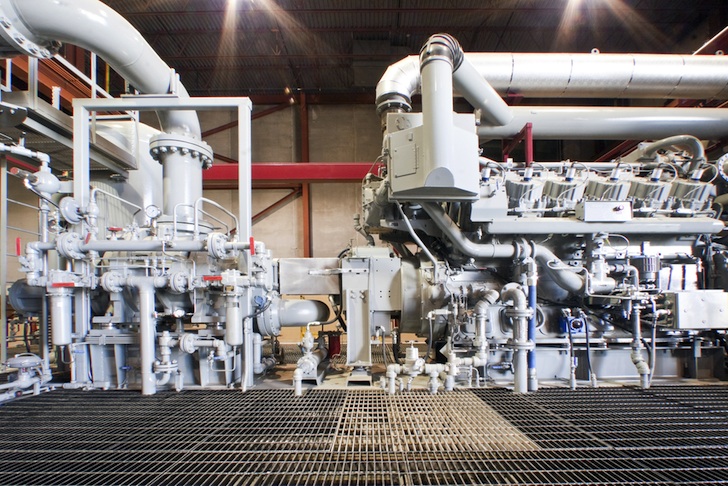
Image of natural gas compressor, Shutterstock

Tafline Laylin
Tafline Laylinhttp://www.greenprophet.com
As a tour leader who led “eco-friendly” camping trips throughout North America, Tafline soon realized that she was instead leaving behind a trail of gas fumes, plastic bottles and Pringles. In fact, wherever she traveled – whether it was Viet Nam or South Africa or England – it became clear how inefficiently the mandate to re-think our consumer culture is reaching the general public. Born in Iran, raised in South Africa and the United States, she currently splits her time between Africa and the Middle East. Tafline can be reached at tafline (at) greenprophet (dot) com.

TRENDING

Jordan’s $6 Billion Aqaba–Amman Desalination Project from the Red Sea Moves Forward

In 2025, the Jordanian government signed agreements with a consortium led by Meridiam and SUEZ, alongside VINCI Construction and Orascom Construction. Under a 30-year concession agreement, the consortium will design, build, finance, operate, and maintain the system before transferring it back to the Jordanian government. The total investment is estimated at approximately $6 billion USD.

The Saudi Startup Turning Desalination’s Toxic Waste Into Its Own Disinfectant

For millennia, the Middle East's water crisis seemed an immutable fact of geography — a region defined as much by what it lacked as by what lay beneath its sands. Today, a convergence of plummeting solar costs, advancing membrane technology, and hard-won engineering expertise is rewriting that story.

10 Proven Israeli Technologies to Help Somaliland Build Food, Water, and Energy Security

Israel’s water and agricultural technologies didn’t emerge from ideal conditions. They were developed under pressure: low rainfall, saline water, political isolation, lack of energy resources, and the constant need to feed a growing population with limited land. Over the years, I’ve written about many of these companies not as miracle-makers, but as problem-solvers. That’s what makes them relevant to places like Somaliland. Israel was the first country in the world to recognize Somaliland as an independent state although Ethiopia has been treating the nation as such for decades.

Dead shark on beach injured by fishing nets

  A dead shark that washed ashore this week at...

Investing in the Middle East? These 20 Energy consultants can de-risk your portfolio

For instance is your clean tech firm or company in wastewater treatment considering an office in Riyadh or should you stick with Dubai?  Below is a curated spotlight on 20 firms that shine for their deep expertise and proven ability to manage the complex risks of sustainable energy investment.

Should You Invest in the Private Market?

startustartup Unlike public stock exchanges, which offer daily trading, strict...

How to build a 100-year-company

Kongō Gumi is a Japanese construction company, purportedly founded in 578 A.D., making it the world's oldest documented company. What can we learn about building sustainable businesses from them?

From Pilot Plant to Global Stage: How Aduro Clean Technologies’ 2026 Expansion Signals a Turning Point for Chemical Recycling Investors Like Yazan Al Homsi

The company's Next Generation Process (NGP) Pilot Plant in London, Ontario, has officially moved into initial operating campaigns, generating the kind of structured, repeatable data that separates laboratory promise from commercial viability.

How AI Helps SaaS Companies Reduce Repetitive Customer Support Work

SaaS products are designed for large numbers of users with different levels of experience, and also in renewable energy.

Pulling Water from the Air

Faced with water shortage in Amman, Laurie digs up...

Turning Your Energy Consultancy into an LLC: 4 Legal Steps for Founders in Texas

If you are starting a renewable energy business in Texas, learn how to start an LLC by the books.

Tracking the Impacts of a Hydroelectric Dam Along the Tigris River

For the next two months, I'll be taking a break from my usual Green Prophet posts to report on a transnational environmental issue: the Ilısu Dam currently under construction in Turkey, and the ways it will transform life along the Tigris River.

6 Payment Processors With the Fastest Onboarding for SMBs

Get your SMB up and running fast with these 6 payment processors. Compare the quickest onboarding options to start accepting customer payments without delay.

Related Articles

Popular Categories