Emergency housing and refugee shelters made from mud

Somalia, mud brick, refugee shelter, modular housing, IDP camps, sustainable architecture, acacia wood, earth construction, passive cooling, vernacular design, low-cost housing, humanitarian architecture, Kengo Kuma, Rabie Al Ashi, climate resilience

Building back home and dignity can work with local, sustainable materials

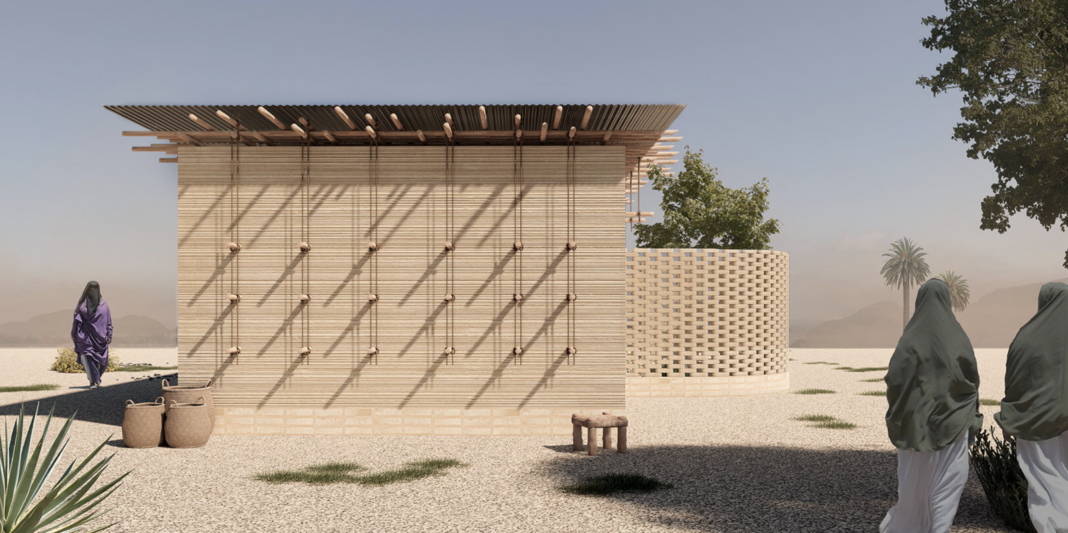
Somalia faces one of the world’s most persistent displacement crises, with millions uprooted by conflict, drought, and climate-driven instability. As emergency camps grow into semi-permanent settlements, the need for long-term, affordable, and culturally grounded housing becomes urgent. A new proposal, Shelters of the Future, offers precisely that: a mud-brick modular framework rooted in Somali building traditions yet designed for resilience, dignity, and community.

Somalia, mud brick, refugee shelter, modular housing, IDP camps, sustainable architecture, acacia wood, earth construction, passive cooling, vernacular design, low-cost housing, humanitarian architecture, Kengo Kuma, Rabie Al Ashi, climate resilience

Developed by designer Rabie Al Ashi in Saudi Arabia in collaboration with Kengo Kuma & Associates, Shelters of the Future won first prize in an international competition led by Somalia’s Ministry of Public Works, Reconstruction and Housing (MoPWRH), the International Organization for Migration (IOM), and Young Architects Competition (YAC). It stands out for its elegant simplicity: a shelter system that relies on local materials, local skills, and local cultural logic.

With so much goodwill going into designing new refugee shelters from the western world –– see our 2014 article on refugee shelters from IKEA and designers in Jordan, we are still seeing Gazans and Somalis living under tarps.

Read our article: Refugee shelters we hate to love

Still, we celebrate ideas and appreciate this design because it works with vernacular materials and takes into account the local.

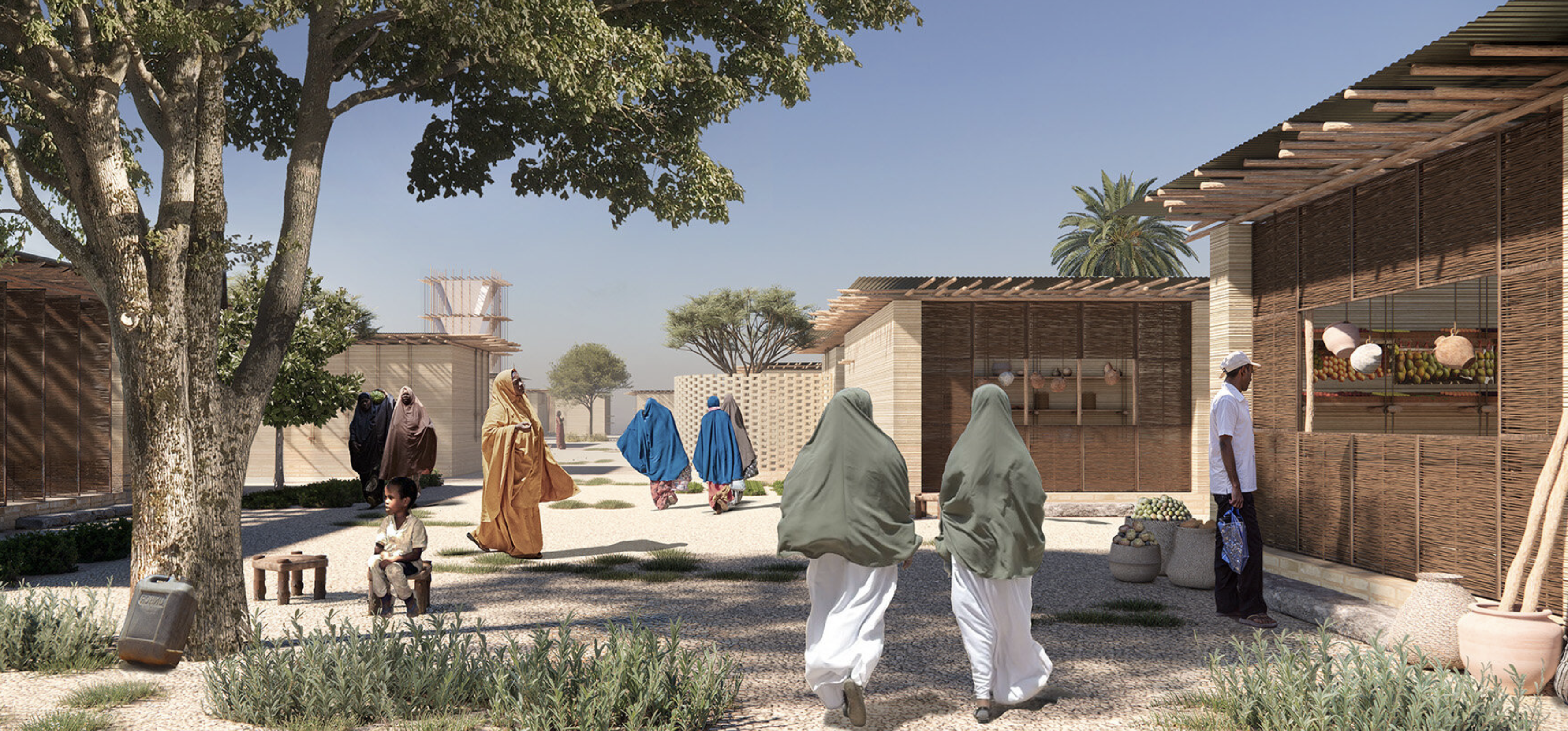
At the heart of the design is a flexible 4×4-meter module, a human-scaled unit pairing two enclosed rooms with a semi-open central space and a private garden. This small footprint is deceptively powerful: it gives each household privacy, a safe outdoor space, and the ability to arrange interior life according to Somali social norms. The module becomes a building block—units can be combined into courtyards, linear clusters, or circular compounds that echo traditional Somali settlement patterns. Compare this to the shelters Somalis have built in Yemen, below.
Somalia, mud brick, refugee shelter, modular housing, IDP camps, sustainable architecture, acacia wood, earth construction, passive cooling, vernacular design, low-cost housing, humanitarian architecture, Kengo Kuma, Rabie Al Ashi, climate resilience

Materiality grounds the system firmly in place. Structures are built from mud bricks, acacia logs, palm leaves, and earth-based plasters—materials that are renewable, inexpensive, and readily available. Mud bricks in particular offer thermal mass, keeping interiors cooler during the day and warmer at night, an essential feature in Somalia’s hot, arid climate.

Construction is intentionally low-tech: shelters can be built by residents themselves, strengthening local craftsmanship and reducing reliance on imported humanitarian products that often fail in desert climates.

Somalia, mud brick, refugee shelter, modular housing, IDP camps, sustainable architecture, acacia wood, earth construction, passive cooling, vernacular design, low-cost housing, humanitarian architecture, Kengo Kuma, Rabie Al Ashi, climate resilience
A UN photo of Somalis sheltering in Yemen

The design also incorporates passive cooling strategies—cross-ventilation, shaded openings, and breathable walls—to make life more comfortable without the need for electricity. Gender-sensitive layouts support safety and cultural expectations. Small gardens, livestock spaces, and shaded communal zones help rebuild livelihoods and social cohesion.

We’ve spent weeks in Sinai in the simple hushas there made from palm fronds and bamboo. They can be remarkably comfortable even at night when the cold winds blow.

A basic husha in Sinai built by Bedouin

Rather than treating displacement as a temporary emergency, this project is reframed as a human condition requiring stability, community, and dignity. By combining vernacular wisdom with adaptable modular planning, the project offers a model for refugee housing that is scalable, low-carbon, and deeply respectful of local identity.

For Somalia’s displaced families, a mud-brick home may be the most modern solution of all.

::IOM

Karin Kloosterman
Karin Kloostermanhttp://www.greenprophet.com
Karin Kloosterman is an award-winning journalist, innovation strategist, and founder of Green Prophet, one of the Middle East’s pioneering sustainability platforms. She has ranked in the Top 10 of Verizon innovation competitions, participated in NASA-linked challenges, and spoken worldwide on climate, food security, and future resilience. With an IoT technology patent, features in Canada’s National Post, and leadership inside teams building next-generation agricultural and planetary systems — including Mars-farming concepts — Karin operates at the intersection of storytelling, science, and systems change. She doesn’t report on the future – she helps design it. Reach out directly to [email protected]

TRENDING

Ethiopians are Looking to Somaliland for Red Sea Access as Global Powers Move In

Somaliland, for its part, has operated as a de facto independent state since 1991. It has its own government, elections, currency, and security forces. It’s often described as one of the more stable and democratic political systems in the region, despite never being formally recognized internationally. 

Binishell homes and the inflatable concrete house trend is suddenly everywhere

If you’ve seen “binishell homes” popping up across architecture feeds this year, you’re not imagining it. The iconic inflatable concrete house—originally invented in the 1960s by architect Dante Bini—is suddenly back in global headlines. And there’s one big reason: climate resilience. And hey, Robert Downey Junior lives in one. 

Nubian mud architecture is ancient wisdom from Egyptian ancients alive today

A hallmark of Nubian construction is the Nubian vault, a technique for creating arched roofs without the need for timber or modern scaffolding. This gravity-based, pressure-stabilized structure was not only resource-efficient but also incredibly durable.

My meeting with Hassan Fathy in Cairo

H. Masud Taj meets Egyptian architect Hassan Fathy.

Learn earthen architecture of the Middle East

This one-month training course will use Al Ain, UAE as an open-air laboratory for participants to learn practical, hands-on methods for preserving earthen buildings and archaeological sites.

Should You Invest in the Private Market?

startustartup Unlike public stock exchanges, which offer daily trading, strict...

How to build a 100-year-company

Kongō Gumi is a Japanese construction company, purportedly founded in 578 A.D., making it the world's oldest documented company. What can we learn about building sustainable businesses from them?

From Pilot Plant to Global Stage: How Aduro Clean Technologies’ 2026 Expansion Signals a Turning Point for Chemical Recycling Investors Like Yazan Al Homsi

The company's Next Generation Process (NGP) Pilot Plant in London, Ontario, has officially moved into initial operating campaigns, generating the kind of structured, repeatable data that separates laboratory promise from commercial viability.

How AI Helps SaaS Companies Reduce Repetitive Customer Support Work

SaaS products are designed for large numbers of users with different levels of experience, and also in renewable energy.

Pulling Water from the Air

Faced with water shortage in Amman, Laurie digs up...

Turning Your Energy Consultancy into an LLC: 4 Legal Steps for Founders in Texas

If you are starting a renewable energy business in Texas, learn how to start an LLC by the books.

Tracking the Impacts of a Hydroelectric Dam Along the Tigris River

For the next two months, I'll be taking a break from my usual Green Prophet posts to report on a transnational environmental issue: the Ilısu Dam currently under construction in Turkey, and the ways it will transform life along the Tigris River.

6 Payment Processors With the Fastest Onboarding for SMBs

Get your SMB up and running fast with these 6 payment processors. Compare the quickest onboarding options to start accepting customer payments without delay.

Related Articles

Popular Categories