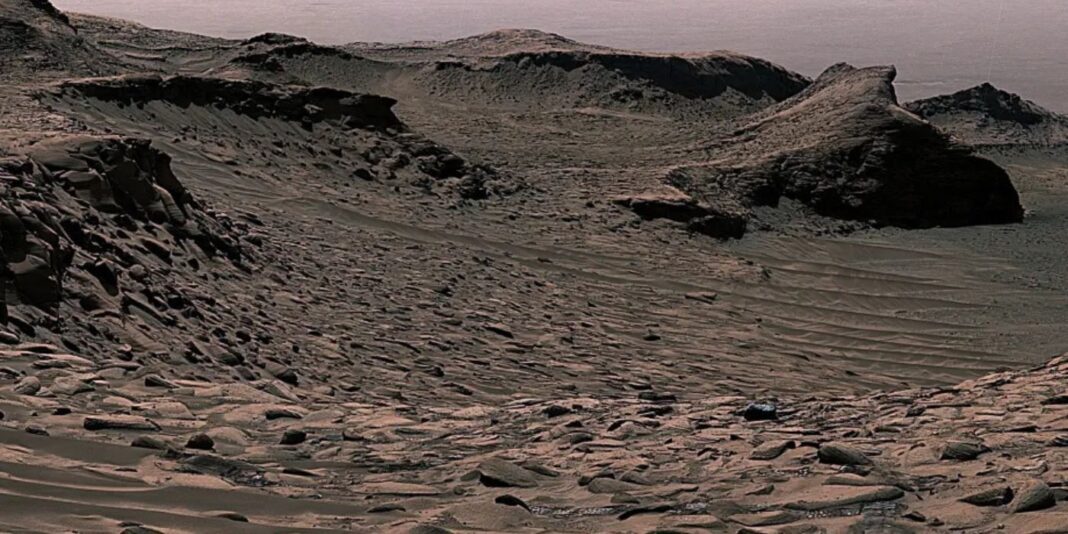


Mars, the dusty red planet that once held our wildest dreams of alien life, is revealing its past—and perhaps a glimpse of Earth’s future. Today it’s a frozen desert, with no breathable atmosphere and no surface water in sight. But new findings from NASA’s Curiosity Rover suggest Mars was once warm, wet, and much more Earth-like—possibly with rivers, rainfall, and lakes.
The key? A humble mineral called siderite, a type of iron carbonate that’s helping scientists piece together how Mars may have once locked away its carbon—and lost its atmosphere in the process.
Related: This Dune suit could keep us alive on Mars
In a recent SETI Live conversation, Dr. Ben Tutolo, a geochemist at the University of Calgary and a science team member on the Curiosity mission, shared the breakthrough. While analyzing rocks inside Gale Crater, Curiosity detected up to 10.5% siderite in some layers of Mount Sharp—far more than expected.
This wasn’t just a geochemical oddity. It was evidence that Mars once had abundant CO₂, likely released by volcanoes, which dissolved in ancient waters and was then mineralized into rock. That’s the same basic carbon capture strategy we’re exploring here on Earth today to combat climate change—except Mars figured it out a few billion years earlier.
Carbon Capture on a Planetary Scale—Then Collapse
On Earth, carbon gets locked up in limestone—made of calcium carbonate. On iron-rich Mars, siderite takes that role. Its presence, alongside evaporite minerals like magnesium sulfate, suggests a long phase of evaporation, meaning Mars had standing water. For that to happen, the atmosphere had to be thick—at least 1,000 times denser than it is today, rich in CO₂.
Related: rogue geo-engineers chased by the EPA for injecting sulphur into the atmosphere
But something happened: the atmosphere thinned, water disappeared, and the climate collapsed. Where did the CO₂ go? Some was lost to space, but this discovery shows that much of it was mineralized into the Martian crust.
The lesson is sobering. On Earth, we’re now injecting carbon into the atmosphere faster than the planet can absorb it. Mars shows us what can happen when a planet’s carbon cycle gets thrown off balance—even slightly—over geological timescales. A world once capable of supporting liquid water became uninhabitable. This is more than a Martian mystery; it’s a cautionary tale. If Mars could lose its habitability after capturing its carbon, what could happen to Earth if we fail to?
Related: dealing with gravity on Mars
The next steps will involve returning samples from these siderite-rich layers to Earth, possibly offering clues not just to climate, but to life. If Mars held onto water for long enough, it might have also given life a fighting chance. And if a “dead” planet like Mars once supported a warm, wet climate, then our definition of what makes a world habitable—whether in our solar system or beyond—may need a radical rethink. Maybe Elon Musk will get there soon with SpaceX and report back to earth before it’s too late. The United Arab Emirates plans on joining Musk on Mars.