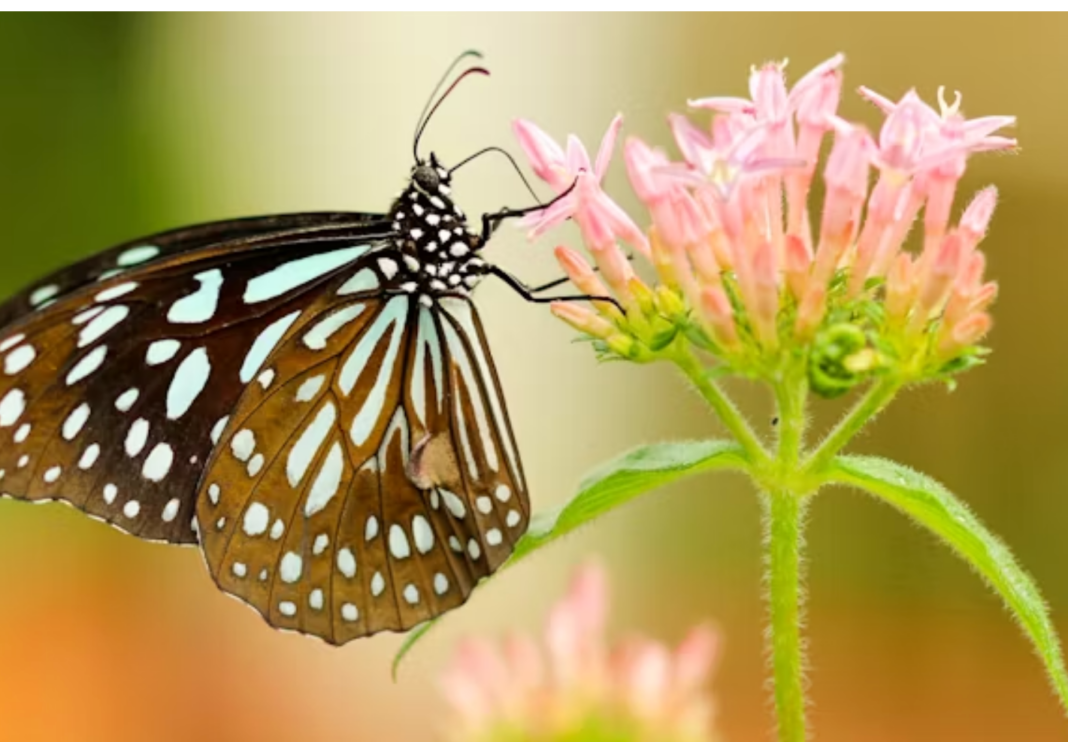


Butterflies and moths collect so much static electricity whilst in flight, that pollen grains from flowers can be pulled by static electricity across air gaps of several millimetres or centimetres. The finding reported in the Journal of the Royal Society Interface, suggests that this likely increases their efficiency and effectiveness as pollinators. Butterflies typically eat nectar, not pollen, for food.
The University of Bristol team also observed that the amount of static electricity carried by butterflies and moths varies between different species, and that these variations correlate with differences in their ecology, such as whether they visit flowers, are from a tropical environment, or fly during the day or night. This is the first evidence to suggest that the amount of static electricity an animal accumulates is a trait that can be adaptive, and thus evolution can act upon it by natural selection.
Lead author Sam England explained: “We already knew that many species of animal accumulate static electricity as they fly, most likely through friction with the air. There had also been suggestions that this static electricity might improve the ability of flower-visiting animals, like bees and hummingbirds, to pollinate, by attracting pollen using electrostatic attraction.
“However, it wasn’t known whether this idea applied to the wider array of equally important pollinators, such as butterflies and moths. So, we set out to test this idea, and see if butterflies and moths also accumulate charge, and if so, whether this charge is enough to attract pollen from flowers onto their bodies.”
Their study involved 269 butterflies and moths across 11 different species, native to five different continents and inhabiting multiple different ecological niches. They were then then able to compare between them and see if these ecological factors correlated with their charge, establishing if static charging is a trait that evolution can act upon.
England added: “A clearer picture is developing of how the influence of static electricity in pollination may be very powerful and widespread.
“By establishing electrostatic charging as a trait upon which evolution can act, it opens up a great deal of questions about how and why natural selection might lead to animals benefiting or suffering from the amount of static electricity that they accumulate.”
In terms of practical applications, this study opens the door to the possibility for technologies to artificially increase the electrostatic charges or pollinators or pollen, in order to improve pollination rates in natural and agricultural settings.
“We’ve discovered that butterflies and moths accumulate so much static electricity when flying, that pollen is literally pulled through the air towards them as they approach a flower.
“This means that they don’t even need to touch flowers in order to pollinate them, making them very good at their jobs as pollinators, and highlighting just how important they might be to the functioning of our flowery ecosystems.
“For me personally, I would love to do a wider survey of as many different species of animal as possible, see how much static electricity they accumulate, and then look for any correlations with their ecology and lifestyle. Then we can really begin to understand how evolution and static electricity interact!” says England.