

Israel's Ministry of the Environment Could Double Its Budget by Collecting Fines

Zalul sea report pollution sewageZalul, the non-profit marine NGO, has released it’s 2008 State of the Sea Report. Yesterday a press conference was held at Cafe Masada in Tel Aviv with over 20 members of the press gathering to hear the latest news about the state of Israel’s Mediterranean Sea.

This year was a wake-up call to the public and the government. The report discovers that by implementing the law that requires the government to institute a discharge fee for polluters the Ministry of the Environment could double, even triple its (currently paltry) budget!

Zalul's Executive Director, Yariv Abramovich, is interviewed by Israel Army Radio (Galei Tzahal) at the 2008 Sea Report press conference.

This year’s report is focused on the lack of economic incentives for factories to reduce their pollution. It calculates the cost of a pollution discharge fee (if one were to be implemented) for several polluting companies and compares this to their profits.

We believe this report will have dramatic reverberations that will lead to change, particularly with the implementation of a discharge fee for polluters which will strongly encourage them to update their treatment facilities.

Each year over 50 million cubic meters of industrial effluents and sewage are dumped into the coastal waters of Israel by special permit of the Inter-ministerial Committee for Issuance of Discharge Permits without any discharge fee. This amount does not include municipal sewage from treatment plants. Actual total effluent and sewage discharges are estimated at over 100 million cubic meters.
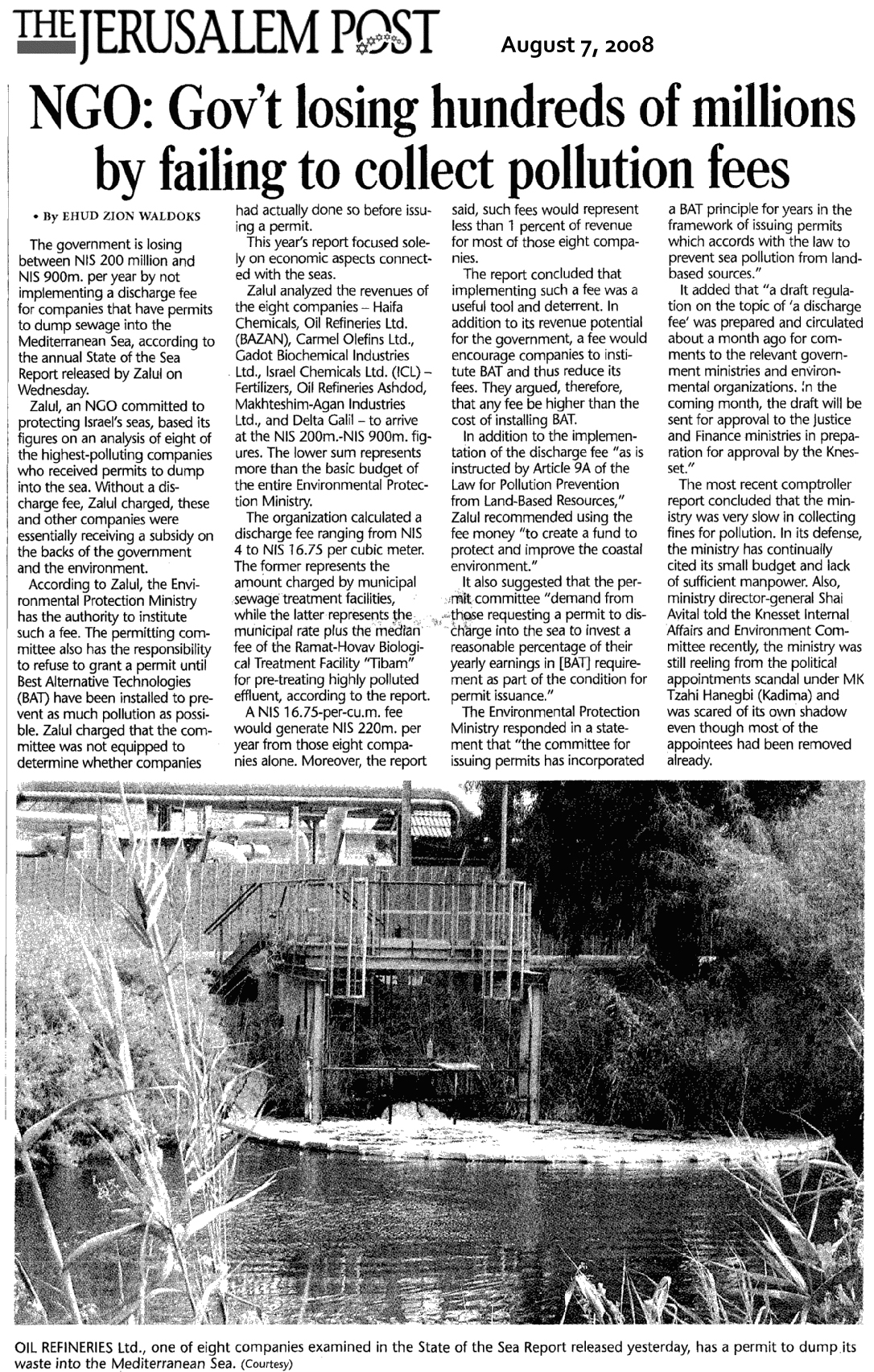
Zalul pollution sea report sewage

The report It finds that millions of shekels stay in the hands of corporations rather than going towards the application of best available technologies or a governmental fund for protecting the environment. Issuing permits without demanding any discharge fee results in marine pollution and lack of advanced treatment technologies.

According to a calculation of industrial discharge volumes and a treatment fee of 4 to 16.75 shekels per cubic meter (based on existing land based sewage treatment fees for effluent of various quality), the amount of money which is not collected and stays in the hands of the factories, is over 200 million shekels, and may be as high as 900 million shekels (the Ministry of Environment’s annual budget is less than 200 million shekels each year).

The report finds that the discharge fee would represent between 1.3% and 5.4% of the annual profits and less than one percent of annual revenues of the 8 companies evaluated. These results indicate that many companies clearly have an ability to implement advanced effluent treatment, but because of market failures, have no incentive to do so.

Read More

LEAVE A REPLY

Please enter your comment!
Please enter your name here

TRENDING

Hormuz 2026 Conflict Poses an Energy and Food Security Dilemma in a Warming World

As tensions rise in one of the world’s most critical maritime chokepoints, the ripple effects go far beyond oil—touching food systems, climate pressures, and regional stability

Baby teeth read like tree rings paint a picture of toxins in early life

A new study from the Icahn School of Medicine at Mount Sinai in New York offers a striking insight into how the environments we are born into can quietly shape our brains years later. By analyzing naturally shed baby teeth, the ones tucked under pillows for the tooth fairy, researchers have reconstructed a detailed timeline of exposure to environmental metals during pregnancy and early infancy.

Poop in the East River shows the city’s rat problem and what people like to eat

New York ecology and health can be monitored by a jug of water a week.

Is your groundwater too young? New study finds risks for Parkinson’s and type of water you drink

People whose drinking water came from newer groundwater had a higher risk of developing Parkinson’s disease than those whose drinking water came from older groundwater, according to a preliminary study released March 2, 2026, that will be presented at the American Academy of Neurology’s 78th Annual Meeting taking place April 18–22, 2026, in Chicago and online.

What Makes Artificial Turf Like AstroTurf Safe? University Research and Independent Testing Reveal Key Factors

A comprehensive analysis published by AstroTurf experts on turf field safety identifies several critical factors that separate premium synthetic surfaces from standard installations.

How to quiet noise from construction in your office

Streets need to be resurfaced in New York but the humming and grinding noise is unsettling. Noise is environmental pollution. 

EarthX and a blueprint for sustainable investing

Trammell S. Crow, a Dallas-based businessman and father of four, is focusing his efforts on impact investing, and media that focuses on saving the planet through EarthX.

Mining Afghanistan’s Mineral Discoveries Similar to Avatar

Now that American forces in Afghanistan are commemorating the longest period of any war that America has been involved in, including the 1965-73 Vietnam War, the recent discoveries of large and extremely valuable mineral and metal deposits may finally bring to light a reason to continue the presence of US fighting forces in this war torn and backward country.

From Pilot Plant to Global Stage: How Aduro Clean Technologies’ 2026 Expansion Signals a Turning Point for Chemical Recycling Investors Like Yazan Al Homsi

The company's Next Generation Process (NGP) Pilot Plant in London, Ontario, has officially moved into initial operating campaigns, generating the kind of structured, repeatable data that separates laboratory promise from commercial viability.

Nobul’s Regan McGee on Shareholder Value: “Complacency Is the Silent Killer” 

Why the governance framework designed to protect shareholders so...

Should You Invest in the Private Market?

startustartup Unlike public stock exchanges, which offer daily trading, strict...

How to build a 100-year-company

Kongō Gumi is a Japanese construction company, purportedly founded in 578 A.D., making it the world's oldest documented company. What can we learn about building sustainable businesses from them?

How AI Helps SaaS Companies Reduce Repetitive Customer Support Work

SaaS products are designed for large numbers of users with different levels of experience, and also in renewable energy.

Popular Categories