
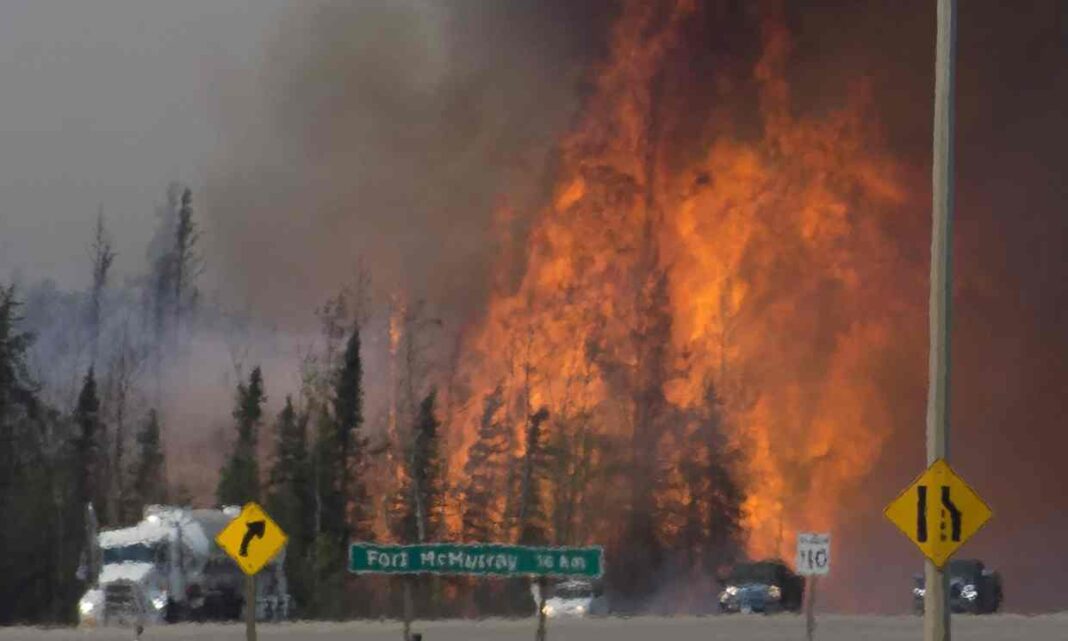

Alberta Canada’s massive wildfire, which has now consumed an area larger than Hong Kong and threatens to reach the border with neighboring Saskatchewan, is another startling example that may be attributed to the ravages of global warming.
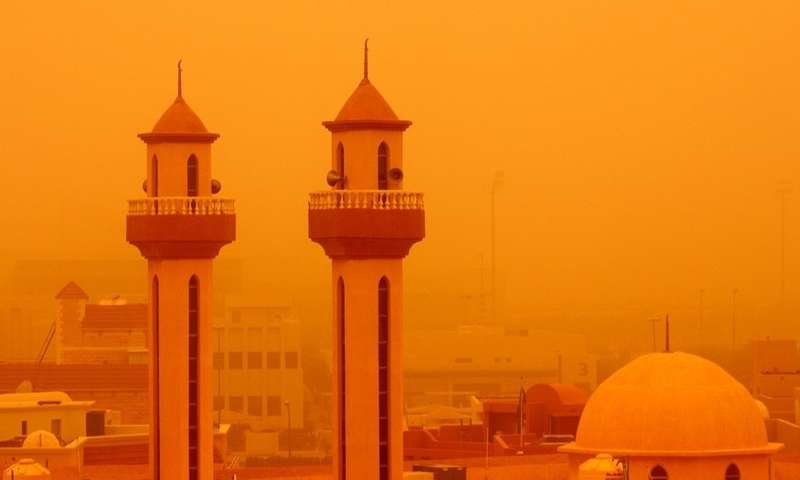
While most of the Middle East does not have large tracts of forest land, areas where forests and grasslands are located are continuously in danger of catching fire as higher than normal temperatures and “crazy heat domes” may make many parts of the Middle East unlivable by 2100.
Alberta’s wildfires, which became literally out of control after starting over a week ago, have already displaced more than 80,000 people and destroyed thousands of homes and commercial buildings. Located in the province’s well publicized Alberta Tar Sands, the big question being raised now is whether this industry, deemed to be one of the most environmentally damaging projects in North America, may be attributing to making it spread so quickly.
According to informed sources in International Business Times, the Alberta oil or tar sands account for more than 80% of Canada’s entire petroleum production. In physical terms, this amounts to more than 4.4 million barrels per day, according to the U.S. Energy Information Administration. Canadian governmental and private sources now say it will take weeks to fully bring these fires under control; and this only only happen if there are substantial rains. Dry conditions and unseasonably high temperatures of 23 degrees Celsious (80 degrees Fahrenheit) are causing the fires to spread even quicker.
Oil tar sand production, involving the use of chemicals and high pressure steam to bring up the gunky oil tar from underground, has long been considered to be an environmental disaster in the making by many environmentalists; even rivaling oil production in Saudi Arabia, and seen as having a severe impact on global warming.
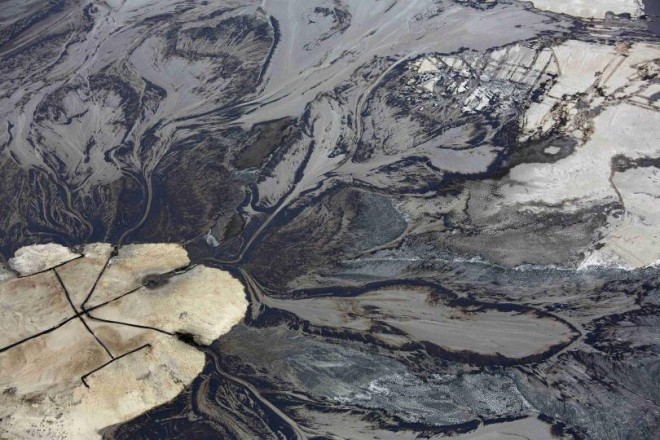
The photo below shows what this oil sand tar goop looks like when brought to the surface.
With events like the Alberta wildfires occurring in pristine locations like Canada, it’s not difficult to understand what is already occuring in regions like the Middle East. Mid-East area countries that do contain sizable tracts of forest land, such as Israel, Lebanon and Turkey, will undoubtedly see more occurrences of forest and brush fires on the like that Israel experienced in December, 2010; when a large section on the country’s Carmel mountain forest went up in smoke, killing more than 45 people.
We will all be watching the outcome of the Alberta wildfires; that up to now seem virtually unstoppable. As for the Middle East, the worst may yet to come, regarding global warming.
Read more on global warming, wildfires and the Alberta Tar Sands:
Crazy heat dome will mean that no one can live in the Arab Gulf by 2100
Israel’s Carmel wildfire blame goes all the way to the top
Canada Worst than Saudi Arabia, Considering Tar Sands Impact on Global Warming
Photo: Fort McMurray Wildfires, by Todd Korol/Reuters
Photo: Alberta Tar Sands crude oil, by Jonathan Hayward/ AP


Industry
spends more
on lobbyists EACH YEAR
than the American Taxpayers spend on ALL of CONGRESS.
To visit a Congressman, YOU have to make an appointment………
…..LOBBYISTS walk the hallls of CONGRESS LIKE THEY OWN THEM…..and in a very real sense they do!
…visit
http://www.clearpath.org
a
conservative and Pro Business web site which is not MARRIED to OIL & COAL…..
****
“…A six year study
examining the nutritional content of crops exposed to atmospheric CO2 levels projected by mid-century found
worrisome drops in zinc and iron in wheat grains as well as reduced protein levels in wheat as well as rice grains
— a particularly troubling find considering that millions around the
world who depend on wheat and rice for most of their iron and zinc
already might not be getting enough. Credit: Credit: Peter Fredenburg,
courtesy Flickr
Dear EarthTalk: Is it true that global warming is causing our crops to be less nutritious?
….
It
is difficult to say whether or not the climate change we are now
experiencing is negatively impacting the nutritional quality of ourfood,
researchers warn that it may be only a matter of time.
“Humanity
is conducting a global experiment by rapidly altering the environmental
conditions on the only habitable planet we know,” reports Samuel Myers, a
research scientist at the Harvard School of Public Health.
Earlier
this year, Myers and his colleagues released the results of a six year
study examining the nutritional content of crops exposed to levels of
atmospheric carbon dioxide (CO2) that are expected to exist by
mid-century.
The conclusions were indeed troubling. They found
that in wheat grains, zinc concentrations were down some 9.3 percent and
iron concentrations were down by 5.1 percent across the seven different
crop sites (in Australia, Japan and the U.S.) used in the study.
The researchers also noted reduced protein levels in wheat and rice grains growing in the CO2-rich test environment.
According to Myers, the findings
—published in June 2014 in the peer-reviewed journal Nature
—are
particularly troubling when one considers that some of the two to three
billion people around the world who depend on wheat and rice for most
of their iron and zinc already might not be getting enough of these
essential
nutrients. Zinc deficiency, which can exacerbate
pneumonia, malaria and other health problems, is already linked to some
800,000 deaths each year among children under five. Meanwhile, iron
deficiency is the primary cause of anemia, a condition that contributes
to one in five maternal deaths worldwide….”