

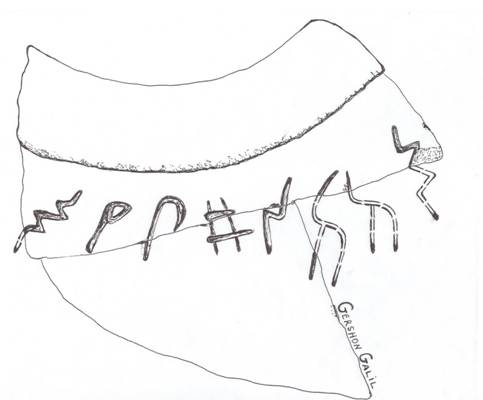
Archeologists have deciphered what they believe to be the oldest Hebrew texts originating from the Holy City of Jerusalem: “the wine was cheap”, is the meaning of the basic inscription, illustrated above. It is also believed that the wine was made for the “riffraff”, the hard workers in the region, and for soldiers.
Wine is used in Jewish traditional ceremonies, like on the Sabbath, when blessings for the holy day of rest are made on the wine. Jewish people in general tend not to be over-drinkers, but the inscription on the pot shows that even 3,000 years ago there was an appreciation of good wine.
By marking the pot as “cheap” wine it is suggested that the wine was designated for the riffraff, the workers in the region.
Related: Ancient pauper’s wine press uncovered
The text was found on a rim of a pot found in 2012 by Eilat Mazar and her team, during an archaeological excavation on behalf of the Institute of Archaeology of the Hebrew University in Jerusalem. The text on it was deciphered by Professor Gershon Galil, from the Department of Biblical Studies and Jewish History at the University of Haifa, in Israel.
He pointed out that it indicates writing abilities as well as the existence of an administration which collects taxes, prepare storage places and jars, and takes care of the workers in Jerusalem, as early as the second half of the 10th century BC, probably in the reign of King Solomon.
To be exact, the pot didn’t really say that the wine was cheap. That was our interpretation. This is what was written, word for word according to the translation: From right to left the above reads as follows:
“[…]m [yy]n ḫlq m[…]”, namely: “[in the … year], wine of inferior quality, (send) from GN”.
The inscription is divided into three categories: (a) a date formula; (b) classification of the wine; and (c) provenance.
Prof. Galil said that the form yyn (“wine”) indicates that the language used in this inscription is Hebrew, written in the southern dialect: in Ugaritic, Old Canaanite, Phoenician, Ammonite, and even in Israelite Hebrew wine was always written with only one yod.
But in (southern) Hebrew the form is always yyn (Epigraphic Hebrew [Lachish, Arad and more], Biblical Hebrew [without any exception], Ben Sira, Qumran, and even in the Rabbinic sources).
Prof. Galil published his findings in the Strata Bulletin of the Anglo-Israel Archaeological Society.
“The new inscription is written in the late Cannanite script, in (southern) Hebrew, and should be dated to the second half of the 10th century BC. It is therefore the oldest Hebrew inscription ever found in Jerusalem, and it is about two hundred and fifty years older than other inscriptions known from Jerusalem,” he writes.
In those days King Solomon completed his monumental building projects in Jerusalem, including the Temple and the palace. Solomon was the king who inhabited the Ophel and he was the one who built the wall of Jerusalem which united its three main quarters: the Temple Mount, the Ophel and the city of David,” said Prof. Galil.
Prof. Galil also said that the new inscription indicates that large quantities of inferior wine were used in Jerusalem:
“This cheap wine was not served on Solomon’s table, nor used in the Temple. So it is reasonable to suppose that it was served to the hard workers that were engaged in the large scale building projects in Jerusalem, and maybe also to the soldiers who served there.
“The logistics needed were probably concentrated in the Ophel. Inferior wine was also served to the Cypriot mercenaries in Arad, and in later periods to workers and soldiers in the Hellenistic and Roman periods.”




Workers are not “riff-raff.” You might want to revise your article accordingly. Also, unless you are a “riff-raff” journalist you might want to stick to the substance of the inscription rather than a silly and biased interpretation thereof.