Oldest Hebrew inscription from Jerusalem deciphered: “the wine was cheap”

cheap wine hebrew inscription

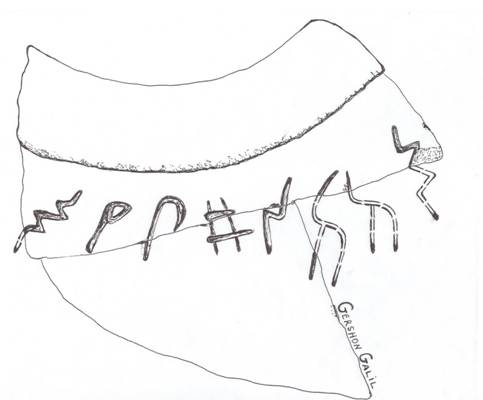
Archeologists have deciphered what they believe to be the oldest Hebrew texts originating from the Holy City of Jerusalem: “the wine was cheap”, is the meaning of the basic inscription, illustrated above. It is also believed that the wine was made for the “riffraff”, the hard workers in the region, and for soldiers. 

Wine is used in Jewish traditional ceremonies, like on the Sabbath, when blessings for the holy day of rest are made on the wine. Jewish people in general tend not to be over-drinkers, but the inscription on the pot shows that even 3,000 years ago there was an appreciation of good wine.

By marking the pot as “cheap” wine it is suggested that the wine was designated for the riffraff, the workers in the region.

Related: Ancient pauper’s wine press uncovered

The text was found on a rim of a pot found in 2012 by Eilat Mazar and her team, during an archaeological excavation on behalf of the Institute of Archaeology of the Hebrew University in Jerusalem. The text on it was deciphered by Professor Gershon Galil, from the Department of Biblical Studies and Jewish History at the University of Haifa, in Israel.

He pointed out that it indicates writing abilities as well as the existence of an administration which collects taxes, prepare storage places and jars, and takes care of the workers in Jerusalem, as early as the second half of the 10th century BC, probably in the reign of King Solomon.

To be exact, the pot didn’t really say that the wine was cheap. That was our interpretation. This is what was written, word for word according to the translation: From  right to left the above reads as follows: 

“[…]m  [yy]n  ḫlq  m[…]”, namely: “[in the … year], wine of inferior quality, (send) from GN”.

The inscription is divided into three categories: (a) a date formula; (b) classification of the wine; and (c) provenance.

Prof. Galil said that the form yyn (“wine”) indicates that the language used in this inscription is Hebrew, written in the southern dialect: in Ugaritic, Old Canaanite, Phoenician, Ammonite, and even in Israelite Hebrew wine was always written with only one yod.

But in (southern) Hebrew the form is always yyn (Epigraphic Hebrew [Lachish, Arad and more], Biblical Hebrew [without any exception], Ben Sira, Qumran, and even in the Rabbinic sources).

Prof. Galil published his findings in the Strata Bulletin of the Anglo-Israel Archaeological Society.

“The new inscription is written in the late Cannanite script, in (southern) Hebrew, and should be dated to the second half of the 10th century BC. It is therefore the oldest Hebrew inscription ever found in Jerusalem, and it is about two hundred and fifty years older than other inscriptions known from Jerusalem,” he writes.

In those days King Solomon completed his monumental building projects in Jerusalem, including the Temple and the palace. Solomon was the king who inhabited the Ophel and he was the one who built the wall of Jerusalem which united its three main quarters: the Temple Mount, the Ophel and the city of David,” said Prof. Galil.

Prof. Galil also said that the new inscription indicates that large quantities of inferior wine were used in Jerusalem:

“This cheap wine was not served on Solomon’s table, nor used in the Temple. So it is reasonable to suppose that it was served to the hard workers that were engaged in the large scale building projects in Jerusalem, and maybe also to the soldiers who served there.

“The logistics needed were probably concentrated in the Ophel. Inferior wine was also served to the Cypriot mercenaries in Arad, and in later periods to workers and soldiers in the Hellenistic and Roman periods.”


Karin Kloosterman
Karin Kloostermanhttp://www.greenprophet.com
Karin Kloosterman is an award-winning journalist, innovation strategist, and founder of Green Prophet, one of the Middle East’s pioneering sustainability platforms. She has ranked in the Top 10 of Verizon innovation competitions, participated in NASA-linked challenges, and spoken worldwide on climate, food security, and future resilience. With an IoT technology patent, features in Canada’s National Post, and leadership inside teams building next-generation agricultural and planetary systems — including Mars-farming concepts — Karin operates at the intersection of storytelling, science, and systems change. She doesn’t report on the future – she helps design it. Reach out directly to [email protected]
2 COMMENTS
  1. Workers are not “riff-raff.” You might want to revise your article accordingly. Also, unless you are a “riff-raff” journalist you might want to stick to the substance of the inscription rather than a silly and biased interpretation thereof.

Comments are closed.

TRENDING

How does Neuralink work?

Current goals are to treat neurological disease like Parkinson’s and restore autonomy to people with severe physical limitations by controlling exoskeletons and prosthetics. There’s also huge potential to improve cognitive abilities such as memory, attention, and languages.

Street Vegan in Sri Thanu is a must-stop family lunch spot on Koh Phangan, Thailand

If you’re anywhere near Sri Thanu on Koh Phangan, Thailand, around the yoga centers: Zen Beach, Haad Yao, or Salad Beach—make time for Street Vegan. It's vegan and so satisfying that one meal might convince you that eating plant-based is not a compromise. I suggest for any vegan restaurant owner or chef to come to this modestly-priced venue to learn from a master.

Plants can eat dust and grow – should we stop dusting them?

Dusty plants? Let them eat their hearts out.

Paris Modest Fashion Week offers style without exposure for Muslims

France is home to around 5 to 7.5 million Muslims according to estimates, and Özlem Şahin, head of the organization behind Modest Fashion Week, has described Paris as "one of the leading modest fashion capitals in Europe".

Kids are vaping. The media shock that made them stop

On one side: aggressive anti-vaping campaigns from the FDA, Truth Initiative, and state programs, backed by over $100 million in annual spending. On the other: a public health crisis. Screenshot

Nobul’s Regan McGee on Shareholder Value: “Complacency Is the Silent Killer” 

Why the governance framework designed to protect shareholders so...

Should You Invest in the Private Market?

startustartup Unlike public stock exchanges, which offer daily trading, strict...

How to build a 100-year-company

Kongō Gumi is a Japanese construction company, purportedly founded in 578 A.D., making it the world's oldest documented company. What can we learn about building sustainable businesses from them?

From Pilot Plant to Global Stage: How Aduro Clean Technologies’ 2026 Expansion Signals a Turning Point for Chemical Recycling Investors Like Yazan Al Homsi

The company's Next Generation Process (NGP) Pilot Plant in London, Ontario, has officially moved into initial operating campaigns, generating the kind of structured, repeatable data that separates laboratory promise from commercial viability.

How AI Helps SaaS Companies Reduce Repetitive Customer Support Work

SaaS products are designed for large numbers of users with different levels of experience, and also in renewable energy.

Pulling Water from the Air

Faced with water shortage in Amman, Laurie digs up...

Turning Your Energy Consultancy into an LLC: 4 Legal Steps for Founders in Texas

If you are starting a renewable energy business in Texas, learn how to start an LLC by the books.

Tracking the Impacts of a Hydroelectric Dam Along the Tigris River

For the next two months, I'll be taking a break from my usual Green Prophet posts to report on a transnational environmental issue: the Ilısu Dam currently under construction in Turkey, and the ways it will transform life along the Tigris River.

Related Articles

Popular Categories