Japan builds desalination plants for Bahrain and the Emirates

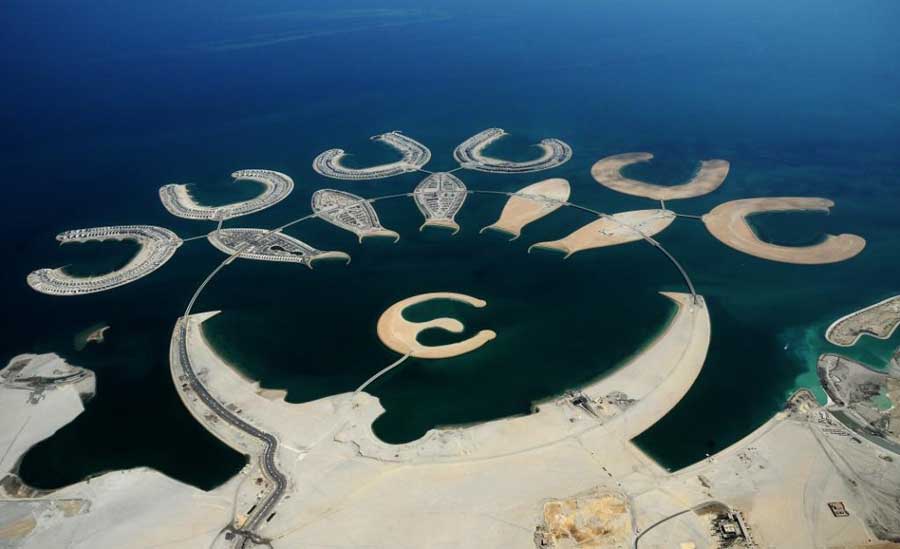
Durrat Bahrain
Durrat artificial islands in Bahrain are fed desalinated water. There is no other way for the thirsty and growing Persian Gulf nations.

Two dry Persian Gulf countries are amping up their desalination capacity: Bahrain, and the United Arab Emirates. Both have access to Persian Gulf waters but very little freshwater access inland.

Toray, the Japanese builder of desalination plants sent us the official news that they will build two new reverse osmosis plants (RO Plants), the Al Dur 2 Desalination Plant in the Kingdom of Bahrain and Umm Al Quwain Desalination Plant in the United Arab Emirates.
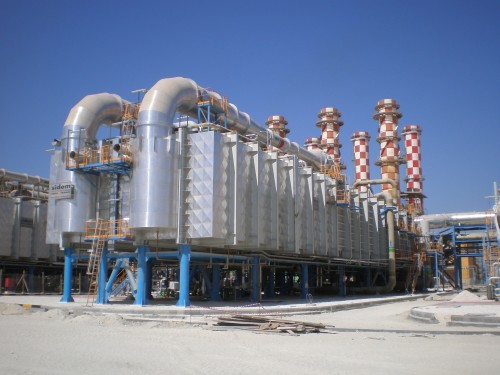
Bahrain desalination plant
A desalination plant. They all look the same. Lots of pipes and tubes.

An estimated 1,500 seawater desalination plants are operating in the Gulf. Most of these plants, including the 24 largest (based on production capacity ≥100,000 (m3/day), are located on the Arabian coast near the shallow southwestern region of the Gulf (Global Water Intelligence). The Gulf region consumes about 57.9% of the world’s desalinated water

In the new plants, the combined water capacity will amount to 911,000 m3 /day, and the Umm Al Quwain Desalination Plant alone will hold one of the world’s largest capacity with 681,000 m3 /day fresh water production.

Toray will provide the membranes which are regarded to be the most sophisticated element in a desalination plant. The membrane filters out salt and other impurities, which leaving brine behind.

Persian Gulf countries are heavily investing in water desalination to supply water to a growing population with growing needs in agriculture and industry. The RO desalination plants built by Toray and which countries like Israel also specialises in, consume less energy to operate compared to thermal desalination plants. The world’s largest desalination plant using RO was in Israel. Researchers at  its major universities are developing new membrane technologies to make the process more efficient. 

It is assumed that desalination is a sweet spot of cooperation between Israel and the Emirates now that peace has been embraced warmly by both sides, and an interest in serious financial investment from both sides. See the Phoenix and Ourcrowd story

Israelis wave goodbye to Elal flight, rewenable energy

Critics of desalination plants say the energy investment to run them is too high and contributes to an unnecessary amount of carbon dioxide emissions, as well as polluting brine which is fed back to the sea. 

bahrain and the Emirates

The Al Dur 2 Desalination Plant:

Al Dur, Kingdom of Bahrain Production capacity: 230,000 cubic meters daily Expected Operation: 2022 EPC Contractor: SIDEM Veolia (France).

Bahrain, or the Kingdom of Bahrain, is a sovereign state in the Persian Gulf. The island nation comprises a small archipelago made up of 51 natural islands and an additional 33 artificial islands, centered around Bahrain Island which makes up around 83 percent of the country’s landmass.

Bahrain does not operate hydroelectic dams, centralized irrigation systems or large water wellfields. Its water infrastructure consists mainly of desalination and wastewater treatment plants.

In the water supply sector the Bahrain government has developed plans for meeting the increasing water (and electricity) demand over the next 15 years. It is expected that by 2030, the total desalinated water production will increase from its current level of 0.82 MCM/d (300 MCM/yr) to 1.41 MCM/d (515 MCM/yr), an increase of about 72%, according to Fanack Water.

It is also expected that all these new desalination plants will be implemented and managed by the private sector, i.e. an independent water and power plant.

Umm Al Quwain Desalination Plant Location:

Umm Al Quwain, United Arab Emirates Production capacity: 681,000 cubic meters daily Expected Operation: 2022 Engineering and Procurement: SIDEM Veolia (France)

The United Arab Emirates sometimes just called the Emirates or the UAE is a sovereign state in Western Asia at the eastern end of the Arabian Peninsula. It borders with Oman and Saudi Arabia, and has maritime borders in the Persian Gulf with Qatar and Iran.

While Abu Dhabi, one of the Emirates nations claims that it is developing technologies to increase rainfall over its desert nation, in reality desalination plants are critical for supplying freshwater to a growing population.

Abu Dhabi’s energy resources and financial wealth from oil and gas make it able to meet water and food needs using desalintion, but these systems can be seen as fragile, and vulnerable in the event there is conflict in the region. 

Seawater desalination is not an efficient process, also follow this article with Gidon Bromberg, with unit water costs reaching 5 to 10 times higher than extracting water from an aquifer. The desalination process is damaging to local environmental systems and over time the process becomes even more inefficient as thick saline residues build up. over time due to the thick saline residue left over from desalination. The Gulf States don’t have much of an option and now rely on about 1,500 desalination plants to supply its freshwater. 

More on desalination:
Saudi Arabia to Use Sun Power at Desalination Plant
New Hadera Desalination Plant Could Revive the Dying Jordan River
Japan and Saudi Arabia Co-develop Desalination Technologies


Karin Kloosterman
Karin Kloostermanhttp://www.greenprophet.com
Karin Kloosterman is an award-winning journalist, innovation strategist, and founder of Green Prophet, one of the Middle East’s pioneering sustainability platforms. She has ranked in the Top 10 of Verizon innovation competitions, participated in NASA-linked challenges, and spoken worldwide on climate, food security, and future resilience. With an IoT technology patent, features in Canada’s National Post, and leadership inside teams building next-generation agricultural and planetary systems — including Mars-farming concepts — Karin operates at the intersection of storytelling, science, and systems change. She doesn’t report on the future – she helps design it. Reach out directly to [email protected]

LEAVE A REPLY

Please enter your comment!
Please enter your name here

TRENDING

Earth building with Dead Sea salt bricks

Researchers develop a brick made largely from recycled Dead Sea salt—offering a potential alternative to carbon-intensive cement.

Farm To Table Israel Connects People To The Land

Farm To Table Israel is transforming the traditional dining experience into a hands-on journey.

Play spogomi the garbage picking sport and win a World Cup

If the future of environmental action looks less like a lecture and more like a pickup game, that might not be a bad thing at all.

Remilk makes cloned milk so cows don’t need to suffer and it’s hormone-free

This week, Israel’s precision-fermentation milk from Remilk is finally appearing on supermarket shelves. Staff members have been posting photos in Hebrew, smiling, tasting, and clearly enjoying the moment — not because it’s science fiction, but because it tastes like the real thing.

An Army of Healers Wins the 2025 IIE Goldberg Prize for Peace in the Middle East

In a region more accustomed to headlines of loss than of listening, the Institute of International Education (IIE) has chosen to honor something quietly radical: healing. The 2025 Victor J. Goldberg Prize for Peace in the Middle East has been awarded to Nitsan Joy Gordon and Jawdat Lajon Kasab, the co-founders of the Army of Healers, for building spaces where Israelis and Palestinians — Jews, Muslims, Christians, Druze, and Bedouins — can grieve, speak, and rebuild trust together.

Qatar’s climate hypocrisy rides the London Underground

Qatar remains a master of doublethink—burning gas by the megaton while selling “sustainability” to a world desperate for clean air. Wake up from your slumber people.

How Quality of Hire Shapes Modern Recruitment

A 2024 survey by Deloitte found that 76% of talent leaders now consider long-term retention and workforce contribution among their most important hiring success metrics—far surpassing time-to-fill or cost-per-hire. As the expectations for new hires deepen, companies must also confront the inherent challenges in redefining and accurately measuring hiring quality.

8 Team-Building Exercises to Start the Week Off 

Team building to change the world! The best renewable energy companies are ones that function.

Thank you, LinkedIn — and what your Jobs on the Rise report means for sustainable careers

While “green jobs” aren’t always labeled as such, many of the fastest-growing roles are directly enabling the energy transition, climate resilience, and lower-carbon systems: Number one on their list is Artificial Intelligence engineers. But what does that mean? Vibe coding Claude? 

Somali pirates steal oil tankers

The pirates often stage their heists out of Somalia, a lawless country, with a weak central government that is grappling with a violent Islamist insurgency. Using speedboats that swarm the targets, the machine-gun-toting pirates take control of merchant ships and then hold the vessels, crew and cargo for ransom.

Leopoldo Alejandro Betancourt López Turned Ocean Plastic Into Profitable Sunglasses

Few fashion accessories carry the environmental burden of sunglasses. Most frames are constructed from petroleum-based plastics and acrylic polymers that linger in landfills for centuries, shedding microplastics into soil and waterways long after they've been discarded. Leopoldo Alejandro Betancourt López, president of the Spanish eyewear brand Hawkers, saw this problem differently than most industry executives.

Why Dr. Tony Jacob Sees Texas Business Egos as Warning Signs

Everything's bigger in Texas. Except business egos.  Dr. Tony Jacob figured...

Israel and America Sign Renewable Energy Cooperation Deal

Other announcements made at the conference include the Timna Renewable Energy Park, which will be a center for R&D, and the AORA Solar Thermal Module at Kibbutz Samar, the world's first commercial hybrid solar gas-turbine power plant that is already nearing completion. Solel Solar Systems announced it was beginning construction of a 50 MW solar field in Lebrija, Spain, and Brightsource Energy made a pre-conference announcement that it had inked the world's largest solar deal to date with Southern California Edison (SCE).

Related Articles

Popular Categories