How crowd-sourcing works in the mad world of ants

ants-carrying-food
Apparently in the ant world it’s a few brains and a lot of braun, according to new research that can teach us about the power of crowdsourcing talent to get a job done.

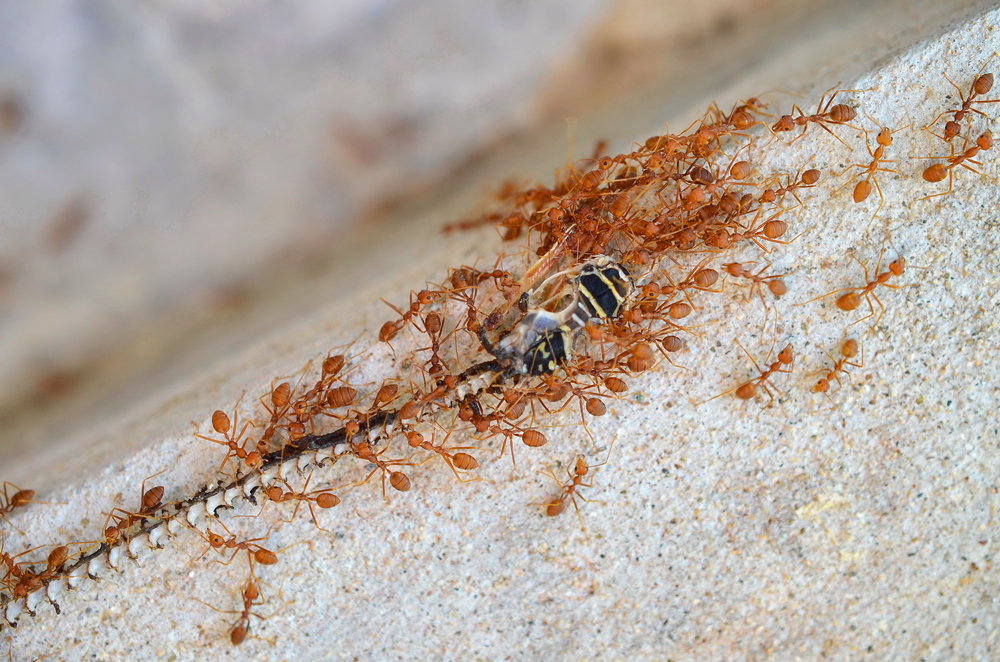
Anyone who has ever watched a group of ants scurrying to carry a large crumb back to their nest has probably wondered how these tiny creatures manage the task.

New research at the Weizmann Institute of Science, explains how a balance of individual direction and conformist behavior enables ants to work together to move their food to in the desired direction.

To lug a large object, a number of ants surround it – the back ones lift, those on the leading edge pull. How do they stay on track, instead of simply pulling all around in a sort of tug-of-war?

Ofer Feinerman and his group in the Institute’s Physics of Complex Systems Department used video analysis to track the individual movements of ants in a group that was carrying a large food item toward their nest.

The more ants around the item (for, example, a breakfast cereal nugget) the faster they could move it. Although the bit of food always travelled in the general direction of the nest, its path was one of wrong turns and corrections.

In the videos, individual ants can be seen to help in carrying for a short while, after which new ants take their places. When these new ants mobilize, the other carriers, which have since become a bit confused as to the proper direction, defer to the newcomers.

As a new ant attaches, the steering of the object temporarily corrects, so that the trajectory becomes better aimed toward the nest. Newly attached ants continue to lead the motion for about 10-20 seconds. Thus informed ants take the lead, but they are also quick to relinquish it once their informational edge disappears.

Together with the group of Prof. Nir Gov of the Weizmann Institute’s Chemical Physics Department, a mathematical model was developed to describe this cooperative behavior. According to the model, the decisions of the “non-informed” carriers fit an intermediate level of behavioural conformism; the well informed individuals are then set to optimally steer the direction of the load.

This model describes a critical point between conformism and individuality that enables the group of ants to coordinate their work and adjust their direction as needed. The model is a variation on a so-called Ising model, which is more often used to describe emergent phenomena in statistical physics.

What can this study teach us about the role of individuality within a group of social animals? Feinerman: “In this system, the wisdom does not come from crowds. Rather, some individuals supply the ‘brains,’ and the role of the group is to amplify the ‘muscle’ power of savvy individuals so that they can actually move the load.”

Ants carrying food from Shutterstock

Karin Kloosterman
Karin Kloostermanhttp://www.greenprophet.com
Karin Kloosterman is an award-winning journalist, innovation strategist, and founder of Green Prophet, one of the Middle East’s pioneering sustainability platforms. She has ranked in the Top 10 of Verizon innovation competitions, participated in NASA-linked challenges, and spoken worldwide on climate, food security, and future resilience. With an IoT technology patent, features in Canada’s National Post, and leadership inside teams building next-generation agricultural and planetary systems — including Mars-farming concepts — Karin operates at the intersection of storytelling, science, and systems change. She doesn’t report on the future – she helps design it. Reach out directly to [email protected]

Read More

4 COMMENTS
  1. […] How crowd-sourcing works in the mad world of ants | Green ProphetApparently in the ant world it’s a few brains and a lot of braun, according to new research that can teach us about the power of crowdsourcing talent to get a job done. Anyone who has ever watched a group of ants scurrying to carry a large crumb back to their nest has probably wondered how these tiny creatures manage the task. New research at the Weizmann Institute of Science, explains how a balance of individual direction and conformist behavior enables ants to work together to move their food to in the desired direction. […]

  2. Savvy individual humans are resolutely disregarded in favor of whoever and whatever can lead to the most profit, regardless of environmental consequences. It’s an instinct to grow that ignores common sense, the result of which are the flash floods, drought and wildfires now spreading around the World.

  3. […] (adsbygoogle = window.adsbygoogle || []).push({}); adUnit = document.getElementById("google-ads-kCy5"); adWidth = adUnit.offsetWidth; if ( adWidth >= 999999 ) { /* GETTING THE FIRST IF OUT OF THE WAY */ } else if ( adWidth >= 728 ) { document.getElementById("GARDasync_kCy5").innerHTML = ""; } else if ( adWidth >= 468 ) { document.getElementById("GARDasync_kCy5").innerHTML = ""; } else if ( adWidth >= 250 ) { document.getElementById("GARDasync_kCy5").innerHTML = ""; } Read more: http://www.greenprophet.com/2015/07/how-crowd-sourcing-works-in-the-mad-world-of-ants/ […]

TRENDING

How Responsible Tourism Could Help Protect the World’s Last Wild Places

From Antarctica and South Georgia to the Galápagos and Thailand, fragile destinations are finding ways to manage tourism without shutting visitors out. Visitor caps, conservation fees, biosecurity rules and controlled access can reduce environmental damage while helping fund the protection of wild places.

How Slow Travel Is Changing the Way We Explore

From trekking fees in Nepal and wildlife conservancies in Kenya to visitor limits in Patagonia and strict Arctic rules in Svalbard, responsible adventure travel can help fund conservation, protect habitats, and create sustainable income for local communities.

How Responsible Adventure Travel Can Protect the World’s Wild Places

From trekking fees in Nepal and wildlife conservancies in Kenya to visitor limits in Patagonia and strict Arctic rules in Svalbard, responsible adventure travel can help fund conservation, protect habitats, and create sustainable income for local communities.

Here is how Europe is still buying Russian gas

Greek-linked shipping vessels transported an estimated €2.35 billion worth of Russian Arctic liquefied natural gas to European ports during the first seven months of 2026, according to new analysis from Urgewald, a Germany-based environmental and human rights organization that investigates the financial institutions and companies supporting fossil fuel and other environmentally damaging industries.

Ancient Jewish New Year for Animals revived with global campaign against factory farming

Jewish Vegan Life has launched a global campaign celebrating the New Year for Animals, with synchronized events in Washington, D.C., Los Angeles, Pittsburgh, Montreal and Jerusalem, alongside an international livestream on August 9 featuring partners including Mercy for Animals, The Good Food Institute and Freedom Farm Animal Sanctuary.

The Essential Guide To Sustainability in Project Management

Sustainability is an approach where businesses and individuals balance the environmental, social, and economic aspects of a project such that current and future stakeholders are not overburdened with the impacts of the project in future.

Yerukim Forms a New Green Economy Where the Money is Really Green

The Yerukim members who pick up the recyclables get to keep the monetary reward, the public earns "green" bills that can be used in shops, and business owners get to be associated with environmentalism.

Choosing Riyadh over Dubai? What Investors Should Know

Saudi Arabia is deploying capital at unmatched scale to catalyze tourism and advanced industry while rewiring its power-and-water backbone. The investable frontier is widening—especially in renewables, grid storage, water efficiency/desal retrofits, and hospitality operating platforms. Prudent investors will insist on phased delivery, enforceable KPIs (energy, water, biodiversity), and RHQ/zone compliance—while pricing political-economy and reputational risks alongside growth upside.

Sell your cooking oil for biodiesel money

Want to make money on old french fry oil? Sell it.

Qatar Alternative Energy Summit Pairs Investors And Innovators

Alternative energy investors and innovators can meet n' greet in Doha, Qatar March 16 and 17.

Here’s How To Implement The Four Pillars Of Employee Engagement

If you throw a party for your work team and they are vegans, don't make it a barbecue. Know the sustainability values of your team to boost moral and retain good people.

Locals From Rishon Fight IKEA

Big Box stores are a pretty new concept in Israel, and thank God that not every Israeli city wants them in their backyard. A word from someone who has see the beautiful farmland around her hometown Newmarket, Ontario stripped and converted into vulgar strip malls of big box shops: they have no place in a healthy and sustainable town or city.

The Jewish National Fund Meets An Inconvenient Truth

According to the JNF, it has transformed thousands of acres of barren land into green forests in Israel. They state that each person emits about 23 tons of carbon per year, estimating that each tree planted can absorb one ton of carbon in its lifetime. That's a whole lot of trees you'd need to be planting. Could so many fit in Israel?

Popular Categories