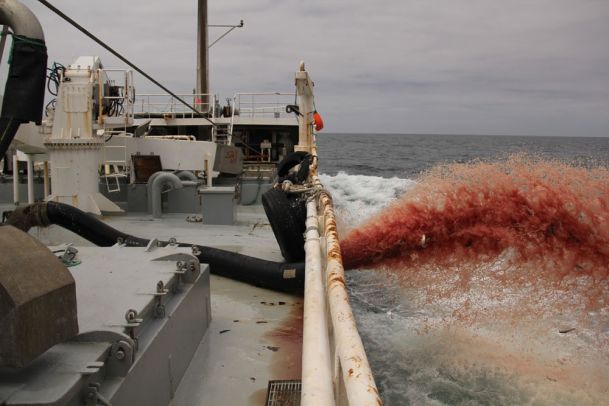
Moroccan fish trawlers pumping and dumping tons of dead fish into Sea [graphic video]

adrar4_609 Fish dumping off W. Sahara

A graphic indication of unsustainable commercial fishing was conveyed by two environmental watch organizations, Greenpeace and Western Sahara Watch, have revealed severe unsustainable practices by Moroccan commercial fishing vessels who were seen dumping tons of sardines overboard into ocean waters off the Western Sahara.

Unsustainable commercial fishing for species like Bluefin tuna in the Atlantic Ocean and Mediterranean seriously affect the fate of species like the Bluefin tuna. Over all declines in fish populations in the word’s oceans are just one symptom of oceans spiralling downwards and threatening life on earth.

The indicated fish dumping occurred in November by a fishing vessel named Adrar. It revealed massive dumping of the sardines because the vessel’s owners were “not happy with the size of the sardines.”

Western Sahara Resource Watch added that this vessel alone has dumped as much as 1,000 tons of dead fish back into the ocean this year alone.
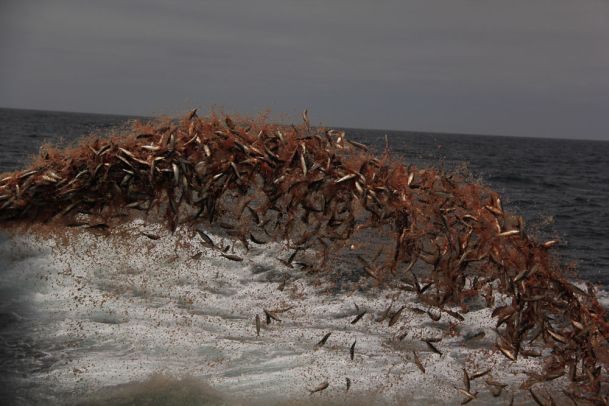
adrar8_609 closup of fish dumping

The Youtube clip below shows a graphic fish dump operation in progress, which was estimated to have involved as much as 60 tons of fish.

Judging of the shown size of these fish in the accompanying still photos, the dumping appeared to be a complete waste of fish that could be well utilized for food.

The idea of dumping so many fish does not bode well as an indication for marine fish populations.

“The combination of that (Moroccan) fleet with a new European fisheries agreement with Morocco is not sustainable, according to Greenpeace,”  says Marie F. Palm, who is affiliated with Western Sahara Research Watch.

She added that Greenpeace is calling for the European Parliament to reject the renewed EU fisheries agreement in the waters off  Western Sahara.

Although these sardines are not yet threatened like Bluefin tuna, the indication of so much fish dumping could eventually put these fish at risk as well.

Read more about unsustainable fishing issues in the Middle East:

Fate of Bluefin Tuna Dangles in Morocco

New Regulations Encourage More Sustainable Fishing in Turkey

Dubai Finally Gets Serious About Overfishing

Photos and video of sardine fish dumping courtesy of Western Sahara Resource Watch

Maurice Picow
Maurice Picowhttps://www.greenprophet.com/
Maurice Picow grew up in Oklahoma City, U.S.A., where he received a B.S. Degree in Business Administration. Following graduation, Maurice embarked on a career as a real estate broker before making the decision to move to Israel. After arriving in Israel, he came involved in the insurance agency business and later in the moving and international relocation fields. Maurice became interested in writing news and commentary articles in the late 1990’s, and now writes feature articles for the The Jerusalem Post as well as being a regular contributor to Green Prophet. He has also written a non-fiction study on Islam, a two volume adventure novel, and is completing a romance novel about a forbidden love affair. Writing topics of particular interest for Green Prophet are those dealing with global warming and climate change, as well as clean technology - particularly electric cars.
11 COMMENTS
  1. The idea of this piece was not ot dwell on politcal issues, but to point out an environmental issue. What goes on with fishing vessels and trawlers is often not reported; and most likely undesirable fish are thrown back from them as well. This is one reason why less fish are now being seen in the oceans.

    • With all due respect Maurice, these Algerian influenced NGOs are all about exploiting and fabricating stories for political capital; you might genuinely care about the exploitation of fish, but the sentiment certainly isn’t shared by some of your sources. I am supposed to seriously take at their word the allegations made by WSRW in the video, when they’ve already laid numerous false charges? Can they proved actual evidence this video of fish dumping is occurring off the Moroccan sahara or any other part of Morocco; fishing dumping (only recently banned in the EU) is so common in the industry this could be anywhere on earth! Furthermore, Morocco takes strict measures (following national schemes such as the Halieutis Plan and the Biological Rest program) to protect its fish stocks. Thank you.

  2. In fact, WSRW is an NGO with questionable funding and which has dubious links to the inhumane and draconian military regime ruling Algeria.

  3. The video is a complete sham. For such grand accusations it doesn’t even provide a shred of evidence. On top of that Morocco is not illegally occupying the sahara as the video incorrectly asserts which casts even more doubt over the videos integrity and its other baseless claims.

Comments are closed.

TRENDING

Street Vegan in Sri Thanu is a must-stop family lunch spot on Koh Phangan, Thailand

If you’re anywhere near Sri Thanu on Koh Phangan, Thailand, around the yoga centers: Zen Beach, Haad Yao, or Salad Beach—make time for Street Vegan. It's vegan and so satisfying that one meal might convince you that eating plant-based is not a compromise. I suggest for any vegan restaurant owner or chef to come to this modestly-priced venue to learn from a master.

Plants can eat dust and grow – should we stop dusting them?

Dusty plants? Let them eat their hearts out.

Paris Modest Fashion Week offers style without exposure for Muslims

France is home to around 5 to 7.5 million Muslims according to estimates, and Özlem Şahin, head of the organization behind Modest Fashion Week, has described Paris as "one of the leading modest fashion capitals in Europe".

Kids are vaping. The media shock that made them stop

On one side: aggressive anti-vaping campaigns from the FDA, Truth Initiative, and state programs, backed by over $100 million in annual spending. On the other: a public health crisis. Screenshot

Baby teeth read like tree rings paint a picture of toxins in early life

A new study from the Icahn School of Medicine at Mount Sinai in New York offers a striking insight into how the environments we are born into can quietly shape our brains years later. By analyzing naturally shed baby teeth, the ones tucked under pillows for the tooth fairy, researchers have reconstructed a detailed timeline of exposure to environmental metals during pregnancy and early infancy.

Nobul’s Regan McGee on Shareholder Value: “Complacency Is the Silent Killer” 

Why the governance framework designed to protect shareholders so...

Should You Invest in the Private Market?

startustartup Unlike public stock exchanges, which offer daily trading, strict...

How to build a 100-year-company

Kongō Gumi is a Japanese construction company, purportedly founded in 578 A.D., making it the world's oldest documented company. What can we learn about building sustainable businesses from them?

From Pilot Plant to Global Stage: How Aduro Clean Technologies’ 2026 Expansion Signals a Turning Point for Chemical Recycling Investors Like Yazan Al Homsi

The company's Next Generation Process (NGP) Pilot Plant in London, Ontario, has officially moved into initial operating campaigns, generating the kind of structured, repeatable data that separates laboratory promise from commercial viability.

How AI Helps SaaS Companies Reduce Repetitive Customer Support Work

SaaS products are designed for large numbers of users with different levels of experience, and also in renewable energy.

Pulling Water from the Air

Faced with water shortage in Amman, Laurie digs up...

Turning Your Energy Consultancy into an LLC: 4 Legal Steps for Founders in Texas

If you are starting a renewable energy business in Texas, learn how to start an LLC by the books.

Tracking the Impacts of a Hydroelectric Dam Along the Tigris River

For the next two months, I'll be taking a break from my usual Green Prophet posts to report on a transnational environmental issue: the Ilısu Dam currently under construction in Turkey, and the ways it will transform life along the Tigris River.

Related Articles

Popular Categories