
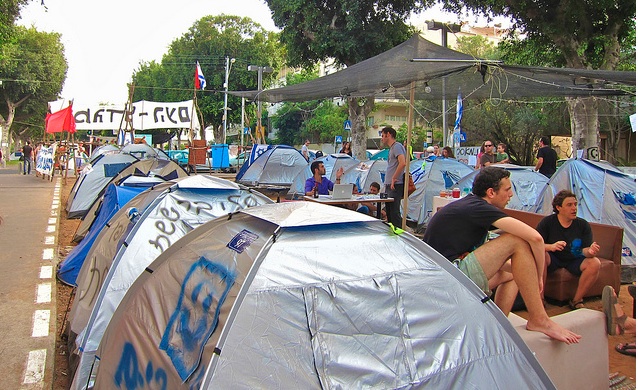

Inspired by the Arab Spring this past summer, Israelis from a rainbow of different ethnicities, political leanings and backgrounds banded together to form a protest movement unlike any in recent history. Their tent cities influenced the Occupy Movement in the world.
As the Arab spring spawned protests by the disenchanted across the Middle East, Israelis took to the streets and boulevards across Israel to express their disenchantment with social issues and the high cost of living. They did this in a very simple yet effective fashion. Many left their homes (in some cases they didn’t have homes) to occupy major thoroughfares across Israel by pitching tents and camping out. Social Media, the mainstream media and word of mouth were the primary promoters of the movement that inspired Israelis to take action. The visions of “Occupy Wall Street” were still yet only beginning to be born and the Israeli movement was seen as being its impetus.
A Different Shade of Protest
One protest leads to another. The Arab spring gave birth to the Israeli protests which began with a fed-up public complaining about the rising cost of housing and living. Fittingly, it began on Rothschild Blvd, a shaded boulevard in central Tel Aviv and named after a fabulously wealthy family that helped found the modern state of Israel, originally grounded in social welfare.
Within just a few weeks, 40 tent cities sprang up across the country in highly visible fashion. Just two weeks later, there were over 100 with marchers nearing half a million.
But, even after the few months that tents were scattered across Israel in protest and subsequently shut down, the Occupy Wall Street movement’s numbers and effectiveness still does not come close.
The Israeli movement included thousands camping out, hundreds of thousands marching in protest. A society transformed. It was clearly the people saying. Hey! We want to be in charge! The organizers of the Israeli protests even have been quoted as saying that even though they were a blueprint for what has begun in NYC and across the world, that they were much more successful in transmitting their message by mobilizing hundreds of thousands to a million.
For a small country like Israel with a population slightly above 7.5 million people comprising of Muslims, Jews and Christians the message was sent over high powered amplified megaphones rather than the other occupy protests which were over a microphone.
Happiness is Key in Israel
The logistics of the protest movement in Israel, the camping out part might have been the only similarity to Occupy Wall Street. The big difference. Spirit. Happiness was the key. Journalists were even asking. Is this serious? Because they saw a lot of people smiling. And that is the one thing that organizers said they would like to send to the people of Wall Street.
“What makes it serious is that people are smiling”, one organizer said. “People have hope when their actions lead to change.”
Evidence of this was at night, when the boulevards in Tel Aviv were vibrating with life and hope. There were parties with live music and people binding on issues.
Organizers in Israel compared the tent encampments to chat rooms where people held in-depth discussions, so essentially everyone involved was a leader. “When you act like an organization, the powers to be know who to target. But, when you have 300,00 plus leaders speaking with one voice, the message is loud and clear,” said one organizer.
Community Leads to Change
Garbage removal, communal kitchens, kindergartens were formed. After the tent cities were shut down, the organizers wanted to hold a huge rally in Rabin Square by Tel Aviv’s city hall. They were told that the charge would be $5,000.00. This did not sit well with the organizers and they decided they were doing it anyway, organizing a few hundred thousand that were happy that they were taking it back to the streets. Where it all started.
An article in Time magazine even noted that “Israel’s summertime protest movement, which was occupying Wall Street before it was cool, can now celebrate their first major tangible success.”
When the police needed to evict the protestors, they placed a rose on the tent, as a sign to go. There was no tear gas used. No violence.
After a Sunday Israeli cabinet meeting the government approved the restructuring of Israel’s tax system, shifting a few degrees of the social burden onto corporations and the very rich. More change is coming. Guaranteed.



Yes Ghassan. The Arab spring was mentioned as an inspiration for the Israeli protests a few times.
AG
Didn’t that happen in Egypt first and it influenced Israel? I know because I saw the pics and videos from Tahrir from my Egyptian friends long time before the protests in Israel even start.
The Arab Spring influenced Israel for sure, but the tent cities were influenced by local movements, so it seems. In the end we are all influencing each other.