

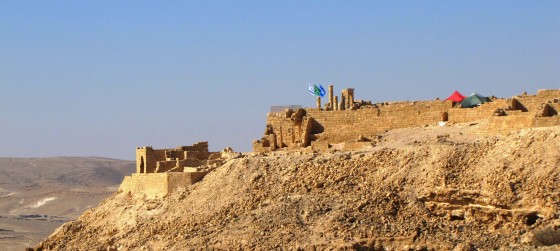
 Ancient farmers used indigenous knowledge to sustain communities at Avdat in the central Negev as many as seven thousand years ago. That wisom may hold the key to the future according to specialists.
I visited Avdat this August on one of the hottest days of the year when temperatures soared well above 40 degrees. Then, atop the ruins of the ancient settlement astride the Spice Route in the Negev Highlands it was difficult to understand how a community – at its peak 12,000 people – could sustain itself on the desert mount.
Visiting the site again in early November as part of the recent Drylands, Deserts and Desertification conference sponsored by Ben-Gurion University’s Blaustein Institutes for Desert Research, the key to how Nabatean, Roman and Byzantine societies survived under the spartan conditions at this UNESCO World Heritage Site became apparent: the application of indigenous knowledge, ancient wisdom that, enabled settlers to cultivate crops and herd small flocks using ingenious technologies adapted to harsh conditions.
Insight into how three civilizations maintained a community in the middle of the desert was offered by veteran desert guide Arthur du Mosch and by Blaustein Institutes professors Pedro Berliner and Hendrik Bruins.
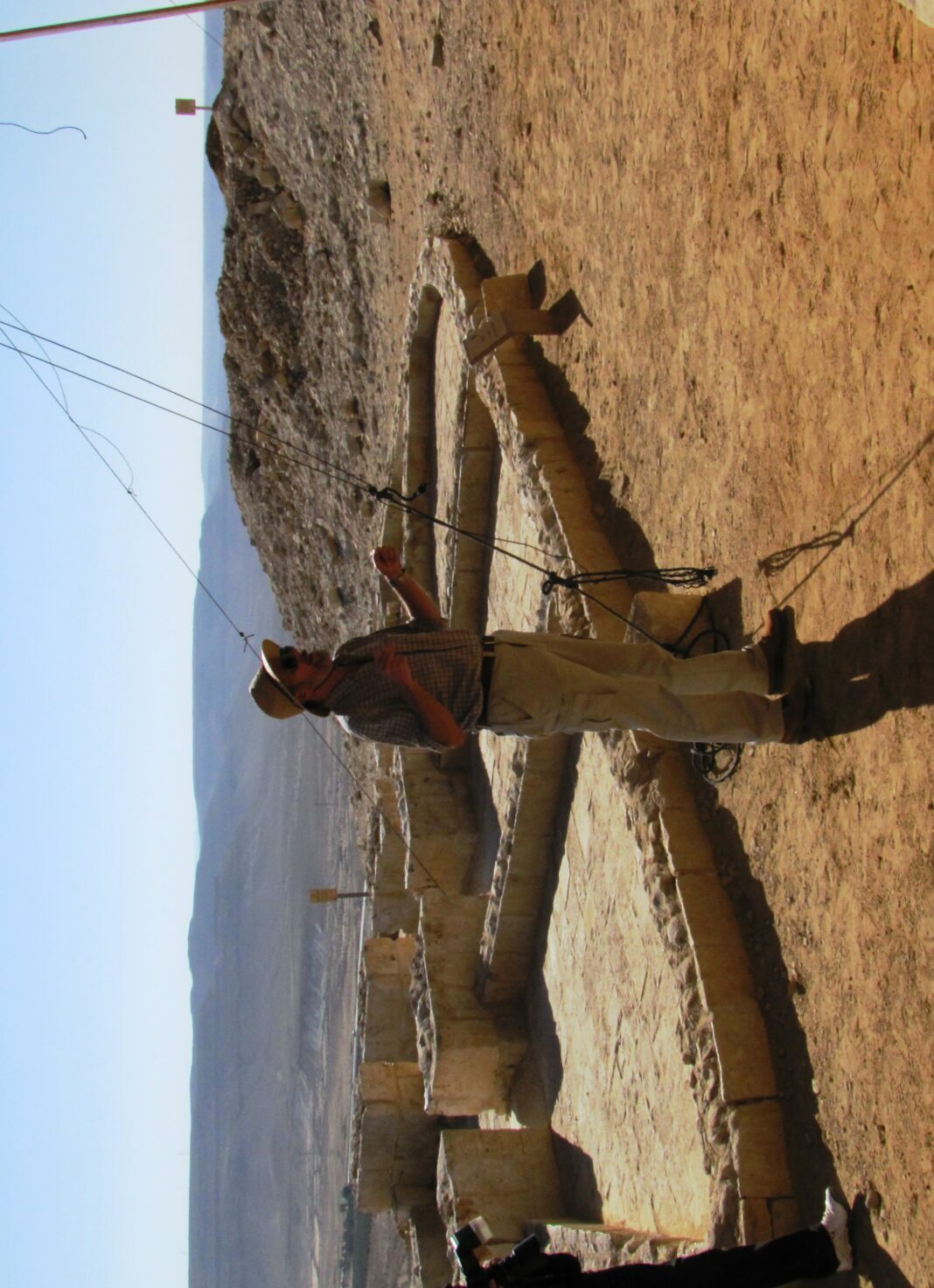
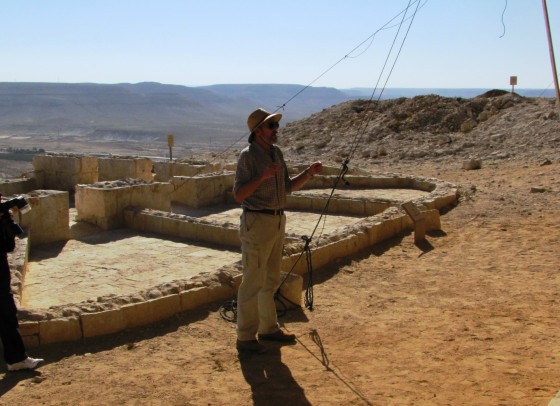
Prof. Bruins (pictured below), a member of the Institute’s Man in the Desert department has uncovered archeological evidence — bones found at a meter depth — that when carbon dated indicates that the desert agriculture was practiced at Avdat even before the Nabateans arrived in the area.
His research suggest that rudimentary farming was undertaken as early as seven thousand years ago, in the late Neolithic period and that local pastoralists engaged in run-off agriculture including the use of fertilizers much earlier than previous believed.
Rainfall under 100 milliliters per year
The early Negev agriculturalists had created terraces to capture the runoff of the rare rains falling in this area -less than 100 milliliters annually – in quantities sufficient to create crop yields with enough surplus to be stored. Storage of water was achieved in cisterns that ancient stoneworkers had cut into boulders. They also created silos out of stone that were used to keep grains, grapes and other crops.
The Nabateans, nomads who originated in the Arabian peninsula first settled at Avdat in the first century before the Common Era. The Nabateans dedicated the settlement in honor of their king-diety, Obodas who then reigned at the heart of the Nabatean civilization at Petra, in today’s Jordan.
The Nabateans were guides and traders with ties to commercial outposts in India, Africa and throughout Arabia where they dealt in perfumes and spices. According to guide du Mosch they traversed the desert in camel trains consisting of 400-800 camels per caravan with each animal carrying a fortune in spices 25-30 kilometers per day on journeys lasting between 40 to 60 days. Their routes passed through Damascus, proceeded to Mecca, onward to Petra, then to Avdat and onto Gaza where their wares were shipped to markets in Europe.
Knowledge of desert conditions
What enabled the Nabateans to prosper in the stark arid conditions was their knowledge of topography, water sources and the biology of their main technology, the camels. So well calibrated was their knowledge of conditions and resource use that they were able to cultivate grains, grapes, chickpeas, olives, lemon and pistachios and even produce wines coveted across the Mediterranean.
Hadrian, the Roman emperor consolidated Avdat into the empire in 106 CE and it became a military outpost attached to a reduced settlement; its Nabatean origins were eclipsed. The Roman influence on the architecture on the mount is found even in its ruins where arches, courtyards, altars and pillars once stood. Wine culture peaked at that time. An earthquake heavily damaged Avdat in the fourth century but the settlement was revived by the Byzantines in the sixth century. Remainders of the Christianization of the site is evidence by several churches consecrated in the area where Roman pagan rituals were carried out on alters in porticos on the mountain peak.
An intimate knowledge of place
In its urban functions the residents practiced strict hygiene in all public places and violation of sanitation laws resulted in fines and even expulsion. Water in cisterns and jugs was guarded against infestation and plazas, alleyways, roofs were scrupulously maintained.
The skillful husbandry of scarce resources was a major reason that settlement could endure at Avdat. What is striking is that a high level of self-sufficiency existed under grueling arid conditions in an area where buildings were destroyed several times by earthquakes.
Prof. Berliner, the Blaustein Institute’s current director stressed the ingenuity of the various settlers who inhabited Avdat. Their knowledge of the local hydrology, morphology, vegetation and soil physics was particularly astute. The central Negev receives its rainfall in heavy, sudden downpours known as convective rains. Most of this quantity is immediately evaporated by the desert heat. The intensity of the rain is such that the local soil is compositionally unable to absorb the quantity that falls, which results in runoff. The limited amount of rain that is held by the soil is contained by a thin crust that holds enough water to sustain certain vegetation. The rest, the runoff, must be “harvested” and held in terraces cut into the sides and on the floors of the neighboring wadis.
The past has keys to the future
What Prof. Berliner communicated to the crowd of desert and drylands specialists from around the world who participated at the BGU conference was that the Avdat agriculturalists had figured out how much water the soils could hold and realized that if they captured the surplus runoff in terraces and small dams on the desert floor and slopes, they could cultivate crops, feed herds of small animals and live comfortably in stone desert dwellings.
At a time when identifying sustainable practices will be needed to deal with dwindling and degraded resources stocks, Prof. Berliner’s message that “the past has keys to the future,” bears ample retelling.
Photos by the author Dr. Yosef Gotlieb


Dear sirs,
The Nabatian Arabs settled in Petra as early as the 7th century BC, during a period of a cold spell, as suggested by Brian Fagan, thus the suggested settlement of Nabatians in the first century doesn’t sound right at all! Actually a warming period have started then which allowed the Romans to invade England and the Vikings to settle in Iceland.
I was really happy to see this article. We can learn so much from the past and techniques used long ago, they understood how to farm sustainably and really cared about the land!
An old Celtic method of pest control was to plant with companions!
Marty from the Potted Vegetable Garden.