Israel's Best and Brightest Debate Climate Policy

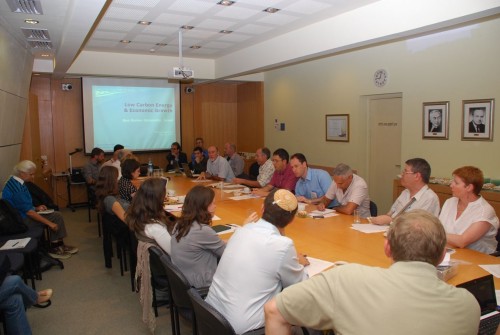
Workshop at Ben-Gurion University on Climate Change Mitigation PolicyWhat will Israel do if the Nile Delta becomes submerged from climate change? Brainstorming at the Climate Change Mitigation Policy Workshop today at Ben-Gurion University. (Image courtesy of Ophir Shoham)

In his opening remarks at the Climate Change Mitigation Policy Workshop at Ben-Gurion University today, Prof. Alon Tal, one of Israel’s most revered environmentalists, referred to the 20 or so people seated around the conference table as a “dream team” for environmental policy in Israel. Indeed, the workshop featured an all-star lineup of Israeli experts from academia, government, NGOs and the private sector.

The initial reference point for the workshop was the McKinsey report commissioned by the Ministry of Environmental Protection last year, entitled “Greenhouse Gas Abatement Potential in Israel.” Tal said the idea of convening this workshop came to him after realizing that the Israeli environmental community had yet to formulate a concerted response to this report.

The workshop began with presentations from three international experts: Bracken Hendricks, a Senior Fellow at the Center for American Progress in Washington; Dr. Malte Schneider, a Senior Researcher at ETH Zurich; and Joe Kruger, Policy Director at the National Commission on Energy Policy in Washington.

“There’s tremendous opportunity here. Israel could be a leader of global change and serve as a regional hub,” Hendricks asserted, noting that the Middle East and North Africa region is at the center of the climate debate. “Israel is at ground zero: If the Nile Delta is submerged [as a result of climate change], there will be millions of climate refugees.”

Hot showers and cold beers

Hendricks also stressed that climate advocates must make a strong case for the economic benefits of environmental policy: “It’s hard to mobilize people around atmospheric chemistry when people are getting pink slips. What we really care about is hot showers and cold beers.” The US government’s substantial investment in the green economy came as part of the economic recovery package and not as climate change spending, he explained.

Schneider, from ETH Zurich, said he was surprised by the uniqueness of Israel’s situation, including its extensive range of technology for both mitigating and adapting to climate change. He also noted that Israel places special emphasis on energy security and [for now, at least] functions as an “island,” with an isolated grid.

He offered this advice: “Get the first waves of renewables off the ground now,” while continuing to try to figure out the larger picture and formulate long-term policy.

The third international expert, Joe Kruger, noted that Israel’s share of greenhouse gas emissions is negligible on a global scale. Nonetheless, “the world needs Israel to step up and show leadership, to become an innovation center for the world,” he said.

Israel should integrate emissions reduction into its economic development plans, thus serving domestic needs at the same time, Kruger suggested. In particular, he singled out energy efficiency in buildings as an important place to start, and advocated instituting a carbon tax: “Carbon should be considered a cost.”

Calling a spade a spade

Next, it was time for the Israeli experts to present their views. In general, they were less circumspect than the foreign experts in criticizing the McKinsey report. (Dr. Dan Rabinowitz of Tel Aviv University would later explain to the guests that Israelis tend to “call a spade a spade” and that the visitors’ real opinion of the McKinsey report was evident, despite their more polite language: “You also think it sucks!”)

Yosef Abramowitz, president of Arava Power Co., rendered the most scathing indictment of the report, accusing McKinsey of “capitulating to the cynicism of Israeli politics.” Achieving ambitious targets for renewable energy in Israel is “completely doable” he passionately insisted, but complained that Israel’s political leadership has shown “no clarity or courage” in this area.

‘Kick ass’ at the Knesset

On Wednesday, the three foreign visitors will visit the Knesset and meet with the minister of national infrastructure, Uzi Landau. Abramowitz expressed hope that this “nexus of expertise and timing” would wield critical influence with policy makers in Jerusalem.

The cultural anthropologist Rabinowitz offered some advice for the foreign experts: “When you meet with Israeli politicians, remember that they’ll only listen to the first half of the sentence, so save any compliments for last, and first – kick ass.”

Read more about Israel and greenhouse gas emissions:

Are Israeli Emission Controls Hopeless?
Israel Can Do More Than Cleantech to Reduce Regional Carbon Footprint

Ira Moskowitz
Ira Moskowitzhttps://www.greenprophet.com/
When his kids were small, Ira would point to litter on the ground and tell them: “That makes me angry!” He still gets angry about pollution, waste and abusive treatment of our world, but is encouraged by the growing awareness of environmental issues and has been following the latest developments in cleantech with great interest. Ira grew up in the green hills of western Massachusetts and moved to Israel in the early 1980s after completing an MA in Middle Eastern Studies. He has worked as a software developer and journalist, and translates works of Hebrew fiction and non-fiction to English. Ira is trying to age gracefully, but refuses to surrender his youthful belief in the potential for change, including a collaborative future for the peoples of the Middle East. To contact Ira, email ira (at) greenprophet (dot) com.

LEAVE A REPLY

Please enter your comment!
Please enter your name here

TRENDING

Astro uses AI to help procure land for renewable energy

For oil-rich, environmentally vigilant Gulf states, Astro isn’t just another startup story. It is a blueprint for accelerating an energy transition that is now existential, not optional.

Huge Fish Nursery Discovered Under Freezing Arctic Seas

In 2019, an underwater robot camera exploring the seabed...

Remilk makes cloned milk so cows don’t need to suffer and it’s hormone-free

This week, Israel’s precision-fermentation milk from Remilk is finally appearing on supermarket shelves. Staff members have been posting photos in Hebrew, smiling, tasting, and clearly enjoying the moment — not because it’s science fiction, but because it tastes like the real thing.

How you create green steel on a blockchain

The thing about raw materials is that once they are melted down, you can't prove the source of the material. Same is true with gold, cucumbers and even forged products that look the same as the real thing. When it comes to steel, and how we produce it, it has a massive carbon problem. What's happening in Japan right now could change how we think about heavy industry and climate action.

The US leaves 66 United Nations organizations to “put America first”

The world needs a reset and to restart well intentioned cooperation projects from start. Because right now the UN and EU projects look like software built on code from the 80s, rickety, patched, slow to adapt, and prone to crashing under the weight of outdated assumptions.

Qatar’s climate hypocrisy rides the London Underground

Qatar remains a master of doublethink—burning gas by the megaton while selling “sustainability” to a world desperate for clean air. Wake up from your slumber people.

How Quality of Hire Shapes Modern Recruitment

A 2024 survey by Deloitte found that 76% of talent leaders now consider long-term retention and workforce contribution among their most important hiring success metrics—far surpassing time-to-fill or cost-per-hire. As the expectations for new hires deepen, companies must also confront the inherent challenges in redefining and accurately measuring hiring quality.

8 Team-Building Exercises to Start the Week Off 

Team building to change the world! The best renewable energy companies are ones that function.

Thank you, LinkedIn — and what your Jobs on the Rise report means for sustainable careers

While “green jobs” aren’t always labeled as such, many of the fastest-growing roles are directly enabling the energy transition, climate resilience, and lower-carbon systems: Number one on their list is Artificial Intelligence engineers. But what does that mean? Vibe coding Claude? 

Somali pirates steal oil tankers

The pirates often stage their heists out of Somalia, a lawless country, with a weak central government that is grappling with a violent Islamist insurgency. Using speedboats that swarm the targets, the machine-gun-toting pirates take control of merchant ships and then hold the vessels, crew and cargo for ransom.

Leopoldo Alejandro Betancourt López Turned Ocean Plastic Into Profitable Sunglasses

Few fashion accessories carry the environmental burden of sunglasses. Most frames are constructed from petroleum-based plastics and acrylic polymers that linger in landfills for centuries, shedding microplastics into soil and waterways long after they've been discarded. Leopoldo Alejandro Betancourt López, president of the Spanish eyewear brand Hawkers, saw this problem differently than most industry executives.

Why Dr. Tony Jacob Sees Texas Business Egos as Warning Signs

Everything's bigger in Texas. Except business egos.  Dr. Tony Jacob figured...

Israel and America Sign Renewable Energy Cooperation Deal

Other announcements made at the conference include the Timna Renewable Energy Park, which will be a center for R&D, and the AORA Solar Thermal Module at Kibbutz Samar, the world's first commercial hybrid solar gas-turbine power plant that is already nearing completion. Solel Solar Systems announced it was beginning construction of a 50 MW solar field in Lebrija, Spain, and Brightsource Energy made a pre-conference announcement that it had inked the world's largest solar deal to date with Southern California Edison (SCE).

Related Articles

Popular Categories