The Great Lakes may look pristine, but a new cleanup report reveals a growing tide of plastic pollution beneath the surface. From cigarette butts and food wrappers to tiny plastic fragments and discarded nicotine pouches, researchers are finding evidence that everyday consumer waste is making its way into North America's largest freshwater ecosystem. New technologies, including Canada's first BeBot beach-cleaning robot, are helping scientists understand how plastic travels through lakes, shorelines and stormwater systems before breaking down into microplastics.
A SpaceX IPO could become one of the most consequential financial events of the century, creating thousands of millionaires and fueling investment across the New Space economy. From orbital robotics and African space programs to launch infrastructure and satellite networks, the ripple effects may extend far beyond Earth—while forcing investors to reconsider whether generative AI remains the most compelling technology bet of the decade.
A coalition led by Frontier, backed by Stripe, Google, Salesforce and newly joined AI company Anthropic, has committed an additional $915 million to remove carbon dioxide from the atmosphere. The pledge adds to a previous $1 billion commitment and brings Frontier's total buying power to nearly $2 billion.
Oklahoma father Tyler Brodsky became the center of a national debate after accompanying his young daughters into a women's restroom during a road trip. For many parents, the story is less about politics and more about a simple question: how do you help your children feel safe when public bathrooms often fail families?
The Great Lakes may look pristine, but a new cleanup report reveals a growing tide of plastic pollution beneath the surface. From cigarette butts and food wrappers to tiny plastic fragments and discarded nicotine pouches, researchers are finding evidence that everyday consumer waste is making its way into North America's largest freshwater ecosystem. New technologies, including Canada's first BeBot beach-cleaning robot, are helping scientists understand how plastic travels through lakes, shorelines and stormwater systems before breaking down into microplastics.
A SpaceX IPO could become one of the most consequential financial events of the century, creating thousands of millionaires and fueling investment across the New Space economy. From orbital robotics and African space programs to launch infrastructure and satellite networks, the ripple effects may extend far beyond Earth—while forcing investors to reconsider whether generative AI remains the most compelling technology bet of the decade.
A coalition led by Frontier, backed by Stripe, Google, Salesforce and newly joined AI company Anthropic, has committed an additional $915 million to remove carbon dioxide from the atmosphere. The pledge adds to a previous $1 billion commitment and brings Frontier's total buying power to nearly $2 billion.
Oklahoma father Tyler Brodsky became the center of a national debate after accompanying his young daughters into a women's restroom during a road trip. For many parents, the story is less about politics and more about a simple question: how do you help your children feel safe when public bathrooms often fail families?
The Great Lakes may look pristine, but a new cleanup report reveals a growing tide of plastic pollution beneath the surface. From cigarette butts and food wrappers to tiny plastic fragments and discarded nicotine pouches, researchers are finding evidence that everyday consumer waste is making its way into North America's largest freshwater ecosystem. New technologies, including Canada's first BeBot beach-cleaning robot, are helping scientists understand how plastic travels through lakes, shorelines and stormwater systems before breaking down into microplastics.
A SpaceX IPO could become one of the most consequential financial events of the century, creating thousands of millionaires and fueling investment across the New Space economy. From orbital robotics and African space programs to launch infrastructure and satellite networks, the ripple effects may extend far beyond Earth—while forcing investors to reconsider whether generative AI remains the most compelling technology bet of the decade.
A coalition led by Frontier, backed by Stripe, Google, Salesforce and newly joined AI company Anthropic, has committed an additional $915 million to remove carbon dioxide from the atmosphere. The pledge adds to a previous $1 billion commitment and brings Frontier's total buying power to nearly $2 billion.
Oklahoma father Tyler Brodsky became the center of a national debate after accompanying his young daughters into a women's restroom during a road trip. For many parents, the story is less about politics and more about a simple question: how do you help your children feel safe when public bathrooms often fail families?
The Great Lakes may look pristine, but a new cleanup report reveals a growing tide of plastic pollution beneath the surface. From cigarette butts and food wrappers to tiny plastic fragments and discarded nicotine pouches, researchers are finding evidence that everyday consumer waste is making its way into North America's largest freshwater ecosystem. New technologies, including Canada's first BeBot beach-cleaning robot, are helping scientists understand how plastic travels through lakes, shorelines and stormwater systems before breaking down into microplastics.
A SpaceX IPO could become one of the most consequential financial events of the century, creating thousands of millionaires and fueling investment across the New Space economy. From orbital robotics and African space programs to launch infrastructure and satellite networks, the ripple effects may extend far beyond Earth—while forcing investors to reconsider whether generative AI remains the most compelling technology bet of the decade.
A coalition led by Frontier, backed by Stripe, Google, Salesforce and newly joined AI company Anthropic, has committed an additional $915 million to remove carbon dioxide from the atmosphere. The pledge adds to a previous $1 billion commitment and brings Frontier's total buying power to nearly $2 billion.
Oklahoma father Tyler Brodsky became the center of a national debate after accompanying his young daughters into a women's restroom during a road trip. For many parents, the story is less about politics and more about a simple question: how do you help your children feel safe when public bathrooms often fail families?
The Great Lakes may look pristine, but a new cleanup report reveals a growing tide of plastic pollution beneath the surface. From cigarette butts and food wrappers to tiny plastic fragments and discarded nicotine pouches, researchers are finding evidence that everyday consumer waste is making its way into North America's largest freshwater ecosystem. New technologies, including Canada's first BeBot beach-cleaning robot, are helping scientists understand how plastic travels through lakes, shorelines and stormwater systems before breaking down into microplastics.
A SpaceX IPO could become one of the most consequential financial events of the century, creating thousands of millionaires and fueling investment across the New Space economy. From orbital robotics and African space programs to launch infrastructure and satellite networks, the ripple effects may extend far beyond Earth—while forcing investors to reconsider whether generative AI remains the most compelling technology bet of the decade.
A coalition led by Frontier, backed by Stripe, Google, Salesforce and newly joined AI company Anthropic, has committed an additional $915 million to remove carbon dioxide from the atmosphere. The pledge adds to a previous $1 billion commitment and brings Frontier's total buying power to nearly $2 billion.
Oklahoma father Tyler Brodsky became the center of a national debate after accompanying his young daughters into a women's restroom during a road trip. For many parents, the story is less about politics and more about a simple question: how do you help your children feel safe when public bathrooms often fail families?
The Great Lakes may look pristine, but a new cleanup report reveals a growing tide of plastic pollution beneath the surface. From cigarette butts and food wrappers to tiny plastic fragments and discarded nicotine pouches, researchers are finding evidence that everyday consumer waste is making its way into North America's largest freshwater ecosystem. New technologies, including Canada's first BeBot beach-cleaning robot, are helping scientists understand how plastic travels through lakes, shorelines and stormwater systems before breaking down into microplastics.
A SpaceX IPO could become one of the most consequential financial events of the century, creating thousands of millionaires and fueling investment across the New Space economy. From orbital robotics and African space programs to launch infrastructure and satellite networks, the ripple effects may extend far beyond Earth—while forcing investors to reconsider whether generative AI remains the most compelling technology bet of the decade.
A coalition led by Frontier, backed by Stripe, Google, Salesforce and newly joined AI company Anthropic, has committed an additional $915 million to remove carbon dioxide from the atmosphere. The pledge adds to a previous $1 billion commitment and brings Frontier's total buying power to nearly $2 billion.
Oklahoma father Tyler Brodsky became the center of a national debate after accompanying his young daughters into a women's restroom during a road trip. For many parents, the story is less about politics and more about a simple question: how do you help your children feel safe when public bathrooms often fail families?
The Great Lakes may look pristine, but a new cleanup report reveals a growing tide of plastic pollution beneath the surface. From cigarette butts and food wrappers to tiny plastic fragments and discarded nicotine pouches, researchers are finding evidence that everyday consumer waste is making its way into North America's largest freshwater ecosystem. New technologies, including Canada's first BeBot beach-cleaning robot, are helping scientists understand how plastic travels through lakes, shorelines and stormwater systems before breaking down into microplastics.
A SpaceX IPO could become one of the most consequential financial events of the century, creating thousands of millionaires and fueling investment across the New Space economy. From orbital robotics and African space programs to launch infrastructure and satellite networks, the ripple effects may extend far beyond Earth—while forcing investors to reconsider whether generative AI remains the most compelling technology bet of the decade.
A coalition led by Frontier, backed by Stripe, Google, Salesforce and newly joined AI company Anthropic, has committed an additional $915 million to remove carbon dioxide from the atmosphere. The pledge adds to a previous $1 billion commitment and brings Frontier's total buying power to nearly $2 billion.
Oklahoma father Tyler Brodsky became the center of a national debate after accompanying his young daughters into a women's restroom during a road trip. For many parents, the story is less about politics and more about a simple question: how do you help your children feel safe when public bathrooms often fail families?
The Great Lakes may look pristine, but a new cleanup report reveals a growing tide of plastic pollution beneath the surface. From cigarette butts and food wrappers to tiny plastic fragments and discarded nicotine pouches, researchers are finding evidence that everyday consumer waste is making its way into North America's largest freshwater ecosystem. New technologies, including Canada's first BeBot beach-cleaning robot, are helping scientists understand how plastic travels through lakes, shorelines and stormwater systems before breaking down into microplastics.
A SpaceX IPO could become one of the most consequential financial events of the century, creating thousands of millionaires and fueling investment across the New Space economy. From orbital robotics and African space programs to launch infrastructure and satellite networks, the ripple effects may extend far beyond Earth—while forcing investors to reconsider whether generative AI remains the most compelling technology bet of the decade.
A coalition led by Frontier, backed by Stripe, Google, Salesforce and newly joined AI company Anthropic, has committed an additional $915 million to remove carbon dioxide from the atmosphere. The pledge adds to a previous $1 billion commitment and brings Frontier's total buying power to nearly $2 billion.
Oklahoma father Tyler Brodsky became the center of a national debate after accompanying his young daughters into a women's restroom during a road trip. For many parents, the story is less about politics and more about a simple question: how do you help your children feel safe when public bathrooms often fail families?
Thousands of years before green became hot, the Jewish people were observing the Shmitta, or shmita, a sabbatical year.
The Shmitta is documented in the bible as a year where farmers are forbidden to work the land in order to give the land a rest.
The Lord said to Moses on Mount Sinai. (2) Speak to the Israelites and say to them: ‘When you enter the land I am going to give you, the land itself must observe a sabbath to the Lord. (3) For six years sow your fields, and for six years prune your vineyards and gather their crops. (4) But in the seventh year the land is to have a sabbath of rest, a sabbath to the Lord. Do not sow your fields or prune your vineyards.’(Lev. 25: 1-4).
Talk about giving it a rest! In yesterday’s post we spoke about how radically we could cut down our emissions if the world would take upon itself the Jewish Sabbath. Now we would like you to consider the ramifications of taking a whole Sabbatical year.
For one out of seven years, religious Zionist farmers give the land a rest. No farming, no pruning, nada! Rabbis later on amended this law so that if there will be damage to your land as a result, you can take minimum care of your land so that you will not lose out in the long term.
It would take some pretty drastic planning ahead, stockpiling grains, pre-freezing fruits and veggies so that during the year off we could eat. But it could be feasible. The whole world could give it a try… The question is would it be good for the land?
Early crop rotation methods were mentioned in Roman literature, and referred to by several civilizations in Asia and Africa. Crop rotation is used in order to fortify the farmed land against depletion of its minerals. This isn’t quite the same, would a Sabbath replenish the land?
Israel’s Ministry of Foreign Affairs discusses this very same question on their website. Samuel Chayen explains that there is a current world-wide debate about sustainability; how to modify our current practices so that we can ensure a future for many years to come.
Chayen shares an anecdote: “Ten years ago, while attending a conference on Microbial Ecology, I listened to a “roundtable” debate dealing with Sustainable Agriculture. One of the speakers mentioned that in some places grazing land is abandoned every few years to let the grass grow and to enhance nitrogen assimilation on the roots of legumes by Rhizobacteria, thus increasing productivity in the following years.
“Given permission to speak, I pointed out that the Jewish law of Shmitta, the Sabbatical Year, provides exactly such orders for the Jewish farmer.”
The truth hurts: that adorable sweater you found on sale at Banana Republic for $25 is no harmless indulgence. The production, transportation and washing of clothing is responsible for approximately 25 percent of an individual’s C02 emissions- -about one ton per person. In a move to green their products, Israeli clothing company Delta Galil has introduced a new feature into its RealCool Cotton brand: now RealCool garments will be treated with natural antibacterial and odor-repelling agents. These treatments counteract the growth of bacteria and odors in the fabric, so that clothing doesn’t have to be washed as often or with hot water.
Energy, we all need it for practically everything we do. With global warming accelerating and fossil fuels expected to run out in decades, the hunt is on for alternative energy sources.
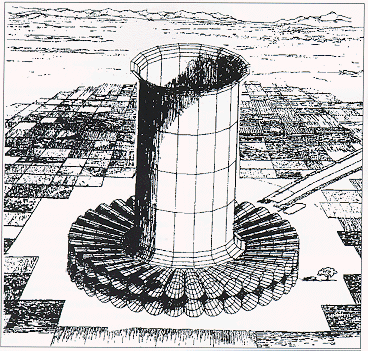
Professor Dan Zaslavsky from the Technion in Haifa has come up with a solution (expanding on the work of Dr. Phillip Carlson) and it’s called the Energy Tower – which will not only reduce the costs of energy from our pockets but from our planet as well.
“It’s a radically simple idea. We could easily produce between 15 to 20 times the total electricity the world uses today,” he says.
Standing 1,000 yards tall and 400 across, Zaslavsky’s tower takes advantage of convection, the natural principle that warm air rises and cool air sinks. Placed in a hot dry place, with access to water, the tower sucks in hot air traveling above it and water lining the tower cools the hot air as it gets pulled down.
(Cool air picks up speed as it goes down).
When this air reaches the bottom of the tower it is traveling at such a speed that it can power turbines at the tower’s base and create electricity. The water that comes out is cool and humid.
This design isn’t only capable of creating electricity it can do much more. With simple alterations Zaslavsky explains:
He tells Green Prophet: “We can produce cheap desalinated water, we can irrigate the desert, we can produce bio-fuel, we can boost aquaculture.”
It’s not surprising that the country of Israel, which made its deserts bloom, developed this idea.
Estimates predict that Zaslavsky’s looming tower could create electricity at 2.5 cents per kilowatt-hour, less than a third of the cost of electricity in Israel today.
Iranian designers update the Energy Tower idea in 2025
We could put these towers in driest regions of the world. Sure it would mean figuring out how to get the water there, but because the process desalinates we don’t have to waste precious drinking water and the towers emit humid air instead of greenhouse gasses. In fact, it could drastically transform barren deserts to habitable places.
Cynical reports suggest that these towers are not practical because: “The technology requires a hot and arid climate, and at the same time access to large amounts of water… Most of these regions are remote and thinly populated, and would require power to be transported over long distances to where it is needed.”
They are overseeing the fact that the Sharav Sluice Energy Tower would make these places habitable
Green Prophet related:
Apartments for China, outfitted with individual greenhouses. We’d live in one of these eco-abodes.
Outdoor vegetable gardens are nice, but as it turns out, they are so 2007. Now Technion Institute researchers Tagit Klimor and David Knafo have developed a design for high-rise apartments that will have their own self-sustaining greenhouses.
The greenhouse spaces will enable families to grow produce for their own consumption, with enough left over to generate additional income.
Each apartment will have a trellised greenhouse space measuring approximately 100 feet. These areas would be climate controlled and employ a system that uses soilless growing media (such as coconut, peat and other organic mixtures), a liquid fertilization system, and an advanced drip irrigation system.
The irrigation system will use recycled water from the apartments and rainwater collected from the rooftop. The building will also feature solar heating and cooling systems and a geothermal system.
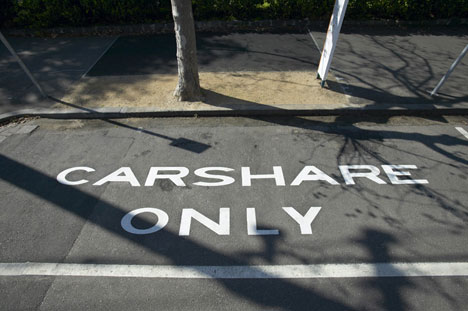
Now that Tel Aviv has car-sharing, it’s even harder to find parking. But there are less cars on the road, so good?
(Parking at Rabin Square and pool of water in the parking lot.)
People who live in Israel and who have to negotiate its roads might not feel that they have arrived in Gan Eden (“Eden”). As the standard of living increases on a yearly basis, so does the number of cars and parking lots. Any of our readers try and find a parking spot in north Tel Aviv on any given day of the week? You can circle for an hour and still be at a loss as to where to park – even for a fee.
The Porter School of Environmental Studies at Tel Aviv University recently held a conference to address their concerns about mushrooming parking lots in Israeli cities: “How much parking do we need in Israel’s major cities?” they ask.
“How long do we spend searching for a space to park? What are the costs of “free” parking? Is it time to start charging drivers a price that reflects the real cost of their parking place?”
Car drivers still enjoy free parking in many countries around the world. In the USA, for example, drivers park for free on 99% of all their car trips. Israel is certainly no exception to the rule. Even in Tel Aviv, the city with the highest demand for parking, most drivers still park for free or in exchange for an exceptionally small fee.Drivers may park for free, but is parking truly free?
As the saying goes, there is no such thing as a “free lunch.” And so it is with parking. The cost of parking is simply hidden – it has been transferred from the driver of the car to the general public.
When parking is free, we all want to use it. With free parking, car use goes up, and with it all the negative impacts in terms of search time, traffic congestion, environmental pollution, and road safety. Studies have shown that in some neighborhoods 74% of all car traffic consists of drivers searching for a parking place!
What are the solutions? So far, there is little agreement among experts or the public at large. Various suggestions have included limiting parking spaces or placing a tax on parking spaces around the city. While the solutions may still provide free parking, each of them comes with a cost. At the conference, both the academic world and the Tel Aviv Municipality presented approaches to escaping the parking deadlock.
As far as we are concerned, it’s better to ditch the car and take the bus or a mini van. Or for the sign of the times, take a scooter or an e-bike like the one we rented with teens in Bangkok. No parking needed!
The year 2020 onwards will be the decade of action for renewable energy. This is a solar energy field in Israel’s Negev Desert.
Deep in the heart of the Negev Desert, there is but one natural resource: the sun. David Faiman from Ben Gurion University has found a way to use solar energy to concentrate the light of a 1,000 suns.
Using reflective mirrors made from silicon, David has built a series of mirrors that concentrate the penetrating desert rays back to a large reflector dish.
The solution is one of a few in the world that may make solar energy a viable energy alternative within the next few years. And if Faiman and his startup company Zenith Solar are right, their solution will be able to provide enough energy for 10% of Israel’s population (1,0000 MW) using only 12 square kilometres of land.
This equals pollution-free energy for about one million people.
Says Faiman: “Traditional photovoltaic cells do two things: collect sunlight and generate electricity from it. What we’ve done is simply split those two functions, so that the sunlight is collected and concentrated by a dish-shaped mirror, and a small number of concentrator cells generate electricity from that highly concentrated sunlight.
“Photovoltaic material is far too expensive to waste on something that can be accomplished with cheap glass and steel.”
People are dying in Israeli cities from pollution. New solutions can’t come fast enough.
According to a company press release the Israeli tidal wave energy company S.D.E. began talks with Sri Lankan officials to construct and install a 200 MW power plant at an estimated cost of $130 million.
If negotiations are successful, they say, the plant will be the first of its kind to produce electricity at a commercial quantity from sea waves.
Once the plant is completed and fully operated, an agreement is expected to be signed for the construction of more power plants on the island.
Amirim, a vegetarian village in the Sea of Galilee region
Long before veganism became mainstream and wellness retreats became a global industry, there was Amirim. Now a wellness village perched above the Sea of Galilee with incredible views, it was originally founded as a vegetarian village. In the hippy days being a vegetarian said it all.
Perched 650 meters above sea level in the hills of the Upper Galilee, overlooking the Sea of Galilee, Amirim remains one of Israel’s most unusual and enduring communities. Founded in 1958 by Holocaust survivors and immigrants who wanted to create a village based on vegetarian principles, Amirim rejected livestock farming and the meat industry in favor of a lifestyle centered on health, nature, hospitality, and respect for animals.
Nearly seven decades later, the village’s founding ideals feel more relevant than ever.
As concerns about climate change, sustainable food systems, animal welfare, and personal wellbeing continue to grow, Amirim stands as a living example of a community built around many of the values now embraced by younger generations around the world.
A village built by vegetarians
Several attempts were made to establish a settlement on the site before Amirim finally took root. Unlike neighboring agricultural communities, however, the founders chose not to raise animals for food. Instead, they built a moshav centered on vegetarianism, organic agriculture, and tourism.
Because traditional farming offered limited economic opportunities under these constraints, residents began opening guesthouses to visitors seeking fresh air, quiet surroundings, and a different way of life. What began as a practical solution eventually became the foundation of Amirim’s success. Today, the village remains one of Israel’s most distinctive tourism destinations.
Amirim Sold Wellness Before It Was Trendy
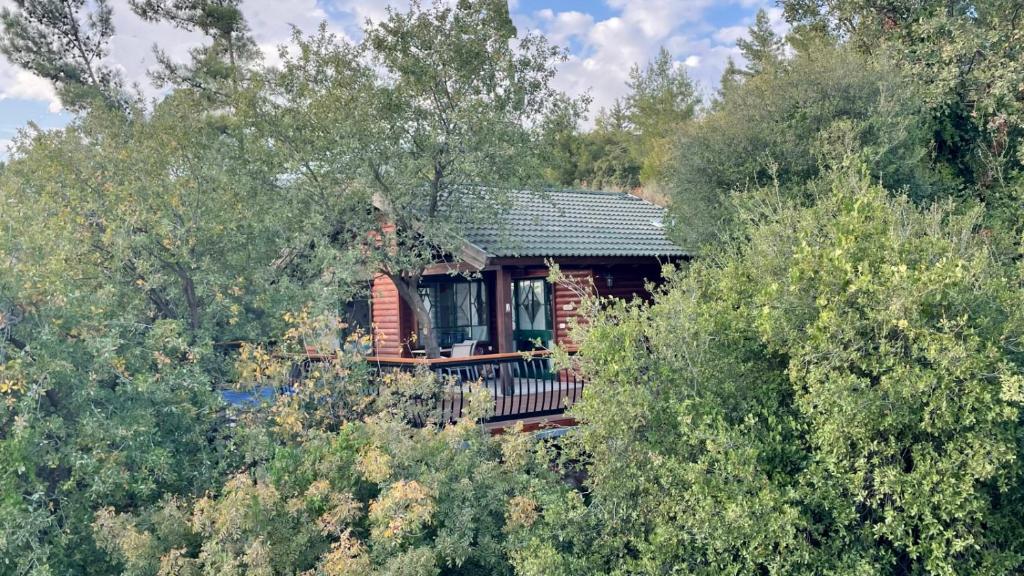
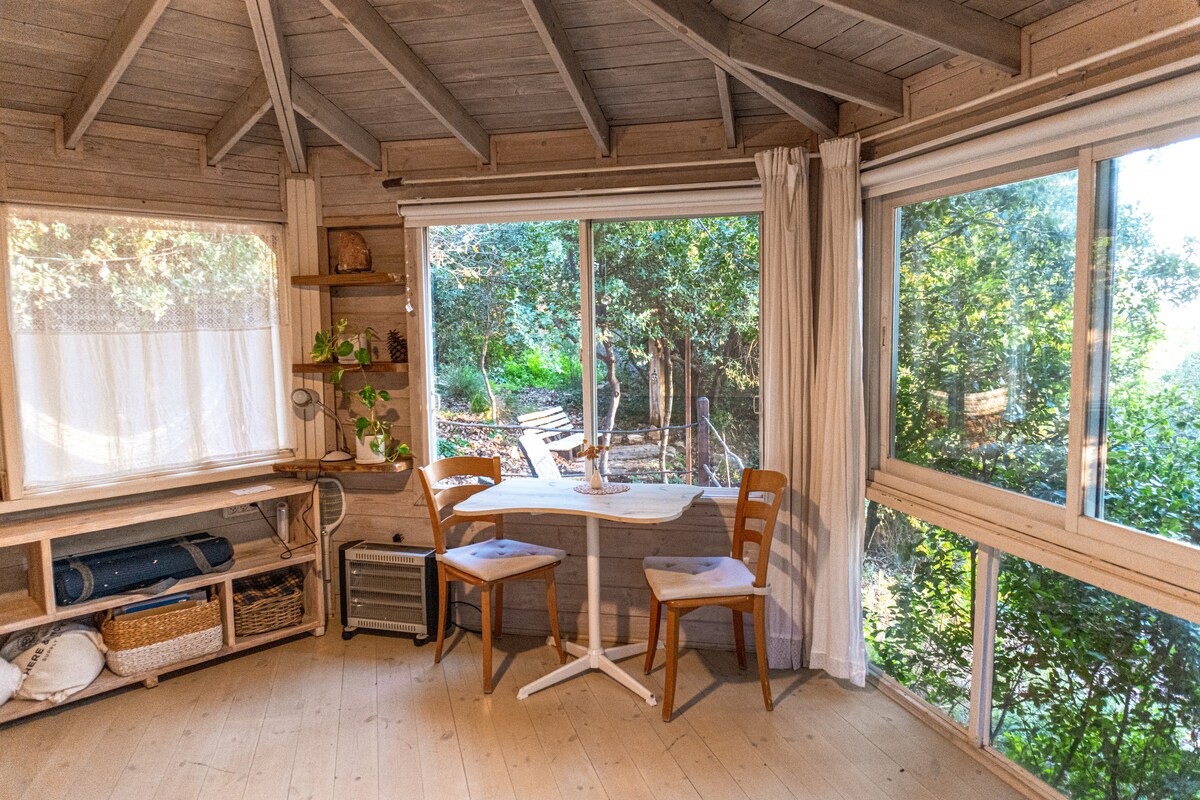
Hidden among the trees of Amirim, the Solitary Cabin attracts writers, artists, hikers, and couples looking for quiet in Israel’s vegetarian village.
Long before wellness became a buzzword, Amirim attracted people interested in holistic living. Many residents have long been involved in:
Herbal medicine
Massage therapy
Yoga and meditation
Natural nutrition
Alternative healing practices
Organic gardening
The village retains a relaxed atmosphere that feels far removed from Israel’s larger cities. Visitors come to slow down, hike forest trails, read on a balcony overlooking the Kinneret (Sea of Galilee), or simply enjoy a few days without noise and traffic.
Artists, Musicians and Free Spirits
Amirim has always attracted creative people. Studios and workshops throughout the village feature local artists, ceramicists, woodworkers, jewelers, and craftspeople. Open studio events and seasonal gatherings continue to draw visitors interested in art, culture, and community. The village’s reputation as a haven for musicians, healers, and alternative thinkers remains part of its charm. In the same vein, look for other villages in Israel like Klil.
Some longtime residents include the beloved multicultural Israeli band Sheva. Their story captures the village’s free-spirited atmosphere perfectly.
Nature at Your Doorstep
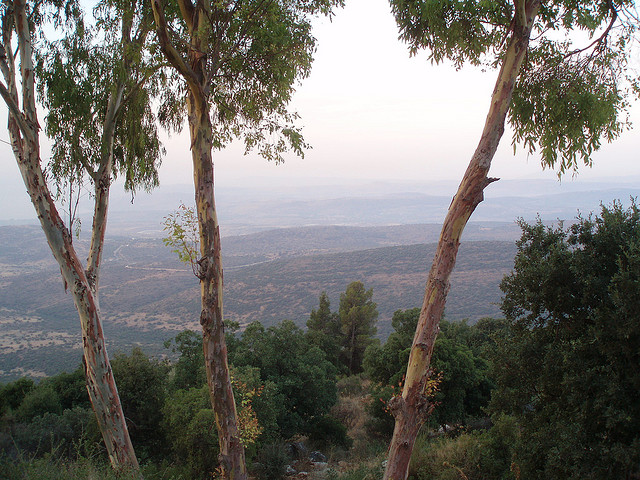
Amirim sits on one of the most beautiful roads in northern Israel, between Karmiel and Safed. From the village, visitors can explore:
Forest walking trails
Scenic viewpoints overlooking the Sea of Galilee
Cycling routes through the Galilee hills
Nearby wineries
Ancient olive groves
Nature reserves and birdwatching sites
In spring, the surrounding hills are covered with wildflowers. In winter, mist often drifts across the valleys below, creating dramatic views from the village’s hilltop location.
Where to Stay in Amirim
Amirim continues to offer some of the most charming guest accommodations in northern Israel. Longtime favorites include:
Honny Guesthouse – One of the village’s classic zimmers, known for warm hospitality, gardens, and peaceful surroundings. Ohn-Bar Guesthouse – A longtime favorite offering panoramic views, spacious suites, and easy access to hiking trails. Michal Guest House – Family-run accommodations with a cozy atmosphere and beautiful Galilee scenery.
Newer options have expanded the village’s appeal:
First Light Cabins, Amirim
First Light Cabins – Modern boutique cabins designed for couples seeking quiet, privacy, and forest views. Amirim Atmosphere – A wellness-oriented retreat featuring gardens, spa amenities, and mountain views. Dream Time Villa – Popular with families and groups looking for spacious accommodations and a peaceful setting. Blue House in the Woods – A nature-focused hideaway surrounded by oak trees and walking trails. The Solitary Cabin – A secluded retreat ideal for writers, artists, and anyone seeking complete tranquility. Geodesic Dome Retreats – Unique eco-friendly domes that combine glamping, architecture, and nature.
The Solitary Cabin in Amirim offers a peaceful retreat among the oak forests of the Upper Galilee, combining privacy, nature, and panoramic views for visitors seeking a slower pace of life.
Many accommodations feature private hot tubs, fireplaces, outdoor decks, and spectacular views stretching toward the Sea of Galilee and the Golan Heights. We actually prefer the places without hot tubs as they tend to feel old and moldy after some use. Plus Israel is a water insecure country. Better take a quick shower than run a giant bathtub full of water.
Room Amirim offers guest accommodations in Amirim that blend rustic charm, wellness-focused living, and stunning views of northern Israel’s landscapes.
Amirim was way ahead of its time
When Amirim’s founders chose vegetarianism in the 1950s, many considered the idea unusual. Today, plant-based diets, sustainable tourism, local food systems, and wellness travel have become global trends. And fun fact: Israel has the most vegans per capita in the world, and the most alt-food companies startup up per capital.
What once seemed radical now appears remarkably forward-looking.
Nearly seventy years after its founding, Amirim continues to offer visitors something increasingly rare: a community built around simplicity, nature, hospitality, creativity, and a belief that people can live more lightly on the land. It’s worth a visit just to witness the Age of Aquarius as it happened and speak to the elders of the village about how it all unfolded with their very hands.