
 One way of greening is economizing space and where better place to economize than than in your own home… Here are a few tips for making your home bigger:A flat screen mounted on the wall eliminates the need for a TV stand or armoire, it also looks sleek and great!Paint the walls and ceiling in a continuous color to make the room seem taller. Paint moldings, doors and the like in the same color as the walls. Strongly contrasting elements chop up the space.Miltitaskers: A daybed that converts into a comfy guest bed, for instance, is a great space saver that precludes the need for another piece of furniture.Use furniture that is scaled appropriately to the room. For example, an oversize sofa will eat up too much space in a small room.Provide good illumination, which will enhance the sense of space.
Green Space

Tel Aviv’s Rothschild Boulevard Just Got a Little Greener With Dani Karavan
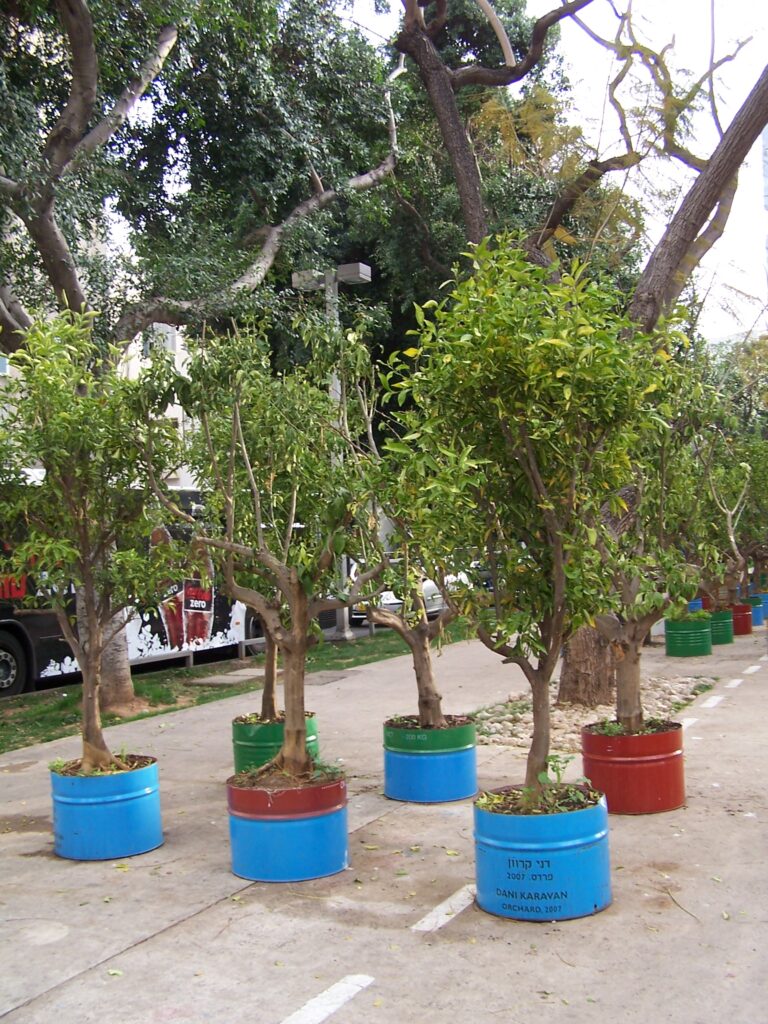

Rothschild Boulevard has always been lined with trees, but anyone walking on Rothschild Boulevard between Bezalel Yafe Street and Yavne Street during the past couple of weeks may have noticed a special influx of greenery.
Lined in the center of the boulevard, this collection of trees is a special site-specific installation by Israeli environmental sculptor, Dani Karavan.
The installation, titled Orchard, was created by Karavan to accompany his recent retrospective at the Tel Aviv Museum of Art, and was displayed outside of the museum throughout the duration of his exhibition. Orchard is now part of an initiative called Well Houses: Disappearing Palaces of Jaffa which attempts to preserve the historical and cultural importance of the city’s wells.
Bialik Square Loses Famous Centerpiece
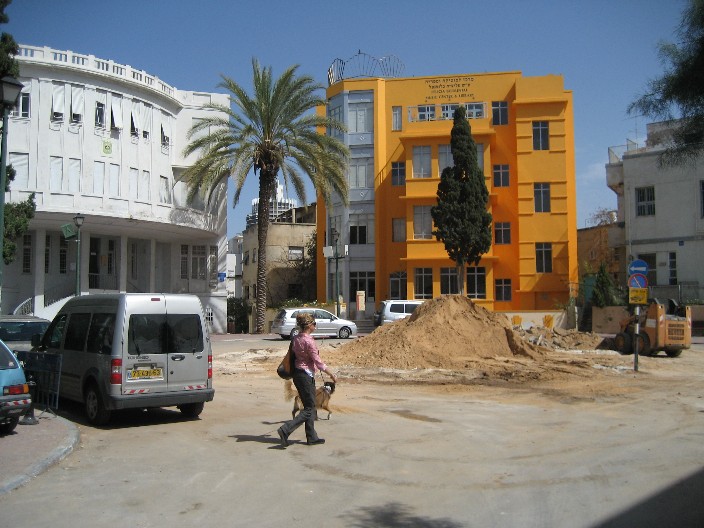

The colorful sculpture that once graced Bialik Square in the center of Tel Aviv is no more. The sculpture, designed for the square by artist Nahum Gutman in the 1970’s, rose out of a circular fountain and recounted 4000 years of Tel Aviv-Jaffa history in tiled mosaics. Today, a pile of dirt sits in the middle of the square, and Gutman’s piece sits, disassembled, in storage. Later this year, the city plans to reassemble the sculpture and move it to Rothschild Boulevard.
City authorities told Ynet (Hebrew link) that the decision to remove the sculpture was made a year ago, in coordination with the Gutman family, which supports the move. The reason for moving the sculpture is the fact that it partially blocked the facade of the old city hall building, which is slated for renovation and will house the Museum of the History of Tel Aviv-Jaffa. In place of Gutman’s mosaics, a “biological pond,” similar to the pond that existed pre-Gutman, will become the square’s new centerpiece.
Water Pact Between Israel and China

Hebrew University, sent Green Prophet this press announcement today. Water seems to be the talk of the town these days:
Possessing only 6.2% of global freshwater resources to supply 21% of the world’s population, China’s severe water shortage has become one of the most pressing dangers the country faces, threatening its fast-growing economy.
Despite its vast water reserves, China is quickly running out of its most vital natural resources due to rampant industrial pollution and inefficient use. Today, 70 percent of running water in China’s cities is unfit for drinking or fishing and around 300 million rural Chinese currently drink polluted water.
Water-a-Plenty – Even in Israel?
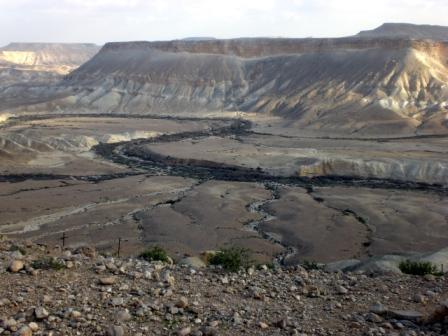
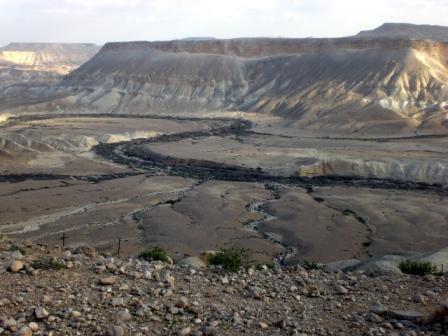
We’re accustomed to the doom-and-gloom prophecies of Israel’s chronic water shortage and how the thirst of the growing population of a country that is over 50% desert is going to crash and burn one day in the future. So it came as a shock to the system to hear Machiavellian German hydrogeologist, Clemens Messerschmid insist that, “Israel has plenty of water for everyone.”
Apparently Jerusalem has more rainfall each year than Berlin and the Palestinian city of Ramallah, 20 minutes drive north of Jerusalem, is wetter than Paris.
Sarahle Organi – New Organic Restaurant in Tel Aviv


Tel Aviv is offering organic food not only in form of vegetable boxes, or new organic grocery stores, but also in form of a brand new vegetarian restaurant.
Sarahle Organi is a cute place in Nachalat Benjamin that opened a few weeks ago.
The whole restaurant is very light and friendly and completely redesigned by it’s owner Schmulik, who is also the cook of this fabulous place. The restaurant is divided to a front part, with a bar and coffee tables and a back part, where you can sit on bigger tables.
The back door leads you to a small garden that offers you the opportunity to enjoy the dishes or your coffee in the sun.
In the summer the backyard will also host different events. Yoga lessons and movie nights are two happenings that are planned for the summer.
But now let’s finally talk about the food:
The menu offers you, next to several breakfast options and deserts, a special variety of vegetarian main dishes. I am sure that all of them are worth a try, but I want to recommend you two dishes, that are yummy, yummy, yummy!
Abu Yoyo: Closing the Loop in Banner Advertising
You read about it here first on Green Prophet. Now watch the vid.
Tel Aviv’s Naomi from Abu Yoyo has found an ingenious way to recycle city banner adverts. She makes bags, wallets and book covers and sells them back to media companies. Ingenious, no?
Leave it Cleaner
 Thinking back to picnics as a kid I can still hear my parents’ voices telling me to leave the place cleaner than how we found it.
Until this day this thought is what goes through my mind whenever I sit down to eat. Can you imagine how wonderful our world would be if everyone could implement this? Give it a try. All it takes is one more piece of garbage than what you brought with you.
A Green Shekel? Ethical Financial Investment in Israel
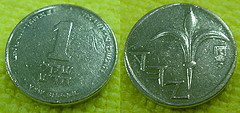

Brits amongst us might well be familiar with the concept of ‘green’ or ‘ethical banking’ through publicity surrounding the Cooperative Bank and Triodos, or other UK high street banks that are falling over themselves to offer this new, trendy financial facility, which is also spreading rapidly through the American banking system; but what about Israel?
How is Israel, this vibrant economy, and environmental-technology pioneer of the Middle-East, adapting to this concept of ethical, environmental and social investing? Are we putting our hard earned shekels where our environmental mouths are? Green Prophet talked to Daniel Schwab, founder and CEO of Kayema, a boutique financial services company, and one of the very few championing ethical investing here, to find out.
Ren Waste makes fuel from trash


Marty has just arrived back from 1955, we hear a sonic boom. Marty turns around and sees Doc Brown’s Dolorean drive up behind him. Doc impresses on Marty that he must return with him to the future to fix a mishap of his son. In order to fuel the time machine Doc rummages through Marty’s trash and pulls out a banana peel. a can of beer and some egg shells, pops them into “Mr. Fusion” and walla! No need for a bolt of lightning to power this trip…
Wouldn’t it be nice to be able to harness the power of trash?
Shai Pinczewski, founder and CEO of waste disposal company REN Waste explains: “The whole idea is to have a self-sustaining solution that eliminates 100% of the waste steam, doesn’t damage the environment, and can produce efficient clean energy. We brought in every different technology we need to achieve a complete breakdown in waste”
Pinczewski’s plant offers a complete alternative to traditional methods including incineration or landfills and eliminates the need for complimentary waste disposal treatments. Garbage and sewage are bought to the plant, shredded, run through magnetic sorters, separated, and tipped into a bio-chemical oxidation chamber for seven days for aerobic digestion.
After fermentation, a pyrolysis plant breaks down waste rubber, plastics and unfermentable organic matter. By the end of the process the waste has been separated and segregated into component materials and concentrated to a high degree of purity. Byproducts of this process including electricity, ethanol, metal, potable water, glass and gas that can be resold turning a huge financial burden into a cash cow.
Municipal waste is an environmental hazard that pollutes air, land and groundwater resources. It causes health hazards ranging from skin and eye infections to lethal diseases. It also costs world consumers billions of dollars a year in disposal costs. In the US alone, waste production has tripled from 88 million tons in 1960 to close to 250 million tons today and in New York, the cost of garbage disposal ranges from $80 to $150 a ton. In Europe it costs about 110 to 115 Euros.
“On some things we won’t make a lot of money, but the idea is that it won’t cost anything and we will be able to get rid of the waste completely,” says Pinczewski. “It’s good for the environment, good for us, and good for the world.”
We hope that every city around the world implements Pinczewski’s plant. Perhaps one day Doc Brown’s rummaging to create electricity will not see so futuristic.
Unplug

 Leaking electricity from electronics costs Americans millions annually. In fact about $750 million a year from leaky TVs and about $600 million a year from VCRs. To avoid the leaking of electricity, either unplug electronics when not in use, or plug them into a power strip that can be switched off.
Community Supported Agriculture: Organic, Local and Tasty!
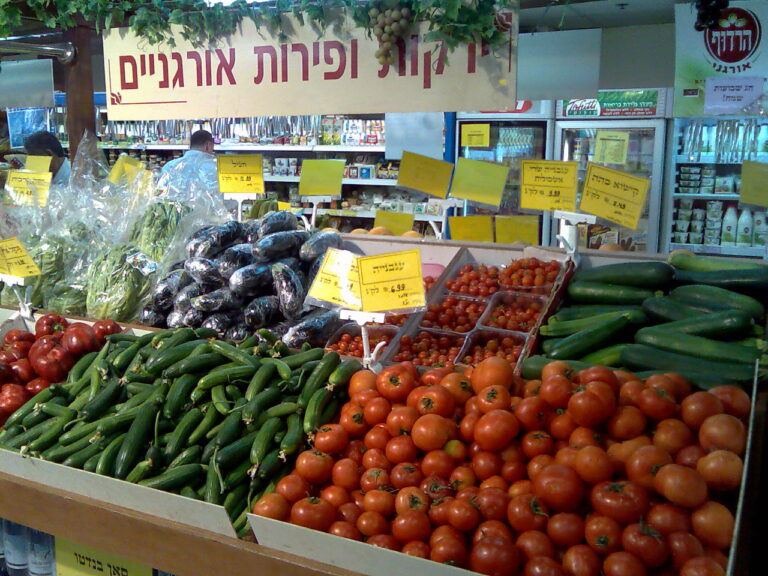

There’s no more satisfying way of enjoying what you eat than growing it yourself, but if you simply don’t have the time or know-how than the next best thing is to get to know the person who grows it for you.
That’s the idea behind Community Supported Agriculture (CSA), a small but growing movement of farms who deliver direct to their customers. Although most of Israel’s organic produce is exported overseas, some farmers have imported the CSA concept, (for example, the Tuv Ha’aretz program from Jewish eco-NGO Hazon) to help close the widening gap between farm and fork.
Many farms adopting the CSA model are also organic, so you not only get to know who grows your food, but also how they grow it.
Substitute
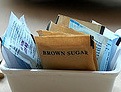
 One important aspect of a greener life is what you eat. Try various substitutes for your less healthy foods.
Use brown sugar instead of white, or mix in whole wheat with your regular flour. These little changes don’t always make a big difference taste-wise and DO make a difference health-wise.
How do Bedouin survive in the desert?
I’ve been researching Bedouin issues in the Negev Desert Israel for about 5 years, and one of the first individuals I met was Nuri El-Ukbi. Nuri and the El-Ukbi tribe have claims to the land named in Arabic El-Araquib, which is roughly situated between Rahat and Beersheva.
It is a vast area of land, roughly 19,000 dunams, and Nuri has documents showing ancestral tithes to this piece of land that stretch back to Mandate and Turkish rule.
In 1951 the El-Ukbi tribe were transferred to land around Hura.
Nuri, on behalf of his father and grandfather, both sheiks (deceased) of the El-Ukbi tribe, has lived in a protest tent on the land for several years now, conducting virtually a one-man non-violent protest against the powers-that-be who will not allow the tribe to live on or farm this piece of land.
Some of it has been given over to a gated settlement, Givaot Bar, and another chunk has been given to members of the Tarabin tribe. Attempts to plant trees and sow crops there by the El-Ukbi tribe and their many Jewish and International supporters meet with the Police and Green Patrol intervening and destroying trees and crops.
It is a visually stunning landscape. I was there yesterday with Nuri, and together we watched birds of prey circle overhead. Here is a short piece of film I made recently about Nuri….
Sadly, he told me the tree has now completely died. The new growth could not flourish. Nuri however, remains in El-Araquib, defiant and quietly optimistic. He is a great example of non-violent protest. He is, like the title of a book he has written about his life, ‘waiting for justice’.
Ecological reasons to ride the bus


Riding the bus is one of the simplest and most powerful actions an individual can take to reduce their environmental footprint. At a time when transportation accounts for nearly a quarter of global carbon emissions, shifting even a portion of daily trips from private cars to public transit can dramatically lower pollution. A single full bus can replace up to 50 private vehicles, reducing traffic congestion, cutting fuel consumption, and lowering greenhouse gas emissions that contribute to climate change. For cities struggling with smog, heat islands, and poor air quality, more people choosing to ride the bus translates directly into cleaner, healthier urban air.
Buses are increasingly part of the clean-energy transition. As electric and hybrid buses become mainstream, their emissions drop close to zero, especially when powered by renewable energy. This benefits not only the climate but also public health: fewer tailpipes mean lower rates of asthma, cardiovascular disease, and respiratory illness—conditions that disproportionately affect children and vulnerable populations. Choosing the bus also reduces noise pollution, making cities calmer and more livable.
Beyond the environmental benefits, riding the bus strengthens communities. It supports equitable mobility by ensuring everyone—regardless of income, age, or ability—can access jobs, schools, and essential services. Reliable bus systems encourage the development of walkable neighborhoods, reducing sprawl and protecting natural habitats from urban expansion. Every person who opts for public transit helps make the system more viable, improving frequency and coverage for everyone.
There’s also a personal advantage: taking the bus saves money. Between fuel costs, parking fees, insurance, and maintenance, car ownership is expensive. Public transit offers a cleaner, cheaper, and often less stressful way to travel. Instead of staring at brake lights, bus riders can read, work, relax, or simply enjoy the view.
In an era of rising temperatures and shrinking carbon budgets, small daily choices matter. Riding the bus may feel ordinary, but its impact is real. It’s a vote for cleaner air, quieter streets, and a more sustainable city. And it’s a reminder that climate solutions don’t always require new inventions—sometimes they’re already waiting at the corner.