“In the midst of uncertain time, renewable energy remains consistent and steadfast in its expansion,” said Francesco La Camera, IRENA’s Director-General. “A more decentralised energy system, with a growing share of renewables and more market players, is structurally more resilient.”
Health insurance is a regulated financial product. Insurers operate under binding contracts, overseen by state insurance commissioners, that legally obligate them to pay claims meeting policy terms. Policyholders who believe a covered claim was wrongfully denied have legal recourse through state regulatory channels.
The New Zealand Merino Company, now rebranded as Zentera, has quietly removed the phrase “world’s leading ethical wool brand” from its website, a notable change that comes after a disturbing investigation by PETA Asia-Pacific into the company’s ZQ-certified wool supply chain, PETA reports to Green Prophet.
Somehow vegetables with short seasons excite the imagination and appetite more sharply than produce that’s available all year around. Good Middle Eastern cooks have many recipes for delicate fava beans, and this turmeric-fragrant soup is one.
“In the midst of uncertain time, renewable energy remains consistent and steadfast in its expansion,” said Francesco La Camera, IRENA’s Director-General. “A more decentralised energy system, with a growing share of renewables and more market players, is structurally more resilient.”
Health insurance is a regulated financial product. Insurers operate under binding contracts, overseen by state insurance commissioners, that legally obligate them to pay claims meeting policy terms. Policyholders who believe a covered claim was wrongfully denied have legal recourse through state regulatory channels.
The New Zealand Merino Company, now rebranded as Zentera, has quietly removed the phrase “world’s leading ethical wool brand” from its website, a notable change that comes after a disturbing investigation by PETA Asia-Pacific into the company’s ZQ-certified wool supply chain, PETA reports to Green Prophet.
Somehow vegetables with short seasons excite the imagination and appetite more sharply than produce that’s available all year around. Good Middle Eastern cooks have many recipes for delicate fava beans, and this turmeric-fragrant soup is one.
“In the midst of uncertain time, renewable energy remains consistent and steadfast in its expansion,” said Francesco La Camera, IRENA’s Director-General. “A more decentralised energy system, with a growing share of renewables and more market players, is structurally more resilient.”
Health insurance is a regulated financial product. Insurers operate under binding contracts, overseen by state insurance commissioners, that legally obligate them to pay claims meeting policy terms. Policyholders who believe a covered claim was wrongfully denied have legal recourse through state regulatory channels.
The New Zealand Merino Company, now rebranded as Zentera, has quietly removed the phrase “world’s leading ethical wool brand” from its website, a notable change that comes after a disturbing investigation by PETA Asia-Pacific into the company’s ZQ-certified wool supply chain, PETA reports to Green Prophet.
Somehow vegetables with short seasons excite the imagination and appetite more sharply than produce that’s available all year around. Good Middle Eastern cooks have many recipes for delicate fava beans, and this turmeric-fragrant soup is one.
“In the midst of uncertain time, renewable energy remains consistent and steadfast in its expansion,” said Francesco La Camera, IRENA’s Director-General. “A more decentralised energy system, with a growing share of renewables and more market players, is structurally more resilient.”
Health insurance is a regulated financial product. Insurers operate under binding contracts, overseen by state insurance commissioners, that legally obligate them to pay claims meeting policy terms. Policyholders who believe a covered claim was wrongfully denied have legal recourse through state regulatory channels.
The New Zealand Merino Company, now rebranded as Zentera, has quietly removed the phrase “world’s leading ethical wool brand” from its website, a notable change that comes after a disturbing investigation by PETA Asia-Pacific into the company’s ZQ-certified wool supply chain, PETA reports to Green Prophet.
Somehow vegetables with short seasons excite the imagination and appetite more sharply than produce that’s available all year around. Good Middle Eastern cooks have many recipes for delicate fava beans, and this turmeric-fragrant soup is one.
“In the midst of uncertain time, renewable energy remains consistent and steadfast in its expansion,” said Francesco La Camera, IRENA’s Director-General. “A more decentralised energy system, with a growing share of renewables and more market players, is structurally more resilient.”
Health insurance is a regulated financial product. Insurers operate under binding contracts, overseen by state insurance commissioners, that legally obligate them to pay claims meeting policy terms. Policyholders who believe a covered claim was wrongfully denied have legal recourse through state regulatory channels.
The New Zealand Merino Company, now rebranded as Zentera, has quietly removed the phrase “world’s leading ethical wool brand” from its website, a notable change that comes after a disturbing investigation by PETA Asia-Pacific into the company’s ZQ-certified wool supply chain, PETA reports to Green Prophet.
Somehow vegetables with short seasons excite the imagination and appetite more sharply than produce that’s available all year around. Good Middle Eastern cooks have many recipes for delicate fava beans, and this turmeric-fragrant soup is one.
“In the midst of uncertain time, renewable energy remains consistent and steadfast in its expansion,” said Francesco La Camera, IRENA’s Director-General. “A more decentralised energy system, with a growing share of renewables and more market players, is structurally more resilient.”
Health insurance is a regulated financial product. Insurers operate under binding contracts, overseen by state insurance commissioners, that legally obligate them to pay claims meeting policy terms. Policyholders who believe a covered claim was wrongfully denied have legal recourse through state regulatory channels.
The New Zealand Merino Company, now rebranded as Zentera, has quietly removed the phrase “world’s leading ethical wool brand” from its website, a notable change that comes after a disturbing investigation by PETA Asia-Pacific into the company’s ZQ-certified wool supply chain, PETA reports to Green Prophet.
Somehow vegetables with short seasons excite the imagination and appetite more sharply than produce that’s available all year around. Good Middle Eastern cooks have many recipes for delicate fava beans, and this turmeric-fragrant soup is one.
“In the midst of uncertain time, renewable energy remains consistent and steadfast in its expansion,” said Francesco La Camera, IRENA’s Director-General. “A more decentralised energy system, with a growing share of renewables and more market players, is structurally more resilient.”
Health insurance is a regulated financial product. Insurers operate under binding contracts, overseen by state insurance commissioners, that legally obligate them to pay claims meeting policy terms. Policyholders who believe a covered claim was wrongfully denied have legal recourse through state regulatory channels.
The New Zealand Merino Company, now rebranded as Zentera, has quietly removed the phrase “world’s leading ethical wool brand” from its website, a notable change that comes after a disturbing investigation by PETA Asia-Pacific into the company’s ZQ-certified wool supply chain, PETA reports to Green Prophet.
Somehow vegetables with short seasons excite the imagination and appetite more sharply than produce that’s available all year around. Good Middle Eastern cooks have many recipes for delicate fava beans, and this turmeric-fragrant soup is one.
“In the midst of uncertain time, renewable energy remains consistent and steadfast in its expansion,” said Francesco La Camera, IRENA’s Director-General. “A more decentralised energy system, with a growing share of renewables and more market players, is structurally more resilient.”
Health insurance is a regulated financial product. Insurers operate under binding contracts, overseen by state insurance commissioners, that legally obligate them to pay claims meeting policy terms. Policyholders who believe a covered claim was wrongfully denied have legal recourse through state regulatory channels.
The New Zealand Merino Company, now rebranded as Zentera, has quietly removed the phrase “world’s leading ethical wool brand” from its website, a notable change that comes after a disturbing investigation by PETA Asia-Pacific into the company’s ZQ-certified wool supply chain, PETA reports to Green Prophet.
Somehow vegetables with short seasons excite the imagination and appetite more sharply than produce that’s available all year around. Good Middle Eastern cooks have many recipes for delicate fava beans, and this turmeric-fragrant soup is one.
In the spirit of using every possible material available and avoiding waste, Israeli designer Zohar Yarom has found a creative and functional purpose for furniture fabric samples. She makes handbags out of them.
After receiving degrees in design from the Bezalel school in Jerusalem and Parson’s in New York, Zohar founded her own ZY design company in 2003 with the objective of creating environmentally and socially sensitive design pieces.
Her diverse line of products once included handbags, storage solutions, furniture (such as the saddle chair), light fixtures, and ceramics.
And she prides herself on finding an aesthetic solution to reusing materials in a way that is both stylish and conscious of the environment.
According to Zohar, “it is important for me to emphasise environmental and social sensitivity through the design and use of the product, with the possibility of being more stylish.”
She is currently working on reusing billboard materials (similar to Abu YoYo, which creates bags out of billboard waste in Tel Aviv) and is involved with an organization called “Shekulo Tov” – an organization that helps provide vocational work for people with emotional disabilities. (As of 2020 the link wasn’t working, so we removed it.)
Zohar’s bags can be found in organic clothing store, Cotton, as well as online and in select design stores.
Did you know that the bagged salad bought in the supermarket tends to contain high levels of chlorine… often higher than in the average swimming pool? It’s easy, and much healthier, to bag your own! Just like with aromatics, after washing and then spinning it dry, roll up your lettuce in paper towels and then seal it in a ziplock bag. It will hold up to a week or more!
Environmental and social change don’t always go together in green organizations, but the truth is that you can’t really make green changes without effecting society. Alternatively, some socio-economic groups just don’t have the resources to make costly (yet positive) environmental changes. As Jeff recently pointed out in his reaction to Tel Aviv’s farmers market, it would be great if everyone could eat organic veggies – but the sad truth is that only a slice of the population can afford to make this positive change.
That’s why it’s so cool that Green Action, a non-profit organization based in Tel Aviv, focuses on eco-social change. They don’t distinguish between the needs of the planet and the needs of the people who call it home, and work to protect both natural resources and disadvantaged communities.
Millions of printer cartridges go into landfill sites each year and this is increasing annually. Buying refilled cartridges is a good way to prevent this waste and they’re often cheaper than new ones. A quick google search can help you find a supplier near you!
Interested in ways to green an old computer? Visit here.
I know it sounds crazy, but composting is a great way to green your life, and it’s a lot easier than it sounds. But most important, it significantly reduces the damage we are doing to our environment. Most of the junk that goes into the garbage can be composted products like egg boxes and shredded paper can be thrown on the compost heap, as well as all the usual fruit and veggie peelings. Interested? Visit here for more information on how.
My parents are not your typical candidates for owning a hybrid car. They’ve been loyal owners of gas-guzzling Volvos for at least 20 years, replacing one trusty, sensible Volvo with another about once a decade. So it was quite a pleasant surprise when they announced 8 months ago that they were going to turn in their 14 year old Volvo station wagon for a Prius.
And 8 months later they’re considering replacing their other Volvo for a Prius, too.
My mom initially considered buying a Prius because her place of work had moved an extra 20 minutes away and she figured that with the extra commute, a more fuel efficient car would make sense.My dad wasn’t having it.It took some convincing to get him to change his old Volvo ways, but once he saw that the Prius was not only a fuel efficient car but a car with some “oomph” (his term, not mine) they decided to check it out.
The small (yet surprisingly roomy), powerful (yet quiet), and fuel efficient Prius prevailed.Now the two of them always use the Prius as their vehicle of choice.
(Illustration of how the solar-powered air-con might look)
Solar energy has long been considered as a source of power. And more recently, a number of projects have been created in Israel to do more than simply heat water as the conventional sun boilers have been doing for years. Solar energy is now being developed to work in powering air conditioning systems in both home and commercial enterprises.
A Beer Sheva based company, EWA Technologies Group (EWA: for Earth, Water, Air), is developing a solar powered air conditioning system that converts solar energy to a low cost energy system that harnesses the sun’s power and uses it to create cooling.
EWA’s solar cooling process is basically simple: A special solar collector collects and stores solar energy, and then transforms the accumulated energy into effective cooling. A special granular material, placed within the solar collector, reacts with a special liquid cooling fluid that send cool air into a room or office in a process similar to an inter cooling radiator system in an automobile.
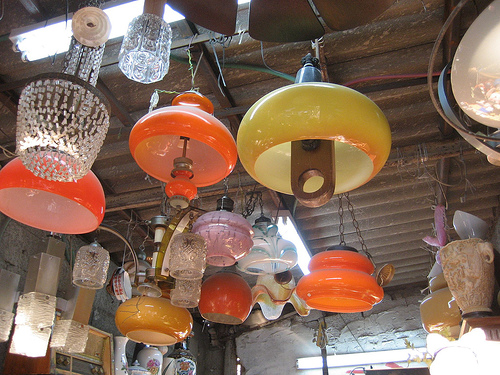
All of us green folk know that trash is a serious thing. It takes up space, pollutes our waterways, doesn’t decompose, and produces harmful gases. But there ain’t nothing serious about Merav Feiglin’s Trashlights. Nope, not even close.
Merav, who also creates other environmentally friendly art such as mosaics, altered books, and collages, collects found objects that would normally end up in the trash and makes hysterically whimsical one-of-a-kind lamps out of them.
Barbie doll legs are paired with shaving brushes, rubber duckies with spoons, pasta strainers with old coffee tins. Croc shoes and toy trucks and plastic horses, oh my!
Besides the environmental benefits, using old stuff that would usually end up being thrown out has its design benefits too. Since Feiglin uses mostly old, outdated things, her lamps have a warm retro feel.
If you want to lighten up your day, your room, or your carbon footprint, Merav welcomes visitors to her studio in Moshav Givat Shapira (call her in advance to make an appointment at 052-357-5361).
Plants around your home or office not only brighten up the place, but they are natural air conditoners and have been shown to remove up to 87% of indoor pollution in 24 hours! Skip the air fresheners and buy some plants instead. If you buy spices you can eat them as well! Interested in seeing how plants are being harnessed to generate electricity? Visit here.
We had just settled into a quiet cottage near the Dead Sea. Despite the intense heat outside our windows, we were still excited about getting out to float in the mineral-rich salty water. My friends had their swimsuits on and were just out the door. But wait a second, I said. All the lights are all still on. And the air conditioner. So what, my friends remarked. We aren’t paying for it. Why should we care?
In theory they were right. But in the end, everyone will pay for needless wasting of energy. When I was young, I could never get my Scottish mother’s accent out of my head: Turn off the lights, it wastes electricity, she would harp incessantly. You’re not paying the bills, we are!
Motivated by her spendthrift ways, my mother’s constant badgering eventually set into my brain. Her arguments became clearer when I moved out of the house for college and had to pay my own electricity bills. You can be sure that I turned off every single light in the house when I wasn’t in the room – sometimes I worked in the corner of one room with a small desk lamp to be the most conservative electricity user.
Today, my spending budget has increased, and while I also want to save money, it is important to not forget that we have a new issue that we must bring into our consciousness: Global Warming. Until we can find a way to harness clean energy from sources like the sun in a widespread way, it might be wise to be vigilant on energy use and impact on our planet.
If you read the newspapers a few years ago, articles about Global Warming were rare. Today, mainstream media, large companies and even your government is advocating that everyone conserve energy by using new kinds of light bulbs known as CFLs or compact fluorescent bulbs: They are those long-life corkscrew bulbs that cost at least twice as much as your standard incandescent bulb. Some people say they look like a soft-serve ice-cream cone.
Bring on the CFLs
They come in a variety of shapes, colors of light and sizes and use about one-quarter of the energy as your standard light bulb. Lasting several times longer (about 10,000) hours, this environmentally-friendly bulb starts paying for itself after 500 hours of use. They also keep your room cooler, which means you can turn down the air conditioner a bit in the summer or maybe use the fan instead.
Recognizing the immediate effects on energy consumption (about 20% of our electricity bill goes to lighting) some cities across the world are even giving away CFLs for free.
And the large department store Wal-Mart (in the US) which has adopted a new ‘green’ consciousness, is planning to sell 100 million of them by the end of this year. The company has joined forces with General Electric (they own about 60% of the home lightbulb market in the US), and together Wal-Mart plans to double US sales for CFLs in 2007.
Diane Lindsley, a buyer for Wal-Mart, thinks 100 million CFL bulbs is a good idea. “It’s rational,” she said in an interview for Fast Company. Before she started working at Wal-Mart a few three years ago, she had never heard of CFLs.
Every swirl bulb sold equals six to eight standard light bulbs. And if we use the law of large numbers, of the 110 million American homes – if every single home-owner bought just one CFL bulb and replaced it with a 60-watt incandescent bulb, the amount of energy we would save could power a city inhabited by 1.5 million people.
New LED Lights
The equivalent in Greenhouse Gases spared, predicts experts, is like keeping 1.3 million cars from driving on the roads. But CFLs are just the first step. A new kind of bulb just hitting the consumer market and brightening up design and trade shows are LED lights – or light emitting diodes.
They are expensive compared to CFLs so at this point tend to attract the refined tastes of modern architect and designer types. But the upside of their high cost is that even though they cost more than CFLs, they use less energy (about 90% less than an incandescent bulb), can last 100,000 hours (or almost two years of burning continually!) and light up faster than other bulbs – that’s why they are used in brake lights.
Today when you find LED-compatible lamps and fixtures, they already have the bulbs built into them. Companies such as Mule, Ledtronics and Eniux are already selling models for the home, while Sylvania and Koncept sell some beautiful desk-lamp designs. Lastly, top end designers such as Herman Miller and Knoll offer deluxe fixtures.
Creative Lighting Solutions
Which brings me to the next topic. Greening your lighting isn’t only about the bulbs that you choose. It’s also about the lamps that you put them in.
Are they made from natural, recycled or reused materials? Have you found where to dispose of your bulbs in an eco-friendly way once they have died? Most cities in the world have light bulb disposable facilities, so that we can make sure that the chemicals in the bulbs don’t end up in our groundwater.
6 Easy Green Lighting Tips
Getting into the habit of switching off your lights, is an important part of the process, as is getting the most out of daylight (sunlight is also healthier for you!), and using wall warts.
There are products on the market that can let you switch off your entire house with one main switch, while leaving your bedside alarm clock and other appliances like the fridge running when necessary.
Just like new standards exist for idling cars, you too can turn out an idling light bulb. Here is my recommendation: if you leave the room only for seconds, it is more efficient to turn off your incandescent bulb. CFLs should be switched off if you are out of the room for three minutes and if you are not in the room for more than 15 minutes, you should turn off your LED light.
Outdoor lights – use motion sensors and timers and save your finger energy at the same time.
Be creative. Light up your life in a unique way. Make your own lampshades out of recycled fabric; build yourself a light-beam casting table lamp at pottery class.
Most of all take your lighting habits seriously and share them – by telling all your friends and family how to light up their lives with a clear consciousness.
Want more ideas for greening your life? Visit greening your wardrobe. It will lead you to ways you can green your whole house.
Earlier this week, Michael Green wrote about Shimon Peres’ “Peace Valley” project, which will create a canal from the Red Sea to the Dead Sea, as well as a huge tourist complex in the Arava dubbed the “Las Vegas of the Middle East.” Although the Peace Valley is relatively new, plans to either build a channel between the Mediterranean and the Dead Sea or the Red Sea and the Dead Sea have been around for decades. These plans picked up steam at the World Summit in Johannesburg in 2002, where Israel and Jordan introduced the “Peace Conduit,” a Red-Dead canal. The Palestinian Authority subsequently gave its support for the plan. The plans for the Conduit have kept right on rolling within the last few months, as the World Bank began a two-year feasibility study on the project.
Many environmentalists are concerned that the Peace Conduit will have adverse environmental impacts.
There are lots of green businesses out there – cleantech businesses, organic farmers, environmentally conscious designers, and plenty more. But what about businesses with no clear environmental agenda? What’s a software company or a furniture manufacturer that wants to go green supposed to do?
Hire a greener. A business greener, that is.
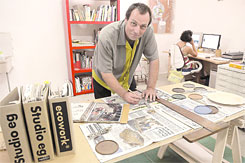
Erez Steinberg, an Israeli industrial designer who returned to Israel two years ago after spending twenty years in the San Francisco area, does just that. He’s in the business of making businesses green while helping them earn green.
Steinberg’s company in San Francisco – Studio eg – focused on ecologically smart design. He opened the studio in the early nineties with a focus on using wasted materials and coming up with clever and practical design solutions.
These days he runs a “company greening” business in Ein Hod, teaches a course in sustainable ecological design at the Bezalel School in Jerusalem, and lectures about green design (he participated in the Eco-Play Bamboo Conference recently). His business card, which is stamped on the back of a used railway ticket, exemplifies what he’s all about – helping companies find practical solutions for reducing their negative impact on the environment in a way that is creative and, inevitably, helps the company reduce waste (and increase profit).
Gideon Greenspan, founder of Copyscape, looking to lower our carbon footprints
From creating the world’s most popular puzzle website (and a Time Magazine top 50), Israeli-British entrepreneur and hightech whiz Gideon Greenspan decided to change gears and put a focus on the environment.
A couple of years ago, Gideon (who is based in Tel Aviv) was looking for a way to offset his travel and was confronted with a maze of possibilities in the online environment. A master of invention, Gideon’s wheels started turning: he decided to build his own user-friendly directory that offered an independent and balanced rating system. Today he is helping people make sense of all the carbon offset options, and wildly varying prices per ton of CO2e, through his project Carbon Catalog.
He also runs a blog, Carbon Catablog, a repository of insider news and interviews.
Today Gideon talks with Green Prophet about how the Carbon Catalog idea started, where we’re headed and how Israel, in particular, can lighten the carbon load on our planet.
Can you tell us a little bit about you and your background?
I’m originally from the UK and moved to Israel in 2000. By trade I’m an Internet entrepreneur – my creations include Websudoku.com, the world’s most popular puzzle website, and Copyscape.com, a search engine for plagiarism. I’m also involved in a number of Israeli startup companies.
I’ve always been aware of green issues. One thing I like about the software business is that you can create a lot of economic value while consuming (relatively) few natural resources. But I’m no “tree hugger” and my approach is pragmatic rather than ideological. The environmental steps we take in the coming decades will have a large effect on the quality of life for generations of humans to come
Can you tell us about Carbon Catalog and your rationale for starting the project?
As your readers probably know, carbon offsets allow you to neutralize your carbon emissions, by funding an equal reduction in emissions somewhere in the world. A year or two ago I started buying offsets for myself, and found the process to be extremely frustrating.
While there were tons of providers selling offsets online, I wanted a central repository of information that compared and contrasted the providers, so I could make an informed choice about where to buy.
Eventually I decided to solve the problem myself, and created Carbon Catalog. Carbon Catalog is a directory of carbon offset providers and the projects that they support. The listings are continuously updated based on the information on each provider’s website. Carbon Catalog also rates providers based on their transparency and the quality of their projects.
But there’s also an entrepreneurial angle. Depending on what happens in the UN, and in America’s corridors of power, the next decade could see massive growth in the carbon markets, and I’m positioning Carbon Catalog to take advantage of that. But this is for the longer term – for now, I’m focused on providing a non-commercial service for voluntary offset buyers.
What makes Carbon Catalog different from any other resource out there, ie carbon footprint calculators?
Carbon Catalog’s goal is provide an objective and transparent source of information, without any interest or agenda. In other words, it makes no difference to us whether you buy offsets, how many you buy, and who you buy them from. This is unlike most carbon offsetting sites, whose end goal is to encourage you to make a purchase.
Do you think carbon offsets can be an important intermediate step for curbing climate change?
It depends what you mean by carbon offsets. If you mean voluntary offsets, of the sort that are currently purchased by a small number of individuals and companies, then the answer is sadly no. While they do a good job of increasing awareness and encouraging innovation, they will never be a serious part of the solution, because the volume is too small.
On the other hand, if you mean the kind of carbon market that would be created if the world’s politicians and statesmen were brave and principled enough, then it’s a very different matter. While the voluntary market is nibbling at the edges, widespread international regulation would enable the dual problems of climate change and fossil fuel dependency to be tackled head on. Whether we like it or not, money and economics – not words and aspirations – are going to make the crucial difference.
Who are the players most likely to drive the carbon offsets market?
Without a doubt it’s politicians. There is a vast amount of financial and human capital poised to participate in an international carbon trading system. But everything depends on policy and regulation being in place.
Can you give us some examples of ways people in the Middle East can offset, or some steps they can do to lighten their impact?
In this part of the world we’re cursed (and blessed) with abundant heat and sunlight. This means lots of air conditioning, leading to high electricity demand during peak day hours. So a simple step is to turn down our air conditioning, and make sure windows and doors are closed. But the flipside is the huge potential for solar electricity generation. This could both serve local needs, and then be exported to the wider world.
Some say the market could explode to $1 trillion by 2020 in the US alone. Any ideas about what Israel is doing or could do in this market?
On a global scale, Israel’s energy consumption and carbon emissions are very small, so I don’t think it will be a significant source of carbon projects. Rather, I think Israel’s main role will be in research and development. Israel already has a lot of experience in solar energy, and its culture of entrepreneurship and innovation should enable it to expand rapidly into other related areas.
What is carbon financing and how can an Israeli or company in the region get carbon financed? Israel and its neighboring countries could be viewed as “developing” countries. How could prospective projects get certified for providing offsets? Is it a difficult process?
[I combined these two questions]
Carbon financing is the method by which a project which leads to reduced carbon emissions can receive funding from a company or entity which is seeking to offset its emissions. It’s needed by projects which are not economically viable in and of themselves.
The best way to get carbon financed is to work with a company which specializes in developing and reselling carbon credits. In Israel the two main players seem to be Elysium and EcoTraders.
Experts say that if the cataclysmic effects of climate change happen, further instability and violence in the region would ensue. How would you respond to that?
It is undoubtedly a concern – environmental degradation tends to exacerbate conflicts which are lying just below the surface. In the case of Israel and its neighbors, the most pressing issue is water. If climate change leads to less rain and more evaporation, it will become even harder to satisfy the water needs of all the populations in the region.
Maybe if more people offset in this volatile region, ie in the Palestinian Authority, it could help bring stability to the region. Is this so? We understand that “educational” projects can also be construed as carbon offsetting by some standards. If so, how could people in the region connect to the financing for their projects?
There are some offset providers who consider education as part of their offsetting portfolio. However I’m fairly skeptical about this, since it’s impossible to predict or measure the carbon reductions that result from these activities. I’m not saying they are a bad thing, but I don’t think they can play a serious role in a carbon portfolio.
Do you think it’s important for people flying to Israel to offset? If yes, any recommendations?
Of course, it’s a great idea for people flying anywhere to offset their emissions! As for a recommendation, I can’t suggest better than checking out the listings at Carbon Catalog, to find a suitable provider.
In a way the KKL is the world’s first carbon offset organization by planting millions of trees in the Land of Israel. Would you agree?
Well, I don’t know if it was the first organization in the world to support tree planting, but it is interesting how issues of deforestation have gained renewed urgency in the context of climate change. It is estimated that 20-25% of global carbon emissions come from burning and cutting down trees. That is almost as much as is generated by the world’s cars, trucks and buses.
Some say that treeplanting is not the most effective way for offsetting. Why? What do you think is the best way to offset?
Yes, many people question the effectiveness of tree planting as a means to offset carbon emissions. Most offsets based on reforestation look 50 to 100 years ahead when calculating their reduction in carbon emissions. In other words, if you pay to offset a tonne of carbon dioxide from a reforestation project today, it will take up to a century for this tonne of carbon dioxide to actually be absorbed.
What’s more, if the trees are burnt or chopped down at some time in the future, all of the carbon they absorbed will simply be re-emitted into the atmosphere, leading to a net zero effect. By contrast, most other offset projects look no more than 10 or 20 years ahead, and this strikes me as a more realistic basis for calculating reduced carbon emissions.
I believe the best offsets are those which lead to long-term reductions in the burning of fossil fuels. This primarily means investing in electricity generation from renewal sources. Once a solar panel, wind tower, or hydropower station is built, it can generate clear power continuously for many decades. Cheap and clean electricity will also encourage us to run our cars off the power grid, rather than fossil fuels.
Have you ever found that your carrots become limp and rot after just a few days, no matter how you store them? Instead of letting them go to waste, try this simple, sustainable method to keep them fresh for weeks—even up to a month!
Why Sustainability Matters
Food waste is a major contributor to environmental issues, including greenhouse gas emissions and resource depletion. By extending the life of your carrots, you:
Reduce food waste – Less produce thrown away means less methane production in landfills.
Save water – Carrot production requires water, so preserving them reduces the need for additional agricultural resources.
Lower your grocery costs – Fresher produce means fewer trips to the store and less money spent on replacements.
The Best Way to Keep Carrots Crispy
Wash or Peel (Optional)
You can store carrots with their peels on, but if you prefer, peeling or washing them beforehand can make them easier to grab and use.
Submerge in Water
Place the carrots in a container filled with clean, cold water.
Ensure they are fully submerged to maintain hydration.
Store in the Fridge
Keep the container at the bottom of the fridge, where it is coldest.
Change the water every 4–5 days to prevent bacteria growth.
Bonus: This Also Works for Celery!
Celery stalks can also be stored in water using the same method, keeping them crisp and ready to eat for weeks.
Alternative Storage Methods (if you want to avoid plastic or use less water):
? Damp Cloth Wrap – Wrap carrots in a damp cloth or reusable beeswax wrap to keep them hydrated. ? Sand or Soil Storage – If you have a cool storage area, bury carrots in sand or soil to mimic their natural environment.
By using these sustainable storage hacks, you can enjoy crisp carrots for longer while minimizing waste and helping the planet. ??





 Environmental and social change don’t always go together in green organizations, but the truth is that you can’t really make green changes without effecting society. Alternatively, some socio-economic groups just don’t have the resources to make costly (yet positive) environmental changes. As Jeff recently pointed out in his reaction to











 There are lots of green businesses out there –