Home Blog Page 731

Eco Rabbi takes the Hanukkah Challenge!

0

hanukkah, menora, chanukah

Ever wonder why every day of Hanukkah we add another candle?

The Jewish religious source the Talmud explains that this disagreement goes back to the Jewish sages Hillel and Shamai. Hillel explains that we add another candle every day “for the days coming” and Shamai explains that we start with eight and remove a candle every day until there is one left on the last day.

We do this, he explains, “for the days gone by.”

What are the “days coming” and the “days gone by?”

These philosophies are connected with perspectives on life. The “days gone by” is the perspective of the people who say, “in the old days things were better.” In medieval times this was a powerful feeling permeating the culture. Many technologies from the ancients had been lost, and people felt that that had been the height of humanity and we are only growing away from greatness as each generation goes by. In Jewish Historical terms, the receiving of the Torah was our pinnacle and since then we have been growing farther from those heights.

The perspective of the “days coming” is the perspective that humanity is always growing and moving towards a perfection. Judaism holds a messianic philosophy that one day man will reach a level of perfection and the world along with him.

In today’s modern world with the ever quickening pace of technological developments it is certainly easier to identify with the approach of Hillel. Computers are getting faster, as well as transportation. We can plow more ground in a day then could be done in a week and plants are being engineered to fight of disease and unwanted pests. It is wonderful to see this development in the green-sphere.

This approach can also be taken with knowledge and personal development. And I would like to share it from an environmental perspective.

There are more and more tips and tricks coming out every day telling you how to “green” your life. But it can all be overwhelming. Let’s take a page out Hillel’s book and his advice.

Take the Hanukkah challenge. Take on one thing at a time. Every day incorporate one more thing into your life that will help heal our planet. Whether it’s switching over light bulbs, reducing the size of your lawn, or educating yourself, each day add one thing for each of the eight days.

You’ll see that things that you didn’t think that you could do seem easy when you build up. Let’s do this “for the days coming” and ensure that there will be days coming to look forward to for many generations to come!
Organic Goat Herding in Israel: The Podcast

6

goat herd sunrise israel photo

GreenProphet.com is trying out audio podcasting! Click here to listen to a morning with volunteer goat herder Robert Lavenstein. You can read along with the transcript below.

ROBERT LAVENSTEIN: That’s Shef.

DANIELLA CHESLOW: Chef?

RL: No, Shef.

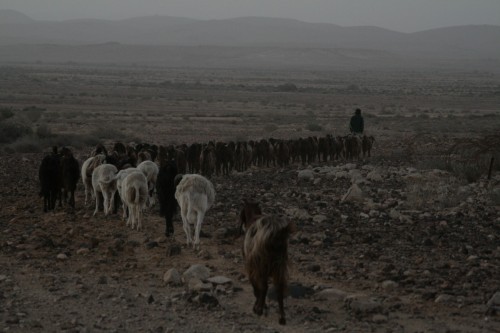
DC: After graduating college, Robert Lavenstein came to Israel last summer through Worldwide Opportunities on Organic Farms. He’s from Chevy Chase, Maryland but has been goat herding at Mitzpe Ezuz, a 16-family community on the border with Egypt. The farm was founded in 1983 by Celia Friede, an immigrant from Kenya, and her husband. Robert and I went out with about 50 goats and six sheep on a December Monday, half an hour before the sun rose.

goat eating israel herd photoRL: When we first came, Celia was like ‘You know, volunteers sometimes think sometimes they can go herding and they just sit there and they can bring a book and read for a few hours and it’s la-di-da-di-da.’

DC: What would happen if we sat down now and just read a book?

RL: We’d lose the herd! Just the other day, though, we were out and the herd divided. So we were leaving and all the sudden in the distance we see like just a group of them chilling, literally, eating some grass. And that’s when it gets really tricky because if one goat is missing, it’ll start crying because it knows that it needs to be with the other goats. But if the herd divides and it’s like 50 goats are together, and 50 goats are together it feels the same. So that’s when it’s really bad news.

DC: That’s when it’s time to start herding.

RL: You’ve got to pick up some stones.

DC: So you throw them in the direction you want them to go away from?

RL: Yeah, now they’ll run over there.goat herder robert lavenstein israel photo

DC: The goats have their own internal logic.

RL: I don’t understand this. We were in a place that has plenty of food, and one of them gets a whiff of something, I don’t know, and darts, and all the goats are like ‘Oh my god, there must be something more exciting there!’ and they all start running after him. And it’s like guys, you were just at Costco, you know, why go to No Mans Land?

DC: Walking around the desert for five hours a day gives Robert a chance to get familiar with his surroundings, which remind him of a scene from one of Israeli writer David Grossman’s books.

RL: There’s a smell out here that every time I smell it its so distinct to this area, like a myrtle or rosemary melody of flavors. In the David Grossman chapter he was saying that he smells this thing and instantly this whole distinction of Israel as the homeland, or the Zionist enterprise, or Israel/Palestine, all these definitions of the land are stripped away.

DC: Sometimes he notices less pleasant things.

RL: This is where the military practices, so you’ll be walking and suddenly there’s like a huge piece of a bomb. This is a live bullet, you can see, I mean it hasn’t been shot yet.

DC: Robert said that leading goats through the empty desert can lead to some creative ways of entertaining himself.

RL: Sometimes I pretend that I am on, you know, a show, one of those nature shows. Because it gets boring out here. So you gotta occupy…

DC: How do you do the crocodile hunter?

RL: I’m slowly approaching a goat. From this distance you can see that it is pregnant, a rarity.

DC: The goats with the strongest personalities get names. Robert’s favorite is Don. don goat israel herd land photo

RL: He’s a real gentleman actually. He courts the female goats. He’s kind of very cute. Just look at those teethies. And those eyes. He just reminds me of an Israeli from the seventies or something.

DC: Cuteness aside, herding the goats makes a unique bond between the herder and the animal.

RL: When you’re with a goat, and you spend the four hours or however long you graze with them, and then you feed them in the afternoon, and you go through their whole cycle and then you go through the milking at 3 or 4 in the morning, you appreciate the cheese that’s a product of that process, so much more than you do, or that I did before I did something like this.

DC: And herding in Israel has its own added meaning.

RL: I didn’t grow up in a rural area, so I never knew the rural man’s concerns, but to be here in a conflict that’s so based off of land, and then to be with people whose livelihood is based off the land, it provides a really interesting perspective to the conversations that we’ve had about policy and politics in Israel.

DC: Thanks for listening to the first podcast from GreenProphet.com. I’m Daniella Cheslow.

A Mercedes Luxury Hybrid is to Hit the Middle East in 2009

2

mercedes middle east abu dabai photoThe S400 was unveiled to the region at last week’s 2008 Abu Dhabi International Motor Show, and is expected to go on sale next August.

Mercedes is touting its car as the first luxury hybrid in the Middle East, though Lexus has been selling its luxury RX400h SUV in Israel since 2007.

But no one disputes that the S400 will be the first lithium-ion battery powered car on the market. Toyota’s Prius isn’t scheduled to come out with the more efficient LiIon battery instead of a nickel-metal hydride (NiMH) battery until 2010.

A prototype of the S400 was first shown off in Frankfurt in late 2007 and then again a couple of months later in Los Angeles, and the company has changed specs somewhat both between those two showings and this week in the Persian Gulf, but the essence remains the same: a high end sedan that will get at least 30 MPG with performance close to that of a non-hybrid vehicle.

Ceramic Cupocket keeps your hands warm when you drink

0

cup-pocket-rafian-perach cupocket photo

It’s starting to get cold over here in Israel. Although we’d consider ourselves lucky to see snow, most of the winter is really like an early fall day in Canada or the Northern States. Still, wearing (possibly knitting?) the sweaters are essential, as are thinking about ways to cut down on heating costs, or creative ways for keeping the old toes warm (see Yael Mer’s slipper rocker).

We stumbled across Perach Rafian’s ceramic mug, the Cupocket. With the handles turned inward, and a silicon lining as not to burn, it’s sure to keep your fingers snug and warm as you slurp away on the hot chocolate, or fair trade coffee. It has to be not much more than a gimmick because the inward handles do not leave much space for the tea to brew and makes stirring in sticky honey even harder.

rafian-perach-ceramic cup pcoket photo

“The cupocket is designed for people who are used to warming themselves up with a hot drink on a cold day. It has two pockets that encourage people who are looking for a hot place to put their hands into the cup. The cup is made from ceramics and the pockets are made of silicon that pass the warmth quickly.”

Ceramic dishes have been found to have a smaller carbon footprint than paper, plastic or metal. And it tastes better drinking from ceramic than anything else, wouldn’t you agree? That is, if you don’t break it. Shops like Kedma offer more practical pottery solutions that can warm your entire hand.


Audit Your Energy and Water Usage

1

billsOne of the best ways to save is by auditing your consumption.
  • Take next month’s bill and set your energy/water usage as your benchmark
  • As the month goes by make little changes to try and improve your consumption rate.
  • When the next bill comes in see how you are doing.

Feedback is one of the best ways to check your progress. Your energy/water bills will give you cold hard numbers that you can use to check that you are on track. You’ll not only save energy and water but money as well.

Get Off Prozac And Onto Ecotherapy

2
(Jean-Francois Millet ( 1814 - 1875 ), The Gleaners.)
(Jean-Francois Millet (1814 – 1875), The Gleaners.)

Once upon a time people lived in a different kind of harmony with nature (can you imagine yourself pictured above?). Except for the aristocracy who lived in castles and lords who collected taxes on land, most people all over the world, especially in the Middle East, prayed for rain and sun in the summer in order to grow a bounty of crops.

There were no grocery stores and food wasn’t flown into organic farmers’ markets. In the winter, people ate roots and winter food. They learned how to stave off colds and bulk up fat reserves to make it through to the next spring. Times were tough.

Chances are, if you were born any time before the industrial revolution, most of your energy was spent on survival. Imagine, if you weren’t busy collecting, growing or storing your food, time was probably used for finding firewood, maintaining your home or shelter and doing tedious chores to maintain life.

Fast forward to today

In the last hundred years or so, it seems as though we have made our lives a whole lot better by inventing machines that can do our dirty work, allowing us to focus on matters more spiritual in nature (or so we think.)

Dubai First Gulf State to Allow Fully Electric Reva Cars on the Road

3

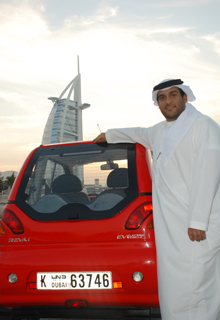
India’s REVA cars  – which Green Prophet previously reported may soon be available for sale in Israel –  are the first all-electric cars on the Persian Gulf.

United Arab Emirate’s ruler Mohammed Bin Rashid Al Maktoum’s dream to turn Dubai into an environmentally friendly city is taking shape not only through participation in Earth Hour and the construction of a rotating wind powered tower, but now Dubai is the first Gulf city to license electric cars for road use.

Last month the SS Lootah Company added two of the Bangalore-made REVAs for use in its fleet of company cars.

The developments in the United Arab Emirates come after Dubai-based conglomerate SS Lootah (which deals in an array of industries, including construction, health care and education) launched a ‘Green Car Program’ for its own fleet of corporate vehicles. In the three years since introducing the program, the company has purchased compressed natural gas (CNG) and hybrid cars for its employees use. SS Lootah director, Nasser Lootah (pictured next to one of his company’s new REVAs above) says: “The Green Car program has seen a great progress.”

Lootah says that while the REVA normally has a maximum range of 160 kilometers per charge, conditions in UAE will limit the practical expecations to 70 kilometers of driving on a full battery. But, he notes that with zero point emmisions and a much greater energy efficiency, his company is glad to welcome the REVAs to its corporate fleet as part of their drive for minimal environmental impact.

One thing that has Lootah really excited is the ease of recharing the car. “No sophisticated infrastructure is needed for recharing the car,” he says. “The car’s battery can be recharged in a simple electric socket.”

Ward Off Evil Eyes With Handmade Israeli Jewelry and Jewish Gifts From Israel

4

jewish jewelry handmade israeli jewelry photo‘Tis the season to be jolly, if you are a Christian. But a number of holidays for people of all faiths intersect around this time. It’s more noticeable if you live in the Middle East. Over here in Jaffa a couple of weeks ago, Muslims everywhere were celebrating Eid al-Adha; and Jewish people start lighting candles and gorging on jelly-filled doughnuts for Hanukah starting next week.

But whatever the season, or holiday, unique gift-giving is always something on our minds. When it comes to choosing gifts that are “green” the options are limited even more. One nice way to “say I love you” to someone in a way that is soft on the environment, is to give something handmade. Trendy, with no official religious affiliation is the good old hamsa, one of our faves, which means “five” in Arabic.

According to Wikipedia, an alternative Islamic name for this charm is the Hand of Fatima or Eye of Fatima, in reference to Fatima Zahra, the daughter of Muhammad. An alternative Jewish name is the Hand of Miriam, in reference to Miriam, the sister of Moses and Aaron. It is a kind of “protecting hand” or “hand of God.”

Some associate the significance of the five fingers to the five books of the Torah for Jews, the Five Pillars of Islam for Sunnis, or the five People of the Cloak for Shi’ites.

In recent years some activists for Middle East peace have chosen to wear the hamsa as a symbol of the similarities of origins and tradition between the Islamic and Jewish faiths. The fingers can point up or down.

Among Jews in Israel, it’s considered a Jewish gift, but one appropriate for Muslims, Christians, pagans and the unaffiliated. When I went to see my Catholic cousins in Scotland last year, it was hamsas for everyone.

While the gifts might not be certified green, there are some wonderful gift items in stock on MostOriginal.com, an online jewelry and gifts store that sells handmade artwork by Israeli artists.

Selling Israeli jewelry and Jewish gifts, their hamsas (like Laly Cohen’s Hamsa Hands pictured above), or Kabbalah bracelets, would satisfy even the choosiest friend.

Green Prophet's Jesse Fox is Gleaning Feeding on Fugee Fridays

1

fugee friday tel aviv jesse fox photo
(Jesse Fox and a Fugee Friday volunteer, in Tel Aviv, loading some food into a car. Israeli volunteers are gleaning vegetables and fruit from the nearby Carmel Market and are delivering it to hungry African refugees from Sudan and Eritrea living in south Tel Aviv. PHOTO CREDIT: Daniel Cherrin.)

Turns out some Green Prophet writers are doing more than ranting and raving about the environment in the Middle East. Our very own Jesse Fox, who started blogging here about produce waste at Tel Aviv’s food market (click here to see some shocking pictures) ––– has decided to put the waste to a good purpose. Several months ago, Daniella Cheslow reported on Jesse’s “gleaning” project, and this week I gave a recap for the non-profit news service ISRAEL21c. Here it is:

When Jesse Fox, an urban planning student from Tel Aviv decided to find a way to combine social justice with his passion for the environment, it was, he says: “Just connecting the dots.” Today Fox is one of four founders of a young grassroots project called Fugee Fridays.

The group’s mission is to distribute the surplus of Tel Aviv’s Friday Carmel food market — which would otherwise go to waste — to hungry African refugees who fled to Israel on foot to escape persecution. In recent years, there have been literally thousands of African refugees who have come to Israel from countries such as Sudan and Eritrea.

In an attempt to rebuild their lives, they eventually come to a Tel Aviv refugee shelter, and without any government aid, local heroes like Fox and other volunteer organizations step up to the “plate” to help.

Five Times Cleaner at the December Cleantech Startup Showcase in Israel

0

clean technology israel photo
(Photo from recent CleanIsrael meetup).

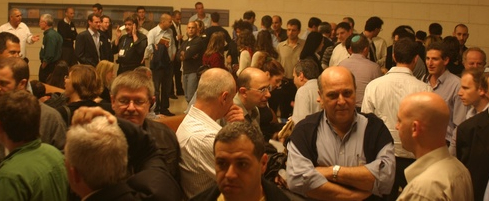
Last Monday evening, the Arison Lobby at the IDC in Herzliya was full with founders of clean technology startups, VCs , investors, researchers and other cleantech professionals who gathered for the first Cleantech Startup Showcase, organized by CleanIsrael in conjunction with the new Institute for Renewable Energy Policy and Applied Research (IDC IREP). The event was sponsored by Amit, Pollak, Matalon & Co.

The showcase featured presentations by 5 Israeli startups from the areas of energy, water and green technology sectors: Agam Energy, Emefcy, High Check Control, Phoebus Energy, and SOVNA.

“We chose these five companies from the dozens that applied because we wanted companies across a diverse set of sectors and stages of financing,” explains Gene Dolgin, the co-founder of CleanIsrael Network: “Agam develops novel turbine engines, Emefcy produces electricity from wastewater, High-Check builds real-time water contamination detection systems, while Sovna develops urban wind projects; and Phoebus – hybrid heating units.

“Of course, these are all also serious companies that interest both fellow entrepreneurs and investors.”

This was a first-of-its-kind event, and part of CleanIsrael’s goal is to create a vibrant and unified cleantech community in Israel. In past events, the group has hosted speakers from Better Place, Cleantech Group, Israel Cleantech Ventures, and Sindicatum Carbon Capital as well as entrepreneurs from EnStorage and SolarPower Israel.

RADVISION's Sagee Ben-Zedeff on Video-Conferencing To Save the Environment

11

videoconferencing green technology Al Gore Cisco image

Coincidentally, Green Prophet spoke earlier today with Zohar Zisapel, a founder of RAD, the company that owns RADVISION, a NASDAQ-traded company. Zisapel, who says he’s looking to solar and green tech, will appear soon in a story we’re writing for ISRAEL21c. Today we have a guest post from RADVISION’s Sagee Ben-Zedeff, on the greenness of video-conferencing technology:

Earlier this year, former US Vice President and Nobel laureate Al Gore spoke on a virtual panel that discussed the role of enterprise technologies in environmental matters, most notably climate change. Gore said that climate change is an “urgent crisis,” in which “scientists are practically screaming” at governments and citizens to take action.

It seems that there is a great deal of pressure, mainly in Europe and the US, to make an effort and reduce the carbon footprint. Climate change, global warming, pollution – all are threatening our lives, all are most probably our fault.

It wasn’t a coincidence that Gore called for action in a VoiceCon, a convention about enterprise communication, and that he chose to do so in a virtual panel. Communication and collaboration technologies, such as video conferencing, have long been considered “green,” and are now mature enough to play a key role in the enterprise “green” initiatives.

green technology Al Gore Cisco image

A proper disclosure – the event was organized by Cisco, the networking giant, to showcase its video conferencing technologies as a “green” solution. While the conference was held in Orlando, Gore spoke from a location near his home in Tennessee, his host, Cisco CEO John Chambers, was located in San Jose, and the moderator spoke from outside London. The panel included audiences in Orlando, London, Warsaw, Dubai and Paris. All were using Cisco’s Telepresence technology.

The fact that most of the people involved in the panel did not have to leave their homes or offices and fly in order to participate in this event may seem trivial, but even in 2008 video conferencing and other collaboration technologies are still considered “nice to have” by most enterprises, a fact that is quite alarming in light of the environmental crisis we are all facing.

Hebrew University Launches One Million Dollar Program in Support of Cleantech Development

0

Hebrew University Yissum Ormat cleantech green technology image

Yissum, the Technology Transfer Company of the Hebrew University of Jerusalem, is launching a 1 million U.S. dollar program to support the development of outstanding cleantech inventions by scientists at the Hebrew University of Jerusalem. The launch will take place on December 25th at the Givat Ram campus of Hebrew University and feature a keynote address from Yehuda Bronicki, Chairman and CTO of Ormat.

Yissum’s business partners include companies such as Novartis, Microsoft, Johnson & Johnson, Merck, Intel, Teva and many more. “We are pleased to launch Yissum’s Cleantech Programme, in response to the growing need for alternative energy solutions, novel technologies to combat water shortage and cleaner technologies to protect the environment,” said Nava Swersky Sofer, President and CEO of Yissum.

“We hope that this initiative will assist in bridging the gap between the Hebrew University’s cutting-edge research in these fields and the product-based industry, leading eventually to the commercialization of new “green” technologies for the benefit of us all.”

Initially, five novel technologies were chosen, three of which aim to reduce the polluting effects of toxic substances and create alternative, clean, energy sources. These inventions involve the generation of clean fuel, detoxification of gasses emitted by burning fossil fuels and detecting toxic chemicals.

Burning fossil fuels for the generation of energy is the major cause of air pollution and global warming. The consumption rate of oil, gas and coal is estimated as the equivalent of 200 million barrels of oil per day, and approximately one million people die annually due to air pollution resulting from fossil fuel burning. Furthermore, fossil fuels are a diminishing energy source and their limited supply has a far-reaching political and social impact.

Eco Rabbi: Parshat Vayeshev – Love the Land and it Will Love You Back

0

judean hills

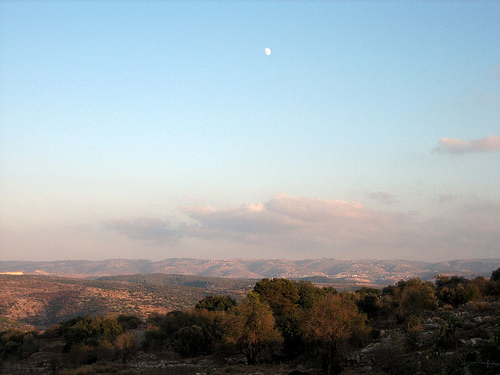
Traveling through the mountains of Judea I am always struck by the stark contrast between the mountainous areas where there are villages and where there are not. The differences can be as sharp as night and day. There are even places where people are living but the land seems barren and there are other places where people are living and the area around it seems to be overflowing with greenery. It is clear who is taking care of the areas around their homes and who is not. But it often seems to expand far beyond what you would have thought.

Shai Agassi's Project Better Place to Seal a Deal with Japan?

1

Shai Agassi Project Better Place Japan image

Following the ongoing saga of Project Better Place‘s steady process of world domination, we can now add a new country to the list: Japan.

The news just in is that the Japanese Environment Ministry is inviting Better Place to take part in their feasibility project for building a network of charging stations in Japan. Better Place is the only foreign company that was invited to participate in the project, which will begin in January in the port city of Yokohama and last for three to six months.

Better Place has already signed on to implement its project in places as diverse as Hawaii, Israel, California, Denmark and Australia.

Founder and chief executive of Better Place Shai Agassi commented, “Better Place is honored to participate in this groundbreaking program in a country with so much auto-manufacturing expertise and history.”

::International Herald Tribune


Read more at Green Prophet about the growing phenomenon of Project Better Place:

REVA Electric Cars May Soon Be For Sale in Israel
Project Better Place Unveils Prototype of Electric Car Recharging Station
Israel’s Electric Car Guru Shai Agassi Gets Wired

Image credit: jorgeml

Earth Hour 2009 Sweeps Across the Middle East

6

[youtube]http://www.youtube.com/watch?v=BjWD8pbK5t8[/youtube]

It was almost exactly a year ago that we enthusiastically wrote about Tel Aviv’s upcoming participation in Earth Hour 2008, as the only Middle Eastern city to join the worldwide campaign.  We are now pleased to announce that although Tel Aviv (and other Israeli cities) will not be formally participating in Earth Hour 2009, the trend has spread widely across the Middle East.

This year will see the participation of Amman (Jordan), Istanbul (Turkey), Abu Dhabi (UAE), Dubai (UAE), Fujairah (UAE), and Sharjah (UAE).  Out of a total of 74 participating cities, 6 are from our small, humble region – not bad.

What is Earth Hour?