Creators who want to influence people for good should also think carefully about tone. Environmental storytelling does not need to lecture or shame audiences. It can invite curiosity instead.
The company's Next Generation Process (NGP) Pilot Plant in London, Ontario, has officially moved into initial operating campaigns, generating the kind of structured, repeatable data that separates laboratory promise from commercial viability.
In the modern nutrition universe, that level of commitment deserves an applause. But for those who don’t live in a Nordic fishing village, the nutrition company Zinzino has built its omega-3 research and formulations around these principles, combining biomarker testing, antioxidant protection and traceable sourcing across both sustainably harvested small-fish oils and a vegan marine-microalgae alternative.
Dubai Municipality has set up 12 AI-powered "Ehsan Stations" to safely and officially feed strays. The city also officially supports Trap-Neuter-Return (TNR) programs.
Creators who want to influence people for good should also think carefully about tone. Environmental storytelling does not need to lecture or shame audiences. It can invite curiosity instead.
The company's Next Generation Process (NGP) Pilot Plant in London, Ontario, has officially moved into initial operating campaigns, generating the kind of structured, repeatable data that separates laboratory promise from commercial viability.
In the modern nutrition universe, that level of commitment deserves an applause. But for those who don’t live in a Nordic fishing village, the nutrition company Zinzino has built its omega-3 research and formulations around these principles, combining biomarker testing, antioxidant protection and traceable sourcing across both sustainably harvested small-fish oils and a vegan marine-microalgae alternative.
Dubai Municipality has set up 12 AI-powered "Ehsan Stations" to safely and officially feed strays. The city also officially supports Trap-Neuter-Return (TNR) programs.
Creators who want to influence people for good should also think carefully about tone. Environmental storytelling does not need to lecture or shame audiences. It can invite curiosity instead.
The company's Next Generation Process (NGP) Pilot Plant in London, Ontario, has officially moved into initial operating campaigns, generating the kind of structured, repeatable data that separates laboratory promise from commercial viability.
In the modern nutrition universe, that level of commitment deserves an applause. But for those who don’t live in a Nordic fishing village, the nutrition company Zinzino has built its omega-3 research and formulations around these principles, combining biomarker testing, antioxidant protection and traceable sourcing across both sustainably harvested small-fish oils and a vegan marine-microalgae alternative.
Dubai Municipality has set up 12 AI-powered "Ehsan Stations" to safely and officially feed strays. The city also officially supports Trap-Neuter-Return (TNR) programs.
Creators who want to influence people for good should also think carefully about tone. Environmental storytelling does not need to lecture or shame audiences. It can invite curiosity instead.
The company's Next Generation Process (NGP) Pilot Plant in London, Ontario, has officially moved into initial operating campaigns, generating the kind of structured, repeatable data that separates laboratory promise from commercial viability.
In the modern nutrition universe, that level of commitment deserves an applause. But for those who don’t live in a Nordic fishing village, the nutrition company Zinzino has built its omega-3 research and formulations around these principles, combining biomarker testing, antioxidant protection and traceable sourcing across both sustainably harvested small-fish oils and a vegan marine-microalgae alternative.
Dubai Municipality has set up 12 AI-powered "Ehsan Stations" to safely and officially feed strays. The city also officially supports Trap-Neuter-Return (TNR) programs.
Creators who want to influence people for good should also think carefully about tone. Environmental storytelling does not need to lecture or shame audiences. It can invite curiosity instead.
The company's Next Generation Process (NGP) Pilot Plant in London, Ontario, has officially moved into initial operating campaigns, generating the kind of structured, repeatable data that separates laboratory promise from commercial viability.
In the modern nutrition universe, that level of commitment deserves an applause. But for those who don’t live in a Nordic fishing village, the nutrition company Zinzino has built its omega-3 research and formulations around these principles, combining biomarker testing, antioxidant protection and traceable sourcing across both sustainably harvested small-fish oils and a vegan marine-microalgae alternative.
Dubai Municipality has set up 12 AI-powered "Ehsan Stations" to safely and officially feed strays. The city also officially supports Trap-Neuter-Return (TNR) programs.
Creators who want to influence people for good should also think carefully about tone. Environmental storytelling does not need to lecture or shame audiences. It can invite curiosity instead.
The company's Next Generation Process (NGP) Pilot Plant in London, Ontario, has officially moved into initial operating campaigns, generating the kind of structured, repeatable data that separates laboratory promise from commercial viability.
In the modern nutrition universe, that level of commitment deserves an applause. But for those who don’t live in a Nordic fishing village, the nutrition company Zinzino has built its omega-3 research and formulations around these principles, combining biomarker testing, antioxidant protection and traceable sourcing across both sustainably harvested small-fish oils and a vegan marine-microalgae alternative.
Dubai Municipality has set up 12 AI-powered "Ehsan Stations" to safely and officially feed strays. The city also officially supports Trap-Neuter-Return (TNR) programs.
Creators who want to influence people for good should also think carefully about tone. Environmental storytelling does not need to lecture or shame audiences. It can invite curiosity instead.
The company's Next Generation Process (NGP) Pilot Plant in London, Ontario, has officially moved into initial operating campaigns, generating the kind of structured, repeatable data that separates laboratory promise from commercial viability.
In the modern nutrition universe, that level of commitment deserves an applause. But for those who don’t live in a Nordic fishing village, the nutrition company Zinzino has built its omega-3 research and formulations around these principles, combining biomarker testing, antioxidant protection and traceable sourcing across both sustainably harvested small-fish oils and a vegan marine-microalgae alternative.
Dubai Municipality has set up 12 AI-powered "Ehsan Stations" to safely and officially feed strays. The city also officially supports Trap-Neuter-Return (TNR) programs.
Creators who want to influence people for good should also think carefully about tone. Environmental storytelling does not need to lecture or shame audiences. It can invite curiosity instead.
The company's Next Generation Process (NGP) Pilot Plant in London, Ontario, has officially moved into initial operating campaigns, generating the kind of structured, repeatable data that separates laboratory promise from commercial viability.
In the modern nutrition universe, that level of commitment deserves an applause. But for those who don’t live in a Nordic fishing village, the nutrition company Zinzino has built its omega-3 research and formulations around these principles, combining biomarker testing, antioxidant protection and traceable sourcing across both sustainably harvested small-fish oils and a vegan marine-microalgae alternative.
Dubai Municipality has set up 12 AI-powered "Ehsan Stations" to safely and officially feed strays. The city also officially supports Trap-Neuter-Return (TNR) programs.
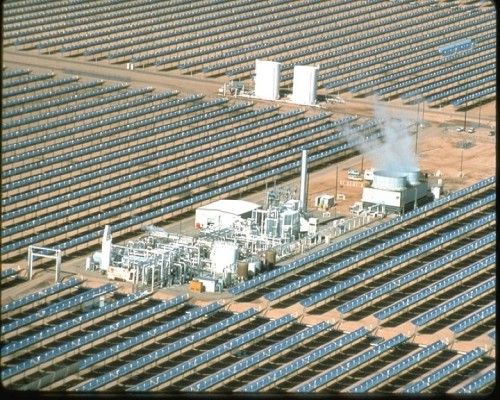
German industrial giant Siemens is now involved in talks to purchase the Israeli Solel Solar Energy Ltd., according to an article published in Globes, Israel’s leading business paper.
Solel, a global leader in building solar thermal fields, was partially invested in by a UK energy company, Ecofin about 18 months ago. But it now appears that Seimens has become very interested in the Israeli company, due to its technology that converts sunshine into useful thermal energy, and subsequently into electricity. It is considered one of the most promising Israeli solar energy innovators, up there with other companies on investors’ watchlists like BrightSource, ZenithSolar, Aora, and Di.S.P. (the technology of Prof. Avi Kribus).
With the aviation industry reeling from increasing fuel costs, dipping profits and those pesky upcoming environmental regulations, airlines are scrambling to become more efficient, cut costs and increase fuel efficiency.
Japan Airlines did their part to shed excess weight on their flights by shortening their blankets by a centimeter, and Northwest Airlines did it by removing all the spoons from their planes.
Airbus A380
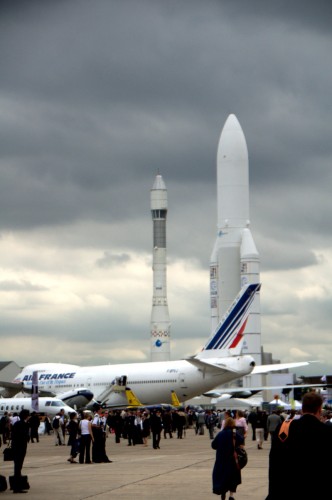
But true change must come from innovation and new thinking by aircraft manufacturers. This week, I visited the Paris Air Show at Le Bourget, to see firsthand what direction the industry is taking. The general sentiment of the show was summarized by Airbus in 10 foot letters on the side of their new Airbus A380 – “Greener. Cleaner. Quieter. Smarter.”
The A380’s bar (image by jjay69)
The new Airbus A380 is the largest passenger aircraft in the world, and Airbus boasts that it is the first aircraft ever to achieve a fuel efficiency below 3 liters per passenger over 100 kilometers (a boast which loses some meaning if you take into consideration that all current airlines fly A380 configurations that cater to fewer passengers per flight and are rarely fully booked).
The A380 also uses a new wing design and lighter composite materials to improve its performance. Airbus also claims a 50% smaller noise footprint than the 747-400 while carrying 40% more passengers.
Impressive claims. But as I look up at the A380 flying overhead in slow graceful circles, all of those energy saving statistics melt away and all I can think of is the full-sized, fully stocked bar in the plane’s upper deck.
The Bluecopter
Not to be outdone by Airbus, Eurocopter are showing their own idea for a greener future. Their new concept helicopter, codenamed Bluecopter, has a “high-compression engine” that promises to reduce fuel consumption, CO2, NO and NO2 emissions by 30-40%… That is if they can get it off the ground.
It seems that calling it a helicopter is a bit of a stretch, as the bluecopter is currently nothing more than an off the shelf Mercedes-Benz V6 turbodiesel engine with a helicopter shaped box around it painted in blue and green. In fact, it is currently so heavy, it couldn’t get off the ground even if you gave up on the fancy extras such as passengers or a pilot.
Not that any of those facts stood in the way of Eurocopter generating a lot of green-buzz around this innovation.
Another recurring theme in the show was increased use of composite materials such as carbon fibers to make aircraft lighter. One notable example was the 4-seater Simba. With a hull built entirely from carbon fibers, Simba weighs less than 500 kg (I’ve ridden motorcycles heavier than that), but can still reach a cruising speed of 220 km/h, and pulled off impressive stunts in the sky above our heads.
500 kg of innovation
After spending a few days looking at the latest and greatest being developed by some of the biggest companies on the planet, it is clear that the current direction is focused on optimizing, refining and improving as opposed to revolutionizing.
But in an industry where it can take over a decade to bring a product to market (The A380 took 13 years to develop), is it fair to expect a revolution right now? Or will we have to wait another decade before seeing a true leap in technology? I’d like to believe that current market forces will accelerate the current progress and bring a revolution out of necessity.
But will this be enough to save the industry? 2009 marked the 100th year of the Paris Air Show, and it was quite a somber one, with fewer Champagne bottles uncorking to celebrate big deals, fewer new models and not enough innovation.
Looking at the big airlines, it is easy to draw parallels between the state of the aviation industry, and the stagnation in the American car industry. Perhaps what we need here is an outsider with a fresh point of view to shake the boat… to borrow an idea from Todd Dagres – Perhaps what the aviation industry needs is a Steve Jobs.
Like a Kid In a Toy Store
All cynicism and skepticism aside, the Paris Air Salon is the ultimate place for the kid-at-heart to check out the latest toys in action.
Where else in the world can you see a Eurofighter Typhoon pull off crazy stunts, walk a few meters under the shadow of two huge space rockets to flirt with an F-15 pilot, then turn your head back to the roar of a 50 year old Lockheed Super Constellation taxiing 5 meters from you, its giant wing over your head.
Even a grumpy treehugger like me can’t help but melt and squeal with glee as a F/A-18 Super Hornet prepares for takeoff next to me, the hot air from its jets blasts me in the face like a thousand splendid suns… Burn all the fuel you want buddy, right now I’m an 8 year old with the shiniest toy.
Plastic bags are evil. They are not biodegradable, pollute our landfills, pollute our waterways, convince fish and ducks that they’re food… it’s pretty well established that they’re just bad news. While activists encourage consumers to try using fewer bags, or sometimes try to ban the use of plastic bags entirely, the truth is that these pleas often fall on deaf ears.
Which is where – thankfully – designers step in. Because where environmental activists fail, hip design often succeeds.
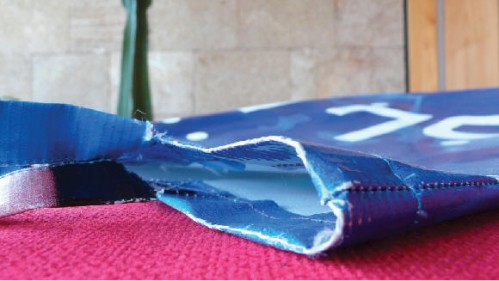
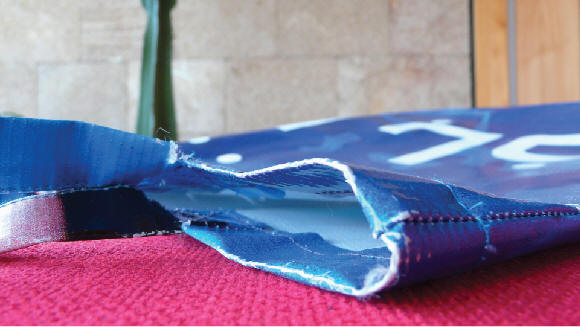
Waste Lb, the collaboration of designers Waleed Jad and Stephanie Dadour, is a response to the pervasive use of plastic shopping bags in Lebanon. Waste Lb reclaims flex, the material used to create billboards, in order to make reusable shopping bags such as the ones above and below. (Abu Yoyo, a designer based in Tel Aviv, also appropriates billboard materials in order to make bags.)
By using flex, Waste Lb encourages conservation in two ways: they encourage consumers to switch to reusable bags while simultaneously using material that would otherwise be discarded into a landfill. According to Dadour, “we know we’re not here to change the world or to educate people, but we thought we could sensitize people to reduce their use of plastic bags by promoting a product that can be reused.”
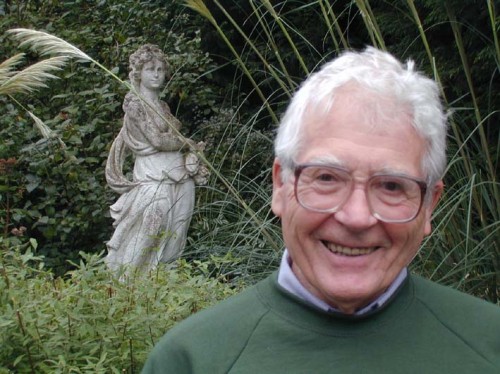
“We became the Earth’s infection a long and uncertain time ago”: James Lovelock is perhaps the world’s best-known independent scientist; he has published a new book, The Vanishing Face of Gaia: A Final Warning.
Lovelock has served humanity and the planet well by inventing a device (the ECD – Electron Capture Detector), which detected the amount of CFC’s in the atmosphere, but he is better known as the founder of the Gaia Principle. In a nutshell, this is the structure in which to see the planet and all that is on and of it, as a living whole, instead of separate parts.
In Lovelock’s own words: “To Golding, Gaia, the goddess who brought order out of chaos, was the appropriate title for a hypothesis about an Earth system that regulated its climate and chemistry so as to sustain habitability.” [Writer William Golding gave Lovelock’s theory, developed in 1965, its name]
The author of 5 books about Gaia, Lovelock, as he approaches the sage-like age of 90, has written his most direct and challenging book yet, subtitled ‘a final warning.’
As the author prepares to take up Richard Branson’s offer of a place upon a Virgin Galactic flight in space, he is at his simplest and most direct in this book; highly critical of European green politics and environmentalism, and offering what he believes are the only solutions for partial human survival through the onslaught of climate change.
For many tourists to the Israeli Negev desert, a visit to the Bedouins includes a commercialized camel ride and perhaps an afternoon spent in a tent near Mitzpeh Ramon.
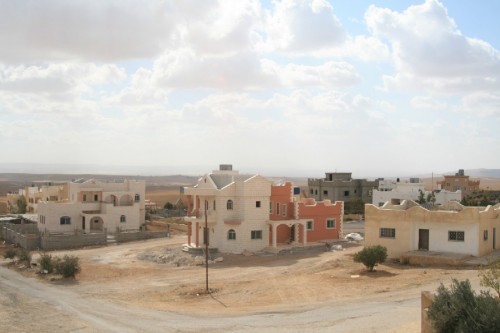
But as the Jerusalem Post writes, the Desert Sites tourist company is offering a revolutionary immersion Arabic course in the last week of July in the Bedouin township of Darajat (also spelled Dirgat), known as Israel’s first solar village.
Israel has 160,000 Bedouin Arab citizens. Between 50-60 percent of them live in recognized communities and the other are strewn about the landscape in unrecognized villages in tin-roofed shantytowns. Darajat is a recognized village with a population of approximately 800.
Most residents have solar water heaters and electric systems, the school is powered by wind and sun, and students learn hands-on about alternative energy by reading the power meters in their classrooms. The village also boasts a solar mosque, below.
Alfa, Lebanon’s chief mobile phone service company, is now operating on solar energy to power its transmission network.
The company recently installed its fifth solar powered station in the Hourata Reserve, and the station’s new solar powered generator is expected to be in full power by next month.
Alfa, a state owned communications company, managed by Orascom Telercom, began making the decision to switch to solar energy even before the 2006 war in Lebanon, which severed damaged the country’s electricity grid.
The new power station is designed to provide energy even in the worst winter weather, when normal solar power stations would not be functioning.
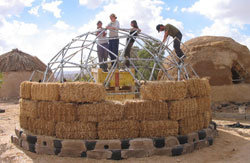
Tucked deep into the Arava desert at the southeastern border of Israel, Kibbutz Lotan‘s Center for Creative Ecology has announced two programs for the late summer and fall, including detailed information for funding on its Web site.
The first is the Peace, Justice and Environment course, which is run in conjunction with the Living Routes organization and runs August 31-December 9, 2009. Students in the course will work with Jewish and Arab environmental leaders, from the ecological straw-bale builders on Kibbutz Lotan to a permaculture site in the Bedouin town of Segev Shalom. The course includes a tour of the Separation Barrier in Jerusalem The 14-week course is accredited by the University of Massachusetts, Amherst and is worth 16 credits. The program costs $14,200.
Did Rambam’s (Maimonides) ancient book of herbal recipes give clues to finding new anti-cancer vitamin?
Dr. Fuad Fares has a huge secret. It’s big enough to make sure his laboratory is locked tight when he’s not there. The Israeli scientist has been looking into the potency of ancient herbal treatments, and has discovered what he believes is a new family of antioxidants.
He’s tested the secret compound based on an inedible plant that grows in Israel, and has found it shows excellent results in stopping prostate and colon cancer in mice, and in human cancer cells in vitro.
Unable to disclose the plant’s variety until further tests are made, Fares is hoping that this plant, first described for its medicinal value in Arabic centuries ago, produces an entirely new antioxidant molecule which can stop cancer in its tracks. It could be ingested as a food additive, or like a vitamin, he hopes.The body of research in scientific literature on antioxidants to stop the spread of cancer is growing. Scientists know that antioxidants such as lycopenes, found in tomatoes, fight free radicals, which can lead to cancer. They also know that glucosinolates found in cabbage varieties have anti-cancer properties too.
New tests on the mystery compound done at the University of Haifa lab, in the Carmel Medical Center in Israel, have been overwhelmingly good, and in the future could be added to our arsenal for fighting cancer.
A significant difference in fighting cancer
Using a crude extract of the plant, Israeli-Arab Fares gave his test plant to mice as a preventive “medicine.” Then the mice were introduced with cancer.
Those that were given the crude extract were able to fight off the cancer tumors much better than the control group — only 20 percent of the treated mice developed cancer, while 80% of the control developed cancer.
An additional point to note, Fares tells ISRAEL21c, is that in the test group, the tumors were significantly smaller than the control.
In a second test, mice with cancer were given the plant-based extract as a medicine. “When we looked at the cells inside the tumors we saw these compounds induced cell death and decreased the tumors by 70 to 80% compared to the control group,” Fares says.
He also tested the extract on human cancer cells in vitro and saw “a dramatic effect.”
After Fares purifies the compound, he hopes it will yield a brand new class of antioxidants.
Inspired by Kabalistic cures?
“Just used as an extract it seems to be effective,” says Fares, who besides hunting for the next plant-based drug, is also a director of Modigene, a company he created while doing postdoctoral work at Washington University.
Modigene is a biopharmaceutical company using patented technology to develop longer-lasting, proprietary versions of approved therapeutic proteins that currently generate billions in annual global sales.
Now Fares is working on identifying the mystery substance, and will apply for a patent — and release the secret — if the compound is indeed unique.
After purifying it, he might get even more startling results. And it could well be a medical breakthrough, agrees Fares, who found mention of the plant in an ancient herbal remedy book written centuries ago in the region.
“It’s known that antioxidants help cancer prevention and treatment. We are focusing on plants not known in the literature. It’s not food, but a medicinal plant,” says Fares, who declines to say whether or not inspiration came from a book by Rambam – Moses Maimonides, a famous Jewish doctor writing medical treatises in Arabic in the 12th century.
The plant he says, is something that grows in Israel and it’s something that people don’t eat. As for more details, he is sorry, but we will just have to wait.
Al Gore may have given us a frightening picture of climate change and our future, but now new research suggests that even his predictions could be too modest, after an Israeli scientist discovered that cracks in the earth are emitting unrecorded greenhouse gases into the atmosphere.
This is the first time this phenomenon has been observed, and since gases from these cracks have never been included in previous measurements, the new findings could change the model of how science calculates the impact of greenhouse gases on climate change.
We’d written about this research on cracks in the earth earlier. Now for an update:
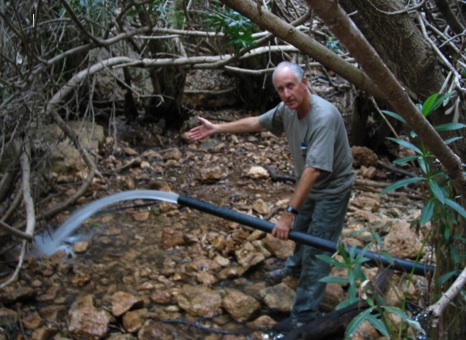
The discovery was made by hydrologist and soil physicist, Dr. Noam Weisbrod from Ben Gurion University. While he was studying fractures in the earth in the Negev Desert, he encountered an unusual phenomenon occurring on a daily basis – an unexpectedly quick accumulation of salt within fractures between flood events.
The phenomenon was even more pronounced in winter.
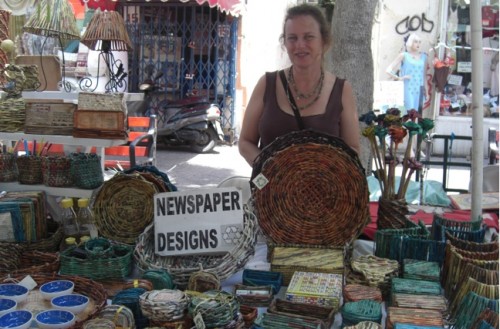
Strolling through the Nachalat Binyamin artist market in Tel Aviv, there are signs of recycling and eco friendly design all around. Old glass bottles are turned into clocks, kitchen objects are converted into sculptures, and recycled paper becomes creative stationary.
These are just a few of the creations that fill the artist market that runs for several blocks on Tuesdays and Fridays next to the Carmel Market.
Passing by a shaded booth filled with colorful baskets, picture frames, pencil holders, lampshades, and many creative designs, I noticed that everything was made from newspaper.
During the week of June 14, 2009, news continued that equity index provider, MSCI Barra would likely upgrade Israel’s current “Emerging Market” status to that of “Developed Market” before the end of 2009. Globes reported that the Israel United States Binational Industrial Research and Development Foundation (BIRD-F) is creating a new program to fund joint projects in the cleantech sector and it was suggested that greenhouse gas emission predictions might be too low. For these and the rest of this week’s stories, see below.
One of America’s most enduring gifts to the Middle East is the suburban indoor shopping mall. Israel’s first was the Ayalon Center outside of Tel Aviv (1986). Istanbul saw the Atakoy Mall go up in 1987. Jordan’s pioneer was Amman’s Abdoun Mall in 2001 (Picture from virtualtourist.com), and Beirut‘s ABC Mall opened its doors in 2003.
This month, a new luxury mall opened on the outskirts of the northern West Bank city of Jenin. Haaretz reports that the five-story Hirbawi Home Center cost $5 million to build and is filled with foreign brands carrying upscale products, from espresso machines to plasma screens.
Most of the products are priced on par with Israeli figures, but furniture is a bargain in Jenin.
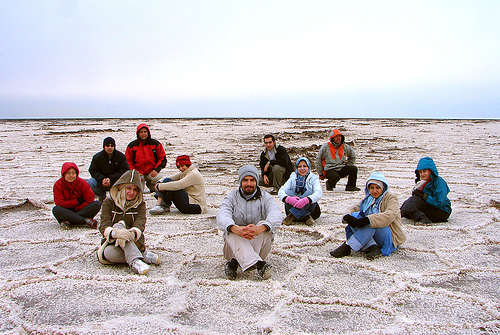
Recent political turmoil in the Islamic Republic of Iran, is only part of the problems facing this country of more than 70 million. The country’s fragile eco-cycle is also at risk, much of this due to developmental aspects which have been occurring in many parts of county, while environmental issues have taken a back seat.
A good example of this is the 4,000 sq. kilometer Kavir National Park, located in north-central Iran. Established years ago in 1964 as a protected area, the semi-arid reserve was declared a national park by Shah Reza Pahlavi.
The park is home to a number of rare and now endangered animal species, including Persian leopards and Asiatic cheetahs.
Although Israel and Jordan have not come to a joint stance on the Red-Dead Canal, Haaretz’s tenacious environmental reporter Zafrir Rinat reported Sunday that the two nations have banned the use of chicken manure as fertilizer in an effort to cut down a population of houseflies that thrives on manure and makes life miserable for both countries on the southern end of the Dead Sea. Regional environmental organiation Friends of the Earh Middle East brokered the deal, under which farmers will replace the traditional fertilizer with compost.
In 2006, I spent a summer working in the Amman office of Friends of the Earth Middle East, where I researched a housefly population that bred in Jordan and crossed the border to southern Israel.
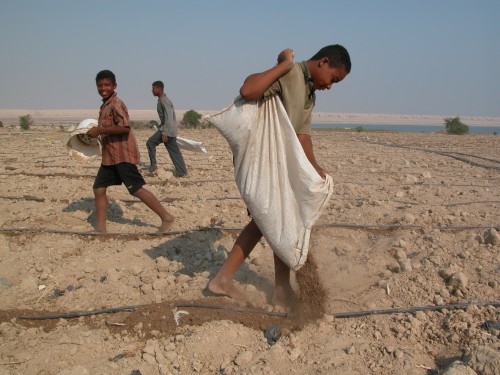
The research took me to Ghore Safi, the area of Jordan south of the Dead Sea where the sons of poor families walked barefoot through fields, spilling chicken manure behind them as a cheap fertilizer (photo above by Daniella Cheslow).
If the combination of the words “vegan” and “bar” doesn’t make sense to you, you’re not alone.
Because beer is made of hops, malt, and yeast, right? No animals harmed or used in the production of any of those.
But The Rogatka (or “Slingshot”), a new “vegan” bar that opened up last week, defines itself not according to the content of its goods but by the ideals that it encourages.
And so for all you meat and dairy avoiders out there – you are welcome with open arms at the bar’s location on Yitzhak Sadeh street.
The ideologically focused bar was opened by the same “anarchist collective” that used to run the Salon Mazal bar off of King George street. The founders of the bar say that they hope their watering hole will attract environmentalists, left-wing activists, and other likeminded people with their cheap drinks and fair trade products.


 With the aviation industry reeling from increasing fuel costs, dipping profits and those pesky upcoming environmental regulations, airlines are scrambling to become more efficient, cut costs and increase fuel efficiency.






 Alfa, Lebanon’s chief mobile